

What is an Import-Export License in Dubai?
An import-export license in Dubai, also called a trading license UAE, is an official permit that allows a business to buy goods from foreign markets and sell them domestically or source products locally and ship them abroad. It is one of the most sought-after commercial license types in the UAE, given the country’s role as a global re-export hub.
Not every business automatically needs this license. You require one if your core activity involves the international buying and selling of goods, whether that is electronics, textiles, food products, machinery, or consumer items. A general service business, for example, does not need a dedicated import-export license.
The key authorities involved are the Department of Economic Development (DED) for mainland businesses and individual Free Zone Authorities such as DMCC, JAFZA, and DAFZA for free zone entities. Each has its own application process, fee structure, and set of conditions.
It is also worth distinguishing between a general trading license and a specialized import-export license. A general trading license covers a wide variety of goods, while an import-export license may be specific to a defined product category, particularly when goods require regulatory approvals (such as food, chemicals, or medical devices).
Types of Import-Export Licenses in Dubai
Before applying, you need to decide which business structure suits your goals. Dubai offers three main paths for import-export businesses.
- Mainland import-export license: Issued by the DED, this license lets you trade freely across the UAE market and beyond. You can deal directly with government contracts, operate from any location in Dubai, and face no restrictions on where you can sell. Since the 2021 reforms, 100% foreign ownership is permitted in most activities, with no local sponsor is needed in most cases.
- Free zone import-export license: Ideal for businesses that focus on re-export or international trade without needing to sell directly within the UAE mainland. Free zones like JAFZA, DMCC, and Dubai Airport Free Zone offer zero customs duty on imports, 100% repatriation of profits, and streamlined logistics. Trading inside the UAE mainland requires a local distributor or mainland agent.
- Offshore trading structure: An offshore entity (such as through Jebel Ali Offshore) does not allow you to operate physically in the UAE but is used for holding, invoicing, and international contracts. It is best suited for businesses that want a UAE-based legal entity for global trade without a physical presence.
Benefits of Getting an Import-Export License in Dubai
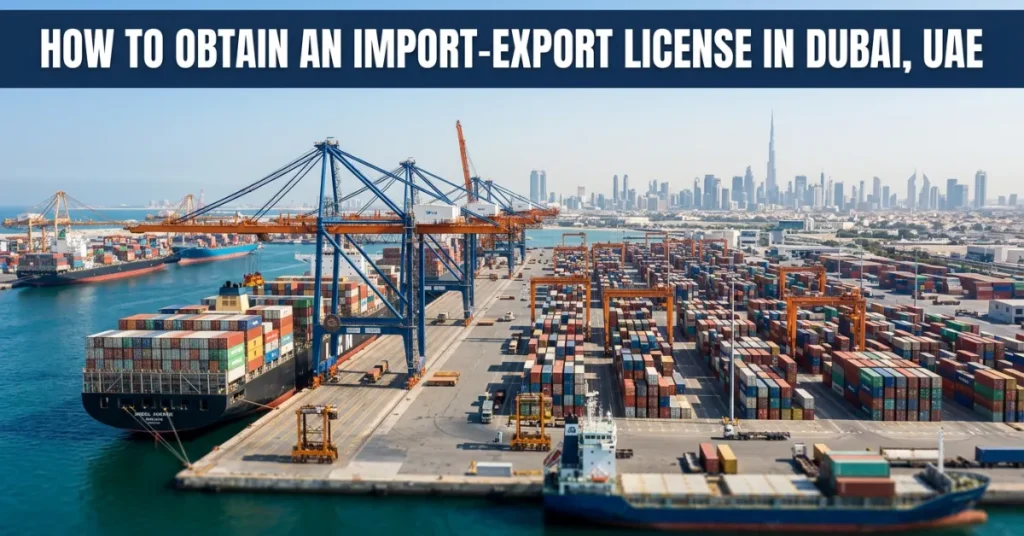
Dubai offers a genuinely compelling environment for international traders. Here is what makes it stand out:
- 100% foreign ownership in most activities (post-2021 reforms)
- 0% personal income tax and 9% corporate tax above AED 375,000
- Access to 200+ global markets through UAE trade agreements
- Strategic location connecting Asia, Africa, and Europe
- World-class logistics through Jebel Ali Port and Dubai airports
- Strong banking infrastructure for international transactions
- Simplified customs procedures through the Dubai Trade portal
- Government-backed free zones with full profit repatriation
Step-by-Step Process to Obtain an Import-Export License

The process is straightforward once you know the sequence. Here is how it works from start to finish.
Step 1: Choose your business activity
Define exactly what you plan to import or export. In Dubai, every business license is tied to specific commercial activities. For general merchandise, a broad “general trading” activity works. For regulated goods, such as food products, pharmaceuticals, chemicals, or electronics, you will need to list those product categories precisely and may require additional approvals from relevant authorities. Getting this right from the beginning saves you from having to amend your license later.
Step 2: Select your jurisdiction
This is perhaps the most consequential decision. If you plan to sell primarily within the UAE, a mainland license gives you unrestricted access to the local market. If your model is international re-export or you want customs duty benefits, a free zone license is better suited. Your choice also affects ownership structure, visa quotas, and office requirements, all of which impact your overall cost.
Step 3: Reserve your trade name
Your company name must follow UAE naming guidelines: avoid religious references, offensive words, or names too similar to existing registered entities. The name should reflect your business activity. Once shortlisted, you reserve it through the DED’s online portal or the relevant free zone authority. A reservation is typically valid for a limited period, so begin your application promptly after this step.
Step 4: Apply for initial approval
Initial approval is the government’s preliminary green light to proceed with your business setup. You submit your proposed business activities and shareholder information to the DED or free zone authority. For product categories requiring regulatory sign-off, such as food (Dubai Municipality) or medical items (Ministry of Health), this is when you begin those parallel approvals.
Step 5: Secure office space
A registered office address is mandatory. For mainland businesses, you need a physical office with an Ejari (registered tenancy contract). Free zones typically offer flexible options: a full office, a shared workspace, or a flexi-desk, the most cost-effective choice for startups. The type of space you choose affects how many employee visas you can obtain.
Step 6: Submit documents and pay fees
Once your trade name and initial approval are in place, you submit the full application package (see the documents section below) along with the license fee. Processing is usually handled through the DED’s Basher portal for mainland applications or directly through your chosen free zone’s business center.
Step 7: Register for a customs code
This is a step many first-time traders overlook. To legally move goods in and out of Dubai, you need a customs importer/exporter code from Dubai Customs. Without this code, your shipments cannot clear customs, regardless of whether your trading license is active. Registration is done through the Dubai Trade portal and typically takes one to three working days.
Documents Required for an Import-Export License
Gather these before you begin the application. Missing documents are the most common reason for processing delays.
- Passport copies of all shareholders
- UAE visa copies (if applicable) or entry stamp pages
- Trade name reservation certificate
- Initial approval certificate from DED or free zone authority
- Memorandum of Association (MOA) attested for mainland companies
- Office lease agreement / Ejari certificate (mainland) or flexi-desk agreement (free zone)
- Emirates ID copies of shareholders (if UAE resident)
- No-objection certificate from current UAE sponsor (if applicable)
Cost of an Import-Export License in Dubai
Expect to budget between AED 12,000 and AED 30,000+ for the full setup, depending on your chosen jurisdiction and business structure. Free zone packages are often bundled and can be more transparent on pricing, while mainland costs vary with office size and visa requirements.
Mainland vs Free Zone – Which Is Better for Import-Export?
The right choice depends on where you plan to sell and how your supply chain is structured. Here is a direct comparison:
| Factor | Mainland | Free Zone |
|---|---|---|
| Foreign ownership | 100% (most activities) | 100% |
| UAE market access | Unrestricted | Requires mainland agent |
| Customs duties | Standard applicable | Zero within free zone |
| Office requirement | Physical office + Ejari | Flexi-desk available |
| Setup cost | Higher (AED 18,000+) | Lower packages available |
| Best suited for | UAE-focused trading | Re-export & global trade |
Common Mistakes to Avoid
These errors slow down approvals and increase costs often for first-time business owners who assume the process is simpler than it is.
- Choosing the wrong jurisdiction based on cost alone, then realizing mainland access is restricted
- Skipping customs code registration and discovering shipments cannot clear customs
- Not checking the UAE’s restricted or prohibited goods list before selecting your product category
- Underestimating logistics costs, such as warehousing, freight forwarding, and port charges add up significantly
- Selecting a business activity that is too narrow, then needing to amend the license later at extra cost
- Failing to obtain sector-specific approvals (e.g., from Dubai Municipality for food items) before starting operations
How Long Does It Take to Get an Import-Export License?
For most straightforward applications, the license processing time in Dubai ranges from 3 to 10 working days once all documents are correctly submitted. Free zone applications, particularly at established zones like DMCC or DAFZA are often faster due to dedicated business centers and streamlined digital portals.
The timeline can extend if your product category requires additional regulatory approvals. A food trading license requiring Dubai Municipality sign-off, for instance, may add 5 to 15 working days. Similarly, mainland applications with multiple shareholders or complex ownership structures may go through extra verification rounds. Plan for 2 to 4 weeks as a comfortable total estimate when factoring in document preparation, bank account opening, and customs registration.
Do You Need Additional Approvals?
Depending on what you import or export, you may need clearance from one or more government bodies in addition to your trading license. This is an area where many applicants are caught off guard.
- Food products: Dubai Municipality approval and food import registration are mandatory. Perishable goods also require cold chain compliance documentation.
- Medical and pharmaceutical products: Ministry of Health (MOH) and Dubai Health Authority (DHA) clearances apply. These can take 4 to 8 weeks independently.
- Electronics and telecommunications equipment: The Telecommunications and Digital Government Regulatory Authority (TDRA) requires type approval for certain devices.
- Chemicals and hazardous materials: Dubai Civil Defence and relevant MOEI approvals are needed, with safety documentation requirements.
- Weapons, defence-related goods, and controlled substances: These face strict federal-level approvals and are not accessible to most commercial entities.
Tips to Start a Successful Import-Export Business in Dubai
- Research carefully high-volume categories in Dubai, including electronics, food commodities, textiles, machinery, and automotive parts
- Understand customs duty structures upfront so your margins account for applicable tariffs and VAT on imports
- Build relationships with freight forwarders and customs clearing agents early, they save time and prevent costly errors at the port
- Use Jebel Ali Port’s logistics ecosystem; it handles over 19 million TEUs annually and connects directly to 140+ global ports
- Register on the Dubai Trade portal from day one to manage shipments, customs codes, and duty payments in one place
- Open a multi-currency bank account to handle USD, EUR, and AED transactions efficiently across supplier and buyer markets
Why Work with a Business Setup Consultant?
The UAE business setup process is not complicated, but it is detail-intensive. A business setup consultant familiar with Dubai regulations can shorten your timeline meaningfully, handling document preparation, liaising with authorities, and flagging potential issues before they become delays.
Consultants are particularly valuable when your product category requires parallel regulatory approvals, when you are setting up from outside the UAE and cannot be physically present, or when you are choosing between multiple free zone options and need an objective cost-benefit analysis. The cost of a good consultant is almost always recovered in time savings and avoided amendment fees.
Look for a firm with a DED-accredited registration and proven experience with your specific product category. A general business setup company may not know the nuances of, say, pharmaceutical import approvals or electronics type certifications.
Our Support for Import-Export License Setup in Dubai
We simplify the process of getting an import-export license in Dubai by guiding you at every step. Our team helps you choose the right jurisdiction, prepare documents, and handle approvals without delays. We make sure your business complies with UAE regulations so you can start trading with confidence. For expert assistance, contact Ripple Business Setup at +971 50 593 8101, email info@ripplellc.ae, or WhatsApp +971 4 250 0833.
FAQ
What is an import-export license in Dubai?
An import-export license allows businesses to legally trade goods across international borders from Dubai. It is usually issued as a commercial or trading license.
How much does an import-export license cost in Dubai?
The cost typically ranges from AED 12,000 to AED 30,000 or more, depending on location, business activity, and office requirements.
Can foreigners own an import-export business in Dubai?
Yes, foreign investors can own 100% of their business in most sectors, especially in free zones and many mainland activities.
How long does it take to get the license?
The process usually takes 3 to 10 working days if all documents are complete.
Do we need a customs code for import-export activities?
Yes, a customs code is mandatory to import or export goods through Dubai ports.
Conclusion
Dubai remains one of the world’s most accessible and rewarding environments for import-export businesses. The process from choosing your jurisdiction and reserving a trade name to securing your customs code is systematic and manageable with the right preparation.
Disclaimer: This content is for general informational purposes only and does not constitute legal or financial advice. Business setup requirements, costs, and regulations in Dubai may change over time. It is recommended to consult with a professional advisor or relevant UAE authorities before making any business decisions.