


The UAE real estate market has never been more active. With Dubai and Abu Dhabi continuously attracting investors, expats, and businesses, the demand for professional property management services has surged. If you are looking to enter this growing sector, the first thing you need is a Property Management License. Without it, you cannot legally manage properties, collect rent, handle tenants, or represent landlords in the UAE.
What is a Property Management License and Why It Matters
A Property Management License is a government-issued authorisation that legally permits individuals or companies to manage residential or commercial properties on behalf of property owners. In the UAE, this license ensures you operate within the regulatory framework set by authorities like the Real Estate Regulatory Authority (RERA) and the Dubai Land Department (DLD).
In simple terms, this license covers everything from managing rental agreements and tenant communications to overseeing maintenance and collecting rent. Without it, you are not legally permitted to offer these services commercially. Beyond legal compliance, holding a valid license builds trust with landlords and tenants, gives you access to formal listings, and positions your business as a credible, professional operation in a competitive market. This is especially important in Dubai, where regulatory standards for real estate property management are strictly enforced.
Who Needs a Property Management License in the UAE
Not everyone in the real estate space needs this specific license, but many do. Here is who typically requires one:
- Real estate companies that manage residential or commercial properties on behalf of owners
- Individual property managers offering professional rental management license services
- Investors who manage multiple rental units and charge fees for doing so
- Companies providing leasing, facility management, or tenant sourcing services
If your business also involves buying and selling properties, you will likely need a real estate brokerage license in addition to your property management authorisation. Some operators apply for both to cover the full spectrum of real estate activity. It is always best to confirm with the relevant authority based on your exact business model.
Types of Property Management Licenses in the UAE
Before you apply, it helps to understand the different license types available in the UAE. Each serves a specific purpose:
- Real Estate Brokerage License: Covers buying, selling, and leasing of properties on behalf of clients. Issued through the DLD real estate license framework. Required if you plan to broker deals alongside property management.
- Property Management License: Specifically authorises the management of residential and commercial properties, including rent collection, tenant relations, and maintenance coordination. This is the core license for property management companies.
- Facility Management License: Covers the operational management of buildings, including maintenance, cleaning, and technical services. Often required for larger commercial portfolios.
Each license falls under a distinct business activity code. Choosing the wrong one can create compliance issues down the line, so get clarity before you proceed.
Step 1: Choose Your Business Activity and Jurisdiction
Your first decision is where and how you want to set up your business. In the UAE, you have three main options: Mainland, Free Zone, or Offshore. Each has different implications for how you operate, who you can serve, and what your costs will look like.
- Mainland: Allows you to operate across the UAE, work with government clients, and set up offices anywhere. Ideal for those targeting a broad market. You may need a local service agent in some cases, though recent reforms have made 100% foreign ownership possible in many mainland activities.
- Free Zone: Offers 100% foreign ownership, faster company formation, and a streamlined setup process. However, some free zone companies face restrictions on conducting business directly in the mainland market. Popular free zones include DMCC, SHAMS, and IFZA.
- Offshore: Generally used for holding or investment purposes, not for actively managing properties in the UAE.
For most property management businesses, a mainland or a relevant free zone is the practical choice. Your jurisdiction affects your license type, operational scope, and even your ability to register properties with Ejari. Make this decision thoughtfully, as changing later adds time and cost.
Step 2: Register Your Business and Trade Name
Once you have chosen your jurisdiction, the next step is to register your company and reserve your trade name. This is handled through the Department of Economy and Tourism (DET) for mainland companies, or through the relevant free zone authority for free zone setups. The process is more straightforward than many people expect, but attention to detail matters.
- Choose a unique business name that reflects your activity and complies with UAE naming conventions. Avoid names that are already taken or that include restricted terms.
- Submit your trade name application to the relevant authority along with passport copies and other basic documents.
- Receive your initial approval, which gives you the green light to proceed with the next steps.
Trade name registration in UAE typically takes 1 to 3 working days. Once approved, your name is reserved for a set period while you complete the rest of the process. Do not delay the next steps, as reservations can expire.
Step 3: Get Approvals from Real Estate Authorities
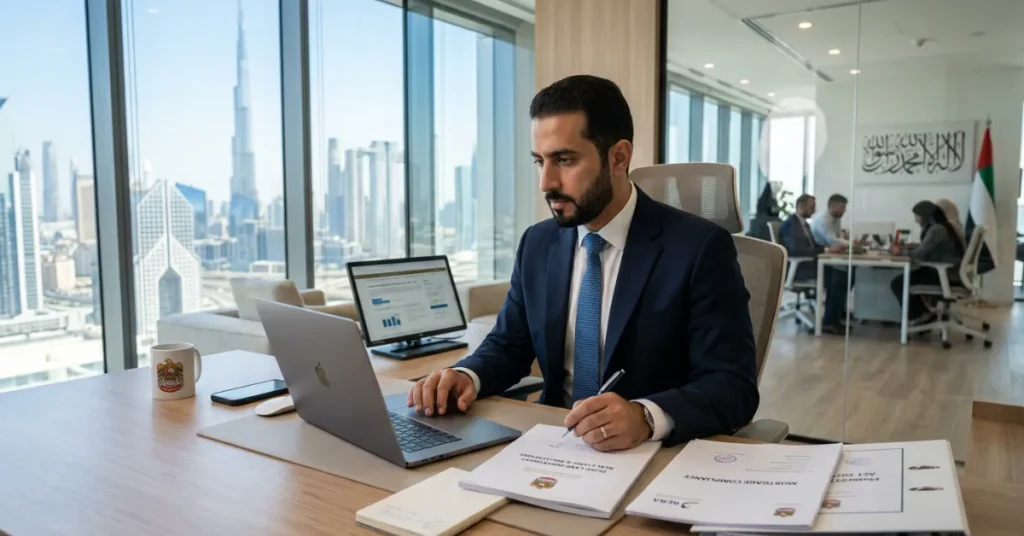
This is the most critical step for anyone pursuing a property management license in the UAE. Depending on your location and activities, you will need approval from RERA (Real Estate Regulatory Authority) or the relevant emirate-level authority. In Dubai, RERA certification is mandatory for anyone involved in real estate management.
- Apply for RERA certification through the Dubai Land Department portal or in person at their offices.
- Complete the required RERA-approved training course, which covers UAE property laws, rental regulations, and landlord-tenant rights.
- Pass the RERA exam if required for your license type. The exam tests your knowledge of real estate law and ethical practice.
- Obtain your professional license or broker card, which must be renewed annually.
| Expert Tip: Many applicants underestimate the time needed for RERA certification. Build at least 2–3 weeks into your timeline for this step alone. The training and exam can be done back-to-back, but approval processing takes additional time. |
Outside Dubai, similar processes apply through Abu Dhabi’s Department of Municipalities and Transport or Sharjah’s respective real estate bodies. Requirements vary slightly by emirate, so always verify with the local authority.
Step 4: Secure Office Space and Final License Approval
The UAE requires most licensed businesses to have a physical office space. For property management companies, this is not just a formality it is a regulatory requirement that signals your business is genuinely operational. Once you have your office lease in place, you are ready for the final push.
- Lease a commercial office space in an approved location. The size and type of space may vary based on your jurisdiction.
- Register your tenancy contract through Ejari, the official online system for registering rental contracts in Dubai. This is mandatory and ties your trade license to a verified address.
- Submit your full documentation package, including trade name approval, initial approval, RERA certification, office lease, passport copies, and any other required documents.
- Receive your final Property Management License from the relevant authority.
Ejari registration in Dubai is done through the DLD portal or at authorised typing centres. Without it, your business address cannot be officially verified, which will block your license issuance. Make sure your lease is active and signed before initiating this step.
Cost of Getting a Property Management License in UAE
Costs vary based on your jurisdiction, company structure, and specific license type. That said, here is a realistic breakdown of what to expect for a standard setup:
- Trade license fees: AED 5,000 – AED 15,000, depending on the authority and business activity
- Company registration and approvals: AED 2,000 – AED 5,000
- Office rent (annual): AED 15,000 – AED 40,000+, depending on location
- RERA training and exam fees: AED 1,500 – AED 3,000 per person
- Ejari registration and miscellaneous fees: AED 500 – AED 1,500
| Estimated Total Range: AED 15,000 – AED 50,000 for the first year.This range reflects the difference between a lean free zone setup and a full mainland company with a larger office. Ongoing costs include annual license renewal, RERA card renewal, and office lease renewals. |
Documents Required for Property Management License
Here is a concise checklist of what you will typically need to submit:
- Passport copies of all shareholders and managers
- UAE visa copies (if already in the country)
- Emirates ID copies
- Business plan outlining your activities and proposed structure
- Trade name approval certificate
- Office lease agreement (Ejari registered)
- RERA certification or proof of enrolment for key personnel
- No Objection Certificate (NOC) if applicable
Requirements may differ slightly based on your chosen jurisdiction and whether you are setting up as a solo operator or a company. Always confirm the exact document list with the relevant authority or a business setup consultant before submitting.
How Long Does It Take to Get a Property Management License
Most applicants complete the full process in 2 to 6 weeks, provided their documents are in order. Free zone setups can sometimes be completed in as little as 5 to 7 working days for the company registration portion. However, when you factor in RERA certification (which includes training, exam, and processing time), the realistic timeline extends to 3 to 4 weeks. Mainland setups may take slightly longer depending on approvals from multiple departments. The best way to speed things up is to have all your documents ready before you begin and to work with someone who knows the process well.
Common Mistakes to Avoid When Applying
These are the most frequent errors that slow down applications or result in rejections:
- Choosing the wrong license type: Selecting a general trading license instead of a real estate-specific one will require costly corrections later.
- Ignoring RERA requirements: Some applicants assume the trade license alone is enough. It is not. RERA approval is non-negotiable for property management in Dubai.
- Incomplete documentation: Missing a single document can pause your entire application for days or weeks. Prepare a complete checklist in advance.
- Underestimating costs: Many first-time applicants budget only for the license fee and are caught off guard by office rent, RERA fees, and other charges.
- Delaying office setup: Your Ejari registration must be completed before your license can be finalised. Do not treat this as an afterthought.
Benefits of Starting a Property Management Business in UAE

Once licensed, the business opportunity is significant. Here is why property management remains one of the most attractive sectors in the UAE:
- High rental demand: Dubai and Abu Dhabi consistently record high rental occupancy, giving property managers a steady stream of clients.
- Recurring income: Property management fees are typically charged monthly, creating predictable, recurring revenue streams.
- Growing expat population: With over 3.5 million residents in Dubai alone, the demand for rental properties and professional management continues to grow.
- Strong real estate market: The UAE government actively supports real estate investment through long-term visa programs, freehold zones, and transparent regulations.
- Scalability: Starting with a small portfolio and scaling to dozens of managed units is a common and proven path in this market.
How Our Experts at Ripple Business Setup Support You
We guide you through every step of getting a Property Management License in the UAE. From choosing the right business structure to handling approvals and documentation, we manage the full process with accuracy. Our team ensures everything is completed on time so you can focus on growing your business. Contact Ripple Business Setup at +971 50 593 8101, email info@ripplellc.ae, or WhatsApp +971 4 250 0833 to get started.
FAQs
Do we need special approval for property management in Dubai?
Yes, approval from real estate authorities is required before starting operations.
Can foreigners apply for a Property Management License in UAE?
Yes, foreigners can apply through mainland or free zone options with full ownership available.
How long does it take to get the license?
It usually takes between 1 to 4 weeks, depending on approvals and documentation.
Is office space mandatory for this license?
Yes, in most cases, a physical office is required to complete the licensing process.
Conclusion
Getting a Property Management License in the UAE comes down to four core steps: choosing the right jurisdiction, registering your business, securing RERA approval, and finalising your license with a verified office address. Each step builds on the last, and with the right preparation, the entire process can be completed in a matter of weeks.
Disclaimer: This content is for general informational purposes only. Rules, costs, and requirements may change based on UAE regulations and authority updates. We recommend consulting with a professional advisor for accurate and up-to-date guidance.