

Protecting personal wealth in today’s complex financial environment has become a top priority for entrepreneurs, investors, and high-net-worth families across the region. As business risks grow more unpredictable and cross-border asset ownership becomes more common, many individuals are turning to structured legal vehicles to safeguard what they have built. One of the most powerful tools available today is the UAE Foundation Company.
What Is a UAE Foundation Company?
A UAE Foundation Company is a legal entity created under specific free zone regulations that allows an individual (the founder) to transfer personal or business assets into a separate legal structure. Once assets are transferred, the foundation becomes their legal owner. The founder can still define how those assets are managed, how income is distributed, and who benefits from them all through a founding charter and accompanying bylaws.
Unlike a standard limited liability company, a UAE Foundation Company has no shareholders and is not designed to carry out commercial trading. Its sole purpose is asset holding, wealth management, and structured distribution. This makes it fundamentally different from an operating company and positions it closer in function to a private trust but with key structural advantages.
The three most widely used jurisdictions for UAE Foundation registration are the DIFC Foundation, the ADGM Foundation, and the RAK ICC Foundation. Each operates under its own legislation, though all share the core principle of a foundation being a separate legal person governed by a council rather than a board of directors.
Why High Net Worth Investors Use UAE Foundation Structures
Wealthy individuals and business families choose UAE Foundations because they address several common challenges at once. A single foundation can ring-fence personal assets from business liabilities, provide a clear inheritance structure, and maintain a level of privacy not available through ordinary company registration. This combination of functions is difficult to replicate through any other single legal structure.
The key reasons investors choose foundation structures include the following:
- Protecting personal assets from business liabilities and creditor claims
- Maintaining family wealth across multiple generations through structured succession
- Avoiding inheritance disputes by clearly defining beneficiary entitlements in the charter
- Creating a layer of privacy around beneficial ownership and asset control
- Separating personal financial exposure from operational business risk
Consider a practical example. A Dubai-based entrepreneur owns shares in five companies across different sectors, holds real estate in three countries, and manages a significant investment portfolio. By transferring these assets into a UAE Foundation, the entrepreneur separates personal wealth from the risk of any single business failing or facing legal action. If one company is sued, the foundation, not the individual, owns the shares, and personal assets remain protected.
Secret 1 – Separate Personal Wealth from Business Risk

The most fundamental reason investors establish a UAE Foundation is to create a legal barrier between personal wealth and business risk. When assets are held directly by an individual, those assets are exposed to any financial or legal difficulties that arise from their business activities. A lawsuit against a company, an unpaid creditor, or a disputed contract can potentially reach personal bank accounts, real estate holdings, and investment portfolios if no protective structure exists.
Once assets are transferred into a UAE Foundation Company, the foundation becomes the legal owner of those assets. The founder no longer holds title to them personally. This means that in most circumstances, a claim against the founder as an individual cannot be enforced against assets held by the foundation. The assets are legally ring-fenced.
This protection is particularly relevant for the following asset types:
- Real estate portfolios held across the UAE and internationally
- Shares in operating companies and holding entities
- Intellectual property, including patents, trademarks, and licensing rights
- Investment portfolios managed through banks or brokerage accounts
To illustrate this in practice, consider a business owner in Dubai who places shares in multiple companies into a UAE Foundation Company. If a commercial dispute arises against the founder personally, the foundation as the legal owner of those shares, is a separate entity. Creditors generally cannot attach foundation assets to satisfy personal claims, provided the foundation was properly structured before any dispute arose.
Secret 2 – Use a Foundation for Global Wealth and Succession Planning
Inheritance disputes are a significant risk for wealthy families, particularly when assets span multiple countries with different legal systems. Without a clear structure, the distribution of wealth after a founder’s death can be contested, delayed, or subject to forced heirship laws that override personal wishes. A UAE Foundation Company addresses this directly by allowing founders to create binding governance rules for how their wealth is managed and distributed both during their lifetime and after.
The founder sets out a detailed charter when establishing the foundation. This charter defines who the beneficiaries are, what they are entitled to receive, and under what conditions distributions can be made. It can also include provisions for how the foundation should be managed if the founder is incapacitated or passes away. Because these rules are embedded in the legal structure itself, they have far greater enforceability than a simple will.
Key succession planning advantages of a UAE Foundation include:
- The founder can specify the exact conditions under which beneficiaries receive income or capital
- Assets continue to be managed by the foundation council without interruption after the founder’s death
- The structure avoids probate processes in multiple jurisdictions for internationally held assets
- Generational wealth transfer can be managed in a controlled, planned manner over decades
As a practical example, a UAE-resident family patriarch transfers a portfolio of regional properties and company holdings into an ADGM Foundation. The charter specifies that his children receive annual income distributions after his passing, and that the principal assets remain intact for the grandchildren until they reach a specified age. The foundation council manages this plan according to the charter, removing ambiguity, reducing family conflict, and ensuring the wealth serves its intended purpose across generations.
Secret 3 – Maintain Privacy and Long-Term Asset Control
Privacy is a significant consideration for high-net-worth individuals managing international assets. In many corporate structures, beneficial ownership information is increasingly disclosed through public registers. UAE Foundation Companies, particularly in jurisdictions such as DIFC and ADGM, offer a higher degree of confidentiality than standard company registrations. In many foundation structures, the founder’s name does not appear in public registers, and beneficiary information is protected within the foundation’s private charter.
The governance of a UAE Foundation is managed by a foundation council rather than by the founder directly. The council is responsible for administering assets and making distributions in accordance with the charter. This council structure creates an operational separation between the founder’s personal identity and the day-to-day management of the assets, further protecting privacy while still allowing the founder to set the rules.
The key privacy advantages of a UAE Foundation Company include:
- Founder identity may not appear in publicly accessible registers, depending on the jurisdiction
- Beneficiaries are defined privately in the charter rather than disclosed to public authorities
- Council management structure separates personal identity from asset administration
- Long-term control is maintained through the charter, which can be updated within the rules of the applicable regulations
For investors managing assets across multiple international jurisdictions, this level of privacy is particularly valuable. It prevents the public disclosure of asset ownership structures that could create unwanted attention, complicate commercial negotiations, or expose beneficiaries to unnecessary risks.
Key Features of a UAE Foundation Company
Understanding the structural characteristics of a UAE Foundation helps investors evaluate whether it is the right vehicle for their situation. The core features that distinguish a foundation from other legal entities are the following:
- Foundations have no equity owners; assets belong to the foundation itself
- A council manages assets in place of a board of directors
- The founder defines rules for management and distribution in these documents
- The foundation is an independent legal entity distinct from its founder
- Foundations can hold assets located anywhere in the world
- Not structured for commercial trading or profit distribution to owners
UAE Foundation vs Trust: Key Differences
Both foundations and trusts are used for asset protection and wealth planning, but they operate differently. Understanding the distinctions helps investors choose the right structure for their goals and the legal environment in which their assets are located.
| Feature | UAE Foundation | Trust |
| Legal Structure | Separate legal entity | Legal relationship only |
| Control Mechanism | Foundation council | Trustee manages assets |
| Governing Document | Charter and bylaws | Trust deed |
| Separate Legal Person | Yes | No |
| Privacy Level | High – council structure | Moderate – trustee named |
| Popular Jurisdictions | DIFC, ADGM, RAK ICC | Offshore, common law jurisdictions |
| Best For | Family wealth, multi-asset holding | Simpler beneficiary arrangements |
In the UAE context, many international investors prefer foundations because they provide a clearer governance structure and are easier to administer across multiple jurisdictions. Foundations are also better suited to holding company shares, real estate, and other non-financial assets when compared to traditional trusts.
Where You Can Register a UAE Foundation Company
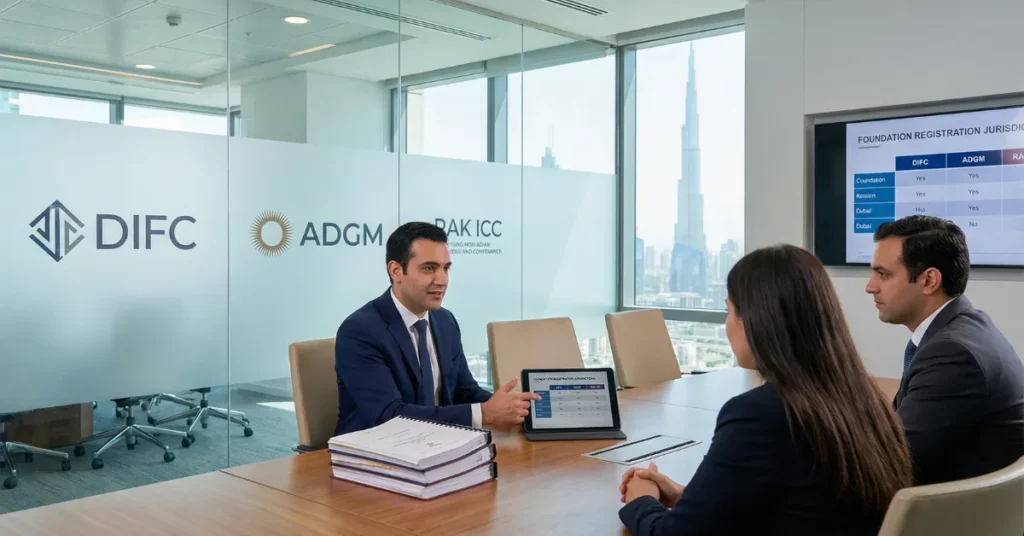
Three main jurisdictions in the UAE offer foundation registration, each with its own regulatory framework, cost structure, and target market. Selecting the right jurisdiction depends on the complexity of your asset structure, the intended beneficiaries, and your budget.
DIFC Foundation
- One of the most internationally recognised free zone foundations in the region
- Regulated under DIFC Foundation Regulations and governed by common law principles
- Popular with international investors, family offices, and global asset managers
- Strong legal enforcement framework and access to DIFC Courts
ADGM Foundation
- Based in Abu Dhabi and governed under ADGM’s foundations framework
- Common law jurisdiction with a reputation for regulatory stability
- Frequently used by family offices and ultra-high-net-worth individuals
- Supported by a modern, business-friendly regulatory environment
RAK ICC Foundation
- A cost-effective alternative to DIFC and ADGM for straightforward structures
- Suitable for holding companies, investment structures, and simpler estate planning needs
- Regulated by the Ras Al Khaimah International Corporate Centre
- Attractive for investors looking for lower initial setup and annual maintenance costs
Documents Required to Set Up a UAE Foundation Company
The documents required to register a UAE Foundation vary slightly depending on the chosen jurisdiction, but the following items are generally required across DIFC, ADGM, and RAK ICC:
- Certified copy of the founder’s passport and proof of residence
- Details of all proposed beneficiaries, including identification documents
- Drafted foundation charter setting out the purpose and governance rules
- Bylaws or regulations document governing the council’s operation
- Registered office address within the chosen free zone
- Evidence of initial capital contribution or asset transfer intention
Professional legal and corporate advisors typically assist with drafting the charter and bylaws, as these documents are central to the foundation’s functioning. Poorly drafted governance documents are one of the most common causes of foundation disputes, so engaging experienced advisors at this stage is strongly recommended.
Cost and Timeline to Establish a UAE Foundation Company
The total cost of establishing a UAE Foundation Company depends on the jurisdiction selected, the complexity of the asset structure, and the legal fees involved in drafting the charter and bylaws. As a general guide, initial registration and setup costs typically range between AED 15,000 and AED 30,000. This figure includes the jurisdiction’s registration fee, the cost of a registered office address, and basic legal advisory fees for standard structures.
More complex foundations involving multi-jurisdictional assets, detailed succession provisions, or customised governance arrangements may cost significantly more due to the additional legal drafting time involved. Annual renewal fees, which cover the maintenance of the registered office, council filing requirements, and regulatory compliance, typically range between AED 8,000 and AED 20,000 per year, depending on the jurisdiction.
In terms of timeline, most UAE Foundation registrations are completed within two to four weeks from the date all required documents are submitted. DIFC and ADGM typically take two to three weeks for standard applications, while RAK ICC may process applications more quickly for straightforward structures. Complex or bespoke foundations may take longer if additional legal review is required by the regulator.
When Should You Consider a UAE Foundation Structure?
A UAE Foundation is not the right solution for every investor, but it is particularly well-suited to a specific set of circumstances. The following situations are where foundation structures deliver the most meaningful asset protection and planning benefits:
- Owners of high-value real estate portfolios in multiple countries who need a centralised holding structure
- Entrepreneurs with ownership in several operating companies who want to separate personal wealth from business risk
- Families seeking to plan multi-generational wealth transfer without the risks of contested inheritance
- Investors holding intellectual property rights who want to protect and license those assets efficiently
- Individuals with international investment portfolios who want a single, privacy-preserving holding vehicle
In each of these scenarios, the foundation’s ability to act as a separate legal entity with clear governance, defined beneficiaries, and long-term asset protection makes it a highly effective tool. For investors with simpler asset structures or short-term holding needs, a standard holding company may be more cost-effective. However, for those managing significant or complex wealth, a UAE Foundation offers a level of legal security and planning sophistication that few other structures can match.
Common Mistakes Investors Make When Structuring Foundations
Despite the clear advantages of a UAE Foundation Company, a number of common mistakes can undermine its effectiveness if the structure is not set up correctly from the outset. Awareness of these pitfalls helps investors avoid costly errors.
- Vague or incomplete governance rules create disputes and administration failures
- Selecting a free zone based on cost alone without considering legal framework, enforceability, and reputation
- Ambiguous beneficiary descriptions lead to legal challenges and distribution delays
- Transferring assets into a UAE Foundation may trigger tax obligations in the founder’s country of residence or citizenship
- Foundations require active council management and annual compliance; neglecting this weakens the structure over time
Expert legal and corporate advisory guidance is essential when establishing a UAE Foundation. Advisors with direct experience in UAE free zone foundation law can ensure the charter is correctly drafted, the right jurisdiction is selected, and all compliance obligations are understood from the start. The cost of professional guidance at the outset is far lower than the cost of rectifying a poorly structured foundation later.
How Our Ripple Business Setup Team Supports UAE Foundation Companies
UAE foundation companies are effective tools for protecting assets, managing wealth, and ensuring long-term succession planning. Our Ripple Business Setup team helps clients understand how to structure foundations to safeguard property, investments, and business interests while staying compliant with UAE regulations. We provide guidance on selecting the right foundation type, preparing legal documents, and registering with the relevant authorities.
Our consultants also advise on governance rules, beneficiary structures, and ongoing compliance requirements. With proper planning, foundation companies can separate assets from personal ownership, maintain control over investments, and protect wealth from potential disputes. For professional assistance, contact Ripple Business Setup at +971 50 593 8101, email info@ripplellc.ae, or WhatsApp +971 4 250 0833.
Conclusion
A UAE Foundation Company is one of the most effective asset protection tools available to entrepreneurs and global investors operating in or through the UAE. By creating a legally separate entity governed by a founder-defined charter, a foundation provides a level of security, privacy, and long-term control that standard business structures simply cannot offer.
Disclaimer: This content is for general informational purposes only and should not be considered legal, financial, or professional advice. UAE foundation regulations may change. Always consult qualified professionals before creating a foundation company.