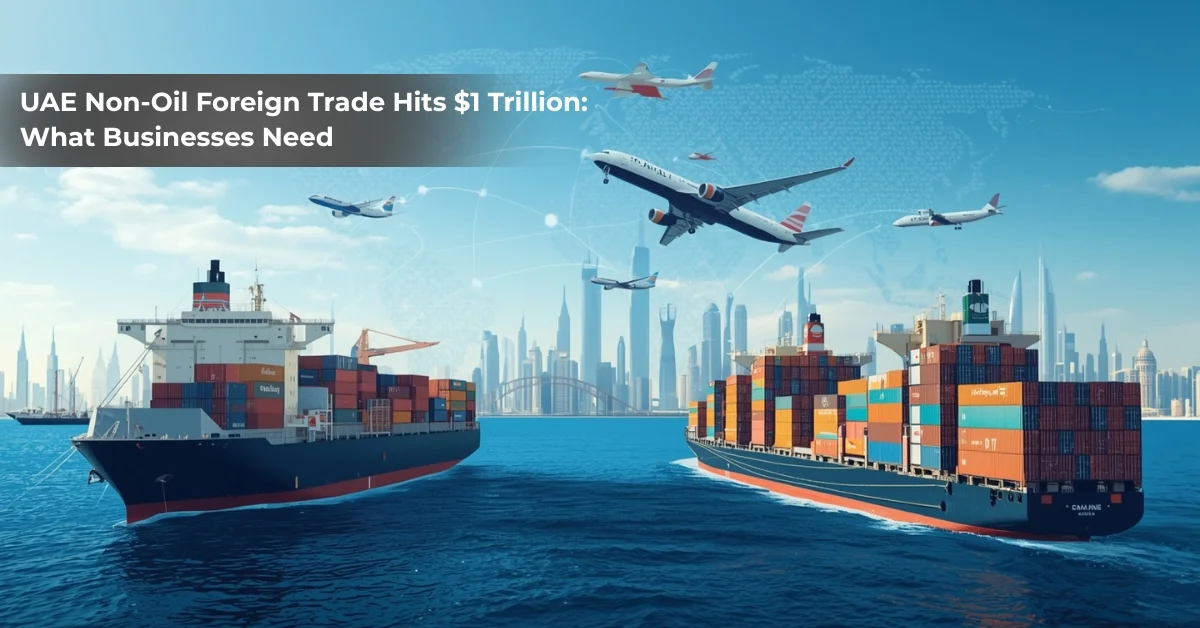
The UAE has crossed a historic economic milestone: UAE non-oil foreign trade has surpassed the $1 trillion mark, reinforcing the country’s transformation into a globally competitive, export-driven economy. This achievement reflects years of strategic policy planning, infrastructure investment, and international trade integration.
For businesses, investors, and exporters, this milestone is more than a headline; it signals long-term market confidence, economic resilience, and expanding global opportunities. As the UAE reduces dependency on hydrocarbons, non-oil trade has become a key stabilizing force supporting sustainable growth beyond oil revenues.
UAE Hits Historic $1 Trillion Non-Oil Trade Milestone
The $1 trillion figure represents the total value of the UAE’s non-oil foreign trade, which includes imports, non-oil exports, and re-exports conducted with global trading partners.
What counts as non-oil foreign trade
Non-oil foreign trade excludes crude oil and natural gas exports and focuses on:
- Manufactured and industrial goods
- Precious metals and jewelry
- Machinery and electronics
- Food products and agri-trade
- Re-exported goods through UAE logistics hubs
Trade structure breakdown
- Imports support domestic consumption and industrial supply chains
- Non-oil exports reflect locally produced and value-added goods
- Re-exports highlight the UAE’s strength as a global redistribution hub
Compared to previous years, the steady rise in trade volume confirms sustained foreign trade growth driven by diversification, not commodity price cycles. Official government trade data consistently links this growth to policy reform, infrastructure investment, and global partnerships.
Reaching $1 trillion signals that the UAE has evolved into a mature, export-driven economy with strong fundamentals and global credibility.
Record Growth in Non-Oil Exports and Economic Diversification
One of the strongest contributors to this milestone is the rapid expansion of non-oil exports over recent years. This growth reflects a deliberate shift away from oil dependency toward high-value trade sectors.
Why diversification matters
- Reduced exposure to oil price volatility
- Greater economic resilience during global slowdowns
- Stable trade revenues across multiple sectors
Key Drivers of the UAE’s Non-Oil Trade Growth
This level of growth did not happen by chance. It is the outcome of coordinated economic policy, international engagement, and private sector participation.
Role of Strategic Economic Policies and Partnerships
The UAE has implemented some of the most pro-trade economic policies in the region.
Key policy drivers
- Comprehensive Economic Partnership Agreements (CEPAs) with Asia, Africa, and Europe
- Reduced tariffs and simplified customs procedures
- Faster trade licensing and exporter support programs
These agreements expanded market access for UAE-based companies while lowering entry barriers for foreign firms using the UAE as a base.
International partnerships
- Strengthened trade corridors with India, China, Türkiye, and Africa
- Government-backed export promotion initiatives
- Support for SMEs entering cross-border trade
Together, these policies reinforced the UAE’s status as a global trade hub with high regulatory clarity and long-term stability.
Expansion in Major Non-Oil Export Sectors
Growth has been broad-based across multiple sectors, reducing reliance on any single industry.
Key sectors driving trade volume
- Manufacturing & industrial goods: Construction materials, aluminum, plastics
- Gold & precious metals: Refining, trading, and re-exports
- Electronics & machinery: Regional distribution centers
- Food & agri-trade: Processed foods and essential commodities
- Logistics & re-exports: Value-added redistribution services
Efficient ports, free zones, and digital customs systems supported supply chain expansion, allowing faster turnaround and cost efficiency critical for high-volume foreign trade growth.
Implications for Investors and the UAE Economy
This trade milestone directly impacts investment flows, business expansion, and private sector growth.
Strengthening UAE’s Role as a Global Trade Hub
The UAE’s geographic position allows it to connect East–West and North–South trade routes seamlessly.
Competitive advantages
- World-class ports, airports, and logistics infrastructure
- Over 40 specialized free zones
- Streamlined cross-border trade regulations
For global firms, the UAE offers a stable investment environment with access to multiple markets from a single base, one reason many multinational companies choose it as their regional headquarters.
Impact on the Private Sector and SMEs
Private businesses and SMEs play a growing role in non-oil trade expansion.
Key benefits for SMEs
- Easier access to export markets
- Trade finance and credit support
- Free zone licensing flexibility
Example: A small food exporter operating from a UAE free zone can scale internationally by leveraging re-export infrastructure, customs efficiency, and regional distribution networks, something far harder in less integrated markets.
What Businesses Need to Do Next
For businesses, this milestone creates opportunity but only for those that act strategically.
Practical steps businesses should take
- Identify export-ready products or services aligned with non-oil sectors
- Align business models with manufacturing, logistics, or value-added trade
- Choose the right setup: free zone vs mainland, based on trade goals
- Focus on compliance: customs rules, product standards, trade licensing
- Build international partnerships early to secure long-term growth
Companies that integrate themselves into the UAE’s export-driven economy gain access to global supply chains and sustained demand.
Future Outlook for UAE Non-Oil Foreign Trade
Looking ahead, the outlook remains positive.
Expected trends
- Continued foreign trade growth through diversification
- Expansion of digital trade platforms and smart logistics
- Increased focus on sustainable and green trade
- Strong long-term economic resilience
Government policy continues to prioritize innovation, sustainability, and global integration, reinforcing confidence in the UAE’s non-oil economic model well beyond the $1 trillion milestone.
How Ripple Business Setup Can Support Your UAE Trade Expansion
As UAE non-oil foreign trade continues to grow, having the right business setup and compliance strategy is essential to enter and scale in this export-driven economy. Ripple Business Setup supports entrepreneurs, exporters, and investors with end-to-end advisory services, including trade licensing, free zone and mainland company formation, customs compliance guidance, and structuring businesses aligned with high-growth non-oil sectors. Whether you are planning to establish a new trading entity or expand existing operations in the UAE, expert guidance can reduce risk and accelerate market entry. To explore your options, contact Ripple Business Setup at +971 50 593 8101, email info@ripplellc.ae, or WhatsApp +971 4 250 0833 for practical, business-focused advice.
FAQ
1. What is UAE non-oil foreign trade?
UAE non-oil foreign trade refers to the import, export, and re-export of goods excluding crude oil and natural gas. It includes sectors such as manufacturing, precious metals, machinery, electronics, food products, and logistics services.
2. Why is UAE non-oil foreign trade reaching $1 trillion important?
Reaching $1 trillion highlights the UAE’s success in building a diversified, export-driven economy. It reflects strong market confidence, reduced reliance on oil revenues, and long-term economic resilience supported by global trade integration.
3. Which sectors drive UAE non-oil foreign trade growth?
Key sectors driving growth include manufacturing and industrial goods, gold and precious metals, electronics and machinery, food and agri-trade, and logistics and re-export services supported by advanced ports and free zones.
4. How does UAE non-oil foreign trade benefit businesses and investors?
Businesses benefit from access to global markets, efficient trade infrastructure, pro-business regulations, and strategic free zones. Investors gain from a stable investment environment, diversified economic growth, and the UAE’s role as a global trade hub.
5. What should businesses do to benefit from UAE non-oil trade growth
Businesses should identify export-ready products, align with non-oil growth sectors, choose the right free zone or mainland structure, ensure customs and regulatory compliance, and build international partnerships early.
Conclusion
The UAE reaching $1 trillion in non-oil foreign trade marks a defining moment in its shift toward a diversified, export-driven economy. For businesses, this milestone confirms long-term market confidence, strong trade infrastructure, and expanding global access beyond oil dependence. Exporters, investors, and service providers that focus on compliance, strategic market alignment, and early integration into non-oil sectors are better positioned to benefit from sustained foreign trade growth. As the UAE continues to strengthen its role as a global trade hub, businesses that plan proactively and align with this direction will gain a durable advantage in regional and international markets.
Disclaimer: The information provided in this article is for general informational purposes only and does not constitute legal, financial, or professional advice. While every effort has been made to ensure the accuracy and timeliness of the content, regulations, trade policies, and market conditions in the UAE may change over time. Businesses are advised to conduct independent research or consult with qualified professionals before making any trade, investment, or business decisions based on the information shared above.