Setting up a business in the UAE is an exciting opportunity but the legal structure you choose will shape nearly every aspect of how your company operates. From ownership rights and personal liability to visa eligibility and tax obligations, the wrong choice early on can cost time, money, and flexibility down the road. With ongoing regulatory updates in 2026, understanding the current landscape of the UAE company legal structure is more important than ever.
What Are Legal Structures for UAE Companies?
A legal structure, sometimes called a legal entity or corporate form, is the officially registered framework that defines how your business is owned, governed, and held accountable under UAE law. Before the Department of Economic Development (DED) or any free zone authority issues a trade licence, the applicant must declare a legal form. This isn’t just bureaucratic formality. The legal entity you choose determines who can own shares, how liability is distributed among partners, what activities are permitted, and how the company appears to banks, investors, and regulators.
In the UAE, legal structures are tied directly to jurisdiction. A mainland company registered with the DED operates under federal commercial law, while a free zone company is governed by the specific free zone authority. Each framework carries distinct obligations, rights, and opportunities, making the selection process a strategic business decision, not just a paperwork exercise.
Why Choosing the Right UAE Legal Structure Matters in 2026
The UAE’s regulatory environment has evolved significantly in recent years from the landmark 100% foreign ownership reforms on the mainland to the introduction of a 9% corporate tax in 2023 (with updates continuing into 2026). The structure you register under will have direct consequences across several dimensions of your business.
Key business impacts
- Ownership rights: some structures cap foreign shareholding; others allow full foreign control
- Foreign investor eligibility: certain entities are restricted to UAE or GCC nationals
- Tax exposure: corporate tax registration thresholds and free zone qualifying income rules vary by structure
- Personal liability: sole proprietorships carry unlimited liability; LLCs and FZ-LLCs limit it to capital contribution
- Banking requirements: banks assess corporate structure during account opening; offshore entities face stricter scrutiny
- Investor confidence: institutional investors typically prefer LLC or FZCO structures with clear governance
- Business expansion flexibility: a free zone entity cannot sell directly to the mainland without a local distributor or DED approval
- Exit and sale process: share transfer rules, MOA requirements, and dissolution procedures differ substantially across structures
Main Legal Structures for UAE Companies
Limited liability company (LLC) in UAE
The LLC is the most widely used business structure on the UAE mainland and arguably the backbone of the country’s commercial economy. It suits trading companies, service providers, and businesses that need unrestricted access to the local UAE market. Under an LLC, each shareholder’s liability is limited to their capital contribution, meaning personal assets remain protected in most commercial disputes. Since the 2021 amendments to the Commercial Companies Law, foreigners can now own 100% of an LLC in most business activities (excluding a defined list of strategic sectors). This change made the mainland LLC far more attractive than it was under the previous 51% local ownership rule. For businesses dealing in physical goods, setting up as a mainland LLC in Dubai or Abu Dhabi offers the widest operational footprint.
Sole proprietorship
A sole proprietorship (or sole establishment) places full ownership and control in the hands of a single individual. It’s straightforward to set up and inexpensive to maintain, making it popular among independent consultants, freelancers, and skilled professionals. The significant downside is unlimited personal liability: if the business incurs debts or faces legal claims, the owner’s personal assets are at risk. This structure is best suited to low-risk, service-based activities where the individual’s personal skills are the primary offering.
- Pros: full control, low cost, simple administration
- Cons: unlimited liability, no shareholders, limited scalability
- Ideal for: consultants, coaches, translators, independent professionals
Civil company
A civil company is designed for licensed professionals, lawyers, accountants, doctors, engineers, and architects who wish to practise together under a shared entity. Unlike a commercial company, a civil company is governed by the UAE Civil Code rather than the Commercial Companies Law. Each partner in a civil company retains personal liability for their own professional actions, which is an important consideration for anyone in a regulated profession. The civil company structure is particularly common in Abu Dhabi and Dubai for law firms and specialist consultancy practices.
Free zone company (FZ-LLC / FZE / FZCO)
Free zone companies are among the most popular legal entities for foreign investors entering the UAE. Whether registered as a Free Zone Limited Liability Company (FZ-LLC), a Free Zone Establishment (FZE single shareholder), or a Free Zone Company (FZCO multiple shareholders), these entities all offer 100% foreign ownership and significant tax incentives. Many free zones offer qualifying income exemptions under the UAE corporate tax regime, making them particularly appealing for holding structures, international trade, and intellectual property.
The UAE hosts over 45 free zones, each targeting specific industries. DIFC and ADGM cater to financial services; Dubai Internet City and Dubai Silicon Oasis attract tech companies; Dubai Media City draws creative and media businesses; JAFZA serves logistics and manufacturing. A tech startup looking for a flexible desk licence with minimal overheads might choose Dubai Multi Commodities Centre (DMCC), while an e-commerce brand might opt for Dubai CommerCity. The trade-off: free zone companies generally cannot sell directly within the UAE mainland without engaging a local distributor or obtaining a dual licence.
Branch office of a foreign company
A branch office allows an established foreign company to operate in the UAE under its parent company’s identity; there is no separate legal entity. The parent bears full legal and financial responsibility for the branch’s activities. A UAE national service agent is typically required (though this is a facilitator, not a shareholder). Branch offices are subject to annual audits and must stick closely to the business activities of the parent. This structure works well for international firms testing the UAE market or providing post-sale support for products manufactured abroad.
Representative office
Often confused with a branch office, the representative office is a far more restricted entity. It can only conduct market research, promote the parent company’s products, and facilitate introductions; it cannot execute commercial sales or sign contracts. Think of it as a permanent marketing outpost rather than an operational subsidiary. It’s most suitable for foreign companies assessing demand before committing to a full market entry.
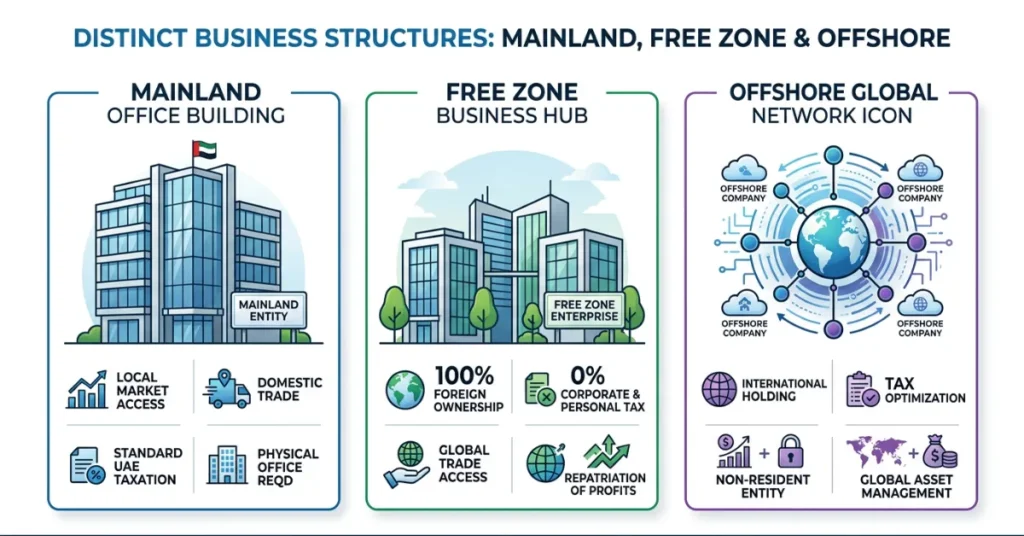
Mainland vs Free Zone vs Offshore: Structure Comparison
| Structure | Ownership | Market access | Tax | Office needed | Best for |
|---|---|---|---|---|---|
| Mainland (LLC) | Up to 100% foreign (most activities) | UAE-wide | Subject to 9% corporate tax above AED 375k profit | Physical address required | Local trading, retail, services |
| Free zone (FZ-LLC/FZE) | 100% foreign | International + limited mainland | Qualifying income may be exempt | Flexi-desk or virtual options | Startups, tech, e-commerce, IP holding |
| Offshore (e.g. RAK ICC) | 100% foreign | No local trade permitted | Low / no corporate tax on offshore income | No physical office required | Asset holding, international invoicing |
Which Legal Structure Is Best for Different Business Types?
Best structure for startups
- Free zone company (FZ-LLC or FZE) for low-cost setup with 100% ownership
- Mainland LLC, if you intend to serve UAE retail or B2B clients directly from day one
Best for e-commerce
- Free zone company platforms like Dubai CommerCity are purpose-built for e-commerce, offering warehousing, customs, and licensing under one roof
Best for consultancy
- Sole establishment for independent professionals operating alone
- Civil company for multi-partner professional service firms (legal, medical, accounting)
Best for international corporates
- Branch office if the parent company already operates and brand recognition matters
- Mainland LLC, if the UAE entity develops independent commercial relationships
UAE Legal Structure Requirements and Compliance Rules for 2026
Regardless of the structure chosen, all UAE companies must comply with an expanding compliance framework. The licensing authority DED for the mainland, respectively, the free zone authority for FZ entities, requires annual licence renewal. Companies must also register with the Federal Tax Authority for corporate tax purposes if they meet the threshold, and VAT registration applies to businesses with taxable supplies above AED 375,000 annually.
- UBO (Ultimate Beneficial Owner) disclosure: mandatory for all entities; failure to file can result in licence suspension
- Corporate tax registration: required for all UAE juridical persons as of 2024–2026 guidance
- Economic Substance Regulations (ESR): relevant for companies in certain activities (banking, insurance, intellectual property, etc.)
- AML/CFT compliance: Anti-Money Laundering controls apply to all entities, with higher requirements for financial services
- MOA / AOA requirements: the Memorandum and Articles of Association must reflect the registered legal structure and shareholder arrangement
- Annual audit: mandatory for most mainland and free zone entities above certain thresholds
Common Mistakes When Choosing a UAE Company Structure
- Choosing based only on setup cost without factoring in ongoing compliance costs
- Ignoring personal liability exposure, especially in sole proprietorships
- Selecting a free zone jurisdiction that doesn’t permit your actual business activity
- Skipping tax planning free zone status does not automatically mean full tax exemption under 2026 rules
- Failing to plan for future scalability a structure that works for a freelancer may not suit a 50-person firm
- Not accounting for visa quotas tied to the company type and office size
UAE Business Examples
Retail trading business
A consumer goods importer supplying supermarkets across Dubai and Abu Dhabi chose a mainland LLC structure after evaluating alternatives. A free zone company would have required a local distributor for every mainland sale, adding cost and complexity. As an LLC with 100% foreign ownership (permitted under the amended Commercial Companies Law), the founders retained full control while accessing UAE-wide clients directly. They secured a DED licence in Dubai and opened a commercial warehouse in Al Quoz a setup not available to free zone entities without a dual licence.
Tech startup in Dubai
A SaaS company with an entirely international customer base chose a free zone entity through Dubai Internet City. Their clients were based in Europe and Southeast Asia, so mainland sales were not needed. The free zone structure gave them 100% ownership, a qualifying income exemption under the corporate tax rules, and access to the free zone’s networking community. Setup costs were lower than a mainland LLC, and the flexi-desk option reduced overheads significantly in the early months.
International brand expansion
A European manufacturing firm entering the UAE market registered a branch office rather than incorporating a new entity. The parent company’s established reputation and ISO certifications were core to winning contracts with UAE government clients; having a separate local entity would have diluted that positioning. The branch office allowed the parent company to contract directly with UAE clients while the local team handled on-the-ground relationship management.
How to Choose the Right Legal Structure for UAE Business Setup

- Define your activity: check that the licence activity you need is available in your chosen jurisdiction
- Decide on ownership: will you have partners? Do you need 100% foreign ownership? Do local partners add strategic value?
- Review tax implications: model out corporate tax exposure under both mainland and free zone scenarios for your expected revenue
- Check visa needs: your company’s visa quota depends on office type and size; factor in how many staff you plan to sponsor
- Compare jurisdictions: even within free zones, fees, flexi-desk availability, and activity lists differ considerably
- Plan for future expansion: if you intend to serve the UAE market in two years, a free zone may create friction later
Our Expert Support for Choosing the Right UAE Legal Structure
Choosing the right legal structure is one of the most important decisions when starting a company in the UAE. Our team at Ripple Business Setup helps entrepreneurs, startups, and international investors select the most suitable company structure based on ownership goals, business activity, tax planning, and compliance needs. Whether you are considering a mainland LLC, free zone company, branch office, or offshore entity, we provide step-by-step support to make the process clear and efficient. Our consultants guide you through documentation, licensing, approvals, and regulatory requirements to help you establish a legally compliant and growth-ready business in the UAE.
For expert assistance, contact Ripple Business Setup at +971 50 593 8101, email info@ripplellc.ae, or WhatsApp +971 4 250 0833. Our office is located at Office 119, Cloud Spaces, Dubai Mall Fountain Views, Level 1, Downtown Dubai.
Frequently Asked Questions
What is the best legal structure for a UAE startup?
For most early-stage startups, a free zone entity (FZ-LLC or FZE) offers the best balance of speed, cost, and ownership flexibility. If the startup targets UAE-based customers directly, a mainland LLC may be worth the higher initial cost.
Can foreigners own 100% of a UAE company?
Yes. Since the 2021 amendments to the Commercial Companies Law, foreigners can own 100% of a mainland LLC in most activities. Free zone companies have always permitted full foreign ownership.
Is an LLC better than a free zone company?
It depends on your business model. An LLC gives you unrestricted UAE market access; a free zone company typically offers lower setup costs and potential tax advantages, but limits direct mainland sales. Neither is universally “better”; the right answer depends on where your customers are.
Which structure has the lowest tax?
Free zone qualifying persons can benefit from a 0% corporate tax rate on qualifying income under certain conditions. Offshore companies (e.g. registered in RAK ICC) typically have minimal tax obligations but cannot conduct local UAE trade.
Can I change my company structure later?
Yes, but it involves a formal process including amending the MOA, notifying the licensing authority, and potentially obtaining new approvals. Changing from a free zone entity to a mainland LLC, for example, effectively means setting up a new entity. It’s always more efficient to choose the right structure from the start.
Final thoughts
Choosing the right legal structure is one of the most consequential decisions you’ll make when entering the UAE market. It affects your ownership rights, tax position, liability exposure, market access, and long-term growth options. The good news is that the UAE offers a genuinely diverse range of structures from the fully flexible mainland LLC to purpose-built free zone entities and lean offshore vehicles, meaning there’s a well-suited option for almost every business model.
Disclaimer: This article is for general informational purposes only and should not be considered legal, tax, or regulatory advice. Company formation rules in the UAE may change based on jurisdiction and business activity. We recommend consulting qualified business setup professionals before making any legal or financial decisions.