

Dubai’s dining scene is one of the most dynamic in the world. Whether you’re planning a boutique café or a full-service restaurant, here’s exactly what you need to do to open legally, efficiently, and confidently.
Why Starting a Restaurant in Dubai Is a Smart Business Move in 2026
Dubai welcomes over 17 million tourists annually, and the UAE’s food and beverage market is projected to surpass AED 45 billion by 2026. That’s not just a statistic it’s the backdrop to a city that runs on dining culture. Brunches are institutions, business deals close over meals, and residents actively seek out new experiences.
The UAE’s F&B market has also matured significantly. Consumer expectations are higher, yes, but so is the infrastructure. Delivery platforms, tourism clusters, and government-backed free zones have made it genuinely easier to launch a restaurant business in Dubai today than it was five years ago.
Consider the story of a small Jordanian café that opened in Al Quoz in 2019 with one location. By focusing on a sharp concept, clean compliance, and smart use of delivery apps, it expanded to three branches across Dubai within four years without external investment. Location, licensing, and consistency were its three pillars. The same formula still works.
Types of Restaurant Licenses in Dubai You Must Know
Before you start, understanding the license structure is essential. The type of license you need depends on your concept, location, and business structure.
- Mainland license (DED): Issued by the Dubai Department of Economy and Tourism. Required for restaurants operating in most commercial areas. Allows you to trade freely within the UAE.
- Free zone license: Available through zones like Dubai Airport Free Zone or Dubai CommerCity. Lower setup costs, but restricts direct trading outside the zone without a local distributor.
- Fine dining / full-service restaurant license: Applies to sit-down establishments with full kitchen operations. Requires full Dubai Municipality food safety compliance.
- Cafeteria / quick service license: Suited for smaller food outlets. Lower fit-out complexity but same hygiene standards.
- Cloud kitchen license: A growing category in Dubai. No dine-in requirement. Lower rent costs, focused on delivery. Popular in Al Quoz and DIP.
- Food truck license: Regulated by the Roads and Transport Authority (RTA) alongside Dubai Municipality. Location permits are required per event or fixed spot.
License costs range from AED 10,000 to AED 50,000+, depending on the type, zone, and scope of your activity. Fine dining establishments in prime mainland locations typically sit at the higher end of the range.
5-Step Municipality Guide to Open a Restaurant in Dubai
1. Choose the Right Business Activity and Location
Your location decision is arguably the single most consequential choice you’ll make. Dubai Municipality divides the city into commercial zones, and not every area permits food and beverage operations at street level or within mixed-use buildings.
Popular restaurant clusters include Downtown Dubai and DIFC for premium dining, JLT and Marina for high-footfall casual concepts, Jumeirah and Al Wasl for neighbourhood dining, and Al Quoz or DIP for cloud kitchens and industrial food production. Each area carries different rental costs Downtown can run AED 350–600 per sq ft annually, while Al Quoz industrial spaces sit at AED 60–100 per sq ft.
Before signing a lease, confirm with Dubai Municipality that the unit is zoned for your specific food activity. A unit approved for a cafeteria is not automatically cleared for a full-service restaurant. Ask your landlord for the unit’s existing usage category and verify it matches your intended license activity.
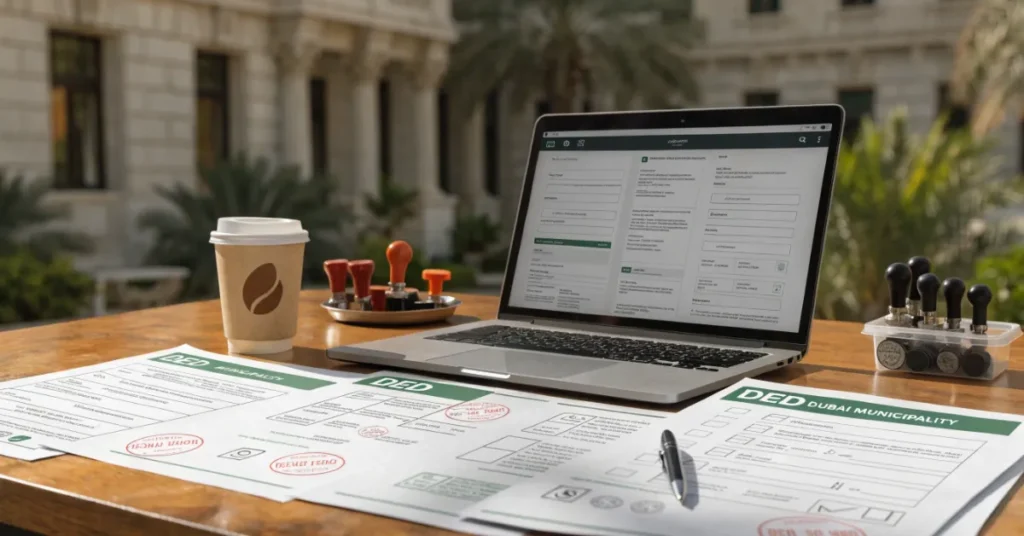
2. Get Initial Approval from DED
The Dubai Department of Economy and Tourism (DED) is your first official stop. You’ll start by reserving a trade name this must be unique, not conflict with existing brands, and comply with UAE naming guidelines (no offensive terms, no names of countries or institutions).
Once your trade name is approved, you submit your initial approval application. Documents typically required include: passport copies of all shareholders, a completed application form specifying your business activity, a No Objection Certificate (NOC) if applicable, and your proposed location details. Initial approval is usually issued within 5–7 working days and is valid for six months while you complete the remaining steps.
3. Secure Food Safety Approval from Dubai Municipality
This is where most applicants encounter delays, and where preparation pays dividends. Dubai Municipality’s Food Safety Department requires pre-approval of your kitchen layout before any fit-out begins. Submitting unapproved designs wastes both time and contractor fees.
Your kitchen layout must comply with HACCP (Hazard Analysis Critical Control Points) principles. This means designated separate zones for raw and cooked food handling, adequate cold storage with specified temperatures, a logical workflow that minimises cross-contamination, and proper drainage, ventilation, and hand-washing facilities at prescribed intervals.
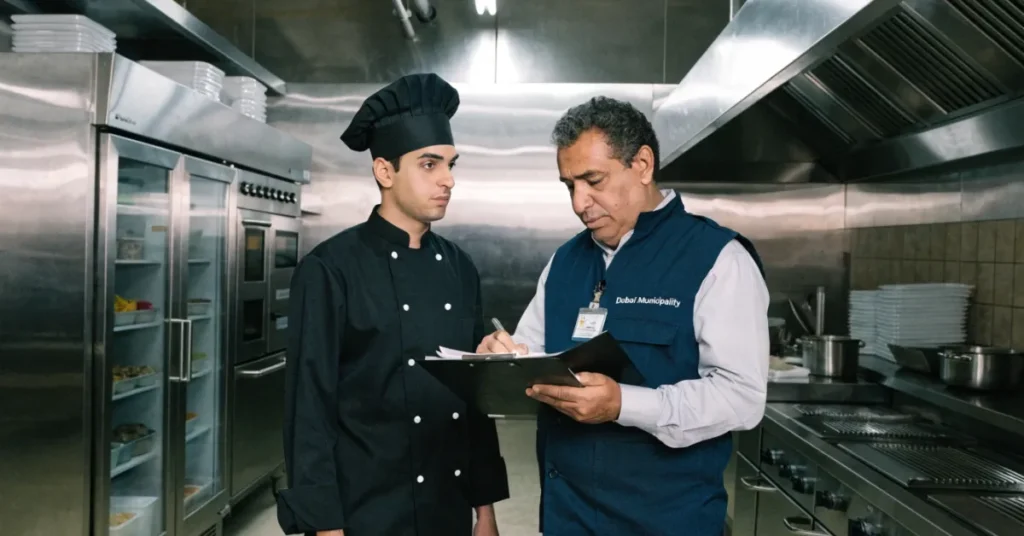
Dubai Municipality will inspect your premises before granting final food facility registration. Their inspectors check surface materials (stainless steel is preferred for food-contact surfaces), pest control provisions, food labelling practices, and staff hygiene training certificates. Non-compliance doesn’t just delay your opening it can result in fines of AED 5,000 to AED 50,000 for serious violations.
4. Design and Fit-Out Approval
- Submit architectural drawings to the Dubai Municipality for food facility layout approval before construction begins.
- Ensure ventilation meets the required 15–20 air changes per hour in kitchen areas, per UAE fire and building codes.
- All drainage must flow away from food preparation areas. Floor gradients of at least 1:50 toward floor drains are standard.
- Cold storage and dry storage areas must be physically separated. Labels, locks, and temperature logs are mandatory.
- Obtain Dubai Civil Defence (DCD) approval for fire safety, which includes fire suppression systems above cooking equipment, emergency exit compliance, and firefighting equipment placement.
- Your fit-out contractor must be registered with the relevant authority. Unregistered contractors can invalidate approvals.
5. Final License and Opening Inspection
Once the fit-out is complete, you invite Dubai Municipality for a final inspection. Inspectors verify that your built space matches the approved drawings and that all hygiene standards are met in practice. Staff should be on-site during this inspection, and food handler certificates must be available.
Upon passing inspection, you receive your food facility registration certificate. Submit this, alongside all other approvals, to DED to receive your final trade license. With the trade license in hand, you are legally permitted to open. The full process from DED initial approval to trade license issuance typically takes 30 to 90 days, depending on the readiness of your documentation.
Cost to Open a Restaurant in Dubai (2026 Breakdown)
| Cost Item | Estimated Range | Notes |
|---|---|---|
| Trade license (DED mainland) | AED 12,000 – 25,000 | Annual, varies by activity type |
| Dubai Municipality food registration | AED 3,000 – 8,000 | Plus inspection fees |
| Fit-out and kitchen equipment | AED 150,000 – 500,000+ | Highly dependent on size and concept |
| Rent (first year deposit + advance) | AED 80,000 – 500,000+ | Location and size dependent |
| Staff visas and recruitment | AED 5,000 – 8,000 per visa | Includes medical and Emirates ID |
| Civil Defense approval | AED 2,000 – 6,000 | Fire safety certification |
| Signage, branding, POS | AED 10,000 – 40,000 | Often underestimated |
A realistic minimum budget for a small café (30–50 seats, mainland, non-prime location) is AED 350,000–500,000 all-in. Fine dining in a prime zone can exceed AED 2 million before opening day.
Key Requirements and Documents Needed
- Passport copies of all shareholders and the General Manager
- Emirates ID (for UAE residents) or entry visa copy
- Tenancy contract registered via Ejari (mandatory for DED)
- Trade name reservation certificate from DED
- Initial approval letter from DED
- Dubai Municipality-approved kitchen layout drawings
- Civil Defense compliance certificate
- Food handler training certificates for all kitchen staff
- NOC from building management or landlord (in some cases)
Dubai Municipality Rules You Cannot Ignore
Dubai Municipality operates one of the most rigorous food safety frameworks in the region, and it enforces it consistently. The key pillars of compliance are:
- Hygiene standards: All food contact surfaces must be non-porous and cleanable. Pest control contracts with a licensed provider must be active and documented at all times. Handwashing stations must be separate from food preparation sinks.
- Food storage and labelling: Ingredients must be stored off the floor (minimum 15cm clearance), raw proteins stored below ready-to-eat items, and all opened or prepared food labelled with preparation date and expiry. FIFO (first in, first out) rotation must be demonstrated to inspectors.
- Staff training requirements: Food handlers must hold a valid food safety certificate from a Dubai Municipality-approved training provider. This applies to kitchen staff, not just management. Certificates are valid for two years and must be renewed.
- Ongoing inspections: Unlike a one-time check, Dubai Municipality conducts unannounced inspections throughout the year. Violation scores are published on the municipality’s website and are visible to the public. A poor inspection result affects your reputation as much as your compliance status.
Common Mistakes to Avoid When Opening a Restaurant in Dubai
- Choosing the wrong location. A popular area doesn’t guarantee customers. Analyse foot traffic patterns at different times of day before committing to a lease.
- Starting fit-out before municipality approval. This is the single most expensive mistake. Unapproved construction may need to be demolished and rebuilt at your cost.
- Underestimating total setup costs. Most first-time owners budget for the obvious items and forget approvals, signage, staff onboarding, and the first three months of operating losses.
- Poor menu planning. A menu that requires too many ingredients creates waste, increases costs, and strains kitchen operations. Start focused and expand based on actual demand.
- Hiring staff before visas are approved. Employing workers without valid UAE residency visas is a serious legal violation with significant financial penalties.
How a Small Restaurant Succeeded in Dubai
In 2022, a Levantine restaurant launched in JLT, a deliberate choice. The founders had identified a gap: affordable, quality Lebanese food in a business-heavy district underserved by sit-down options. They chose a 45-seat unit on the ground floor of a mid-rise tower with both street access and building footfall.
Before signing their lease, they engaged a local business setup consultant who reviewed the unit’s zoning classification. This saved them from committing to a space that would have required expensive variance approvals. They submitted municipality-approved layouts before fit-out and passed inspection on the first attempt a rarity that saved them six weeks.
Within 18 months, the restaurant appeared on Zomato’s top-rated lists for JLT and expanded its revenue by 40% through Talabat delivery without increasing seating. The lessons: pick your location with data, comply early, and let the product do the marketing.
Tips to Grow Your Restaurant Business in Dubai
- Register on food delivery platforms early: Talabat, Noon Food, and Deliveroo collectively account for a significant share of Dubai’s F&B revenue. Set up your delivery presence before opening day.
- Invest in social media before you open: Instagram and TikTok are how Dubai’s dining audience discovers new restaurants. Behind-the-scenes content during build-out generates organic interest.
- Build a loyalty programme from day one: Repeat customers are cheaper to retain than new ones to acquire. Even a simple stamp card increases return visit frequency.
- Practice menu engineering: Identify your highest-margin items and design the menu so the eye naturally finds them first. Placement and description language both influence order patterns.
- Participate in Dubai Food Festival: The annual festival drives massive footfall to participating restaurants and earns media coverage especially for newer entrants.
Why Work with Business Setup Experts in Dubai
The licensing process is manageable, but it’s also time-consuming, document-heavy, and easy to get wrong if you’re unfamiliar with the system. A missed step can mean weeks of delays or, worse, completing fit-out before realising an approval was skipped.
Business setup consultants who specialise in UAE F&B licensing bring several genuine advantages. They know which DED activity codes align with your concept, which municipality inspectors look for, and how to structure your documents to avoid re-submissions. Many have existing relationships with the relevant departments, which can reduce processing time meaningfully.
They also handle visa processing, Ejari registration, and Civil Defence coordination all simultaneously, so you can focus on menu development, supplier relationships, and staff hiring. If your time has a cost, outsourcing the compliance process to experienced professionals usually pays for itself.
How Ripple Business Setup Can Help You Open a Restaurant in Dubai
Starting a restaurant in Dubai involves multiple approvals, strict municipality rules, and detailed documentation. Ripple Business Setup simplifies this process by guiding you through every step, from selecting the right business activity to securing Dubai Municipality approvals and obtaining your trade license. Their team understands local regulations and helps you avoid delays, reduce costs, and stay compliant. Whether you are opening a small café or a full-service restaurant, you can contact Ripple Business Setup at +971 50 593 8101, email info@ripplellc.ae, or WhatsApp +971 4 250 0833 for expert support and a smooth business setup experience.
Conclusion
Opening a restaurant in Dubai is a well-defined process once you understand the framework. The five steps, choosing the right location, securing DED initial approval, obtaining Dubai Municipality food safety clearance, completing fit-out with the necessary approvals, and passing your final inspection form a clear roadmap. Follow them in sequence and document everything.
Disclaimer: The information provided is for general guidance only and may change based on UAE laws and regulations. It is recommended to consult professional business setup advisors for accurate and updated requirements.