


What is a Technical Services Company?
A technical services company is a registered business that provides skilled, trade-based services to residential, commercial, or industrial clients. These businesses handle the hands-on work that keeps buildings running safely and efficiently from fixing an air conditioning unit in July to rewiring an office after a renovation.
In practical terms, common activities under a technical services license include electrical maintenance, plumbing, HVAC installation, painting, carpentry, and IT and networking support. Some businesses focus on one specialty, while others operate as full-scope facility maintenance companies serving multiple property types.
Demand for this category of service-based business is rising sharply in 2026, driven by urban development, aging infrastructure, and a booming property market. Whether you plan to run a lean two-person operation or build a larger maintenance company, the legal foundation you lay from day one determines how smoothly everything scales.
Why Start a Technical Services Company in 2026?
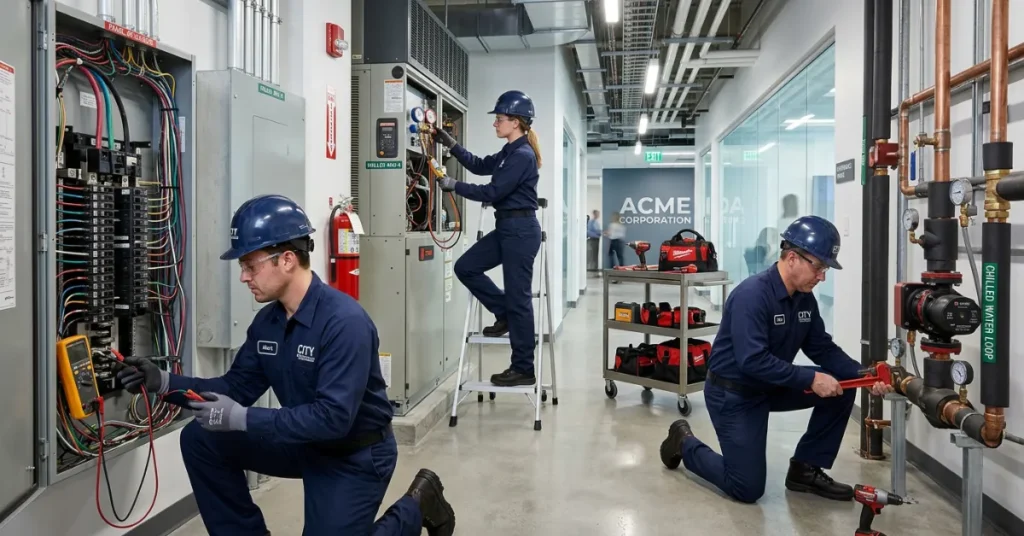
The timing has rarely been better. Construction activity remains high across many markets, and property owners, both residential and commercial, increasingly outsource maintenance rather than hire in-house staff. That shift creates a steady pipeline of work for registered technical services businesses.
Compared with product-based businesses, a technical services company carries relatively low startup costs. You do not need to manufacture or import anything. Your primary assets are skilled people, basic equipment, and a valid license. Once you land a few anchor clients, the recurring-income model means you can forecast revenue months in advance a significant advantage for any growing business.
- High and consistent demand across residential, commercial, and industrial sectors
- Scalable model starts small, adds technicians and services as revenue grows
- Opportunities for long-term maintenance contracts with developers and property managers
- Lower capital requirement compared to manufacturing or retail businesses
Types of Technical Services You Can Offer
Before you register, decide which technical services business activities you want to operate. Your license scope will be tied directly to this decision, so it pays to think ahead about where you want to take the business in the next two to three years.
- Electrical maintenance and installation services
- Plumbing and drainage services
- Air conditioning and HVAC installation, servicing, and repair
- Painting, tiling, and carpentry works
- IT infrastructure, networking, and cabling services
- General facility maintenance and building management
- Civil and minor construction works (where permitted under license)
Practical tip: Licensing authorities classify business activities precisely. “Electrical maintenance” and “electrical contracting” are often separate categories with different requirements. Confirm the exact activity code before you apply, as amending it later adds cost and time.
Legal Requirements to Start a Technical Services Company
Operating a technical services company without proper registration is not just a paperwork risk; it can result in fines, shutdowns, and reputational damage that is difficult to recover from. Licensing authorities in most jurisdictions have tightened enforcement in recent years, particularly for trade-based businesses working on residential properties.
Broadly speaking, you will need a valid business license, a registered trade name, a physical or virtual office address, and any sector-specific approvals relevant to your services. For instance, electrical contractors typically need additional certification from a relevant authority beyond the standard business license. The exact body you register with, a mainland authority, a free zone, or a municipal council, shapes both your cost structure and the markets you can legally serve.
Understanding these requirements upfront prevents the most common and expensive mistake founders make: starting operations under the wrong license category and having to restructure later.
4 Legal Steps to Set Up a Technical Services Company
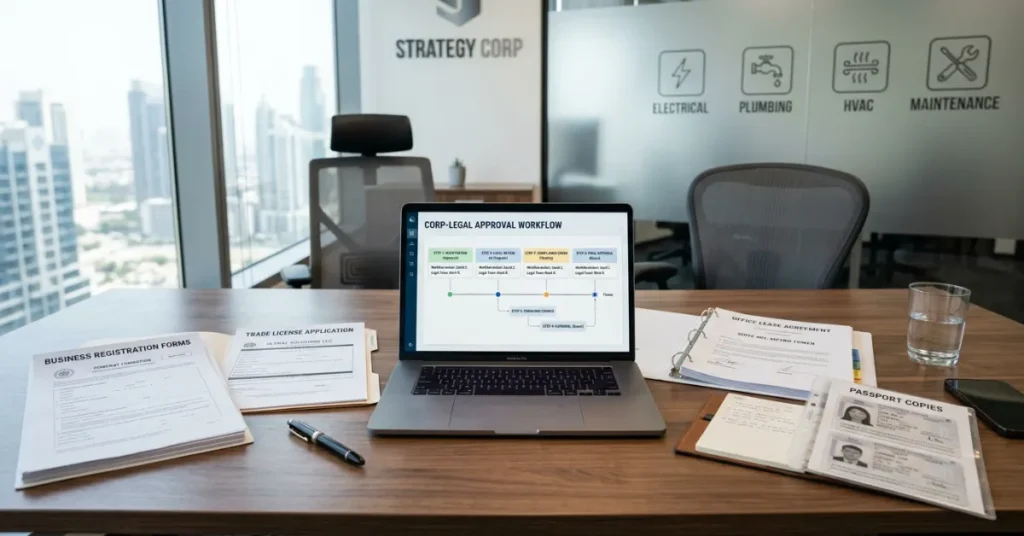
These four steps cover the core registration journey for most jurisdictions. Timelines and specific requirements will vary depending on your location, but the logical sequence holds true almost everywhere.
1. Choose Your Business Activity and Legal Structure
This is the foundational decision, and it affects everything that follows. Start by defining the exact scope of your technical services activities. Authorities want specifics. “General maintenance” is not a recognized category in most jurisdictions, but “HVAC maintenance and repair” or “plumbing services” typically are.
Next, choose a legal structure. A sole proprietorship gives you full control but personal liability. A limited liability company (LLC) protects your personal assets and often looks more credible to corporate clients. Most technical services businesses opt for an LLC structure from the outset, especially if they plan to bid on commercial contracts.
Finally, reserve a trade name before moving forward. The name must comply with local naming conventions, no offensive terms, no names that imply government affiliation, and often no personal names unless you are the sole owner.
- Define the exact scope of technical services activities
- Select legal structure (sole proprietorship or LLC)
- Reserve your trade name with the relevant authority
2. Apply for a Technical Services License
With your business activity and structure confirmed, submit your license application to the appropriate authority. This is where you formally request permission to operate as a technical services company. In many markets, the Department of Economic Development or its equivalent handles this. Some jurisdictions route trade-based businesses through a municipality or a sector-specific body.
Approval timelines vary widely from a few working days with a complete application to several weeks if additional certifications or inspections are required. Technical services businesses that handle electrical or mechanical systems often need sign-off from a separate engineering authority, so factor that into your timeline.
- Passport copies of all owners or shareholders
- Completed license application form
- Trade name reservation certificate
- Business plan (required by some authorities)
- Relevant professional certificates (electrician, HVAC technician, etc.)
3. Secure Office Space and Required Approvals
Most licensing authorities require a physical office address before they issue your license. This does not have to be a large number of new technical services businesses start with a small commercial unit or a shared business center. What matters is that the space is legally registered and that a tenancy contract (or equivalent document) is in place before you submit it as proof.
Depending on your services, you may also need location-specific approvals. A company that stores refrigerants for HVAC work, for example, often needs approval from an environmental or safety authority. Plan for these additional steps rather than discovering them mid-application.
- Signed office lease or tenancy agreement
- Location approval from the relevant municipality
- Safety and compliance sign-off, where applicable
4. Get Final Approvals and Start Operations
Once all documents are verified and fees are settled, the authority issues your technical services license. This is the moment you can legally begin trading, but there are a few operational steps that you should follow immediately.
Register your employees with the relevant labor department and begin visa processing for any overseas-hired technicians. Open a business bank account in the company’s name; most corporate clients and developers require this before they will issue purchase orders or contracts. Then plan your marketing launch; even a basic Google Business Profile and a few well-placed signboards can generate early inquiries while you build your client base.
- Pay all license and government fees to receive the final license
- Register with the labor authority for employee management
- Open a corporate bank account
- Begin marketing digital presence, Google Maps listing, signage
Cost of Setting Up a Technical Services Company in 2026
Startup costs for a technical services company are manageable compared to many other industries, but it is important to budget realistically. The numbers below represent typical ranges; your actual costs will depend on jurisdiction, company structure, and the scope of services you license.
| Cost Item | Estimated Range | Flexi-desk options are available in many cities |
|---|---|---|
| Business license fees | $1,200 – $3,500 | Varies by jurisdiction and number of activities |
| Trade name registration | $100 – $400 | One-time fee |
| Office lease (annual) | $2,000 – $8,000 | Per employee, varies by contract type |
| Employee visas and labor registration | $500 – $1,500 per person | Per employee; varies by contract type |
| Tools and initial equipment | $1,500 – $5,000 | Depends on service scope and quality of tools |
| Marketing and branding | $500 – $2,000 | Website, social media, signage, uniforms |
All in, a lean but properly registered technical services business typically costs between $6,000 and $20,000 to launch depending heavily on team size, office type, and location. Underestimating this figure is one of the most common reasons new companies hit a cash flow crunch in their first few months.
Documents Required for Technical Services Company Setup
Preparing your documentation in advance cuts application time significantly. Most authorities return incomplete applications without processing them, which adds days or weeks to your timeline. Have these ready before you begin:
- Passport copies of all owners and shareholders (clear, full-color scans)
- Visa copies or residency documentation, if applicable
- Trade name reservation certificate
- Office lease agreement or tenancy contract (Ejari or equivalent)
- Completed the license application form from the relevant authority
- Professional qualification certificates for licensed trade activities
- No-objection certificate from the current employer, if the founder is on an employment visa
Common Challenges and How to Avoid Them
Most setup delays and cost overruns follow predictable patterns. Knowing what commonly goes wrong lets you sidestep these problems before they affect your launch timeline.
- Choosing the wrong business activity: Applying for a broad or incorrect activity code is a frequent mistake. Confirm the exact category with the licensing authority before submitting your application.
- Underestimating total startup costs: License fees are visible, but visa costs, equipment, and first-month operating expenses catch many founders off guard. Build a realistic budget with a 15–20% contingency.
- Licensing delays due to missing documents: Incomplete applications are returned and re-queued. Prepare every document before you apply, and double-check formatting requirements for scanned copies.
- Skipping professional certifications: Some activities, especially electrical and mechanical work, require proof of technical qualifications. Confirm these before applying rather than discovering the gap after submission.
Pro Tips to Grow Your Technical Services Business
Licensing is the starting line, not the finish. The businesses that scale quickly share a few common habits and most of them focus on service quality and relationships rather than marketing spend alone.
- Prioritize quality on every job: Word-of-mouth referrals are the most cost-effective growth channel in the maintenance industry. One excellent job generates two more leads.
- Build annual maintenance contracts: A single annual contract with a property developer or facilities manager provides more predictable revenue than dozens of one-off calls.
- Invest in your technicians: Certified and well-trained staff reduce callbacks, improve client satisfaction, and let you bid on higher-value commercial projects.
- Use digital marketing early: A verified Google Business Profile, local SEO, and a basic website deliver qualified leads in the maintenance niche at a low cost.
- Offer emergency response services: 24-hour availability is a differentiator that justifies premium pricing and builds lasting loyalty with residential clients.
- Track your financials from day one: Simple job-cost tracking reveals which services are most profitable and where to focus your sales effort next.
Is a Technical Services Company Profitable in 2026?
The short answer is yes when it is run with discipline. Maintenance services produce recurring revenue, which is the gold standard for any service business. Annual contracts, seasonal service packages, and emergency response retainers all create revenue you can forecast and plan around.
Margins vary by activity. HVAC and electrical work tend to carry higher margins than general cleaning or painting. As the business matures and you move away from one-off jobs toward contract-based work, profitability improves substantially because your acquisition cost per job drops to near zero for repeat clients.
Demand stability is another advantage. People do not stop needing plumbing repairs or air conditioning service during economic downturns if anything, they defer new construction and invest in maintaining what they already own. That counter-cyclical tendency makes technical services businesses more resilient than many other categories.
How to Choose the Right Business Setup Partner
If you are navigating the registration process for the first time, working with an experienced business setup consultant can save both time and money. The right partner knows which documents each authority actually wants (not just what the website says), can flag potential issues before you submit your application, and has existing relationships that sometimes accelerate approvals.
When evaluating a consultant, look for relevant local experience specifically with technical services or trade-based business registration. Ask for references from previous clients in the same sector, confirm they provide a clear breakdown of all fees upfront, and check that they offer ongoing support rather than disappearing after the license is issued. Regulatory requirements change, and having someone who keeps you compliant as your business evolves is worth the investment.
Why Choose Ripple Business Setup for Your Technical Services Company?
Setting up a Technical Services Company can feel complex if you are not familiar with legal steps, licensing, and approvals. Ripple Business Setup makes the process simple and clear by guiding you at every stage, from selecting the right business activity to getting your license approved without delays. Their team understands local regulations and helps you avoid common mistakes, saving both time and cost. Whether you are starting small or planning a full-scale operation, they provide practical support tailored to your business goals. For expert assistance, contact Ripple Business Setup at +971 50 593 8101, email info@ripplellc.ae, or WhatsApp +971 4 250 0833.
Conclusion
Setting up a technical services company in 2026 is a realistic and practical move for anyone with trade skills, management ability, or access to qualified technicians. The market is there, the barriers to entry are manageable, and the recurring-revenue model rewards businesses that deliver consistent quality.
Disclaimer: The information provided in this article is for general guidance only and may vary based on jurisdiction and regulatory updates. It is recommended to consult with a professional business setup advisor for accurate and up-to-date requirements.