Construction projects in the UAE can involve substantial VAT costs across materials, subcontractors, consultants, equipment, professional services and other project expenses. For VAT-registered businesses, recovering eligible Construction Input VAT can significantly affect project cash flow and overall cost. However, businesses cannot automatically recover all VAT paid on construction expenditure. The recovery depends on how the costs relate to taxable, exempt or other activities, whether the business has the required documentation, and whether the input tax has been correctly attributed or apportioned.
What Is Construction Input VAT in the UAE?
Construction Input VAT is the VAT a VAT-registered construction business pays on goods and services purchased for its business activities.
For example, a contractor may pay VAT on:
- Construction materials
- Subcontractor services
- Engineering and consultancy services
- Equipment rentals
- Professional services
- Site-related supplies
- Repairs and maintenance
- Accounting and legal services
If the expenditure relates to taxable business activities and satisfies the applicable recovery conditions, the business may claim the eligible input VAT through its VAT return.
How Does Input VAT Recovery Work for Construction Projects?
Construction businesses should not treat every purchase invoice in the same way. They should first identify what the cost relates to and then determine whether the associated input VAT is recoverable.
The practical process is:
- Identify the expenditure.
- Confirm that the VAT was correctly charged or accounted for.
- Determine which business activity uses the goods or services.
- Attribute the input VAT directly where possible.
- Identify any residual or shared input VAT.
- Apply the appropriate apportionment rules where required.
- Maintain supporting records.
- Report the recoverable amount correctly in the VAT return.
When Can a Construction Business Recover Input VAT?
Input VAT may generally be recoverable when the expenditure:
- Relates to the business.
- Supports taxable supplies or intended taxable supplies.
- Meets the applicable VAT recovery requirements.
- Is supported by appropriate documentation.
- Has been correctly recorded in the VAT accounting system.
The timing of recovery also matters. FTA guidance explains that the relevant conditions include receiving the tax invoice and making payment for the supply, subject to the applicable rules.
When Is Construction Input VAT Not Recoverable?
A business should not assume that all VAT appearing on a construction invoice is recoverable.
Input VAT may be restricted where the cost relates to:
- Exempt supplies
- Non-business activities
- Private use
- Specifically blocked expenses
- Costs for which the required supporting documentation is unavailable
The business should therefore assess the purpose and VAT treatment of each significant expenditure rather than simply applying a blanket recovery percentage.
Which Construction Costs Qualify for Input VAT Recovery?
Construction projects can contain hundreds or thousands of purchase transactions. A structured cost classification system makes VAT recovery much easier to manage.
Construction Materials
Common construction materials can include:
- Cement and concrete
- Steel
- Electrical materials
- Plumbing materials
- Tiles and flooring
- Paint and finishing materials
- Building fixtures
- Other project-specific supplies
Where these costs directly support taxable business activities, the associated input VAT may generally be recoverable, subject to the applicable conditions.
Subcontractor and Specialist Services
Subcontractors often represent a major part of construction expenditure.
Examples include:
- Civil works
- Electrical works
- Plumbing
- Mechanical services
- MEP services
- Landscaping
- Specialist installation
- Site services
Construction companies should check subcontractor tax invoices carefully and ensure that the VAT treatment is correctly reflected in their accounting records.
Professional and Project Costs
Construction projects also generate professional fees, such as:
- Architect fees
- Engineering fees
- Quantity surveying
- Project management
- Legal services
- Design consultancy
- Technical consultancy
- Surveying and testing
The recovery position depends on what the underlying service supports.
For example, a consultancy fee directly related to a taxable construction project may have a different recovery treatment from a general overhead that supports both taxable and exempt activities.
Equipment, Machinery and Site Expenses
Businesses may also incur VAT on:
- Machinery rentals
- Equipment hire
- Site-office expenses
- Repairs
- Maintenance
- Construction tools
- Temporary facilities
- Project-related transportation
These costs should be coded to the relevant project or business activity wherever possible.
Construction Project Cost Records: What Should Businesses Track?
Good project cost records are essential for accurate construction VAT accounting. Instead of recording only the total purchase amount, businesses should capture enough information to establish why the expense was incurred and how its VAT should be treated.
Separate VAT Costs by Project
A useful project cost record can include:
| Record | Information to capture |
|---|---|
| Project | Project name or code |
| Supplier | Supplier name and TRN where relevant |
| Invoice | Invoice number and date |
| Cost | Net expenditure |
| VAT | VAT amount |
| Category | Materials, subcontractor, consultancy, etc. |
| VAT treatment | Recoverable, non-recoverable or residual |
| Allocation | Project or shared overhead |
| Evidence | Invoice, contract and payment records |
This structure helps finance teams reconcile construction costs with VAT returns.
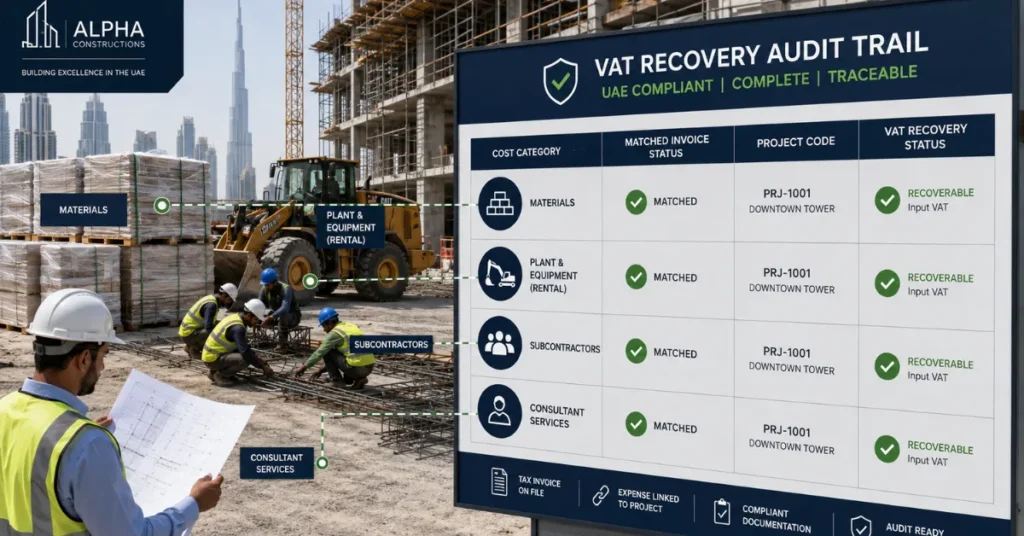
Maintain a Construction VAT Audit Trail
A strong audit trail can include:
- Tax invoices
- Purchase orders
- Contracts
- Subcontractor agreements
- Payment records
- Project cost reports
- VAT calculations
- Credit notes
- VAT return workings
- Apportionment calculations
The FTA states that VAT invoices must generally be retained for at least five years. For businesses that own real estate, certain real-estate records can have a longer retention period.
How to Apportion Input VAT Across Construction Projects
Input VAT apportionment in the UAE becomes relevant when input tax relates partly to activities that allow VAT recovery and partly to activities for which recovery is not available. The FTA’s input tax apportionment guidance describes this as residual input tax. The process starts with direct attribution before the remaining residual input tax is apportioned.
Directly Attributable Construction Costs
The first step is to identify input VAT that can be directly attributed.
For example:
Project A: A contractor purchases AED 200,000 of materials specifically for a taxable construction contract.
If the cost directly supports the taxable supply and meets the recovery conditions, the related input VAT can generally be treated as directly attributable to that taxable activity.
There is no need to apply a general apportionment percentage simply because the company also has other activities.
Shared or Overhead Construction Costs
Some expenses cannot be linked exclusively to one activity.
Examples include:
- Head-office rent
- General accounting services
- Corporate legal fees
- Management costs
- Shared software
- General administrative expenses
If these costs support both recoverable and non-recoverable activities, the related input VAT may become residual input tax requiring apportionment.
Choosing an Appropriate Apportionment Method
Businesses should apply the UAE VAT apportionment rules rather than choosing a percentage simply because it produces a convenient result. The FTA’s guidance provides a standard method for residual input tax, while certain businesses may apply for an approved special method where the standard method does not produce a fair and reasonable result.
Importantly, the FTA’s special-method process is not a general shortcut for every construction company. The FTA identifies eligibility conditions, including making both taxable and exempt supplies and demonstrating that the standard method does not give a fair and reasonable result.
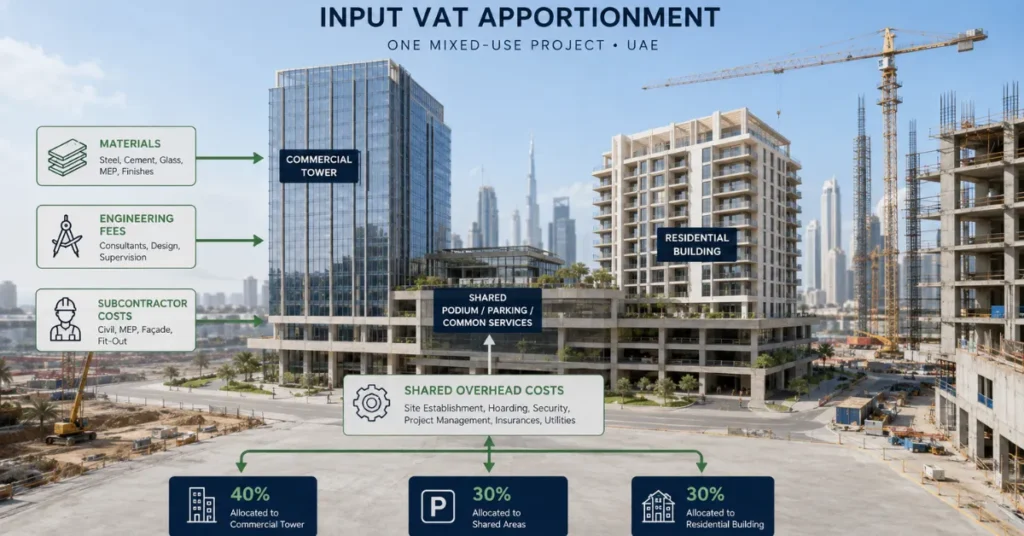
Construction Input VAT Example: Project Cost Apportionment
Consider a UAE property business developing a mixed-use project containing commercial and residential components.
The business incurs VAT on:
- Materials
- Contractor services
- Engineering fees
- Project management
- Head-office expenses
The finance team should not simply claim all input VAT.
Instead, it should:
- Identify costs directly attributable to the commercial component.
- Identify costs directly attributable to the residential component.
- Determine the VAT treatment applicable to the relevant property supplies.
- Separate directly recoverable and directly non-recoverable input VAT.
- Identify shared or residual costs.
- Apply the appropriate apportionment rules to residual input VAT.
- Keep the calculation and supporting evidence.
For example, if a professional fee relates exclusively to a taxable commercial property activity, the business should assess it on that direct basis. If another corporate expense supports multiple activities, the business may need to consider it as a shared cost.
The important principle is direct attribution first, apportionment of residual input tax second.
Construction Input VAT for Developers and Contractors
VAT treatment can differ depending on whether the business acts as a contractor, developer or another participant in the property sector.
Contractors
A contractor generally supplies construction services to its customer. Its input VAT may arise from materials, subcontractors, equipment and professional services used to provide those services.
The contractor should therefore maintain project-level records linking major purchases to the relevant contracts.
Property Developers
Developers face additional complexity because the VAT treatment of property supplies can differ according to the type of property and transaction. The UAE Ministry of Finance states that commercial property supplies are generally subject to the standard 5% VAT rate, while residential property supplies are generally exempt, subject to specific rules and exceptions.
This distinction can directly affect the recovery of VAT incurred during development.
Mixed-Use Construction Projects
Mixed-use developments require particular attention.
A project could contain:
- Commercial units
- Residential units
- Common areas
- Parking facilities
- Shared infrastructure
The business should establish a reasonable method of attributing construction costs and shared expenses to the relevant activities.
Construction Input VAT and Residential vs Commercial Property
Property VAT is one of the most important areas for developers reviewing construction input VAT.
VAT on Commercial Construction
Commercial property supplies are generally taxable at 5% in the UAE. This can allow eligible construction-related input VAT to be recovered where the costs relate to taxable supplies and satisfy the applicable conditions.
VAT on Residential Construction
Residential property requires greater care because residential supplies are generally exempt, although specific zero-rated and other rules can apply. The UAE Ministry of Finance notes that newly constructed residential properties supplied for the first time within three years of construction can fall within the zero-rating rules.
Therefore, developers should determine the applicable VAT treatment based on the specific property supply rather than assuming that all residential construction is either taxable or non-recoverable.
Mixed-Use Developments
A mixed-use project may require different VAT treatment for different parts of the development. This makes project cost coding especially important.
For example, if a developer can directly identify construction costs associated with commercial units, those costs should be separated from costs relating to residential units and shared infrastructure.
Common Construction VAT Recovery Mistakes in the UAE
Construction businesses can create unnecessary VAT risks when project accounting and tax accounting operate separately.
Common mistakes include:
- Claiming VAT on every project expense automatically
- Failing to check tax invoices
- Mixing project and head-office costs
- Using unsupported apportionment percentages
- Failing to distinguish taxable and exempt activities
- Ignoring credit notes
- Incorrect VAT coding in accounting software
- Claiming VAT twice
- Failing to reconcile project ledgers with VAT returns
- Not retaining supporting documents
A particularly important mistake is treating all construction expenditure as fully recoverable. The VAT recovery position depends on what the expenditure supports.
How to Improve Construction Input VAT Recovery and Compliance
A construction business can strengthen its VAT process by building VAT controls into project accounting from the beginning.
Use the following checklist:
- Create separate project codes.
- Record VAT separately from project costs.
- Review supplier tax invoices before claiming VAT.
- Link major purchases to specific projects.
- Identify taxable and exempt activities.
- Separate direct and shared costs.
- Document apportionment calculations.
- Reconcile purchase ledgers with VAT returns.
- Review credit notes and adjustments.
- Retain supporting evidence.
- Conduct periodic VAT reviews.
These controls can help businesses identify errors before they affect a VAT return.
Construction VAT Records and FTA Compliance Requirements
VAT records should allow the business to demonstrate how it calculated its VAT liability and input tax recovery.
For construction businesses, relevant records can include:
- Purchase invoices
- Sales invoices
- Tax credit notes
- Contracts
- Project cost reports
- Payment records
- VAT return workings
- Input VAT calculations
- Apportionment workings
- Accounting records
The FTA’s current VAT legislation library includes the amended VAT law and Executive Regulation, so businesses should verify their treatment against the current legislation and applicable FTA guidance rather than relying on older articles. The FTA legislation page was updated in July 2026 and lists the current VAT legislative materials.
How to Prepare for a VAT Review or FTA Audit
A construction company should be able to explain how it arrived at every significant input VAT claim.
Before a VAT review, check:
- Do purchase records agree with the VAT return?
- Can each major construction expense be traced to a project?
- Are tax invoices available?
- Have directly attributable costs been separated?
- Are shared costs properly identified?
- Are apportionment calculations documented?
- Have credit notes been accounted for?
- Are property transactions classified correctly?
- Are VAT adjustments supported?
- Are records retained for the required period?
The FTA provides dedicated guidance on input tax apportionment and also maintains an updated library of VAT guides and legislation.
How Ripple Business Setup Can Help With Construction Input VAT
Ripple Business Setup helps UAE construction companies, contractors, developers and property businesses manage VAT compliance and accounting requirements. Our support can help businesses review Construction Input VAT, project costs and VAT recovery treatment.
Our services include:
- Construction input VAT review
- VAT recovery assessment
- Project cost and VAT reconciliation
- Input VAT apportionment support
- VAT return preparation and filing
- VAT compliance review
- Accounting and bookkeeping
- Tax documentation and record management
If your construction business handles multiple projects, subcontractors or mixed-use property activities, reviewing VAT treatment and project cost records can help reduce errors and improve compliance.
Contact Ripple Business Setup
- Phone: +971 50 593 8101
- Email: info@ripplellc.ae
- WhatsApp: +971 4 250 0833
- Website: ripplellc.ae
FAQ
Can construction companies recover input VAT in the UAE?
Yes, eligible VAT-registered businesses can generally recover input VAT relating to taxable business activities, subject to the applicable UAE VAT recovery conditions and restrictions.
What construction costs are eligible for VAT recovery?
Eligible costs can include materials, subcontractor services, professional fees and equipment costs where the expenditure relates to taxable business activities and satisfies the applicable recovery requirements.
How is input VAT apportioned in the UAE?
Businesses generally start by directly attributing input VAT to the relevant activities. Residual input VAT relating to both recoverable and non-recoverable activities is then apportioned under the applicable UAE VAT rules.
Can VAT on subcontractor invoices be recovered?
Potentially, yes. The business should verify the subcontractor’s VAT documentation and determine whether the services relate to activities that allow input VAT recovery.
Is VAT on construction materials recoverable?
It can be recoverable when the materials support taxable business activities and the applicable recovery conditions are met. The business should not assume that every material purchase automatically qualifies.
Can developers recover VAT on construction costs?
Recovery depends on the VAT treatment of the developer’s property activities. Commercial property and certain qualifying supplies of newly constructed residential property can have different VAT treatments.
How should shared construction costs be allocated for VAT?
Businesses should first identify costs that can be directly attributed. Shared or residual input VAT should then be considered under the applicable apportionment rules.
What records are required to support input VAT recovery?
Businesses should maintain relevant tax invoices, accounting records, project cost records, payment evidence and VAT calculations. VAT invoices must generally be retained for at least five years.
Can input VAT be recovered on residential construction?
It depends on the nature and VAT treatment of the relevant residential property supply. Residential property can be exempt in certain circumstances, while specific newly constructed residential supplies can qualify for zero-rating.
What happens if a construction company claims VAT incorrectly?
An incorrect VAT claim can result in an inaccurate VAT position and may require correction. Businesses should review questionable claims and follow the applicable UAE tax procedures for correcting errors.
Disclaimer: This article provides general information about UAE VAT and Construction Input VAT recovery and does not constitute tax, legal or financial advice. VAT treatment depends on the facts of each transaction, project and business activity. Businesses should review the current UAE VAT legislation and FTA guidance and obtain professional advice where necessary.