


Restaurant bills often include more than the cost of food and beverages. A customer may see a mandatory service charge, VAT and, in some cases, a voluntary tip. For UAE restaurant owners, these amounts require careful Restaurant Service, VAT, Accounting treatment because a compulsory service charge and a genuine customer tip do not have the same VAT position. The UAE Federal Tax Authority (FTA) specifically distinguishes between service charges imposed by a business and tips freely given by customers.
Restaurant Service Charges vs Tips: What Is the Difference?
The first step in correct restaurant accounting is to identify what the customer is actually paying. A service charge is generally an amount imposed by the restaurant as part of the customer’s bill. A tip, on the other hand, is normally an amount the customer chooses to give voluntarily because of the service received.
This distinction matters for VAT. The FTA’s Taxable Person Guide explains that when a business charges a service charge to customers, it represents further consideration for the principal supply, such as catering services, and follows the same VAT liability as that supply. If a customer freely gives a tip above the total charge, the tip is outside the scope of VAT.
| Payment | Customer obligation | General UAE VAT treatment |
|---|---|---|
| Food and beverages | Yes | Generally standard-rated |
| Mandatory service charge | Yes | Follows the VAT treatment of the principal supply |
| Genuine voluntary tip | No | Outside the scope of VAT when freely given |
The important point is that the label used by the restaurant is not enough. Businesses should consider how the amount is imposed, presented and collected.
What Is a Restaurant Service Charge?
A restaurant service charge is an additional amount that the business requires the customer to pay as part of the transaction. For example, if a restaurant adds a 10% service charge automatically to a customer’s food bill, the customer must pay that amount to settle the bill.
For UAE VAT purposes, the FTA treats such a charge as further consideration for the principal supply. Therefore, restaurants should generally apply the same VAT treatment to the service charge as they apply to the underlying taxable restaurant or catering supply.
What Is a Restaurant Tip or Gratuity?
A voluntary tip is different because the customer freely chooses to give it. For example, a customer receives a restaurant bill of AED 500 and voluntarily leaves an additional AED 50 for the staff. If that AED 50 is genuinely freely given over and above the total charge, the FTA guidance states that no VAT is due on the tip.
Restaurants should therefore configure their systems so that voluntary tips can be identified separately from compulsory charges.
Are Restaurant Service Charges Subject to VAT in the UAE?

Yes, a mandatory restaurant service charge generally follows the VAT treatment of the underlying restaurant service. The FTA specifically states that a service charge imposed on customers is further consideration for the principal supply and follows the same VAT liability. For a typical UAE restaurant making a standard-rated taxable supply, the service charge will therefore generally form part of the amount on which VAT is calculated.
This is particularly important when restaurants design their menus, invoices and point-of-sale systems. A business should not assume that an amount is outside the scope of VAT simply because it is called a “service charge.”
Example of a Mandatory Service Charge
Suppose a restaurant provides:
- Food and beverages: AED 1,000
- Mandatory service charge at 10%: AED 100
- Taxable amount: AED 1,100
- VAT at 5%: AED 55
- Total customer bill: AED 1,155
The AED 100 service charge is treated as further consideration for the restaurant supply under the FTA guidance. Restaurants should ensure their POS and accounting software reflects this treatment correctly.
Are Restaurant Tips Subject to VAT in the UAE?
A genuine voluntary tip is outside the scope of UAE VAT when the customer freely gives it over and above the total charge. The FTA Taxable Person Guide makes this distinction directly: a freely given tip above the total charge does not attract VAT.
When a Tip Is Outside the Scope of VAT
A payment is more clearly treated as a voluntary tip when:
- The customer decides whether to pay it.
- The customer determines the amount.
- The payment is genuinely optional.
- The amount is paid above the restaurant’s total charge.
- The restaurant does not require it as a condition of completing the transaction.
For accounting purposes, restaurants should maintain a separate record for these amounts.
When Restaurants Need to Review the Payment Carefully
Some payment structures can create confusion. For example, a POS screen might display a suggested 10%, 15% or 20% tip. A suggested amount is not automatically the same as a mandatory service charge. The restaurant should review how the customer can accept, reject or change the amount. Greater care is also needed where the restaurant automatically adds “gratuity” to every bill or retains some or all of the amount.
The practical rule is simple: do not classify an amount based only on the word “tip” or “gratuity.” Review the actual arrangement and supporting documents.
Restaurant Service Charge Accounting Treatment
Correct VAT treatment is only one part of the process. Restaurants also need appropriate accounting records. A restaurant’s accounting system should allow management to distinguish ordinary sales from service charges and voluntary tips.
How to Record Mandatory Service Charges
A restaurant can configure a separate service-charge category in its POS and accounting system.
The accounting process should:
- Record the underlying food and beverage sales.
- Record the mandatory service charge separately for reporting purposes.
- Calculate the applicable output VAT.
- Reconcile service charges with daily POS reports.
- Track amounts that become payable to employees or other parties, where applicable.
- Reconcile the final figures with bank and payment-provider settlements.
Separating the service charge from core sales makes management reporting easier while still allowing the business to apply the appropriate VAT treatment.
How to Account for Voluntary Tips
Voluntary tips should also have their own POS and accounting category. Restaurants should avoid simply adding tips to food sales because this can distort revenue reports and make staff distributions harder to track.
Instead, businesses can maintain records showing:
- Total voluntary tips collected.
- Payment method used.
- Amounts allocated to staff.
- Amounts distributed.
- Outstanding amounts payable to employees.
- Supporting POS and payment records.
The exact accounting entry can depend on how the restaurant collects and distributes tips. Businesses should align their accounting treatment with the underlying contractual and employment arrangements.
Example: VAT and Accounting for a Restaurant Bill
Consider two different customer transactions.
Example 1: Food Plus Mandatory Service Charge
A customer receives the following bill:
| Description | Amount |
|---|---|
| Food and beverages | AED 1,000 |
| Mandatory service charge | AED 100 |
| Taxable amount | AED 1,100 |
| VAT at 5% | AED 55 |
| Total | AED 1,155 |
The mandatory service charge forms part of the consideration for the principal restaurant supply and follows its VAT treatment.
Example 2: Food Plus Voluntary Tip
Now assume the customer receives:
| Description | Amount |
|---|---|
| Food and beverages | AED 1,000 |
| VAT at 5% | AED 50 |
| Restaurant bill | AED 1,050 |
| Voluntary tip | AED 100 |
| Total paid | AED 1,150 |
If the AED 100 is genuinely freely given over and above the total charge, the FTA guidance states that the tip is outside the scope of VAT.
These examples show why restaurants need to distinguish service charges from tips before calculating VAT.
How Restaurants Should Set Up POS and Accounting Systems
A restaurant’s POS system plays an important role in VAT compliance. If the POS automatically treats every additional payment as taxable revenue, the accounting records may not reflect the actual nature of the transaction.
Restaurants should consider the following controls:
- Create separate POS codes for food and beverages.
- Create a separate code for mandatory service charges.
- Create a separate code for voluntary tips.
- Assign the correct VAT treatment to each category.
- Review automatic tip prompts.
- Reconcile daily POS reports with accounting records.
- Reconcile card payments with payment-provider statements.
- Reconcile cash sales with cash deposits.
- Review voids, refunds and discounts.
Why POS Configuration Matters for Restaurant VAT
An incorrect POS configuration can create problems throughout the accounting cycle. For example, if a voluntary tip is incorrectly configured as a standard-rated sale, the system may calculate output VAT on an amount that the FTA guidance treats as outside the scope of VAT. Similarly, if a mandatory service charge is incorrectly classified as a non-taxable tip, the restaurant may understate its taxable consideration.
Regular POS reviews can therefore help prevent VAT return discrepancies.
Accounting for Tips Paid to Restaurant Employees
Restaurants often collect tips through cash, cards or digital payment systems before distributing them to staff. The accounting process should clearly show what happens to these amounts.
A restaurant may need to track:
- Tips collected through cash.
- Tips collected through card payments.
- Tips collected through digital payment systems.
- Amounts allocated to employees.
- Amounts already paid.
- Outstanding staff balances.
Where a tip pool operates, the restaurant should maintain a consistent distribution policy and supporting records. Businesses should also consider the applicable UAE employment requirements when determining how employee tip arrangements are administered. The accounting records should reflect the actual arrangement rather than treating all tips as ordinary restaurant revenue.
VAT Invoicing and Record-Keeping for Restaurants
VAT-registered restaurants should maintain reliable records that support their VAT returns and accounting entries.
Useful records include:
- Tax invoices.
- POS transaction reports.
- Service-charge reports.
- Tip reports.
- Daily sales summaries.
- VAT calculations.
- Refund and credit-note records.
- Payment-provider settlements.
- Bank statements.
- Cash reconciliation reports.
- Employee tip distribution records.
The FTA explains that VAT is a transaction-based indirect tax and that registered businesses collect and account for VAT on taxable supplies. Good record-keeping therefore helps the restaurant demonstrate how it arrived at the figures reported in its VAT return.
Common Restaurant VAT and Accounting Mistakes
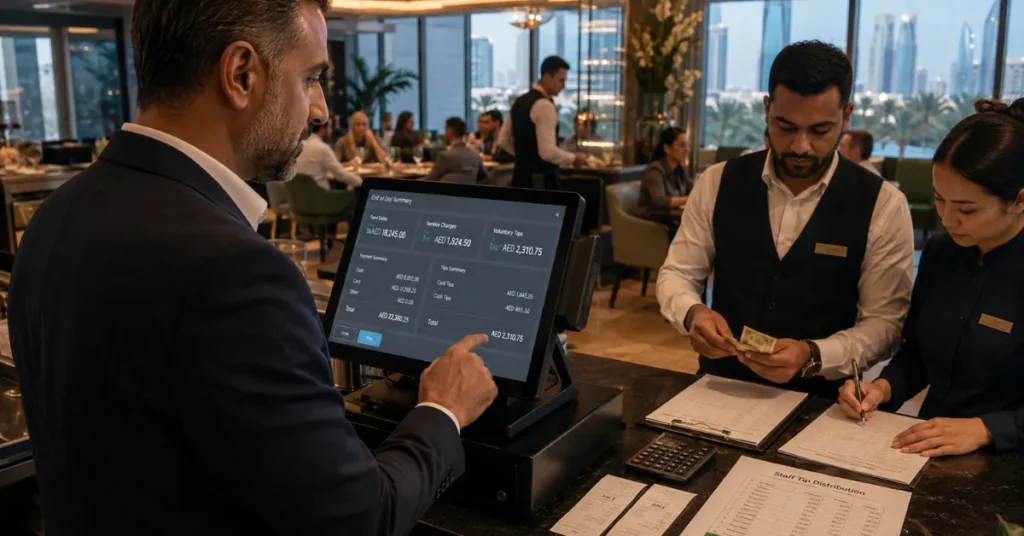
Restaurant businesses frequently create problems by treating similar-looking payments in the same way.
1. Treating Every Tip as Taxable
A genuine voluntary tip is different from a mandatory service charge. The FTA specifically states that a freely given tip above the total charge is outside the scope of VAT.
2. Treating Every Service Charge as a Tip
Calling a compulsory amount “gratuity” does not automatically make it a voluntary tip. If the restaurant requires the customer to pay the amount, the business should examine its VAT treatment as consideration for the underlying supply.
3. Combining Tips With Restaurant Revenue
Combining voluntary tips with food and beverage revenue can make financial reporting unclear. Separate categories make reconciliation and staff distribution easier.
4. Applying the Wrong VAT Code in the POS
A wrong tax code can affect sales reports, VAT calculations and VAT return figures. Restaurants should periodically test their POS configuration rather than assuming the setup remains correct.
5. Failing to Reconcile POS With the General Ledger
Daily sales should be reconciled with:
- POS totals.
- Cash collections.
- Card settlements.
- Digital payment receipts.
- Service charges.
- Tips.
- VAT.
- Bank deposits.
This process can identify errors before they reach the VAT return.
6. Ignoring Refunds, Voids and Discounts
Restaurants should also review adjustments. Refunds, voided transactions and discounts can affect the taxable amount and therefore need appropriate accounting and VAT treatment.
Restaurant VAT Compliance Checklist for UAE Businesses
A practical restaurant VAT checklist can include:
- Confirm whether the business must be VAT registered.
- Identify taxable restaurant supplies.
- Distinguish mandatory service charges from voluntary tips.
- Configure the correct POS VAT codes.
- Record output VAT accurately.
- Maintain appropriate tax invoices and supporting records.
- Reconcile daily POS sales.
- Reconcile card and digital payment settlements.
- Track service charges separately.
- Track employee tip distributions.
- Review refunds, discounts and voids.
- Reconcile VAT figures before filing the VAT return.
For UAE-resident businesses, the FTA currently states that VAT registration becomes mandatory when taxable supplies and imports exceed AED 375,000 over the previous 12 months or are expected to exceed that threshold in the next 30 days. Voluntary registration may be available once the applicable threshold of AED 187,500 is exceeded.
How Restaurant Owners Can Improve VAT and Accounting Accuracy
Restaurant accounting becomes easier when businesses build clear processes rather than correcting errors after each reporting period. A restaurant should review its POS configuration whenever it introduces a new charge, changes its menu structure or modifies its payment process. It should also reconcile sales regularly and investigate differences between POS reports, accounting records, payment gateways, and bank statements.
For multi-branch restaurants, management should use consistent accounting and POS categories across locations. This makes it easier to compare revenue, service charges, tips and VAT between branches.
A periodic review can also identify whether the business has incorrectly treated a compulsory charge as a voluntary tip or vice versa.
Restaurant Service, VAT, Accounting: When to Get Professional Help
Professional accounting support can be particularly useful when a restaurant has multiple branches, complex POS systems or high transaction volumes.
Consider obtaining professional advice when you have:
- Multiple service-charge arrangements.
- Large volumes of card and digital transactions.
- Employee tip-pooling arrangements.
- Frequent refunds and discounts.
- POS-to-accounting reconciliation problems.
- VAT return discrepancies.
- Questions about the classification of specific charges.
- Rapid business expansion.
A UAE accounting professional can review the restaurant’s POS setup, accounting classifications and VAT reporting process and help establish consistent controls.
FAQ
Is VAT charged on restaurant service charges in the UAE?
Generally, yes. Where a restaurant imposes a service charge, the FTA treats it as further consideration for the principal supply, meaning it follows the VAT liability of that supply.
Are voluntary restaurant tips subject to VAT in the UAE?
A tip freely given by a customer over and above the total charge is outside the scope of VAT according to the FTA’s Taxable Person Guide.
Is a mandatory service charge considered part of restaurant revenue?
A mandatory service charge represents further consideration for the restaurant’s principal supply for VAT purposes. The business should nevertheless maintain clear accounting classifications so that management can distinguish the charge from core food and beverage sales.
How should restaurants account for service charges?
Restaurants should record mandatory service charges using a clearly defined accounting and POS category and apply the appropriate VAT treatment. They should then reconcile the amounts with daily sales reports.
How should restaurants record customer tips?
Genuine voluntary tips should be separately identified in the POS and accounting records rather than automatically being combined with restaurant sales. The business should maintain records of collection and distribution.
Should tips and service charges have separate POS codes?
Yes. Separate POS codes make it easier to apply the appropriate VAT treatment, reconcile transactions and track staff distributions.
Do restaurants need to include service charges on tax invoices?
Where a mandatory service charge forms part of the consideration for a taxable supply, the restaurant should reflect the transaction appropriately in its VAT invoicing and records. The exact invoice presentation should comply with the applicable UAE VAT invoicing requirements.
How can restaurants reconcile tips and service charges?
Restaurants can reconcile them by comparing POS reports with cash, card, and payment-provider settlements while separately tracking mandatory service charges, voluntary tips and amounts distributed to employees.
Conclusion
For UAE restaurants, getting Restaurant Service, VAT, Accounting treatment right starts with understanding the difference between a mandatory service charge and a genuine voluntary tip. The FTA confirms that an imposed service charge is further consideration for the principal supply and follows its VAT treatment, while a freely given tip above the total charge is outside the scope of VAT.
Disclaimer: This article provides general information about UAE restaurant service charges, tips, VAT and accounting. It is not legal, tax, or accounting advice for a specific business. UAE VAT rules and FTA guidance may change, so restaurant owners should verify the latest legislation and official guidance or obtain advice from a qualified UAE tax professional before making compliance decisions.