


Dubai’s transition toward cleaner mobility is creating opportunities for businesses that want to develop and operate electric vehicle charging infrastructure. However, starting an EV Charging Business Dubai involves more than purchasing chargers and installing them in a parking area. Entrepreneurs need to consider the appropriate business activity, company licence, site permissions, DEWA requirements, electrical capacity, technical compliance, charging equipment, software, and revenue model.
Importantly, Dubai now has a specific regulatory framework for independent Charge Point Operators (CPOs). Businesses operating public EV charging infrastructure generally need a CPO licence from the Dubai Electricity and Water Authority (DEWA), with separate licensing arrangements for free and paid charging services.
Why Start an EV Charging Business in Dubai?
The growth of electric mobility is increasing demand for accessible charging infrastructure across residential, commercial, and public locations. Dubai has already developed a substantial EV charging network, while its regulatory framework also allows independent private-sector Charge Point Operators to participate in the development and operation of public charging infrastructure.
This creates opportunities beyond traditional public charging stations.
Businesses can explore charging solutions for:
- Shopping malls and retail centers
- Hotels and hospitality properties
- Residential communities
- Office buildings
- Commercial parking facilities
- Fleet and logistics depots
- High-traffic destinations
- Private developments
- Corporate vehicle fleets
The opportunity, however, depends heavily on location, utilisation and operating economics. A charger in a busy location can have a very different commercial performance from an identical charger in a low-demand location.
Is EV Charging a Profitable Business in Dubai?
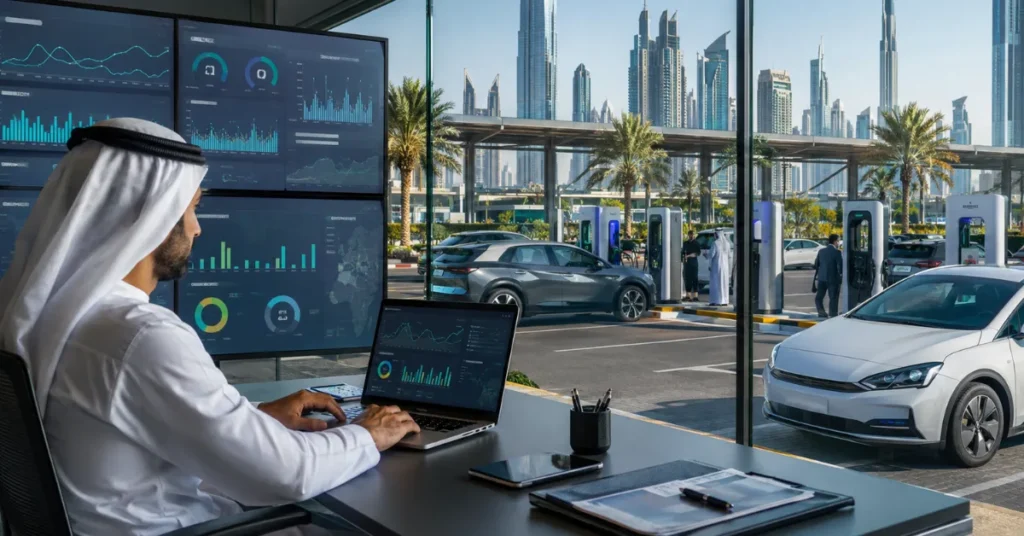
An EV charging business can generate recurring revenue, but profitability is not automatic. The commercial performance of a charging station depends on factors such as customer demand, charging volume, pricing, electricity-related costs, site arrangements, equipment investment, maintenance, and software expenses.
A useful way to evaluate a proposed project is to estimate:
Expected charging revenue − electricity-related costs − site costs − operating costs − financing/depreciation = potential operating return
Key Factors That Determine Profitability
Consider these factors before investing:
- Number of charging sessions
- Average energy consumed per session
- Charger utilisation
- Charging fees
- Electricity costs
- Site rental or revenue-sharing arrangements
- Charger purchase price
- Installation costs
- Electrical upgrades
- Software and network fees
- Payment processing
- Maintenance and repairs
For example, a high-speed DC charger may process more vehicles than an AC charger, but it can also require greater electrical capacity and a larger upfront investment. Therefore, the best charger is not necessarily the fastest one. The right choice depends on the customers and location you intend to serve.
EV Charging Business Licence Dubai: What Licence Do You Need?
A key point for entrepreneurs is that company licensing and EV charging regulation are separate considerations. Dubai’s economic licensing framework requires businesses to operate through an appropriate business licence and meet the conditions and approvals applicable to their economic activity.
For public EV charging, DEWA’s regulatory framework adds another important layer.
DEWA states that independent Charge Point Operators operating public charging infrastructure in Dubai must obtain a CPO licence from DEWA. The framework provides separate licences for CPOs that offer free charging and those that collect payments from end users.
EV Charging Station Licence vs Business Licence
These should not be treated as the same thing.
A business may need to address several components, including:
- Appropriate company/business activity
- Commercial business licence
- Site and property permissions
- DEWA requirements
- CPO licensing, where applicable
- Electrical connection requirements
- Technical compliance
- Other site-specific approvals
The exact requirements depend on how the business operates. For example, an equipment supplier selling chargers is different from a company that owns and operates public charging stations and collects charging fees.
EV Charging Station Dubai: Regulatory and Approval Requirements
Dubai has established a regulatory framework specifically for EV charging infrastructure. DEWA explains that the framework covers the development and operation of EV charging infrastructure and licensing of independent CPOs. It also provides technical regulations for EV charging equipment.
DEWA’s current framework states that any person operating public charging equipment, as defined by the regulation, must obtain the required CPO licence and comply with the EV Charging Regulation.
Key Authorities and Stakeholders
Depending on the project, the process may involve:
- Dubai Electricity and Water Authority (DEWA)
- Dubai Department of Economy and Tourism or relevant licensing authority
- Dubai Municipality, where applicable
- Roads and Transport Authority (RTA), where applicable
- Property owners
- Developers
- Building management
- Electrical and technical contractors
DEWA also coordinates with relevant government entities on technical and safety requirements.
Why Site Approval Matters
Finding a parking space is not enough to establish a viable charging site.
Before committing to a location, assess:
- Who owns the property?
- Do you have permission to use the parking spaces?
- Is sufficient electrical capacity available?
- Can cables and equipment be installed safely?
- Can customers access the chargers easily?
- Are civil works required?
- Can the site accommodate future expansion?
A strong site assessment can prevent expensive changes later.
DEWA EV Charging Coordination in Dubai
DEWA plays a central role in Dubai’s EV charging infrastructure. The authority’s regulatory framework establishes technical requirements and procedures for connecting EV charging equipment to the distribution system. This means entrepreneurs should consider utility requirements before selecting their final equipment.
What Should You Check Before Applying?
A practical feasibility checklist includes:
- Existing electrical capacity
- Proposed charger power
- Number of charging ports
- Expected simultaneous charging
- Distance from electrical infrastructure
- Metering requirements
- Required electrical upgrades
- Parking layout
- Property-owner approval
- Civil works
- Connectivity and monitoring requirements
For public infrastructure, DEWA’s framework is particularly important because the provision of electricity to public charging users is regulated and independent CPOs require the appropriate DEWA licence.
Types of EV Chargers for a Dubai Charging Business
Choosing the right charging technology is one of the most important investment decisions.
AC EV Chargers
AC chargers generally suit locations where vehicles remain parked for longer periods.
Potential locations include:
- Offices
- Residential buildings
- Hotels
- Long-stay parking
- Workplaces
Dubai’s existing public charging network includes AC charging options, including 22 kW public and wall-box configurations.
DC Fast Chargers
DC chargers can provide much faster charging and may suit locations where customers expect shorter charging times.
They can be considered for:
- High-traffic locations
- Fleet operations
- High-turnover parking
- Long-distance travel routes
- Commercial charging hubs
However, higher-power equipment can create greater electrical and infrastructure requirements. DEWA’s current framework also distinguishes certain DC charging installations according to capacity and whether the location has restricted access.
Which EV Charger Is Best for Your Business?
| Charger | Suitable Location | Main Advantage | Main Consideration |
|---|---|---|---|
| AC | Offices, homes, hotels | Longer dwell-time use | Slower charging |
| DC | Public/commercial sites | Faster charging | Higher infrastructure needs |
| High-power DC | Fleet/high-turnover sites | Very fast charging | Greater capacity and investment |
The correct approach is to match the charger to customer dwell time and expected utilisation, rather than choosing equipment solely because it has a higher power rating.
EV Charging Station Cost Dubai: What Should You Budget For?
There is no single reliable cost figure for every EV charging station in Dubai. The total project cost depends on charger type, capacity, number of ports, electrical infrastructure, civil works, and site conditions.
Main EV Charging Business Costs
Budget for:
- Company incorporation and licensing
- CPO licensing, where applicable
- EV charger hardware
- Electrical equipment
- Cabling and protection systems
- Installation
- Civil works
- Utility connection or infrastructure upgrades
- Software platform
- Payment system
- Networking
- Signage
- Parking modifications
- Maintenance
- Insurance
- Site rental or revenue-sharing costs
What Makes EV Charging Installation More Expensive?
The biggest cost drivers can include:
- Higher charger capacity
- Multiple charging ports
- Long cable runs
- Limited existing electrical capacity
- Transformer or switchgear requirements
- Civil construction
- Difficult site access
- Ground works
- Advanced software requirements
For this reason, businesses should conduct a site-specific feasibility assessment before finalising a charger purchase.
EV Charging Business Revenue Models in Dubai
A charging business can use different commercial models depending on its customer base and regulatory structure. However, businesses should distinguish between general commercial concepts and what is actually permitted under Dubai’s EV charging regulations.
Pay-Per-Use EV Charging
Customers pay for charging based on the applicable charging structure. This model can work well for public charging where the operator has regular vehicle traffic. DEWA’s regulatory framework sets out how public charging fees and the different components of those fees are handled. For independent CPOs, the framework also addresses DEWA’s electricity tariff component and the CPO charging fee.
Subscription-Based EV Charging
Subscriptions may be attractive in some charging businesses, particularly private or controlled-access environments. However, operators should not assume that a subscription model is automatically permitted for public charging.
The current DEWA regulation states that independent CPOs or other parties providing access to public charging infrastructure may not collect periodic or one-off subscription fees for access to public charging equipment, subject to the regulation’s stated exceptions.
Therefore, the proposed commercial model should be checked against the applicable regulatory framework before launch.
Fleet Charging
Fleet charging can provide more predictable utilisation.
Potential customers include:
- Delivery companies
- Corporate fleets
- Logistics operators
- Rental businesses
- Commercial transport operators
A fleet agreement may allow the charging operator to forecast demand more accurately than relying entirely on walk-in customers.
Destination Charging
Hotels, malls, restaurants and offices can integrate EV charging into their customer experience.
The business may benefit through:
- Charging revenue
- Increased customer visits
- Longer customer dwell time
- Premium services
- Customer retention
The charging station does not always have to be a standalone business. It can also support the economics of another commercial property.
Revenue-Sharing With Property Owners
A charging operator may work with a property owner under a commercial agreement.
The operator can potentially provide:
- Equipment
- Installation
- Software
- Customer support
- Maintenance
The property owner contributes the location, while the parties agree on commercial terms. The exact arrangement should account for regulatory requirements, operating costs, site responsibilities and revenue allocation.
How to Choose the Right EV Charging Location in Dubai
Location can determine whether an EV charging project performs well. A charger in a busy commercial destination can have a much stronger utilisation profile than one installed where EV traffic remains low.
What Makes a Good EV Charging Site?
Look for:
- Strong EV traffic
- Convenient access
- Good visibility
- Adequate parking
- Appropriate electrical capacity
- Long customer dwell time
- Secure surroundings
- Property-owner support
- Future expansion potential
- Limited charging competition
Site Feasibility Checklist
Before signing a long-term site agreement, assess:
- Customer demand
- EV traffic
- Parking availability
- Electrical capacity
- Installation complexity
- Property permissions
- Applicable approvals
- Expected utilisation
- Operating costs
- Expansion potential
This approach helps reduce the risk of investing heavily in an unsuitable location.
EV Charger Installation Dubai: Technical Considerations
EV charger installation involves more than connecting a charger to a power source. DEWA’s EV Charging Technical Regulations provide technical specifications and installation requirements for private and public EV supply equipment in Dubai.
Technical planning can cover:
- Electrical load calculations
- Distribution equipment
- Cabling
- Protection systems
- Earthing
- Charger positioning
- Network connectivity
- Payment integration
- Safety requirements
- Testing and commissioning
- Maintenance access
Smart Charging and Charging Management Software
Modern charging businesses can use software to manage multiple stations.
Useful features may include:
- Remote monitoring
- Charger status tracking
- Fault alerts
- Customer payment management
- Usage analytics
- Load management
- Energy monitoring
- Multi-location management
For businesses operating several charging stations, software can become an important part of daily operations rather than an optional extra.
Step-by-Step EV Charging Business Setup in Dubai
A structured setup process can reduce delays and unexpected costs.
Step 1: Define Your EV Charging Business Model
Decide whether you will focus on:
- Public charging
- Private charging
- Fleet charging
- Commercial property charging
- Equipment supply
- Installation services
- Charging network operations
Step 2: Select the Appropriate Business Activity
Choose an activity that accurately reflects what your company will actually do. Do not assume that an ordinary trading or technical activity automatically covers public charging operations.
Step 3: Choose Mainland or Free Zone Setup
Evaluate the appropriate jurisdiction based on your activity, ownership requirements, operational location and commercial objectives.
Step 4: Secure a Suitable Charging Site
Confirm property rights and commercial arrangements before investing in equipment.
Step 5: Obtain Required Permissions and Approvals
Identify the approvals applicable to your business, site and charging model. For public charging operations, DEWA’s CPO licensing framework is particularly important.
Step 6: Assess Electrical Capacity
Conduct the required technical assessment before finalising charger specifications.
Step 7: Select Chargers and Technical Equipment
Match charger type and power to expected customer demand.
Step 8: Complete Installation and Testing
Use appropriately qualified technical professionals and complete the required testing and commissioning.
Step 9: Set Up Payment and Charging Management Systems
Customers should be able to use the charging service through a reliable and convenient process.
Step 10: Launch, Monitor and Optimise Operations
Track:
- Sessions
- Energy consumption
- Utilisation
- Revenue
- Faults
- Customer feedback
- Maintenance costs
Use these metrics to determine whether additional chargers or new locations make commercial sense.
Common Mistakes When Starting an EV Charging Business in Dubai
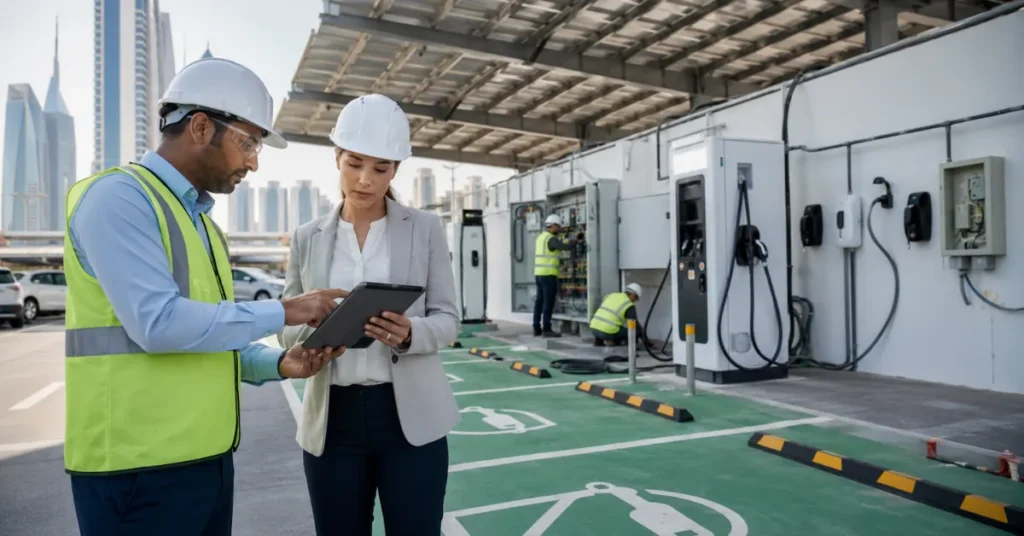
New operators can make costly mistakes if they focus only on the equipment.
Choosing a Site Before Checking Power Capacity
A location may look commercially attractive but require expensive electrical upgrades.
Selecting Chargers Based Only on Price
A cheaper charger may not deliver the performance, reliability, or functionality required for your target market.
Assuming a Business Licence Is Enough
Public EV charging has additional regulatory requirements. DEWA specifically requires independent CPOs operating public charging infrastructure to obtain the applicable CPO licence.
Ignoring Property Approvals
The company needs the legal and commercial right to install and operate equipment at the selected location.
Underestimating Recurring Costs
Maintenance, software, electricity-related costs, site charges and customer support can affect profitability over time.
Installing Too Many Chargers Too Early
Starting with a scalable approach can allow an operator to validate actual demand before making a larger capital investment.
EV Charging Business Dubai: An Illustrative Business Scenario
Consider a hypothetical commercial property with several dedicated parking spaces. The operator could install a combination of AC and DC chargers based on the expected customer profile. During the day, office users could create steady AC demand. Retail customers could use faster charging during shorter visits, while a fleet customer could provide more predictable utilisation.
The operator could then monitor:
- Charging sessions
- Energy consumption
- Peak demand
- Revenue per charger
- Maintenance costs
- Customer retention
- Site utilisation
This example illustrates an important principle: a successful charging business is built around utilisation and site economics, not simply the number of chargers installed.
Is an EV Charging Business in Dubai Right for You?
An EV charging project may be worth considering if you have:
- Access to a suitable location
- Sufficient investment capacity
- A defined customer segment
- A realistic utilisation forecast
- Suitable electrical infrastructure
- A scalable operating plan
You may need to reassess the project if:
- You have no confirmed site
- Electrical upgrades are disproportionately expensive
- Expected utilisation is uncertain
- The revenue model does not cover recurring costs
- Required regulatory approvals are unclear
A feasibility study can help identify these issues before significant capital is committed.
How Ripple Business Setup Can Help With EV Charging Business Setup in Dubai
Starting an EV charging company requires careful coordination between business formation, activity selection, and the operational requirements of the charging project.
Ripple Business Setup can assist entrepreneurs with business setup planning, licence selection, documentation, and company formation in Dubai. The team can also help businesses understand the broader compliance considerations involved in establishing their operations and coordinate the appropriate professional support where technical or regulatory approvals are required.
For guidance on your proposed EV Charging Business Dubai project, you can contact Ripple Business Setup:
- Phone: +971 50 593 8101
- Email: info@ripplellc.ae
- WhatsApp: +971 4 250 0833
FAQ
Do I need a licence to start an EV charging business in Dubai?
Yes, businesses need the appropriate commercial business activity and licence. If the company operates public EV charging infrastructure as an independent Charge Point Operator, DEWA’s current framework requires the applicable CPO licence.
How do I start an EV charging business in Dubai?
Start by defining the business model, selecting the appropriate activity, establishing the company, securing a suitable site, assessing electrical capacity, identifying required approvals, selecting equipment and completing the required installation and commissioning process.
How much does an EV charging station cost in Dubai?
Costs vary significantly depending on charger type, capacity, number of ports, electrical upgrades, civil works, installation and site conditions. A project-specific quotation and feasibility assessment are more useful than relying on a single average cost.
Is EV charging profitable in Dubai?
It can be, but profitability depends on utilisation, pricing, electricity-related costs, site arrangements, equipment investment and operating expenses. A strong location with consistent demand is generally more important than simply installing a large number of chargers.
What approvals are needed for an EV charging station in Dubai?
Requirements depend on the charging model and location. DEWA plays a central role, and public charging operators may need a DEWA CPO licence. Other government entities, property owners and technical stakeholders may also be involved depending on the project.
Do EV charging stations need DEWA coordination?
Yes. DEWA’s framework establishes requirements for connecting EV charging equipment to the distribution system and for operating EV charging infrastructure in Dubai.
Can I start an EV charging business in a free zone?
A free zone company may be suitable for certain business activities, but the appropriate structure depends on the intended activity and where the charging infrastructure will operate. Public charging operations must also comply with the applicable Dubai EV charging regulations.
What is the difference between AC and DC EV chargers?
AC chargers generally provide slower charging and can suit locations where vehicles remain parked for longer periods. DC chargers can provide significantly faster charging and may suit high-turnover locations, but they can require greater electrical infrastructure.
How do EV charging stations make money?
Depending on the regulatory and commercial model, charging businesses can generate revenue through permitted charging fees and commercial arrangements such as fleet services or destination charging. Public charging revenue structures must comply with the applicable DEWA framework.
What factors affect EV charging station ROI?
The main factors include charger utilisation, charging volume, equipment costs, installation costs, electricity-related costs, site charges, maintenance, software expenses, and the commercial terms agreed with the property owner.
Final Takeaway
An EV Charging Business Dubai can offer an attractive opportunity as electric mobility infrastructure expands. But the strongest projects start with feasibility rather than equipment purchases. Entrepreneurs should evaluate the business activity, commercial licence, DEWA CPO requirements, site permissions, electrical capacity, charger technology, installation costs and revenue model before committing significant capital.
Dubai’s current regulatory framework gives independent operators a defined route into public EV charging, while technical regulations provide a framework for compliant infrastructure.
Disclaimer: This article provides general business and regulatory information for educational purposes. EV charging licensing, technical requirements, fees and approval procedures can change. Businesses should verify current requirements with DEWA and other relevant Dubai authorities before starting an EV charging project.