A 3D Printing Business Dubai can serve far more than hobbyists and small consumer orders. Dubai’s growing technology, construction, manufacturing, healthcare, automotive and design sectors create opportunities for businesses offering prototyping, customised production, digital modelling and industrial additive manufacturing. However, choosing the right licence activity is essential because your legal setup should match what your company actually does. The UAE business establishment process requires investors to identify the nature of the activity, legal structure and suitable location before obtaining the relevant commercial licence.
Intellectual property (IP) also deserves attention from day one. A 3D printing company may handle CAD files, product designs, inventions, software, trademarks and proprietary manufacturing processes. Protecting these assets can help reduce the risk of unauthorised copying while creating a stronger foundation for long-term growth.
Why Start a 3D Printing Business in Dubai?
Dubai provides an attractive environment for businesses that combine technology, design and manufacturing. A 3D printing company can serve both local and international customers, depending on its licence, location, operating model and target market. The opportunity also extends beyond simply charging customers to print an object. Businesses can build specialised services around rapid prototyping, product development, engineering models, customised parts, architectural models and low-volume manufacturing.
For example, an architecture firm may need detailed physical models for presentations, while an engineering company may require several prototype versions before moving into mass production. A 3D printing business can serve both customers without necessarily operating as a traditional large-scale manufacturer.
Dubai’s Manufacturing and Innovation Ecosystem
Additive manufacturing can support businesses that need speed, customization, and flexible production. Instead of producing large quantities of one standard component, a company can manufacture smaller batches or customized designs based on digital files.
This creates opportunities in areas such as:
- Construction and architecture
- Engineering and product design
- Healthcare and dental applications
- Automotive
- Aerospace
- Industrial manufacturing
- Education
- Consumer products
The best opportunity often comes from solving a specific industry problem rather than offering generic printing services.
How to Start a 3D Printing Business in Dubai
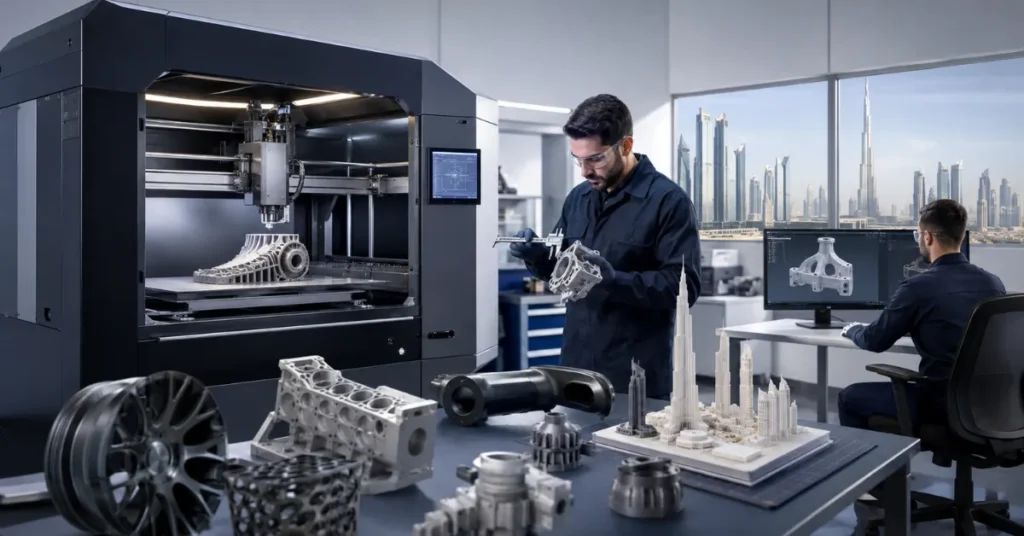
Starting a 3D printing business setup in Dubai requires more than purchasing a printer and renting an office. You should first determine exactly what you plan to sell and then select the business activity and structure accordingly.
Define Your 3D Printing Business Model
Start by identifying your primary revenue model. Your business could operate as:
- A 3D printing service provider
- A rapid prototyping company
- A product design and development studio
- An industrial additive manufacturing company
- A customised product manufacturer
- A 3D printer and equipment trader
- A printing-material supplier
- A design and engineering consultancy
These models can have different licensing and premises requirements. For example, a company providing digital design services may have different requirements from a company manufacturing physical components.
Select the Right Business Activity
Activity selection is one of the most important steps in 3D printing company formation Dubai. The UAE identifies thousands of economic activities, and the nature of the business determines the type of licence and approvals required. The official UAE company-formation guidance specifically places identifying the nature of the business activity at the beginning of the setup process.
Do not select an activity simply because it sounds close to “3D printing.” Consider what your company will actually do, including whether it will manufacture, design, trade, provide consultancy services or sell products.
Choose Mainland or Free Zone
Your choice between a mainland and free-zone structure should depend on your customers, operations, premises and selected activity.
| Factor | Mainland | Free Zone |
|---|---|---|
| UAE market | Broad local operating potential | Depends on structure and activity |
| International business | Suitable | Often suitable |
| Physical facility | Activity-dependent | Authority-dependent |
| Manufacturing | Depends on approved activity and premises | Depends on approved activity and facilities |
| Business ecosystem | Broad market access | Often sector-focused |
Dubai’s official investment platform provides information on mainland and free-zone setup routes, including trade licensing and legal structures.
3D Printing Licence Activities in Dubai
There is no universal licence that automatically covers every possible 3D printing business model. Your 3D printing licence Dubai requirements depend on the actual services and products you intend to offer.
Common Activity Categories to Consider
Depending on your business model and licensing authority, relevant activity categories may involve:
- 3D printing and prototyping services
- Product design and development
- Engineering and technical design
- Manufacturing
- Industrial production
- Technology services
- Trading of 3D printers and equipment
- Trading of approved printing materials
The exact activity name, authority and approval requirements should be confirmed before incorporation.
Why Activity Selection Matters
Choosing an activity that does not accurately describe your operations can create problems later. For example, a business licensed only for consultancy or design may need additional permissions if it begins manufacturing physical products.
Your planned activities should therefore be reviewed alongside:
- Type of products
- Printing technology
- Materials used
- Production volume
- Workshop requirements
- Customer industries
- Import and export needs
- Additional sector-specific approvals
Dubai’s Department of Economy and Tourism provides business licensing services and information for mainland companies, while free-zone authorities issue licences according to their respective activity frameworks.
Mainland vs Free Zone for a 3D Printing Company
The right jurisdiction depends on your business model rather than simply choosing the cheapest licence package.
When Mainland May Make Sense
A mainland structure may be worth considering when your business plans to:
- Serve customers throughout the UAE
- Operate a physical production facility
- Work directly with local companies
- Build a broader UAE customer base
- Conduct activities requiring specific mainland arrangements
When a Free Zone May Be Suitable
A free zone may appeal to businesses focused on:
- International clients
- Export-oriented operations
- Technology-focused activities
- Specialised business ecosystems
- Flexible startup structures
However, each free zone has its own permitted activities, premises rules and regulatory framework. You should compare the actual requirements rather than assuming every free zone provides the same benefits.
Intellectual Property Protection for 3D Printing in the UAE
IP protection can become one of the most important parts of running a 3D printing business in Dubai. A printing company may receive confidential CAD files from customers or create original designs internally. Without proper agreements and protection strategies, those files may be copied, modified, or commercially reproduced without permission.
The UAE Ministry of Economy and Tourism provides services covering patents, industrial designs, trademarks, and other intellectual property matters. Its industrial-property services include patents, utility models, industrial designs, and integrated circuit layout designs.
What IP Can a 3D Printing Business Protect?
Depending on the nature of the asset, protection may involve:
- Patents: For eligible new and inventive technical inventions.
- Industrial designs: For eligible aspects of a product’s appearance.
- Trademarks: For brands, names, logos, and other identifying marks.
- Copyright: For eligible original creative works, including certain digital designs and software.
- Trade secrets: For confidential processes, technical know-how, and business information.
The appropriate form of protection depends on the specific asset, so businesses should obtain professional IP advice where necessary.
Protect Your Digital 3D Files
Digital files can be commercially valuable. A company should consider who can access, copy, modify and distribute its CAD files.
Practical controls can include:
- Access permissions
- Confidentiality agreements
- Secure file storage
- Version control
- Contractor agreements
- Customer terms and conditions
- Clear ownership clauses
Include IP Clauses in Customer Contracts
A custom 3D printing project should clearly state who owns the underlying design.
Contracts can address:
- Ownership of customer-supplied files
- Ownership of newly created designs
- Permission to modify files
- Commercial reproduction rights
- Confidentiality
- Use of designs in marketing
- Responsibility for third-party IP
This becomes particularly important when your company provides both design and printing services.
Best 3D Printing Business Opportunities in Dubai
The strongest 3D printing business opportunities Dubai can come from specialised B2B applications rather than competing only on price.
| Sector | Potential Applications |
|---|---|
| Construction | Models, customized components, and specialized applications |
| Healthcare | Medical and dental models and eligible customized applications |
| Automotive | Prototypes, tooling, and replacement components |
| Aerospace | Prototyping and lightweight component development |
| Architecture | Scale models and design visualization |
| Manufacturing | Tooling, prototypes, and low-volume production |
| Education | Training models and educational projects |
| Consumer Products | Customized products and prototypes |
3D Printing for Construction in Dubai
Construction and architecture provide opportunities for large-format and specialized additive manufacturing. Companies may use 3D printing for architectural models, design visualization, and selected construction-related applications. However, businesses entering this area should distinguish between providing a model or prototype and undertaking regulated construction or manufacturing work. The latter may require additional technical and regulatory considerations.
3D Printing for Healthcare and Dental
Healthcare and dental applications can create high-value opportunities because customers may require customized products and precise models.
Potential applications include:
- Dental models
- Anatomical models
- Product prototypes
- Training models
- Customized components
Businesses should check applicable healthcare, product, and safety requirements before offering regulated products or services.
Industrial 3D Printing Opportunities
Industrial customers may value 3D printing for:
- Rapid prototypes
- Custom components
- Tooling
- Replacement parts
- Low-volume manufacturing
- Product testing
This B2B model can be attractive because customers may value speed and engineering expertise more than simply paying the lowest price per printed item.
Costs and Investment Considerations for a 3D Printing Startup
There is no single 3D printing business cost Dubai figure that applies to every company. Investment can vary significantly depending on the business model.
Important cost categories include:
- Business licence and registration
- Office, studio or workshop
- Industrial or commercial premises
- 3D printers
- Printing materials
- CAD and design software
- Skilled employees
- Maintenance and repairs
- Insurance
- Equipment upgrades
- Website and marketing
- Accounting and tax compliance
A small prototype studio may operate with a very different investment structure from an industrial additive manufacturing facility. Before buying expensive equipment, validate the market and determine whether customers need the printer capacity you plan to purchase.
Compliance Considerations for a 3D Printing Business in Dubai
A 3D printing company should maintain compliance from the beginning rather than treating it as an afterthought.
Key areas can include:
- Correct business licence
- Approved business activities
- Suitable premises
- Equipment and workplace safety
- Product-specific approvals
- Employment compliance
- Import and customs requirements
- VAT compliance
- Corporate Tax compliance
- Accounting and record keeping
- Intellectual property compliance
VAT registration becomes mandatory for a UAE business when taxable supplies and imports exceed AED 375,000 over the relevant period, while voluntary registration is available from AED 187,500 subject to the applicable rules.
Corporate Tax is a separate obligation. UAE juridical persons, including free-zone entities within the Corporate Tax framework, are generally required to register where applicable. The Ministry of Finance states that taxable persons generally file a Corporate Tax return within nine months from the end of the relevant tax period.
How to Build a Profitable 3D Printing Business Model
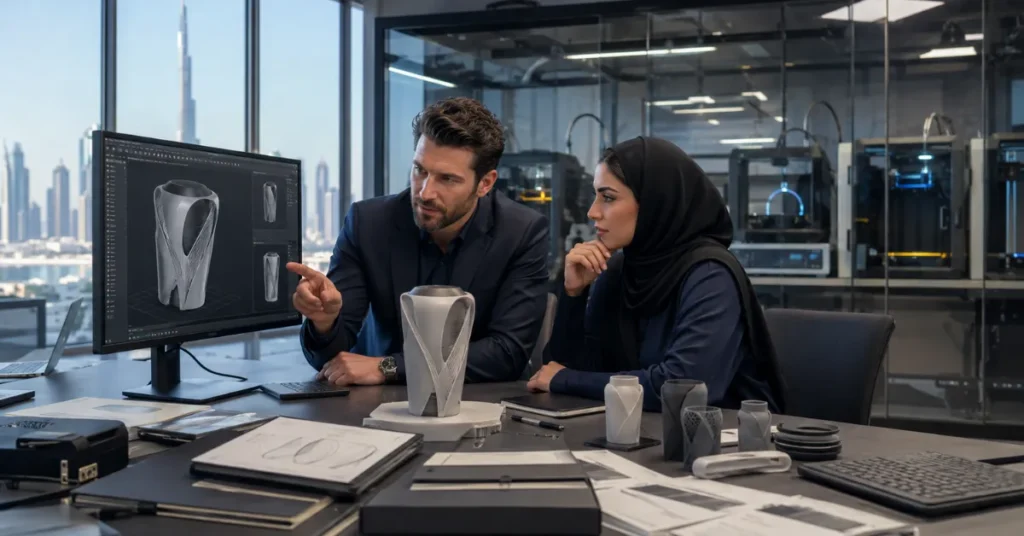
Profitability depends on utilization, pricing, materials, labour, equipment depreciation, and the value delivered to customers.
Service-Based Revenue
You can charge for:
- Individual printing jobs
- Prototype packages
- Design plus printing
- Engineering support
- Custom manufacturing
Product-Based Revenue
A company can also create and sell its own:
- Custom products
- Industrial components
- Replacement parts
- Design-led consumer products
- Branded products
B2B Contract Model
Long-term business relationships can provide recurring work through:
- Prototype development
- On-demand manufacturing
- Product development
- Recurring component production
- Corporate partnerships
For many specialised businesses, moving from one-off consumer orders toward recurring B2B relationships can improve revenue predictability.
Common Mistakes When Setting Up a 3D Printing Business
Avoid these common mistakes:
- Choosing the wrong licence activity
- Selecting a jurisdiction based only on price
- Ignoring workshop or premises requirements
- Printing third-party designs without permission
- Failing to define customer IP ownership
- Underestimating material and maintenance costs
- Entering regulated sectors without checking approvals
- Buying expensive equipment before validating demand
- Failing to use contracts for custom designs
- Ignoring VAT and Corporate Tax obligations
One particularly important mistake is assuming that owning a 3D printer gives you the right to reproduce anything you can download. A digital file may be protected by intellectual-property rights, and businesses should establish whether they have the necessary rights before commercial reproduction.
Is a 3D Printing Business in Dubai a Good Opportunity?
A 3D printing business in Dubai can be a promising opportunity when the company targets a clear market need rather than treating 3D printing as a generic service. Construction, architecture, healthcare, automotive, engineering, manufacturing, and consumer products can all provide potential niches. However, each sector can have different technical and regulatory requirements.
The strongest business model will usually combine the right licence activity with technical capability, effective IP management, reliable production, competitive pricing, and strong B2B relationships.
How Ripple Business Setup Can Help With Your 3D Printing Business in Dubai
Setting up a 3D printing company in Dubai involves several decisions, including business activity, legal structure, jurisdiction, premises, and ongoing compliance. Ripple Business Setup can assist entrepreneurs with business setup planning, licence applications, mainland and free-zone company formation, accounting, VAT and Corporate Tax support.
If you are planning to launch a 3D printing startup, getting the business activity and structure right before investing in equipment can help you avoid unnecessary changes later.
Contact Ripple Business Setup:
Phone: +971 50 593 8101
Email: info@ripplellc.ae
WhatsApp: +971 4 250 0833
FAQ
Do I need a licence to start a 3D printing business in Dubai?
Yes, businesses conducting commercial activities in Dubai generally need the appropriate business licence and approved activity. The exact requirements depend on whether you provide printing, design, manufacturing, trading, or other services.
What licence is required for 3D printing in Dubai?
The appropriate licence activity depends on the actual services and products your company will provide. You should confirm the activity with the relevant licensing authority before starting operations.
Is 3D printing profitable in Dubai?
It can be profitable when the company targets a viable niche and controls equipment, material, labour and operating costs. B2B applications such as prototyping, customized manufacturing, and industrial services can offer opportunities for specialized businesses.
Can I start a 3D printing business in a Dubai free zone?
Yes, depending on the selected free zone and approved activity. You should check whether the zone supports your intended printing, manufacturing, trading, or design activity and whether its premises meet your operational requirements.
How can I protect my 3D printing designs in the UAE?
Depending on the asset, businesses can consider patents, industrial designs, trademarks, copyrights, and contractual confidentiality measures. The UAE Ministry of Economy and Tourism provides official IP-related services.
What industries use 3D printing in Dubai?
Potential industries include construction, architecture, healthcare, dental, automotive, aerospace, manufacturing, education, and consumer products.
How much does it cost to start a 3D printing business in Dubai?
Costs vary according to the licence, jurisdiction, premises, printer technology, materials, software, employees, and operating model. An industrial facility can require substantially more capital than a small prototyping studio.
Can a 3D printing company manufacture products in Dubai?
A company may be able to manufacture products if its approved business activity, premises, and regulatory requirements allow it. Product-specific approvals may apply depending on what is being manufactured.
Conclusion
Launching a 3D Printing Business Dubai can open opportunities across technology, manufacturing, construction, healthcare, engineering, and product development. The key is to start with the business model, identify the correct licence activity and choose a structure that supports your intended operations. IP protection should also form part of the planning process, particularly when your company creates or handles CAD files, product designs and proprietary technology. Finally, account for VAT, Corporate Tax, premises, equipment and sector-specific compliance before committing significant capital.
A focused niche, strong B2B relationships and careful operational planning can help turn 3D printing technology into a sustainable Dubai business.
Disclaimer: This article provides general information for business planning and SEO education. Licensing activities, approvals, tax obligations, and IP requirements can vary according to the business model, products, jurisdiction, and applicable UAE regulations. Confirm current requirements with the relevant UAE authority or qualified professional before establishing or operating a business.