Businesses are increasingly expected to explain how sustainability and climate-related issues could affect their financial performance, cash flows, access to finance, and long-term prospects. For companies exploring IFRS Sustainability, UAE requirements and best practices, this means sustainability information can no longer be treated as a completely separate exercise from financial reporting.
The International Sustainability Standards Board (ISSB) issued IFRS S1 and IFRS S2 in June 2023 to create a global baseline for investor-focused sustainability-related financial disclosures. IFRS S1 covers sustainability-related risks and opportunities, while IFRS S2 focuses specifically on climate-related risks and opportunities.
For UAE businesses, understanding these standards can help finance, risk, sustainability, and management teams build better reporting processes and identify information that may influence business decisions.
What Are IFRS Sustainability Disclosure Standards?
The IFRS Sustainability Disclosure Standards provide a structured approach for companies to communicate material sustainability-related financial information to investors and other users of general-purpose financial reports. IFRS S1 requires companies to disclose information about sustainability-related risks and opportunities that could reasonably be expected to affect cash flows, access to finance, or cost of capital over the short, medium, or long term.
The standards are designed around four core areas:
- Governance: How the company oversees sustainability-related risks and opportunities.
- Strategy: How those risks and opportunities affect the business model and strategy.
- Risk management: How the company identifies, assesses, prioritizes, and monitors them.
- Metrics and targets: How the company measures performance and progress.
The approach is investor-focused. This means a company does not simply need to report everything it does for sustainability. It needs to identify and disclose material information about sustainability-related risks and opportunities that could affect its prospects.
IFRS S1: General Requirements for Sustainability-Related Financial Disclosures
IFRS S1 UAE considerations begin with understanding the general sustainability disclosure framework. IFRS S1 covers sustainability-related risks and opportunities beyond climate. It requires companies to provide useful information about how these matters may influence their prospects and how management responds to them.
For example, a company may identify water availability, supply-chain disruption, workforce issues, or resource dependency as sustainability-related matters. Whether these issues require disclosure depends on the company’s circumstances and materiality.
IFRS S2: Climate-Related Disclosures
IFRS S2 UAE considerations focus specifically on climate-related risks and opportunities. The standard covers areas such as physical climate risks, transition risks, climate-related opportunities, emissions, climate targets, and other relevant metrics. IFRS S2 is designed to be applied with IFRS S1 and incorporates the TCFD recommendations into its requirements.
IFRS S1 and S2 in the UAE: Why They Matter for Businesses
The relevance of IFRS Sustainability Standards UAE reporting depends on a company’s regulatory environment, reporting obligations, listing status, industry, group structure, and other applicable requirements. Businesses should therefore avoid assuming that every UAE company has identical mandatory obligations. However, understanding the standards is increasingly useful for companies dealing with investors, lenders, international groups, major customers, or sustainability-focused financing.
For UAE businesses, climate and sustainability information can also become relevant to strategic decisions. A manufacturing company may face rising energy costs. A property business may consider physical climate risks. A logistics company may evaluate fuel consumption and transition risks.
The important question is not simply, “Do we have an ESG report?” It is:
Could a sustainability or climate-related issue reasonably affect our business prospects, and can we support the information we report with reliable data?
Who Should Pay Attention to IFRS Sustainability Reporting?
Businesses that may benefit from preparing early include:
- Listed companies and businesses preparing for capital-market activity
- Large private companies
- Financial institutions
- Real estate and construction businesses
- Manufacturing companies
- Energy and infrastructure businesses
- Logistics and transportation companies
- Businesses with international investors
- UAE subsidiaries of international groups
- Companies seeking sustainability-linked financing
The exact reporting requirement should always be checked against the company’s applicable UAE regulatory and reporting framework.
How Climate Reporting Connects With Financial Reporting
One of the most important aspects of climate reporting UAE is the connection between climate information and financial information. Climate risks can affect a company’s financial position and performance in several ways. A physical risk could damage assets or disrupt operations. A transition risk could increase costs or require changes to products, technology, or business processes.
IFRS S1 specifically requires information about the current and anticipated effects of sustainability-related risks and opportunities on the business model, strategy, financial position, financial performance, and cash flows.
Examples of Climate Data Affecting Financial Information
Consider these practical examples:
- Extreme heat: Higher cooling requirements may increase operating expenses.
- Flood or weather exposure: Physical risks may affect property, equipment, insurance, or business continuity.
- Energy transition: A company may need additional capital expenditure to replace inefficient equipment.
- Changing energy costs: Higher energy prices can affect margins and cash-flow forecasts.
- Supply-chain disruption: Climate-related events may affect inventory availability and delivery costs.
- Changing customer demand: Market preferences may influence revenue assumptions and investment decisions.
The objective is not to force every climate issue into the financial statements. Instead, companies should understand which sustainability-related matters could reasonably affect their prospects and disclose material information appropriately.
What Information Does IFRS Sustainability Reporting Cover?
IFRS sustainability disclosures use four connected areas: governance, strategy, risk management, and metrics and targets. These areas help readers understand not only what risks exist, but also how management responds to them and how the company measures progress.
Governance and Accountability
Companies should explain the governance processes, controls, and procedures used to oversee sustainability-related risks and opportunities. This may involve the board, senior management, risk committee, finance function, sustainability team, or other relevant departments.
Clear ownership matters because sustainability information often comes from multiple parts of an organization.
Strategy and Climate Risks
Companies should explain how sustainability and climate-related matters affect their business model and strategy. For climate reporting, this can include physical risks, transition risks, climate-related opportunities, and the resilience of the company’s strategy.
IFRS S2 also includes requirements relating to climate transition plans and scenario analysis for assessing resilience to climate-related changes and uncertainties.
Risk Management
A strong climate risk reporting process should connect with the company’s wider risk-management framework.
Businesses should consider how they:
- Identify sustainability and climate risks.
- Assess their potential significance.
- Prioritize relevant risks.
- Monitor changes.
- Report significant risks to management.
This approach helps prevent sustainability reporting from becoming an isolated activity handled only by a communications or ESG team.
Metrics and Targets
Companies should identify appropriate metrics for measuring sustainability-related risks, opportunities, and performance. For climate-related reporting, IFRS S2 includes cross-industry metrics covering areas such as Scope 1, Scope 2, and Scope 3 greenhouse gas emissions, physical and transition risks, climate opportunities, capital deployment, internal carbon pricing, and certain remuneration-related information.
Scope 1, Scope 2 and Scope 3 Emissions in Climate Reporting
Greenhouse gas emissions are an important part of IFRS S2 climate-related disclosures.
| Emissions Category | Simple Explanation | UAE Business Example |
|---|---|---|
| Scope 1 | Direct emissions from sources controlled by the company | Fuel burned by company-owned vehicles |
| Scope 2 | Indirect emissions from purchased energy | Electricity used at an office or warehouse |
| Scope 3 | Other indirect value-chain emissions | Relevant supplier, transportation, or product-use emissions |
IFRS S2 requires disclosure of Scope 1, Scope 2, and Scope 3 greenhouse gas emissions, subject to the standard’s requirements and applicable provisions. It also connects emissions reporting with the broader assessment of climate-related risks and opportunities.
For a UAE logistics company, for example, the reporting process could involve collecting fuel information for its own fleet, electricity data from facilities, and relevant value-chain information.
IFRS Sustainability Disclosures vs ESG Reporting
ESG reporting UAE and IFRS sustainability disclosures are related, but they are not necessarily the same thing.
| IFRS Sustainability Disclosures | Broader ESG Reporting |
|---|---|
| Investor-focused | May address wider stakeholder interests |
| Focuses on financially relevant sustainability information | Can cover broader environmental and social impacts |
| Uses IFRS S1 and IFRS S2 | May use different frameworks |
| Connects sustainability information with general purpose financial reporting | May be presented separately |
| Applies materiality to sustainability-related financial information | Scope and materiality can vary by framework |
The ISSB standards are intended to provide a global baseline of investor-focused sustainability-related disclosures. They also build on and incorporate elements from established reporting initiatives, including the TCFD recommendations.
Therefore, publishing an ESG report does not automatically mean that a company has addressed every requirement of IFRS S1 and IFRS S2.
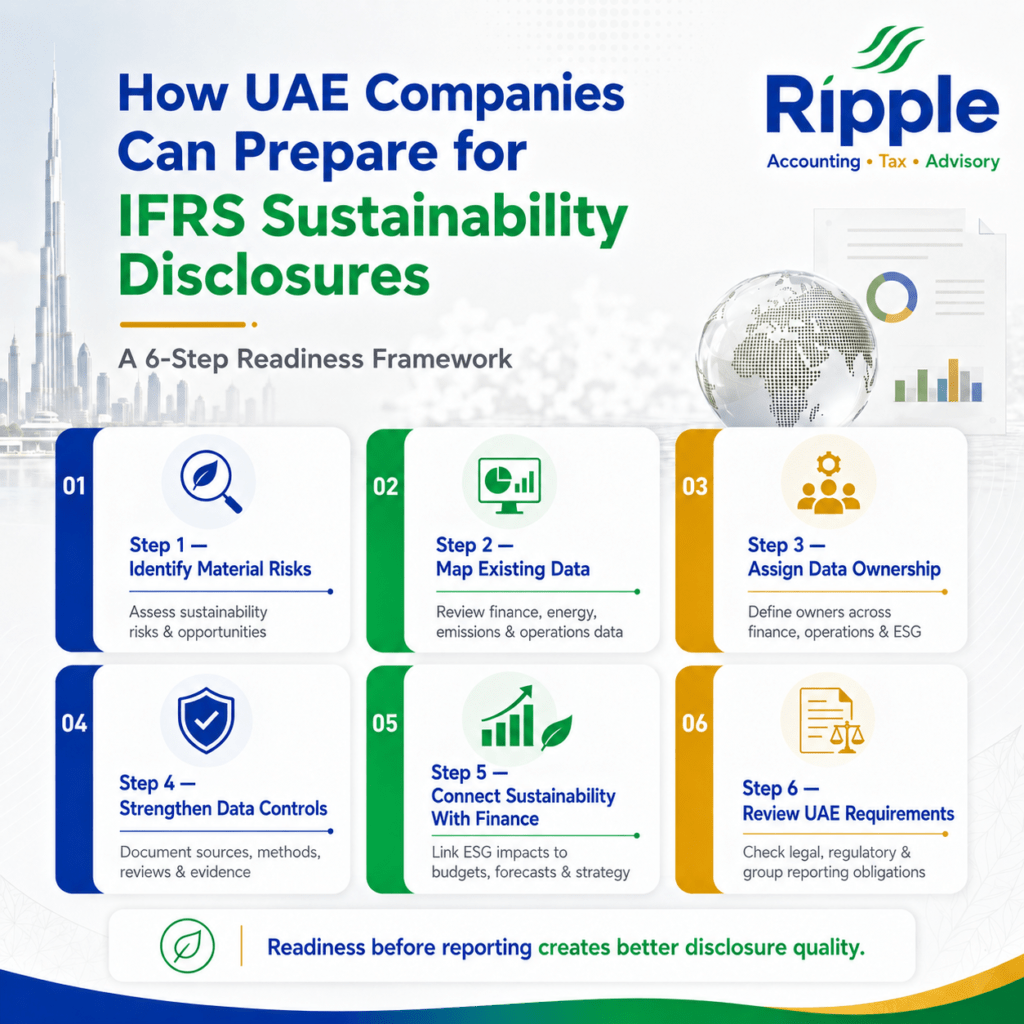
How UAE Companies Can Prepare for IFRS Sustainability Disclosures
A practical sustainability reporting UAE strategy should start with readiness rather than waiting until the reporting process becomes urgent.
Step 1 — Identify Material Sustainability Risks
Start by identifying sustainability-related risks and opportunities that could reasonably affect the company’s prospects. Consider the company’s sector, business model, assets, supply chain, geography, customers, financing, and strategic priorities.
Step 2 — Map Existing Data
Create an inventory of information that already exists across the organization.
This may include:
- Financial information
- Energy consumption
- Emissions data
- Operational records
- Procurement information
- Supply-chain data
- Risk registers
- Existing ESG information
This exercise often reveals data gaps before formal reporting begins.
Step 3 — Assign Data Ownership
Decide who owns each category of information.
For example:
- Finance → financial effects and reporting
- Operations → energy and operational data
- Procurement → supplier information
- Risk → climate and enterprise risks
- Sustainability → ESG data coordination
- Senior management → governance and strategic oversight
Clear ownership improves accountability and reduces duplicated work.
Step 4 — Strengthen Data Controls
Sustainability information needs reliable processes.
Companies should document:
- Data sources
- Calculation methods
- Assumptions
- Review procedures
- Approvals
- Supporting evidence
- Changes from previous reporting periods
A clear audit trail can make future review and assurance more efficient.
Step 5 — Connect Sustainability Data With Finance
Finance teams should work with sustainability and operational teams to understand potential financial effects.
For example, if climate risk could increase energy costs, the business may need to consider how that risk affects forecasts, budgets, investment decisions, and strategy.
Step 6 — Review Applicable UAE Requirements
Finally, businesses should determine which sustainability and financial reporting requirements actually apply to them.
Consider the company’s:
- Legal structure
- Listing status
- Industry
- Regulator
- Group reporting obligations
- Financing arrangements
- Applicable UAE requirements
This step is essential because IFRS Sustainability Standards provide a global baseline, while jurisdictional requirements determine how and where particular companies may need to apply them.
Common Challenges With Climate Reporting in the UAE
Companies often struggle with climate reporting because the required information sits across different departments.
Common challenges include:
- Incomplete historical climate data
- Different data sources and calculation methods
- Lack of clear internal ownership
- Difficulty measuring Scope 3 emissions
- Weak documentation
- Limited integration between finance and sustainability teams
- Inconsistent reporting processes
- Lack of internal controls
How Companies Can Overcome These Challenges
Businesses can improve their readiness by:
- Creating a central sustainability data inventory
- Assigning clear reporting responsibilities
- Documenting calculation methodologies
- Integrating climate risks into enterprise risk management
- Training finance and sustainability personnel
- Testing reporting controls before formal disclosure
- Performing a structured reporting-readiness assessment
The goal should be to build a repeatable process rather than prepare sustainability information as a one-time project.
Example: A UAE Company Preparing for Climate Reporting
Consider an illustrative UAE manufacturing company that operates energy-intensive facilities. Management identifies rising energy costs and extreme heat as potential climate-related risks. The company then collects electricity and fuel data, assesses how energy prices could affect operating costs, reviews the resilience of its facilities, and assigns responsibility for climate-related information.
The finance team works with operations to understand potential financial effects, while management reviews the company’s strategy and targets.
The example shows why climate data and financial reporting should not operate in separate silos. Reliable operational data becomes more useful when the business can explain its connection to risk, strategy, and financial performance.
IFRS Sustainability Reporting Checklist for UAE Businesses
Before developing sustainability disclosures, UAE companies can use this checklist:
- Identify applicable reporting requirements.
- Identify material sustainability risks and opportunities.
- Map relevant climate-related risks.
- Establish governance responsibilities.
- Collect relevant sustainability and climate data.
- Assess Scope 1, Scope 2, and relevant Scope 3 emissions.
- Review data quality and internal controls.
- Assess potential financial effects.
- Document assumptions and methodologies.
- Review disclosures before publication.
The IFRS Foundation provides implementation resources to help companies understand and apply IFRS S1 and IFRS S2.
What UAE Businesses Should Do Next
Businesses preparing for IFRS Sustainability, UAE reporting should start by understanding which requirements apply to their circumstances. Next, they can conduct a gap assessment, identify missing data, establish governance responsibilities, improve data controls, and connect sustainability information with financial planning and risk management.
Starting early gives finance and management teams more time to resolve data-quality problems and establish reliable reporting processes.
How Ripple Business Setup Can Support Your UAE Compliance Journey
Ripple Business Setup can help UAE businesses strengthen their accounting, financial, tax, and compliance processes while they prepare for evolving reporting expectations. A structured approach can help businesses organize financial information, improve reporting processes, coordinate accounting and compliance requirements, and identify areas that need further professional review. If your UAE business is preparing for sustainability, climate, or financial reporting requirements, speak with Ripple Business Setup to discuss your business structure and identify the appropriate next steps.
Contact Ripple Business Setup:
- Phone: +971 50 593 8101
- Email: info@ripplellc.ae
- WhatsApp: +971 4 250 0833
Frequently Asked Questions
What is IFRS Sustainability reporting in the UAE?
IFRS Sustainability reporting refers to sustainability-related financial disclosures prepared using the IFRS Sustainability Disclosure Standards developed by the ISSB. IFRS S1 covers sustainability-related risks and opportunities, while IFRS S2 focuses specifically on climate-related risks and opportunities. Applicability in the UAE depends on the company’s relevant regulatory and reporting requirements.
What are IFRS S1 and IFRS S2?
IFRS S1 provides general requirements for disclosing material sustainability-related financial information. IFRS S2 provides specific requirements for climate-related disclosures and is applied with IFRS S1. Both use the core areas of governance, strategy, risk management, and metrics and targets.
Is IFRS S2 only about carbon emissions?
No. IFRS S2 covers broader climate-related risks and opportunities. Its disclosure requirements include physical risks, transition risks, climate-related opportunities, strategy, resilience, emissions, metrics, and targets. Greenhouse gas emissions are therefore an important part of IFRS S2, but they are not the entire standard.
How does climate reporting affect financial reporting?
Climate-related risks can influence a company’s business model, strategy, financial position, financial performance, cash flows, financing, and cost of capital. IFRS S1 specifically requires companies to consider the current and anticipated effects of relevant sustainability-related risks and opportunities on these areas.
What are Scope 1, Scope 2 and Scope 3 emissions?
Scope 1 covers direct greenhouse gas emissions from sources controlled by a company. Scope 2 generally covers indirect emissions associated with purchased energy. Scope 3 covers other indirect emissions throughout the relevant value chain. IFRS S2 includes requirements for Scope 1, Scope 2, and Scope 3 emissions disclosures.
Do all UAE companies need to prepare IFRS sustainability disclosures?
Not necessarily. The applicable requirements depend on factors such as the company’s regulatory environment, listing status, industry, group structure, and other reporting obligations. Businesses should assess the specific requirements applicable to their circumstances rather than assuming that one rule applies to every UAE company.
How can a UAE company prepare for IFRS Sustainability Standards?
A company can begin by identifying applicable requirements, conducting a gap assessment, identifying material sustainability and climate risks, mapping available data, assigning ownership, strengthening controls, and connecting sustainability information with financial and risk-management processes.
Conclusion
IFRS Sustainability, UAE reporting, represents an important shift toward connecting sustainability information with business strategy, risk management, and financial decision-making. IFRS S1 provides the broader sustainability framework, while IFRS S2 focuses on climate-related risks and opportunities. For UAE businesses, early preparation can make it easier to identify data gaps, strengthen internal controls, and build reliable reporting processes. The most effective approach is to treat sustainability information as part of the wider financial and risk-management process, not as a separate reporting exercise.
Disclaimer: This article is for general informational purposes only and does not constitute accounting, tax, legal, or regulatory advice. UAE reporting requirements can vary by company and may change over time. Businesses should obtain professional advice based on their specific circumstances and applicable regulations.