


For UAE SMEs, having accurate financial information is essential for making confident business decisions. A bank balance alone cannot tell you whether the business is profitable, while a profit figure does not necessarily mean the company has enough cash to pay its suppliers, employees, or taxes. This is where management accounts for UAE SMEs become valuable. A well-prepared monthly report can bring together the Profit and Loss (P&L), Balance Sheet, Cash Flow Statement, and key business KPIs in one practical management report.
Unlike financial statements prepared primarily for external reporting, management accounts help business owners understand what is happening inside the business and decide what to do next.
What Are Management Accounts for UAE SMEs?
Management accounts are regular financial reports prepared for business owners, managers, directors, and other internal decision-makers. They usually summarise financial performance over a specific period, such as a month or quarter. The report can show revenue, expenses, profitability, assets, liabilities, cash flow, budgets, and business-specific KPIs.
For a UAE SME, management accounts may typically include:
- Profit and Loss Statement
- Balance Sheet
- Cash Flow Statement
- Budget versus actual results
- Accounts receivable and payable
- Key performance indicators
- Management commentary
The main purpose is simple: turn accounting data into useful business information.
The UAE Federal Tax Authority also expects businesses to maintain appropriate accounting records and supporting documentation. These records can include income statements, balance sheets, fixed-asset records, inventory information, and records of income and expenses.
Management Accounts vs Financial Statements
Management accounts and financial statements are related, but they serve different purposes. Management accounts are primarily designed for internal decision-making. Businesses can customise the format, reporting frequency, KPIs, and level of detail. Financial statements are prepared according to applicable accounting requirements and may be used for statutory, tax, financing, investor, or other external purposes.
For example, an SME owner may want a monthly management report showing sales by product, customer profitability, advertising costs, and cash collection. A formal financial statement may not provide that same level of management detail.
What Should a Management Accounts Template Include?
A useful management accounts template should provide more than a basic P&L. It should give management a complete view of profitability, financial position, and liquidity.
A practical UAE SME template can contain four main sections:
- Profit and Loss Statement
- Balance Sheet
- Cash Flow Statement
- KPI and variance dashboard
The exact format should reflect the company’s industry, size, accounting method, and reporting requirements.
Management Accounts Template: P&L Example for UAE SMEs
The Profit and Loss Statement shows how much revenue the business generated and how much it spent during a specific period.
A simple monthly P&L management accounts format could look like this:
| P&L Item | Monthly Amount |
|---|---|
| Sales Revenue | AED 150,000 |
| Cost of Sales | AED 60,000 |
| Gross Profit | AED 90,000 |
| Operating Expenses | AED 55,000 |
| Operating Profit | AED 35,000 |
| Finance Costs | AED 3,000 |
| Net Profit | AED 32,000 |
The report becomes more useful when management compares the current figures with the previous month, previous year, or budget.
For example, revenue may increase from AED 130,000 to AED 150,000, but if gross profit falls because supplier costs increased, the business owner needs to investigate the margin rather than celebrate revenue growth alone.
What to Include in the P&L
Depending on the business, the P&L can include:
- Revenue or sales
- Cost of goods sold
- Gross profit
- Salaries and wages
- Rent
- Marketing expenses
- Utilities
- Professional fees
- Technology expenses
- Depreciation
- Finance costs
- Corporate expenses
- Net profit
The categories should remain consistent from month to month so management can identify meaningful trends.
Balance Sheet Template for UAE SMEs
The Balance Sheet shows the company’s financial position at a particular date.
It generally includes three major areas:
Assets = Liabilities + Equity
Assets
Assets may include:
- Cash and bank balances
- Accounts receivable
- Inventory
- Property and equipment
- Prepayments
- Other business assets
Liabilities
Liabilities may include:
- Accounts payable
- Accrued expenses
- Bank loans
- Lease-related liabilities where applicable
- Other amounts payable
Equity
Equity can include:
- Share capital
- Retained earnings
- Current-period profit or loss
- Other applicable equity balances
The Balance Sheet helps management answer questions such as:
- How much cash does the business have?
- How much do customers owe?
- How much does the business owe suppliers?
- Is debt increasing?
- Is working capital under pressure?
A strong management accounts process should reconcile the Balance Sheet accounts rather than simply copying balances from the accounting system.
Cash Flow Statement: Why It Matters to SME Owners
Profit and cash are not the same thing. A business can report a profit while experiencing cash-flow pressure because customers may not have paid their invoices yet.
For example, imagine a Dubai-based service company records AED 100,000 of revenue and AED 70,000 of expenses during a month. It may report AED 30,000 profit, but if most customers have not paid, the company’s actual bank balance may remain low.
That is why cash flow management in the UAE should form an important part of monthly management reporting.
Operating Cash Flow
Operating cash flow can include:
- Customer collections
- Supplier payments
- Salary payments
- Rent
- Utilities
- Other operating expenses
Investing Cash Flow
Examples include:
- Buying equipment
- Purchasing business assets
- Selling fixed assets
- Other business investments
Financing Cash Flow
Examples include:
- Receiving a business loan
- Repaying loans
- Owner or shareholder funding
- Certain distributions to owners
A monthly cash-flow report can help management identify potential shortages before they become urgent.
Monthly Management Accounts Template for UAE SMEs
Many SMEs benefit from preparing monthly management accounts because monthly reporting creates a regular financial review cycle.
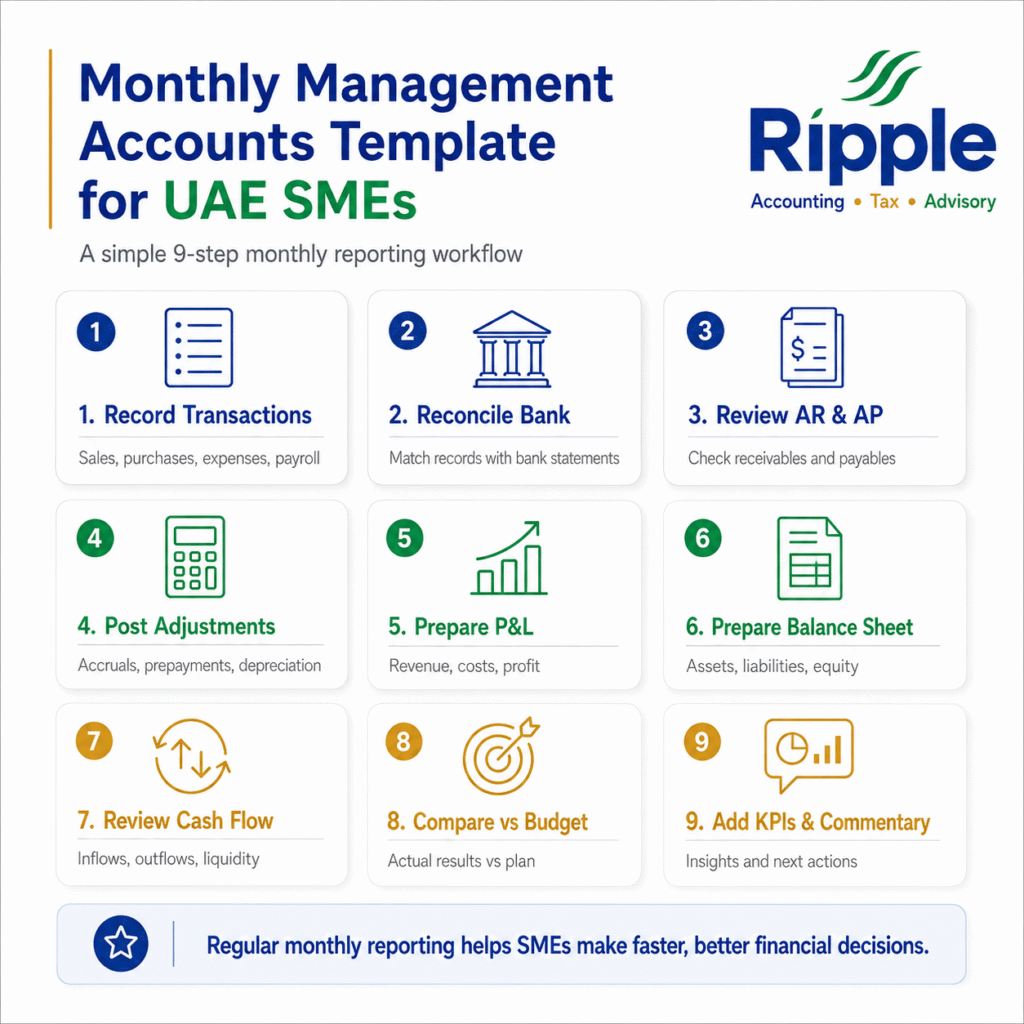
A practical monthly process can follow these steps:
Step 1: Record All Financial Transactions
Ensure sales, purchases, expenses, payroll, bank transactions, and other relevant transactions are recorded correctly.
Step 2: Reconcile Bank Accounts
Compare accounting records with bank statements and investigate differences.
Step 3: Review Receivables and Payables
Identify overdue customer invoices and upcoming supplier obligations.
Step 4: Record Necessary Adjustments
Review accruals, prepayments, depreciation, inventory, and other relevant adjustments.
Step 5: Prepare the P&L
Analyse revenue, direct costs, operating expenses, and profit.
Step 6: Prepare the Balance Sheet
Review assets, liabilities, and equity and ensure key accounts reconcile.
Step 7: Review Cash Flow
Compare cash inflows and outflows and identify upcoming liquidity requirements.
Step 8: Compare Actual Results With Budget
Look for significant differences between actual performance and the original plan.
Step 9: Add KPIs and Management Commentary
Explain why important figures changed and what management should do next.
How Often Should UAE SMEs Prepare Management Accounts?
There is no single reporting frequency that works for every business. Monthly management accounts are often useful for growing SMEs because they provide regular visibility without creating the reporting burden of weekly reporting. Quarterly reporting may be sufficient for a smaller business with relatively stable transactions. A fast-growing company, retailer, restaurant, or cash-intensive business may benefit from more frequent monitoring.
The right frequency depends on:
- Business size
- Transaction volume
- Cash-flow requirements
- Industry
- Number of locations
- Management needs
- Financing arrangements
The important point is consistency. A report prepared every month becomes much more useful when management can compare trends over time.
Management Accounts vs Bookkeeping: What Is the Difference?
Bookkeeping and management accounting are connected, but they are not the same.
Bookkeeping records financial transactions.
Management accounts interpret financial information for decision-making.
For example:
Bookkeeping → Reconciliation → Adjustments → Management Accounts → Analysis → Business Decision
If bookkeeping data is incomplete or inaccurate, management accounts may also become unreliable.
That is why SMEs should maintain proper accounting records before relying on financial reports for important decisions.
UAE VAT and Corporate Tax Considerations in Management Accounts
Management accounts can also support a business’s broader tax and compliance processes, although they should not be treated as a replacement for tax returns or professional tax advice.
The UAE’s Corporate Tax regime applies to financial years starting on or after 1 June 2023, subject to the rules and applicable exemptions.
VAT Accounting
VAT-related balances should be properly recorded and reconciled. A business may need to monitor:
- Output VAT
- Input VAT
- VAT payable or recoverable
- VAT-related adjustments
- Tax invoices and supporting documents
The FTA provides specific VAT guidance and requires registered businesses to comply with applicable VAT filing and payment requirements.
Corporate Tax Accounting
Accurate financial records can help businesses prepare for Corporate Tax calculations and maintain supporting documentation. The UAE Ministry of Finance has issued accounting standards and methods for Corporate Tax purposes, including rules concerning financial statements and accounting methods. Management accounts should therefore be prepared using reliable accounting data and appropriate accounting policies.
Important: Tax treatment can depend on the company’s facts, accounting method, transactions, and applicable UAE legislation. Businesses should obtain professional advice where required.
Common Management Accounts Mistakes Made by SMEs
A management report can lose its value when the underlying process is inconsistent.
Common mistakes include:
- Mixing personal and business expenses
- Not reconciling bank accounts
- Ignoring overdue customer invoices
- Recording transactions in the wrong accounting period
- Forgetting accruals or prepayments
- Focusing only on revenue
- Ignoring cash flow
- Not comparing actual results with budget
- Using inconsistent expense categories
- Preparing reports from incomplete accounting records
Another common mistake is treating management accounts as a collection of numbers rather than a decision-making tool.
The report should answer what happened, why it happened, and what management should do next.
How to Make Management Accounts More Useful
A good management accounts report should move beyond historical reporting.
Use Variance Analysis
Compare:
- Actual vs budget
- Current month vs previous month
- Current year vs previous year
For example, if marketing expenses are 25% above budget, management can investigate whether the additional spending produced additional revenue.
Track Financial KPIs
Depending on the business model, useful KPIs can include:
- Revenue growth
- Gross profit margin
- Net profit margin
- Operating expenses
- Accounts receivable days
- Accounts payable days
- Inventory turnover
- Cash balance
- Cash runway
- Budget variance
Add Management Commentary
Numbers alone do not always explain business performance. A short commentary can explain that revenue declined because of seasonality, gross margin fell because supplier prices increased, or cash improved because the company collected overdue invoices.
This turns financial reporting into practical management reporting.
Practical UAE SME Example: Using Management Accounts to Control Costs
Consider a Dubai trading company generating AED 500,000 in monthly revenue.
Its management accounts show:
- Revenue increased by 12%
- Gross margin decreased by 5%
- Supplier costs increased
- Customer receivables increased
- Bank cash declined
The headline revenue figure looks positive, but the complete report tells a different story.
Management could respond by:
- Reviewing supplier pricing
- Analysing customer-level margins
- Improving collection procedures
- Reviewing unnecessary operating expenses
- Forecasting upcoming cash requirements
Without monthly management accounts, these warning signs could remain hidden until the business faces a serious cash-flow problem.
Excel vs Accounting Software for Management Accounts
An Excel management accounts template can work for a small business with relatively straightforward transactions.
Excel may be suitable when:
- Transaction volume is low
- One or two people manage the accounts
- Reporting requirements are simple
- Management needs a customised internal dashboard
Accounting software may become more practical when:
- Transactions increase
- Multiple users need access
- The company needs automated reconciliations
- VAT reporting becomes more complex
- Management requires regular financial dashboards
- The business operates across multiple accounts or locations
A template is therefore a reporting framework, not a substitute for accurate bookkeeping and accounting systems.
What Should UAE SME Owners Review Every Month?
A monthly management review can include:
- Revenue performance
- Gross profit margin
- Net profit
- Operating expenses
- Bank balances
- Accounts receivable
- Accounts payable
- Cash flow
- Budget variance
- Inventory where applicable
- VAT-related balances
- Corporate Tax-related accounting considerations
- Key operational KPIs
Businesses should also review their accounting records and supporting documents regularly. The FTA has specific requirements concerning accounting records and commercial books, including requirements introduced and updated through its legislation and decisions.
How Ripple Business Setup Can Help With Management Accounts
Ripple Business Setup helps UAE businesses with practical business, accounting, tax, and compliance requirements. Its support can help SMEs organise financial records and improve visibility over business performance. Services can include bookkeeping, accounting support, VAT services, Corporate Tax support, financial reporting, and related business compliance requirements. For professional guidance on your business accounting needs, contact Ripple Business Setup at +971 50 593 8101 or info@ripplellc.ae. You can also visit ripplellc.ae to learn more about the available business and accounting services.
FAQs
What are management accounts for SMEs?
Management accounts are internal financial reports that help business owners and managers monitor profitability, financial position, cash flow, budgets, and KPIs. Businesses often prepare them monthly or quarterly.
What should management accounts include?
A typical report can include a P&L, Balance Sheet, Cash Flow Statement, budget-versus-actual analysis, receivables, payables, and relevant business KPIs.
How often should management accounts be prepared?
Many growing SMEs prepare management accounts monthly. Smaller or less complex businesses may use quarterly reporting, while businesses with fast-changing cash flows may need more frequent reporting.
Are management accounts the same as financial statements?
No. Management accounts are generally designed for internal decision-making and can be customised. Financial statements are prepared according to applicable accounting requirements and may serve external reporting, tax, financing, or statutory purposes.
What is the difference between P&L and management accounts?
A P&L is one component of management accounts. A complete management accounts report can combine the P&L with the Balance Sheet, Cash Flow Statement, KPIs, budget analysis, and management commentary.
Why is cash flow important for UAE SMEs?
Cash flow shows the movement of money into and out of the business. An SME can report a profit while experiencing cash shortages because customers have not yet paid their invoices or because significant expenses are due.
Can I prepare management accounts in Excel?
Yes. An Excel management accounts template can work for a small business with straightforward transactions. As transaction volume and reporting complexity increase, accounting software and professional support may provide better control.
Do management accounts include VAT?
They can include VAT-related balances and reconciliations, but management accounts should not be treated as a replacement for VAT compliance or VAT return preparation.
Do management accounts help with UAE Corporate Tax?
Yes. Accurate financial reporting can help businesses understand their financial performance and support the preparation of information required for Corporate Tax purposes. However, the final tax treatment depends on applicable UAE Corporate Tax rules and the company’s specific circumstances.
When should an SME outsource management accounting?
An SME may consider professional support when financial transactions become difficult to manage internally, management lacks timely financial information, the company is growing rapidly, or the business needs stronger accounting, VAT, Corporate Tax, or financial reporting processes.
Conclusion
A practical management accounts template for UAE SMEs should do more than list accounting figures. It should help owners understand profitability, financial position, liquidity, and the reasons behind important changes. The P&L explains whether the business is making money. The Balance Sheet shows what the business owns and owes. The Cash Flow Statement shows whether the company has enough liquidity to meet its obligations. When these reports are reviewed consistently alongside KPIs and budget comparisons, UAE SME owners can identify problems earlier, control costs, improve collections, and make more informed growth decisions. The goal of management accounts is ultimately simple: give business owners the financial information they need to make better decisions at the right time.
Disclaimer: This article provides general information about management accounts and UAE business accounting. It does not constitute legal, tax, accounting, or financial advice. UAE tax and accounting requirements can change, so businesses should verify the applicable rules and seek professional advice for their specific circumstances.