

Selling products through your own website in the UAE can give you more control over your brand, customer experience, and sales process. However, launching a website is not the same as legally operating an ecommerce business. If you plan to make commercial sales online, you need to align your business activity, licence, product requirements, payment setup, and ongoing compliance. The UAE Government states that an appropriate licence is required for ecommerce activities, and its current guidance covers both physical and digital products sold through websites, apps, social media, and digital marketplaces.
Do You Need a UAE Ecommerce Licence to Sell on Your Own Website?
Yes, businesses conducting ecommerce activities in the UAE need the appropriate licence and approvals. The UAE Government’s ecommerce guidance specifically states that online businesses must obtain the required licences and approvals from the relevant authority. Your website is simply the sales channel. The licence relates to the underlying business and its approved activities.
For example, imagine you want to launch a website selling skincare products to customers in Dubai. Registering a domain, building a Shopify store, and connecting Instagram to the website does not by itself establish the legal business structure needed for commercial ecommerce.
You should first determine:
- What products you will sell
- Which ecommerce or commercial activity applies
- Where the business will be established
- Whether your products need additional approvals
- How you will accept payments
- How inventory will be imported, stored, and delivered
This approach helps you build the online store around the business structure rather than trying to fix licensing issues after launch.
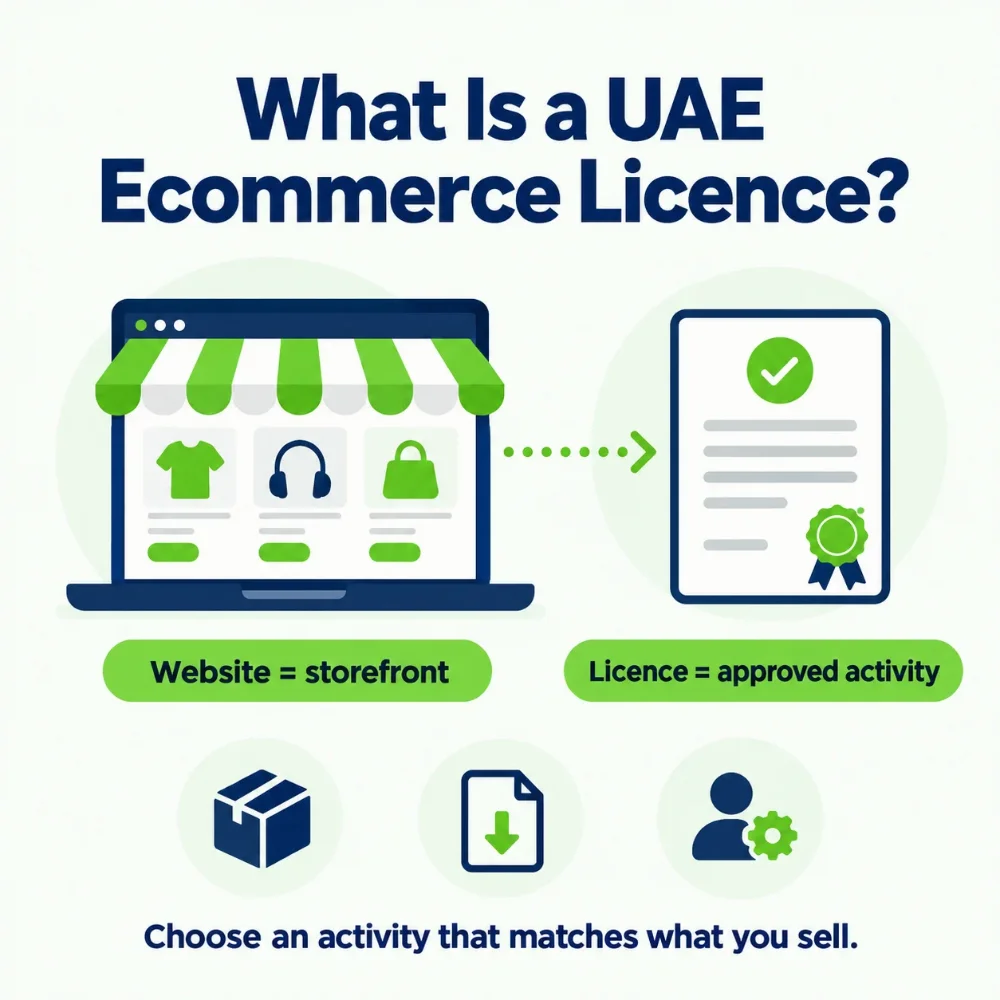
What Is a UAE Ecommerce Licence?
A UAE Ecommerce Licence is the business licensing arrangement that permits an entrepreneur or company to conduct approved ecommerce activities through online channels, subject to the applicable authority requirements. The exact licence structure can vary by emirate and jurisdiction. On the UAE mainland, the government explains that businesses generally need a commercial licence that includes an ecommerce activity. Some emirates may also offer specific ecommerce or individual ecommerce licence categories.
Free zones can also issue specialised licences for businesses selling products and services online.
Ecommerce Activity vs Owning a Website
This distinction is important.
A website is a digital storefront. It does not automatically define your legal business activity.
Your actual activity could involve:
- Selling physical products
- Selling digital products
- Providing online services
- Operating a specialised ecommerce business
- Importing and selling products
- Selling products under a private-label model
The appropriate eCommerce activity should reflect what your business actually does.
For example, a company selling physical consumer products may have different licensing and regulatory considerations from a company selling downloadable software or online consulting services.
How to Choose the Right UAE Online Store Licence
Choosing a UAE online store licence starts with your business model rather than the website platform you intend to use.
Before applying, answer four basic questions:
- What exactly will you sell?
- Who will buy from you?
- Where will you operate?
- How will you fulfil customer orders?
Choose Your Business Activity First
Your selected activity should match your intended commercial operations. For example, an entrepreneur planning to sell clothing through an independent website should identify the appropriate trading/ecommerce activity rather than simply choosing the cheapest available licence.
The same principle applies to businesses selling electronics, food, cosmetics, digital products, or other specialised goods.
Check Whether Your Products Need Approvals
An ecommerce licence does not automatically mean that every product is approved for sale. The UAE Government states that online traders must sell permitted products and obtain approvals for regulated or restricted products where required.
Depending on the product, you may therefore need to investigate:
- Product registration
- Import requirements
- Safety requirements
- Regulatory approvals
- Labelling requirements
- Storage conditions
- Other sector-specific permissions
Checking this before purchasing inventory can prevent costly delays.
Mainland vs Free Zone for an Online Store in the UAE
One of the biggest decisions during an online business setup is whether to establish the company on the mainland or in a free zone. Neither structure works identically for every ecommerce business. Your decision should reflect your customers, products, inventory, logistics, visa requirements, and intended operations.
Mainland Ecommerce Setup
For mainland businesses, the UAE Government states that online sellers need a commercial licence with an ecommerce activity from the relevant emirate’s economic department. A mainland structure can be relevant when your business model focuses heavily on selling directly into the UAE market.
For example, a business that holds local inventory and delivers products directly to customers across the UAE may want to examine mainland licensing alongside its logistics and commercial requirements.
Free Zone Ecommerce Setup
UAE free zones offer specialised online business licences for digital companies, startups, and ecommerce operations. The relevant free zone authority issues the licence according to its own activities and requirements. Free zone options can be particularly relevant for businesses considering international sales, digital operations, or a specialised ecommerce ecosystem. However, entrepreneurs should not assume that a free zone licence automatically gives them identical trading rights to a mainland company.
The UAE Government notes that free zone companies can operate within the free zone and internationally, while direct mainland sales may require a local distributor or additional approvals or arrangements depending on the circumstances.
What Should You Compare?
Before choosing a jurisdiction, consider:
- Target customers
- Product category
- UAE vs international sales
- Import requirements
- Warehousing
- Delivery model
- Office requirements
- Visa requirements
- Payment gateway requirements
- Banking
- Renewal and operating costs
This is more useful than choosing a jurisdiction based only on its advertised licence price.
Can You Sell Online in the UAE Without a Physical Shop?
An ecommerce business does not necessarily need a traditional retail shop simply because it sells physical products online. The UAE Government’s ecommerce framework recognises websites, mobile applications, social media platforms, and digital marketplaces as channels through which ecommerce transactions can take place.
However, the absence of a retail shop does not remove other business requirements.
You may still need to consider:
- The appropriate business activity
- Licensing requirements
- Office or facility requirements applicable to your setup
- Inventory storage
- Warehousing
- Product approvals
- Import procedures
- Payment processing
- Delivery and returns
Therefore, sell online in UAE legally should be understood as a complete business-compliance question, not simply a question about whether you have a website.
What You Need Before Applying for an Ecommerce Licence UAE
Good preparation can make the licensing process more straightforward.
Define Your Ecommerce Business Model
First determine how your store will operate.
Common models include:
- Holding your own inventory
- Buying products from UAE suppliers
- Importing products
- Private-label products
- Dropshipping
- Selling digital products
- Selling through your website alongside marketplaces
Each model can create different operational and compliance considerations.
Prepare Your Business Activity
Your activity should accurately describe what you intend to sell or provide. Avoid choosing an activity simply because its name sounds similar to your business idea. If your proposed activity is unclear, reviewing it with the relevant licensing authority before submitting the application can help prevent restructuring later.
Identify Product Approvals
If your products fall into a regulated category, investigate approvals before ordering stock. For example, a business selling ordinary fashion accessories may face different regulatory considerations from a business selling food, cosmetics, medical-related products, or other controlled goods.
Prepare the Required Documents
Depending on the jurisdiction and business structure, the licensing authority may request documents such as:
- Identification documents
- Proposed business name
- Business activity details
- Ownership information
- Application forms
- Other supporting documents applicable to the setup
Requirements can differ, so entrepreneurs should confirm the current document list with the relevant authority.
How to Get a UAE Ecommerce Licence for Your Own Website
A practical online business setup can follow this general sequence.
Step 1: Define Your Ecommerce Activity
Decide exactly what you will sell and how you will sell it.
Step 2: Choose Your Jurisdiction
Compare mainland and free zone structures based on your actual operating model.
Step 3: Select and Reserve Your Business Name
Choose a compliant business name and follow the applicable name reservation process.
Step 4: Submit the Required Documents
Provide the information and supporting documents requested by the licensing authority.
Step 5: Obtain the Licence
Once the application and approvals are completed, the relevant authority issues the business licence.
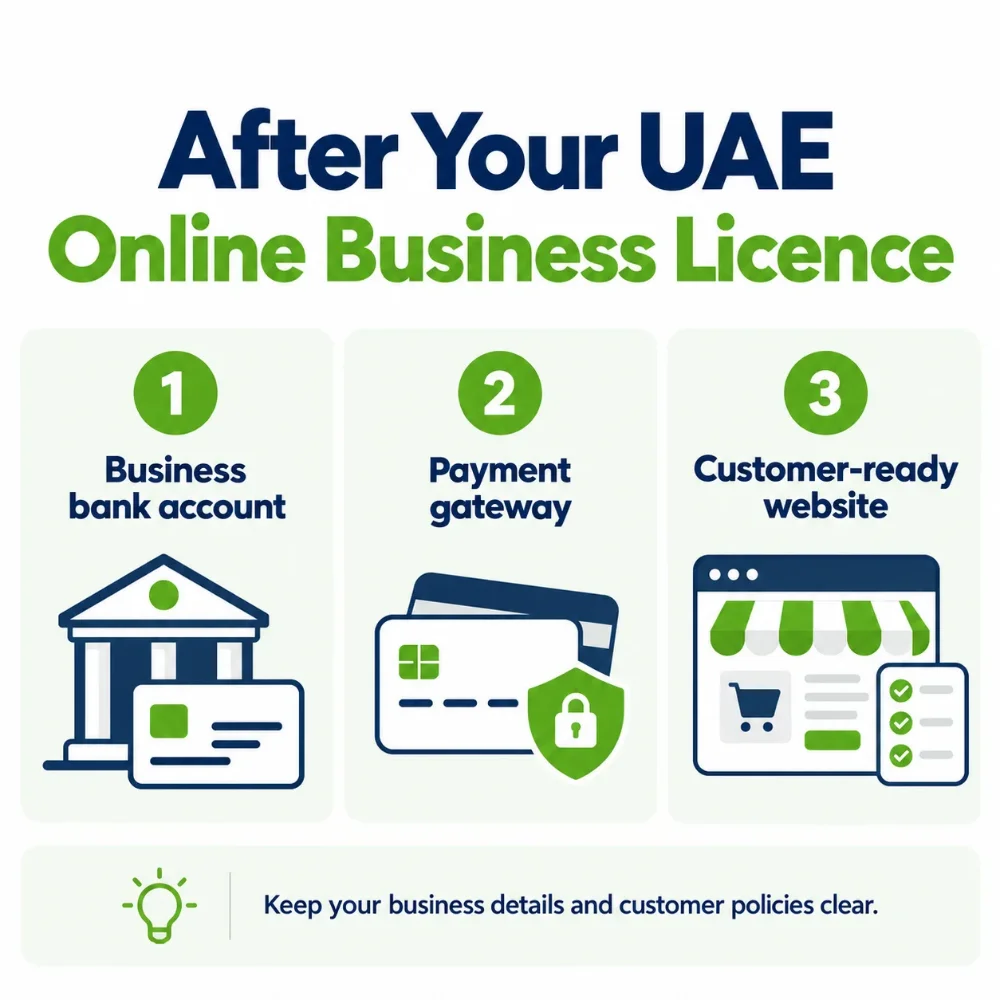
Step 6: Arrange Business Banking and Payment Processing
Your next steps may include preparing a business bank account and applying for a suitable payment gateway.
Step 7: Launch the Website
Only after the underlying business structure is ready should you treat your website as the active commercial sales channel.
This sequence helps connect the licence with the actual operation of your online store.
What Happens After You Get a UAE Online Business Licence?
Obtaining the licence is an important milestone, but it is not the end of your ecommerce setup.
Set Up a Business Bank Account
A business bank account can help separate company transactions from personal finances.
Banks may assess factors such as:
- Business activity
- Expected transaction volume
- Customer markets
- Website
- Source of funds
- Company documents
- Ownership structure
Keeping your business information consistent across your licence, website, bank application, and payment gateway can make the onboarding process more coherent.
Set Up a Payment Gateway
A payment gateway is separate from your business licence. Payment providers may review your business documents and website before approving online card payments. Your website should clearly communicate what you sell and provide relevant customer information.
Prepare Your Website for Customers
Before accepting orders, review:
- Product descriptions
- Prices
- Contact information
- Delivery information
- Return/refund policies
- Payment information
- Terms and conditions
- Privacy information
- Digital invoicing requirements
The UAE Government states that ecommerce traders must provide accurate information, protect customer data, comply with applicable marketing requirements, and provide customers with a clear digital invoice for each transaction.
Do You Need Product Approvals for an Online Store in the UAE?
Sometimes. The need for product approvals depends on what you sell and the rules applicable to that product category. The UAE’s ecommerce guidance states that online traders should sell only permitted products and obtain approvals for regulated or restricted products where required.
Importing Products vs Buying Locally
Your supply chain can also affect your setup. An entrepreneur importing products may need to consider customs, import documentation, product compliance, and storage arrangements. A retailer purchasing stock from an established UAE supplier may have a different operational process.
Therefore, determine the supply chain before finalising the ecommerce business structure.
Why Product Compliance Matters
Consider a simple example. A founder obtains an ecommerce licence and launches a website selling beauty products. After ordering stock, the founder discovers that the intended products require additional regulatory steps. The licence itself does not solve that product-specific issue.
Checking the product category before investing in inventory is therefore an important part of a practical ecommerce launch.
Can You Accept Online Payments With a UAE Ecommerce Licence?
Yes, an appropriately licensed ecommerce business can explore suitable online payment solutions, but obtaining a licence does not automatically guarantee payment gateway approval.
Payment Gateway Requirements
A payment provider may review:
- Business licence
- Company information
- Business model
- Website
- Products or services
- Bank account
- Expected transaction activity
- Customer markets
Requirements vary between providers.
Why Your Website Matters
A payment provider needs to understand what customers are paying for.
A website with incomplete product information, unclear contact details, missing policies, or inconsistent company information can create additional questions during onboarding.
It is therefore sensible to prepare your website before applying for payment processing.
UAE Ecommerce Licence Costs: What Should You Budget For?
There is no single universal price for a UAE Ecommerce Licence.
Your overall setup cost can depend on factors such as:
- Mainland or free zone jurisdiction
- Business activity
- Legal structure
- Number of shareholders
- Visa requirements
- Office or facility requirements
- Product approvals
- Banking
- Payment processing
- Accounting and tax compliance
- Annual renewal
This means the advertised licence fee should not be treated as the complete cost of starting an online business.
A better approach is to calculate the expected total setup and first-year operating requirements.
Common Mistakes When Starting an Online Store in the UAE
Avoid these common gaps when planning your ecommerce business:
- Choosing a business activity that does not match the actual operation
- Assuming a website alone makes commercial selling legal
- Selecting a jurisdiction only because it has a lower advertised price
- Ignoring product approvals
- Ordering inventory before checking regulatory requirements
- Assuming the business licence automatically provides payment gateway approval
- Mixing personal and business transactions
- Ignoring accounting and tax obligations
- Forgetting licence renewal
- Treating licence issuance as the final step
The UAE Government’s ecommerce framework also places responsibilities on online traders relating to permitted products, accurate information, customer data, marketing practices, and digital invoices.
Example: Setting Up a UAE Online Store
Consider a founder who wants to launch a UAE-based website selling home accessories.
The founder plans to:
- Purchase products from suppliers.
- Store inventory in the UAE.
- Sell directly through their own website.
- Accept online payments.
- Deliver products to UAE customers.
A practical planning process would start with identifying the appropriate commercial/ecommerce activity.
Next, the founder could compare mainland and free zone options based on the intended customer market, inventory arrangements, logistics, visa requirements, and other operational factors.
Before purchasing significant stock, the founder should also check whether the specific products require any additional approvals.
After licensing, the founder can prepare business banking and payment gateway applications and make sure the website contains clear product, delivery, payment, return, and business information.
This example illustrates why the licence is only one part of an ecommerce launch.
UAE Ecommerce Licence and Ongoing Compliance
An online store continues to have responsibilities after it starts trading.
These can include:
- Licence renewal
- Bookkeeping
- Financial record keeping
- Corporate Tax compliance where applicable
- VAT compliance where applicable
- Product compliance
- Business banking records
- Updating business information when circumstances change
Does an Ecommerce Business Have Tax Obligations?
Potentially, yes, depending on the business structure, activity, income, and applicable UAE tax rules.
For VAT, the Federal Tax Authority currently states that UAE-resident businesses generally must register when taxable supplies and imports exceed AED 375,000 over the previous 12 months or are expected to exceed that amount within the next 30 days. Voluntary VAT registration is available from AED 187,500 subject to the applicable rules.
Corporate Tax is separate from VAT. The Federal Tax Authority states that taxable persons are required to register for UAE Corporate Tax according to the Corporate Tax Law and implementing decisions.
For natural persons conducting a business, the FTA currently states that Corporate Tax applies where business turnover exceeds AED 1 million within the calendar year, subject to the applicable rules.
Because ecommerce businesses can have different structures and transaction patterns, it is important to assess tax obligations based on the actual business rather than assuming every online seller has identical requirements.
FAQs
Can I sell products through my own website in the UAE?
Yes, but commercial ecommerce activity requires the appropriate licence and approvals. The exact structure depends on the business activity, jurisdiction, products, and applicable requirements.
Is an ecommerce licence required to sell online in the UAE?
The UAE Government states that an appropriate licence is required to conduct ecommerce activities.
What is the difference between an ecommerce licence and a trade licence?
An ecommerce activity can form part of the relevant commercial licensing structure. The exact licence terminology and structure can vary by emirate and jurisdiction.
Can I get an ecommerce licence in a UAE free zone?
Yes. UAE free zones offer specialised online business licences for ecommerce and digital businesses, subject to the relevant free zone’s activities and requirements.
Can I sell to UAE customers from a free zone?
The answer depends on the business structure and how the sales are conducted. The UAE Government notes that direct mainland sales by free zone companies may require a local distributor or additional approvals or arrangements.
Do I need a physical shop for an online store?
Not necessarily. Ecommerce businesses can operate through digital channels, but the applicable licensing, office, storage, and operational requirements still need to be considered.
Do all products require additional approvals?
No. Requirements depend on the product. Regulated or restricted products may require additional approvals.
Can I use a payment gateway with a UAE ecommerce licence?
A licence allows you to establish the business, but payment gateway approval is a separate process. The provider may review your licence, website, products, banking information, and business model.
How much does a UAE Ecommerce Licence cost?
There is no single cost applicable to every business. The total depends on the jurisdiction, activity, legal structure, visas, office requirements, approvals, and other setup factors.
Can I operate an online store without a UAE company?
If you intend to conduct ecommerce activities in the UAE, you should assess the applicable licensing and legal requirements before starting commercial sales. The UAE Government requires appropriate licences and approvals for ecommerce activity.
How Ripple Business Setup Can Help!
Ripple Business Setup helps UAE businesses navigate company formation, government procedures, licensing, banking preparation, and ongoing compliance requirements. Our team can help review your proposed business activity, setup structure, documentation, and relevant visa or quota requirements before you proceed.
For an online store, this can also include considering whether a mainland or free zone structure fits your planned sales model and operational requirements.
Phone: +971 50 593 8101
Email: info@ripplellc.ae
WhatsApp: +971 4 250 0833
Website: www.ripplellc.ae
Final Takeaway
Getting a UAE Ecommerce Licence is only the starting point for building a compliant online store. Your business activity, jurisdiction, products, approvals, banking, payment gateway, website information, and ongoing tax and compliance responsibilities should all fit together.
If you plan to sell through your own website, start by defining exactly what you will sell, where your customers are located, how you will fulfil orders, and whether your products require additional approvals. Then compare the available mainland and free zone structures based on your actual business model.
Disclaimer: This article provides general information about UAE ecommerce licensing and online business requirements and does not constitute legal, tax, or regulatory advice. Licensing, approvals, and compliance requirements may vary based on the business activity, emirate, jurisdiction, and applicable regulations.