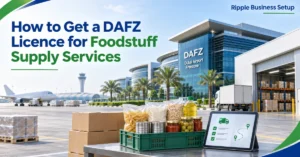


Starting a food supply business in Dubai can create opportunities to serve wholesalers, supermarkets, restaurants, hotels, catering companies, and corporate offices. However, entrepreneurs entering this sector must choose the correct business activity, obtain the appropriate trade licence, and understand the food safety requirements before starting operations. The Foodstuff Supply Services sector covers several activities, including wholesale food distribution, packaged food supplies, food import and export, and commercial food deliveries. Dubai Airport Free Zone (DAFZ) can be an option for businesses looking to operate close to Dubai’s international air cargo network and access regional and global markets.
However, obtaining a DAFZ licence involves more than registering a company. Businesses must also consider product approvals, food storage, transportation, customs procedures, and applicable regulatory permissions.
What Are Foodstuff Supply Services in DAFZ?
Foodstuff Supply Services involve supplying food products to businesses, retailers, and other commercial customers. Companies operating in this sector may purchase products from local manufacturers or international suppliers and distribute them to customers across approved markets.
In DAFZ, businesses can explore food-related trading activities subject to the free zone’s approved activity list and applicable regulatory requirements.
Common food supply business models include:
- Wholesale foodstuff supply: Purchasing food products in bulk and supplying them to retailers and distributors.
- B2B food distribution: Supplying packaged and processed food to commercial customers.
- Corporate pantry supplies: Delivering snacks, beverages, and essential food products to offices.
- HoReCa food supply: Supplying ingredients and food products to hotels, restaurants, and catering businesses.
- Food import and export: Importing food products from international markets and exporting or re-exporting them where authorised.
- Dry and frozen food trading: Distributing packaged, chilled, frozen, and non-perishable food products.
For example, an entrepreneur may establish a company that imports packaged snacks and beverages and supplies them to supermarkets, corporate offices, and hospitality businesses.
The exact licence activity must reflect the products and services the company intends to provide.
Why Choose Dubai Airport Free Zone for a Foodstuff Supply Business?
Dubai Airport Free Zone is located near Dubai International Airport, making it an attractive location for businesses involved in international trade and logistics.
Its location can support companies that depend on air cargo connectivity, international suppliers, and regional distribution networks.
Some potential advantages include:
- Strategic location: Proximity to Dubai International Airport supports access to international cargo networks.
- International trading opportunities: Businesses can explore import, export, re-export, and distribution activities under their approved licences.
- Foreign ownership: DAFZ permits 100% foreign ownership for eligible company structures.
- Business facilities: Available options include offices, warehouses, industrial spaces, and cold storage.
- Regional market access: Dubai provides commercial connections to the Middle East, Asia, Europe, and other international markets.
- Business support: DAFZ provides company formation and administrative services to support business operations.
These advantages may suit food importers, wholesale distributors, and businesses supplying packaged food to commercial customers.
However, entrepreneurs should assess their actual logistics requirements before selecting DAFZ. A company that mainly delivers perishable products to mainland customers may need a different storage and distribution arrangement from an importer that handles packaged, shelf-stable food.
Which Licence Do You Need for Foodstuff Supply Services in DAFZ?
Choosing the correct licence is one of the most important decisions when establishing a food supply business. The licence must cover the actual commercial activities the company intends to perform.
DAFZ offers different licence categories depending on the nature of the business. The main options to consider include the following.
Trade Licence
A trade licence is generally relevant to companies involved in buying and selling approved products. DAFZ states that its trade licence can cover activities such as importing, exporting, re-exporting, distributing, and storing specified products.
This option may suit businesses involved in:
- Wholesale foodstuff trading.
- Packaged food distribution.
- Importing and exporting approved food products.
- Supplying food products to commercial buyers.
General Trading Licence
A general trading licence may suit businesses that want to trade across multiple permitted product categories.
For example, a company may intend to trade packaged food, beverages, and other approved consumer products. It should confirm with DAFZ whether the proposed product categories and activities fit the licence.
Industrial Licence
An industrial licence may be relevant if the company plans to conduct approved light manufacturing, packaging, or assembly activities.
For example, a food business that plans to undertake packaging operations should confirm whether the proposed activity requires an industrial licence and additional food-related approvals.
Important: Do not assume that a service licence automatically covers food trading. Foodstuff supply businesses generally need the relevant trading activities included in their approved licence. Always confirm the exact activity classification with DAFZ before applying. DAFZ
What Are the Requirements for a DAFZ Foodstuff Supply Licence?
Before applying, entrepreneurs should prepare their company information and understand the requirements associated with their proposed business activities.
The requirements can vary depending on the company structure, shareholders, selected licence, and facility.
Common requirements include:
- Approved food trading or distribution activity.
- Proposed company or trade name.
- Passport copies of shareholders and directors.
- Shareholder and authorised representative details.
- Contact information and business address details.
- Business plan or activity description, if requested.
- Office or warehouse selection, depending on operational needs.
- External approvals or no-objection certificates, where applicable.
- Relevant food handling and storage arrangements.
Businesses importing or distributing food products should also plan for food safety compliance. They may need suitable storage arrangements, product registration, food establishment permissions, and supporting import documentation.
Preparing these details before submitting an application can help reduce unnecessary delays.
How to Get a DAFZ Licence for Foodstuff Supply Services: Step-by-Step Process
The DAFZ company formation process involves selecting a licence, choosing a company structure, arranging suitable premises, and completing the required registration formalities.
Here is how entrepreneurs can approach the process.
Step 1: Select Your Foodstuff Supply Business Activities
Start by identifying the exact products and services your company will handle.
For example, your proposed activities might include:
- Dry foodstuff trading.
- Packaged food distribution.
- Frozen food trading.
- Wholesale food supply.
- Food import and export.
- Commercial food distribution.
If you plan to supply hotels and restaurants, identify the food categories you intend to distribute. If your business will import frozen meat, your operational and regulatory requirements may differ from those of a company supplying packaged snacks.
Ask DAFZ to confirm the correct activity wording and whether any additional approvals apply.
Step 2: Choose Your DAFZ Company Structure
DAFZ offers different company formation structures, including a Free Zone Company, a Public Limited Company (PLC), and a branch of an existing foreign company.
Your choice depends on ownership, business objectives, and expansion plans.
- Free Zone Company: Suitable for entrepreneurs establishing a new business with individual or corporate shareholders.
- Branch: Suitable for an existing foreign company seeking to establish a presence in DAFZ.
- PLC: A structure to consider for businesses with broader corporate and shareholding requirements.
Review the eligibility and current incorporation requirements before choosing a structure.
Step 3: Reserve Your Trade Name
Choose a company name that reflects your proposed business activities and follows DAFZ naming requirements. Prepare alternative names in case your preferred option is unavailable or does not meet the authority’s naming guidelines.
The name should also avoid restricted words and misleading descriptions.
Step 4: Prepare and Submit the Required Documents
Prepare the shareholder information, identification documents, company details, and activity information requested by DAFZ. If an existing company plans to establish a branch, additional corporate documents may be necessary.
Check that all documents contain consistent information and that any required attestation or certification is completed.
Step 5: Arrange Your Business Facility
Select a facility based on your operational requirements.
DAFZ offers several facility options, including:
- Office space for administrative and trading operations.
- Warehouse and industrial space for approved storage and operational activities.
- Cold storage for businesses handling temperature-sensitive products.
For example, a company importing packaged dry food may require a different facility from a distributor handling frozen meat and dairy products.
Confirm the facility’s suitability, availability, and permitted use before signing the lease.
Step 6: Obtain Approvals and Complete Licence Issuance
DAFZ reviews the application and relevant supporting documents. Depending on the proposed activities, the business may also need approvals or NOCs from other government authorities. After completing the required formalities, including lease arrangements and applicable payments, the company can proceed towards licence issuance.
Once the licence is issued, complete any additional registrations and regulatory requirements before starting commercial food operations.
DAFZ’s published business setup process provides further information about licence selection, company structures, facilities, and registration formalities.
What Food Safety Approvals Are Required for Foodstuff Supply in Dubai?
Obtaining a DAFZ trade licence does not automatically satisfy every food safety requirement. Businesses handling food must also comply with the applicable local and federal regulations.
Dubai Municipality oversees important food safety functions in Dubai, including food establishment requirements, food product assessment, and imported food controls.
Depending on the company’s activities, relevant requirements may include the following:
- Food establishment registration.
- Food activity permits and approvals.
- Food product registration and label assessment.
- Import and re-export permissions.
- Health and phytosanitary certificates, where applicable.
- Halal certification for relevant products.
- Appropriate food storage and transportation arrangements.
- Food handler training and hygiene procedures.
Dubai Municipality Food Registration and Product Approval
Businesses importing or trading food in Dubai should check the applicable establishment registration and food product registration requirements. Dubai Municipality provides services for registering and assessing food items, obtaining food-related permits, and releasing imported food consignments.
For example, a company importing packaged biscuits from another country should check whether the product requires registration and label assessment before arranging its first shipment.
Businesses should also verify the relevant digital registration procedures before using Dubai’s food import and re-export services.
Food Labelling and Documentation Requirements
Food labels help authorities and consumers identify product ingredients, origin, and important safety information.
Depending on the product and applicable regulations, businesses may need to check:
- Product name and description.
- Ingredient information.
- Country of origin.
- Production and expiry dates.
- Storage instructions.
- Allergen declarations.
- Nutritional information, where required.
Imported food labels must meet applicable UAE and Dubai requirements, including relevant Arabic-language labelling rules.
Food Transportation and Storage Compliance
Food businesses must maintain suitable conditions throughout the supply chain.
For example, frozen food requires appropriate temperature-controlled storage and transportation. Packaged dry food also needs protection from moisture, contamination, pests, and unsuitable storage conditions.
Dubai Municipality publishes guidance on food establishment requirements and food transportation and delivery vehicles. Businesses should review the relevant requirements for their products and operations.
What Documents Are Required to Import Food Products into Dubai?
Food import documentation depends on the product category, country of origin, and shipment requirements.
Businesses should prepare the relevant documents before shipping products to Dubai.
Common documents include:
- Commercial invoice: Shows the transaction details and declared product value.
- Packing list: Provides details of the products, quantities, and packaging.
- Certificate of origin: Identifies the country where the products originated.
- Health certificate: Issued by the competent authority in the exporting country, where required.
- Halal certificate: Required for applicable meat, poultry, and products containing relevant animal ingredients.
- Airway bill or bill of lading: Provides shipment and transportation details.
- Product registration documents: Required where applicable.
- Additional certificates: Phytosanitary or other product-specific documents, depending on the shipment.
Dubai Municipality’s food import and re-export guidance identifies important documentation, including health certificates, packing lists, and halal certificates for relevant products.
What Facilities Do Foodstuff Supply Companies Need in DAFZ?
The right facility depends on the products a company handles and how it distributes them.
For example, a business supplying packaged snacks to corporate offices may operate differently from a company distributing frozen seafood to restaurants.
Consider these facility requirements:
- General warehouses: For suitable packaged and non-perishable food products.
- Cold storage: For products requiring refrigerated conditions.
- Freezer facilities: For frozen meat, seafood, and other frozen products.
- Handling areas: For approved food preparation, sorting, or packaging operations.
- Inventory systems: For tracking product quantities, batches, and expiry dates.
DAFZ lists office space, warehouse and industrial space, and cold storage among its facility options. However, businesses should confirm availability and whether a particular facility meets their food safety and operational requirements.
How Much Does a DAFZ Licence for Foodstuff Supply Services Cost?
The cost of obtaining a DAFZ licence depends on the company’s business activities, legal structure, selected facilities, and operational requirements.
Entrepreneurs should consider the following expenses when preparing their setup budget:
- Company registration fees: Charges associated with company incorporation.
- Licence fees: Costs based on the selected licence and approved activities.
- Office or warehouse rental: Depends on the selected facility and space requirements.
- Cold storage expenses: Additional costs for businesses handling chilled or frozen food.
- Visa and immigration charges: Depend on the number and type of visas required.
- External approvals: Additional charges may apply for food-related permissions, inspections, or certifications.
- Operational expenses: Include logistics, customs clearance, insurance, and inventory management.
For example, a company supplying packaged dry food may have different facility and operational expenses from a business importing frozen seafood.
Since DAFZ fees and facility packages can change, request a current quotation before finalising your business plan. You should also budget separately for food safety compliance and import-related expenses.
Common Challenges When Starting a Foodstuff Supply Business in DAFZ
Starting a food distribution business involves licensing, regulatory, and operational responsibilities. Entrepreneurs who overlook these requirements may face delays or unexpected expenses.
Some common challenges include:
- Incorrect business activity: Selecting an activity that does not cover the intended food products or distribution operations.
- Missing food approvals: Starting import procedures without checking applicable product and establishment requirements.
- Documentation problems: Submitting incomplete or inconsistent shipment documents.
- Storage limitations: Choosing facilities that cannot maintain the required food storage conditions.
- Labelling issues: Importing products without checking UAE food labelling requirements.
- Unexpected logistics costs: Underestimating cold chain transportation, warehousing, and customs expenses.
- Mainland distribution restrictions: Assuming a free zone licence automatically permits unrestricted mainland trading.
Businesses should review these requirements before purchasing inventory or entering supply agreements.
Is DAFZ the Right Choice for Your Foodstuff Supply Business?
DAFZ may suit entrepreneurs who want to establish an international food trading or distribution company in Dubai.
It can be worth considering for:
- International food importers and exporters.
- Wholesale foodstuff distributors.
- Packaged food and FMCG trading companies.
- Businesses supplying hotels, restaurants, and catering companies.
- Companies requiring airport-linked logistics and suitable storage facilities.
However, the right jurisdiction depends on your customers, product categories, storage needs, and distribution model.
If your main objective is to supply food products directly to mainland UAE customers, review the applicable mainland trading and distribution permissions before selecting your free zone.
How Ripple Business Setup Can Help You Obtain a DAFZ Licence
Setting up a foodstuff supply company requires careful planning, especially when selecting the right business activity, preparing incorporation documents, and understanding regulatory requirements.
Ripple Business Setup assists entrepreneurs and investors with UAE company formation and licensing procedures.
Our support can include:
- Guidance on selecting suitable DAFZ business activities.
- Assistance with company structure selection.
- Preparation of incorporation documents.
- Guidance on DAFZ licence application procedures.
- Assistance with understanding visa and facility requirements.
- Guidance on identifying additional food safety and regulatory approvals.
We help entrepreneurs approach their UAE business setup with greater clarity, from initial planning to licence application and ongoing compliance considerations.
For more information, visit our Dubai Airport Free Zone (DAFZ) company setup service.
You can also explore our related guide on Foodstuff Trading in Dubai Airport Free Zone.
Get Guidance on Your UAE Business Setup with Ripple Business Setup.
- Phone: +971 50 593 8101
- Email: info@ripplellc.ae
- WhatsApp: +971 4 250 0833
- Website: www.ripplellc.ae
FAQs
1. Can I start a foodstuff supply business in DAFZ?
Yes, entrepreneurs can explore food-related trading activities in DAFZ, subject to approval of the relevant business activities. Businesses must also meet applicable food safety, product registration, import, and distribution requirements before starting operations.
2. What licence is required for foodstuff trading in DAFZ?
A trade licence is generally relevant for approved food import, export, wholesale, and distribution activities. A general trading licence may also be suitable for businesses trading multiple approved product categories. Confirm the exact activity requirements with DAFZ.
3. Do food suppliers in DAFZ require Dubai Municipality approval?
Depending on their activities, food businesses may need Dubai Municipality establishment registration, food permits, product registration, and other applicable approvals. A DAFZ trade licence does not automatically replace these regulatory requirements.
4. Can a DAFZ company import and export food products?
Yes, a DAFZ company can explore food import, export, and re-export activities when these are covered by its approved licence. It must also follow applicable customs procedures, food safety requirements, and product-specific documentation rules.
5. Can mainland UAE food suppliers deliver directly to DAFZ offices?
Food suppliers may arrange deliveries subject to applicable licensing, access, food safety, and delivery requirements. Businesses should confirm the relevant permissions and procedures with the free zone and regulatory authorities.
6. Does DAFZ provide cold storage facilities for food businesses?
DAFZ lists cold storage among its available facility options. Businesses handling frozen, chilled, or perishable products should confirm availability, permitted use, storage specifications, and suitability for their food safety requirements.
7. How long does it take to obtain a DAFZ foodstuff supply licence?
The timeline depends on document preparation, business activity approval, company structure, facility arrangements, and any external regulatory approvals. Applicants should request an estimated processing timeline from DAFZ before planning their business launch.
Disclaimer: This article is intended for general informational purposes and does not constitute legal, financial, or regulatory advice. DAFZ licensing conditions, food safety requirements, government fees, and approval procedures may change. Confirm current requirements with the relevant UAE authorities before proceeding.