

Selling on Amazon in the UAE can be an attractive opportunity for entrepreneurs, e-commerce brands, and international investors. However, before launching an online store, sellers need to choose the right legal structure and obtain a suitable Amazon Seller Licence for their business activities. In the UAE, Amazon sellers commonly establish either a mainland company or a free zone company. Both structures can support e-commerce activities, but they differ in licensing arrangements, operating flexibility, office and warehouse options, visa packages, banking considerations, and overall costs.
The right choice depends on how you plan to run your Amazon business. A seller focused mainly on online fulfilment may have different needs from a company that plans to operate warehouses, hire employees, import products, and expand into other UAE sales channels.
Do You Need an Amazon Seller Licence in the UAE?
If you plan to operate an Amazon business commercially in the UAE, you generally need an appropriate UAE business licence covering your e-commerce or trading activities. An Amazon seller licence is not necessarily the official name of one specific government licence. Instead, sellers usually obtain a commercial or e-commerce licence with activities that match the products and business model they plan to operate.
Your business licence may support activities such as:
- E-commerce
- Online trading
- General or specific product trading
- Retail activities
- Import and export
- Electronic marketplace activities, depending on the licensing authority
Amazon also has its own seller registration and verification process. Amazon may request business, seller, billing, store, identity, and verification information depending on the seller’s business type and jurisdiction.
Therefore, obtaining a UAE trade licence and receiving Amazon seller account approval are related but separate processes.
What Is an Amazon Seller Licence in UAE?
The term Amazon Seller Licence generally refers to the UAE business licence that allows an entrepreneur or company to conduct commercial e-commerce activities and sell products through platforms such as Amazon.ae.
Depending on the business model, a seller may obtain the licence through:
- A UAE mainland licensing authority
- A UAE free zone
- An e-commerce-focused business setup package
- A commercial trading licence that includes suitable online selling activities
The exact activity matters.
For example, a seller trading electronics may need a different activity from a business selling clothing, cosmetics, food products, or general consumer goods.
Choosing a licence only because it is inexpensive can create problems later if the approved activity does not match the actual business.
Amazon Seller Licence Requirements in UAE
The exact Amazon seller licence requirements vary according to the licensing authority, business activity, shareholders, visa needs, and products being sold.
Typical company formation requirements can include:
- Passport copies of shareholders
- Proposed company name
- Selected business activities
- Licence application
- Incorporation documents
- Shareholder information
- Registered business address where required
- Visa-related documents where applicable
- Additional regulatory approvals for certain products
After forming the company, sellers may also need supporting documents for Amazon account verification and banking.
Additional Requirements for Certain Products
The business licence does not automatically allow unrestricted sale of every type of product. Some product categories may require registrations, approvals, certifications, or permits from relevant UAE authorities.
These can include products such as:
- Food and beverages
- Cosmetics
- Health products
- Supplements
- Medical-related products
- Electronics
- Children’s products
- Certain controlled or regulated consumer goods
Before purchasing inventory, sellers should confirm both the permitted trade activity and any product-specific compliance requirements.
This can help prevent customs delays, marketplace restrictions, or inventory that cannot legally enter or be marketed in the UAE.
Mainland vs Free Zone for Amazon Sellers
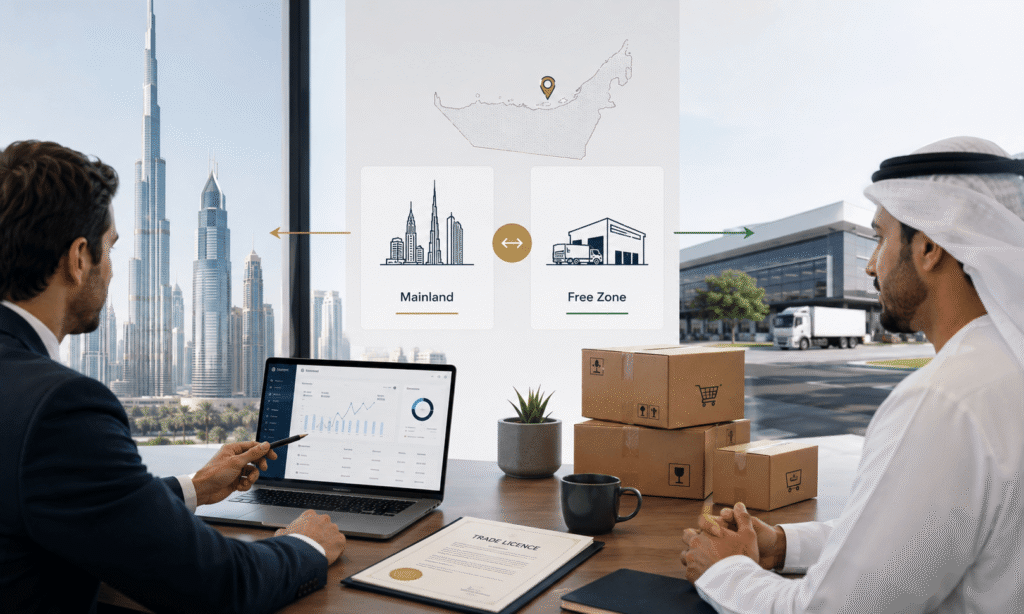
One of the most important decisions when obtaining an Amazon Seller Licence UAE is whether to establish the company on the mainland or in a free zone. Neither option is automatically better for every seller.
Mainland Company
A mainland structure can suit businesses that want broader operational flexibility within the UAE. It may work particularly well for sellers that plan to combine Amazon sales with other local commercial activities, warehousing, direct business relationships, physical retail expansion, or a larger UAE-based operation.
Free Zone Company
Free zones remain popular with online businesses because many offer e-commerce licences, flexible office solutions, visa packages, and relatively streamlined company formation. A free zone can be particularly attractive for entrepreneurs who want to operate a lean online business or use third-party fulfilment. However, rules differ between free zones. Sellers should review the exact licence activity and operating model instead of assuming that all free zones provide the same rights, costs, facilities, or tax treatment.
Amazon Seller Licence UAE: Mainland Option
A UAE mainland company can provide a strong foundation for businesses planning substantial operations in the local market. Amazon sellers can choose suitable trading or e-commerce activities depending on the products they intend to sell and the relevant licensing authority.
Benefits of a Mainland Amazon Business
A mainland company may offer advantages such as:
- Flexibility for wider UAE commercial operations
- Access to suitable office or warehouse arrangements
- Ability to hire employees subject to applicable requirements
- Options for expanding into offline sales
- Opportunities to work with local suppliers and customers
- Ability to build a larger UAE operating presence
The exact benefits depend on the company’s activity and licence.
When Should You Choose Mainland?
Consider a seller building a private-label household products brand. The company plans to import inventory, maintain warehouse stock in Dubai, hire a local sales and logistics team, sell through Amazon, supply other retailers, and eventually operate its own website and showroom.
For this business, a mainland structure may provide useful operational flexibility because Amazon represents only one part of the company’s broader UAE strategy.
Amazon Seller Licence UAE: Free Zone Option
A free zone Amazon seller licence may be suitable for startups, international entrepreneurs, and online-first businesses. Many UAE free zones offer activities covering e-commerce, online trading, and related commercial services.
Benefits of a Free Zone Amazon Business
Depending on the selected jurisdiction, advantages may include:
- Straightforward company formation
- Full foreign ownership
- Flexible licence packages
- E-commerce business activities
- Visa options
- Flexi-desk or office solutions
- Access to selected warehouse facilities
- Suitable structures for international entrepreneurs
However, businesses should evaluate the licence rather than choosing a free zone based only on its advertised starting price.
When Should You Choose a Free Zone?
Consider an entrepreneur who wants to launch a small Amazon FBA brand. The owner plans to source products internationally, use external logistics providers, keep staffing limited, and operate primarily through online marketplaces. A suitable free zone structure may offer a practical starting point for this business. However, the entrepreneur should still review import arrangements, warehouse requirements, customs procedures, banking, tax obligations, and the permitted business activity before incorporating.
Amazon Seller Licence Cost in UAE
There is no single fixed Amazon seller licence cost in UAE.
The total cost depends on several factors, including:
- Mainland or free zone jurisdiction
- Selected business activities
- Number of shareholders
- Number of visas
- Office or flexi-desk requirements
- Warehouse requirements
- Immigration charges
- Establishment card requirements
- Additional government approvals
- Licence duration and renewal fees
A low advertised licence fee may not represent the final cost of operating the business.
Other Costs Amazon Sellers Should Budget For
Amazon entrepreneurs should consider the complete operating budget, including:
- Trade licence fees
- Company registration
- Visa expenses
- Licence renewal
- Business bank account expenses
- Product sourcing
- Shipping
- Customs duties where applicable
- Warehousing
- Product registration
- Packaging
- Amazon marketplace fees
- Fulfilment costs
- Advertising
- Accounting
- VAT compliance
- Corporate Tax compliance
Evaluating the total cost of ownership provides a more accurate picture than comparing licence prices alone.
How to Start an Amazon Business in UAE
Starting an Amazon business becomes easier when you follow a structured process.
1. Choose Your Amazon Business Model
Decide whether you will operate through:
- Private label
- Wholesale
- Reselling
- Your own manufactured products
- Import and distribution
- Amazon FBA
- Seller-fulfilled orders
Your business model can influence the required licence, warehouse arrangements, logistics, and capital.
2. Select the Correct Business Activity
Your licence should accurately reflect what the business will do. For example, general e-commerce activities may not automatically cover every type of regulated product.
3. Choose Mainland or Free Zone
Compare both options based on:
- Business activity
- UAE market access
- Warehousing
- Visas
- Office requirements
- Banking
- Expansion plans
- Setup costs
4. Reserve Your Business Name
Select a compliant company name and complete the reservation process with the relevant authority.
5. Prepare the Required Documents
Submit shareholder identification documents, application forms, and other documents requested by the licensing authority.
6. Obtain Your Business Licence
Once approved, your company can receive its trade or e-commerce licence.
7. Arrange Visas if Required
Business owners and employees may apply for UAE residence visas subject to their licence package and immigration requirements.
8. Open a UAE Business Bank Account
Prepare incorporation documents and information explaining your business model, expected turnover, suppliers, customers, and source of funds.
9. Assess Your Tax Obligations
Review your VAT and Corporate Tax position from the beginning rather than waiting until the business grows.
10. Create Your Amazon Seller Account
Complete Amazon’s business information, seller details, billing, store setup, identity checks, and verification process. Amazon states that verification requirements vary depending on business type and country or region.
11. Source and Import Products
Confirm customs requirements and product approvals before importing commercial stock.
12. Launch and Manage Your Store
Once the legal, operational, and marketplace requirements are complete, you can list products and begin selling.
Amazon FBA Business in UAE: What Sellers Should Know
Amazon FBA, or Fulfilment by Amazon, allows eligible sellers to use Amazon’s fulfilment infrastructure for storing inventory and handling order fulfilment.
The model can reduce some operational work for sellers, but it does not remove the need for proper business planning.
Amazon sellers should still evaluate:
- Business licensing
- Product eligibility
- Inventory sourcing
- Import procedures
- Customs
- Product compliance
- Fulfilment fees
- Storage expenses
- Returns
- VAT treatment
- Accounting
Amazon FBA vs Self-Fulfilment
With Amazon FBA, the seller generally relies more heavily on Amazon’s fulfilment network. With self-fulfilment, the seller manages or outsources storage, packing, shipping, and returns independently. FBA may suit businesses seeking operational convenience, while self-fulfilment may give some sellers greater control over inventory and logistics.
The best model depends on margins, product size, order volume, storage needs, and customer expectations.
VAT for Amazon Sellers in UAE
Amazon sellers should understand UAE VAT obligations early because sales growth can quickly create registration requirements. For UAE-resident businesses, mandatory VAT registration generally applies when taxable supplies and imports exceed AED 375,000 during the previous 12 months, or when the business expects to exceed that threshold in the next 30 days.
Voluntary VAT registration may generally become available when taxable supplies, imports, or qualifying taxable expenses exceed AED 187,500 under the applicable conditions.
Amazon businesses should maintain accurate records for:
- Sales
- Imports
- Purchases
- Business expenses
- VAT invoices
- Credit notes
- Marketplace fees
- Logistics expenses
VAT treatment can become more complex when inventory, international suppliers, cross-border transactions, or designated zones are involved.
Professional tax advice may therefore be useful for businesses with complex supply chains.
UAE Corporate Tax for Amazon Sellers
Amazon sellers should also assess their UAE Corporate Tax position. The Federal Tax Authority states that taxable persons must register for UAE Corporate Tax and obtain a Corporate Tax Registration Number in accordance with the Corporate Tax law and relevant implementing decisions.
An Amazon business should therefore maintain proper accounting records from the beginning.
Relevant records may include:
- Revenue
- Cost of goods sold
- Amazon marketplace fees
- Advertising costs
- Shipping expenses
- Warehousing
- Salaries
- Professional fees
- Business assets
- Inventory records
Free zone businesses should not assume that incorporation in a free zone automatically removes all Corporate Tax obligations.
Corporate Tax treatment depends on applicable legislation, the company’s activities, income, and whether specific qualifying conditions apply.
Can Amazon Sellers Open a UAE Business Bank Account?
Yes. A properly established Amazon business can apply for a UAE corporate bank account. However, account approval remains subject to each bank’s compliance and risk assessment.
Banks may ask for information such as:
- Trade licence
- Certificate of incorporation
- Memorandum or constitutional documents
- Shareholder identification
- Business address
- Business plan
- Supplier information
- Expected turnover
- Source of funds
- Countries involved in transactions
- Amazon business information
The clearer the business model, the easier it can be to explain expected banking activity.
Sellers should keep company and personal transactions separate whenever possible to maintain clean financial records.
Mainland or Free Zone: Which Is Better for Amazon Sellers?
The answer depends on how you intend to operate.
Choose Mainland If:
A mainland company may suit you if:
- You want broader UAE operations
- You plan local physical expansion
- You need significant warehouse or office arrangements
- You plan to hire employees
- You want to sell through multiple UAE channels
- Amazon will be one part of a larger trading business
Choose Free Zone If:
A free zone may suit you if:
- You want a streamlined online setup
- Your business is primarily e-commerce based
- You need a suitable e-commerce activity
- You want flexible licence and visa packages
- You plan to rely heavily on third-party logistics
- You are an international entrepreneur establishing a UAE presence
Quick Decision Rule
Do not choose between mainland and free zone based only on the cheapest licence.
Instead, consider your products, fulfilment model, import process, customers, banking requirements, warehouse needs, visas, taxes, and plans for expansion.
Common Mistakes Amazon Sellers Make in UAE
Several avoidable mistakes can increase costs or delay an Amazon business launch.
1. Choosing the Cheapest Licence
The cheapest package may not include the activity, visa allocation, office solution, or operational permissions your business needs.
2. Assuming Every Free Zone Is the Same
Free zones differ in activities, licence packages, facilities, costs, customs arrangements, and business support.
3. Ignoring Product Approvals
A trade licence does not automatically approve regulated products for import or sale.
4. Mixing Personal and Business Transactions
This makes bookkeeping and tax compliance more difficult.
5. Ignoring VAT Until Sales Grow
Successful sellers can cross VAT thresholds quickly.
6. Overlooking Customs Requirements
Imported inventory may require customs registration, documentation, duties, or product approvals.
7. Ignoring Total Amazon Costs
Advertising, storage, returns, shipping, marketplace fees, and fulfilment costs can significantly affect profit margins.
8. Assuming a UAE Licence Guarantees Amazon Approval
Amazon independently verifies seller information and documents. A business licence does not automatically guarantee seller account approval.
Amazon Seller Licence UAE: Practical Examples
Example 1: Small Online Seller
An entrepreneur wants to sell accessories through Amazon.ae and operate without employees during the first year. A suitable free zone e-commerce setup may provide a relatively lean structure, provided the selected licence covers the activity and supports the intended logistics model.
Example 2: Growing Amazon FBA Brand
A seller imports branded household products in larger quantities and uses Amazon fulfilment. The company should evaluate licensing, product approvals, customs, VAT, inventory accounting, and fulfilment costs together rather than treating them as separate decisions.
Example 3: Multi-Channel UAE Retailer
A business wants to sell through Amazon, its own website, wholesale distributors, and eventually physical retail. A mainland structure may provide greater operational flexibility depending on the exact activities and expansion strategy.
Documents Needed for Amazon Seller Business Setup
Common documents can include:
- Passport copies
- Shareholder information
- Proposed trade name
- Business activity details
- Company application forms
- Incorporation documents
- Business address information
- Visa documents where applicable
- Additional approvals where required
The exact requirements depend on the jurisdiction, nationality, legal structure, licence activity, and business model.
How Ripple Business Setup Can Help With an Amazon Seller Licence UAE
Setting up an Amazon business involves more than simply obtaining a trade licence.
Ripple Business Setup can support entrepreneurs with different parts of the UAE business setup process, including:
- Mainland company formation
- Free zone company formation
- E-commerce licence assistance
- Business activity selection
- UAE residence visa processing
- Business bank account assistance
- VAT registration
- Corporate Tax support
- Accounting and compliance services
The goal is to select a structure that supports your current Amazon business while leaving room for future growth.
Ripple Business Setup
Phone: +971 50 593 8101
Email: info@ripplellc.ae
WhatsApp: +971 4 250 0833
If you are unsure whether a mainland or free zone company is more suitable for your Amazon business, getting professional guidance before choosing the licence can help you avoid unnecessary restructuring later.
FAQ
Do I need a licence to sell on Amazon UAE?
Businesses operating commercially in the UAE generally need an appropriate business licence covering their activities. The exact licence depends on your business model, products, jurisdiction, and how you sell.
Amazon also conducts its own account verification process.
What licence do I need to sell on Amazon in UAE?
Many sellers use an e-commerce or commercial trading licence with activities appropriate for online selling.
The exact activity should match the type of products and commercial operations conducted by the business.
How much does an Amazon seller licence cost in UAE?
The cost varies according to the jurisdiction, licence type, business activity, visas, office requirements, shareholders, warehouse requirements, and additional approvals.
Sellers should compare the complete annual business cost rather than only the advertised licence fee.
Is mainland or free zone better for Amazon sellers?
Neither option is universally better.
Mainland may suit businesses planning wider UAE operations, while a free zone can work well for lean e-commerce or internationally focused setups.
Your ideal choice depends on your operating model.
Can foreigners get an Amazon seller licence in UAE?
Foreign entrepreneurs can establish businesses in the UAE under various mainland and free zone structures, subject to the applicable licensing and ownership rules.
Can I start an Amazon FBA business in UAE?
Yes, businesses can use Amazon fulfilment options where eligible. However, sellers still need to address licensing, product compliance, imports, customs, tax, and accounting requirements.
Do Amazon sellers need VAT registration in UAE?
For UAE-resident businesses, mandatory VAT registration generally applies once taxable supplies and imports exceed AED 375,000 over the previous 12 months or are expected to exceed that amount within the next 30 days.
Do Amazon sellers pay UAE Corporate Tax?
Amazon businesses should assess their Corporate Tax position under UAE law. Taxable persons generally have Corporate Tax registration obligations, although the final tax treatment depends on the legal structure, activities, taxable income, and applicable provisions.
Can I open a UAE bank account for an Amazon business?
Yes. UAE companies can apply for corporate bank accounts, but approval depends on the bank’s compliance process, documentation, business model, expected transactions, and risk assessment.
Can I sell on Amazon UAE with a free zone company?
A free zone company may operate an Amazon business where its approved activities and operating structure support the intended e-commerce model.
Sellers should confirm the exact permissions with the relevant free zone before incorporation.
How long does it take to start an Amazon business in UAE?
The timeframe varies because company incorporation, visas, banking, product approvals, customs, and Amazon account verification can follow separate processes.
A simple business may complete some stages faster than a regulated product or complex import business.
Conclusion
Both mainland and free zone structures can provide viable routes for obtaining an Amazon Seller Licence in UAE. A mainland company may provide greater flexibility for businesses planning broader UAE operations, local expansion, warehousing, staffing, and multiple sales channels. A free zone can provide a practical option for online-first entrepreneurs seeking flexible business setup packages and e-commerce activities. The best structure ultimately depends on what you sell, where your inventory comes from, how orders are fulfilled, whether you need employees or warehouses, and how you plan to grow.
Disclaimer: This article is provided for general informational purposes only and does not constitute legal, tax, financial, or business advice. UAE licensing, VAT, Corporate Tax, Amazon policies, and regulatory requirements may change and can vary by business activity and jurisdiction. Always confirm the latest requirements with the relevant UAE authorities or a qualified professional before making business decisions.