

Food delivery platforms have become a major sales channel for restaurants, cafés, and cloud kitchens, but Food Delivery Commissions can make revenue accounting challenging. Businesses often receive a net settlement after platforms deduct commissions, refunds, discounts, and other charges. However, the amount deposited into the bank is not always the correct revenue figure. Understanding gross vs net revenue, IFRS 15, and proper platform reconciliation helps businesses maintain accurate financial records and reporting.
What Are Food Delivery Commissions?
Food delivery commissions are amounts charged by an online delivery platform for providing services connected with customer ordering, delivery, payment processing, marketplace access, or other platform-related activities. The exact commercial model varies between platforms. A restaurant may pay a percentage of the order value, a fixed fee, payment-related charges, promotional costs, or a combination of different charges.
For accounting purposes, businesses should separate these amounts rather than recording one net figure.
A typical transaction could look like this example:
| Transaction | Amount |
|---|---|
| Customer order value | AED 100 |
| Platform commission | AED 20 |
| Amount settled to restaurant | AED 80 |
The AED 80 settlement is a cash-flow figure. It does not, by itself, determine the restaurant’s revenue. The accounting team should review the platform agreement, order reports, commission statements, refunds, discounts, tax invoices, and settlement reports before deciding how to present the transaction.
Gross vs Net Revenue: What Is the Difference?
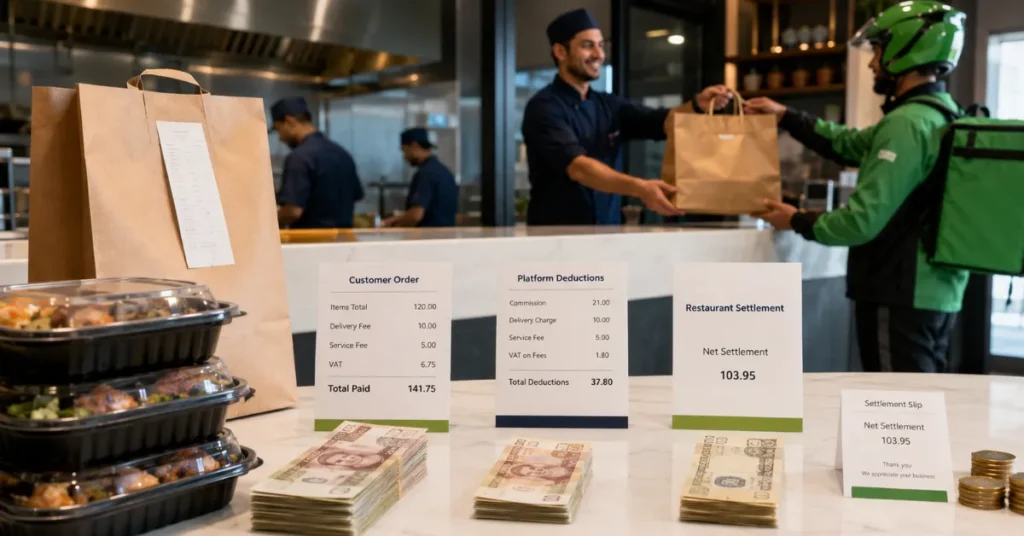
Gross revenue generally represents the consideration associated with the specified goods or services before separately recognised expenses such as a platform commission.
Net revenue represents the amount recognised as revenue after determining that certain amounts should not form part of the entity’s revenue. In a principal-versus-agent arrangement, an agent generally recognises only the fee or commission it earns.
This distinction matters because gross and net presentation can produce very different reported revenue figures even when the underlying cash received is identical.
What Is Gross Revenue?
When a business is the principal for the specified good or service, it generally recognises the gross amount of consideration to which it expects to be entitled.
For example, assume a restaurant controls the food supplied to the customer and the platform provides a marketplace and delivery service.
If the customer order is AED 100 and the platform commission is AED 20, a simplified gross presentation could be:
- Revenue: AED 100
- Platform commission expense: AED 20
- Cash or platform receivable: AED 80
The commission therefore appears separately from revenue.
What Is Net Revenue?
When an entity is acting as an agent for a specified good or service, it generally recognises the fee or commission it earns rather than the full amount paid by the customer. IFRS 15 requires an entity to assess the nature of its promise and whether it controls the specified good or service before transfer. An agent arranges for another party to provide the good or service and recognises the fee or commission for that service.
Therefore, businesses should not choose gross or net presentation simply because one method produces a higher or lower revenue figure.
Gross Revenue vs Net Revenue Example
Consider a restaurant with the following transaction:
| Item | Amount |
|---|---|
| Customer order | AED 100 |
| Delivery platform commission | AED 20 |
| Settlement received | AED 80 |
If the restaurant is the principal for the food supplied, the accounting may show AED 100 of revenue and AED 20 of commission expense.
If the entity is an agent for the specified goods or services, the revenue recognised may instead be limited to the applicable fee or commission.
The contractual facts and control assessment determine the appropriate presentation.
Principal vs Agent Under IFRS 15
The principal-versus-agent assessment is central to food delivery revenue recognition. IFRS 15 requires an entity to identify the specified goods or services in the arrangement and determine whether it controls those goods or services before they are transferred to the customer. If it controls them, it is the principal. If it arranges for another party to provide them, it is generally the agent.
This assessment can directly affect whether revenue appears on a gross or net basis.
When Is a Business the Principal?
A business is generally the principal when it controls the specified good or service before transferring it to the customer. For a restaurant, the food preparation and supply arrangement may require careful analysis of the specific promises made to the customer and the role of the delivery platform.
Relevant questions include:
- Who is responsible for fulfilling the promise?
- Who controls the specified good or service?
- Who bears relevant risks?
- Who has responsibility for customer fulfilment?
- What does the customer understand it is purchasing?
- What does the contract between the parties require?
IFRS 15 provides indicators that help an entity assess control, but the assessment focuses on the facts and circumstances of the arrangement rather than one isolated indicator.
When Is a Business the Agent?
An agent generally does not control the specified good or service before it reaches the customer. Instead, it arranges for another party to provide it. In that situation, the agent’s revenue generally represents the fee or commission earned for arranging the transaction.
This distinction is particularly important for businesses operating marketplaces or platforms where another party actually provides the underlying food, delivery, or other specified service.
Key Indicators to Consider
Businesses should document the factors considered in their principal-versus-agent assessment, including:
- Primary responsibility for fulfilment
- Control over the specified good or service
- Inventory or fulfilment risk
- Pricing discretion
- Customer complaint responsibility
- Refund obligations
- Contractual rights and obligations
- Relationship with the customer
IFRS materials note that principal-versus-agent judgements can significantly affect the amount of revenue recognised, making appropriate documentation important.
How to Account for Food Delivery Platform Commissions
Once the business determines the appropriate revenue presentation, it can design its accounting entries around the actual transaction flow.
A restaurant should avoid automatically posting the bank settlement as sales.
Instead, it should reconcile the following:
Customer orders → gross sales → discounts/refunds → platform deductions → VAT → settlement → bank receipt
This approach creates a clear audit trail.
Restaurant Acting as Principal
Suppose a restaurant records AED 1,000 in qualifying food sales through a delivery platform.
The platform deducts AED 200 as commission and transfers AED 800.
A simplified gross accounting approach could be:
Dr. Platform receivable — AED 800
Dr. Commission expense — AED 200
Cr. Food sales revenue — AED 1,000
When the platform transfers the settlement:
Dr. Bank — AED 800
Cr. Platform receivable — AED 800
The actual journal entries should reflect the contractual arrangement, tax treatment, timing, refunds, discounts, and other applicable accounting requirements.
Restaurant Acting as Agent
Where the business acts as an agent for the specified goods or services, revenue generally reflects the fee or commission earned from arranging the transaction rather than the entire customer consideration. The accounting entry should therefore reflect the entity’s actual performance obligation and entitlement.
This is why copying a standard restaurant journal entry into every delivery-platform arrangement can produce incorrect financial statements.
How Delivery Platform Fees Affect Restaurant Revenue
Food delivery platform fees can affect much more than the amount deposited into the bank.
They can influence:
- Reported revenue
- Commission expenses
- Gross profit margins
- Operating expenses
- Accounts receivable
- VAT records
- Management reporting
- Financial statement analysis
- Tax calculations
For example, two restaurants could receive the same AED 80,000 settlement from a platform but report different revenue figures if their contractual arrangements and accounting conclusions differ.
Management should therefore understand the difference between sales value, recognised revenue, platform deductions, and cash settlement.
How to Account for Discounts, Refunds and Cancellations
Discounts and refunds create another layer of complexity in restaurant accounting. The business should identify who funds the discount and who is responsible for the refund.
Customer Discounts
A discount may be funded by:
- The restaurant
- The delivery platform
- Both parties
- A promotional arrangement
For example, if a customer receives AED 20 off an AED 100 order, the accounting should not assume that the platform commission calculation and revenue treatment are the same in every contract.
The underlying agreement determines the appropriate treatment.
Customer Refunds and Cancellations
Restaurants should also reconcile:
- Cancelled orders
- Partial refunds
- Full refunds
- Failed deliveries
- Customer credits
- Platform adjustments
A platform settlement report can contain several adjustments that do not correspond directly to individual bank transactions.
Recording only the final settlement can therefore hide errors.
Promotional Credits and Coupons
Promotional arrangements require particular attention when the platform contributes to a customer discount.
The accounting team should identify:
- Who provides the discount?
- Who bears its economic cost?
- What does the customer pay?
- What does the platform pay?
- What does the contract say about commission calculations?
These answers help determine the appropriate accounting treatment.
VAT on Food Delivery Commissions and Platform Fees
UAE businesses also need to consider VAT separately from revenue recognition. The UAE Federal Tax Authority states that VAT is a transaction-based indirect tax and provides guidance, references, and public clarifications for taxpayers. For a restaurant using a delivery platform, the accounting team should distinguish between the restaurant’s food supply and the platform’s separate service or commission arrangement. Do not assume that the net bank settlement represents the taxable value of the restaurant’s supplies.
Businesses should review the relevant tax invoices and contractual arrangements and determine the applicable VAT treatment for each supply.
VAT registration is also important for UAE businesses. The FTA currently states that the mandatory VAT registration threshold is AED 375,000 of taxable supplies and imports, while the voluntary registration threshold is AED 187,500, subject to the applicable rules.
Because VAT treatment can depend on the specific transaction and contractual structure, businesses should use current FTA guidance when preparing their VAT records and returns.
Food Delivery Commission Reconciliation: A Practical Process
A strong reconciliation process helps restaurants identify missing sales, duplicate transactions, incorrect commissions, refunds, and settlement differences.
Match These Records Every Month
The accounting team should compare:
- POS sales reports
- Delivery platform order reports
- Platform settlement reports
- Commission statements
- VAT invoices
- Refund reports
- Cancellation reports
- Promotional adjustments
- Bank statements
The goal is to make sure the sales recorded in the accounting system agree with the underlying platform activity.
Simple Monthly Reconciliation Formula
A useful management reconciliation can start with:
Gross orders − commissions − refunds ± other adjustments = expected settlement
However, this formula is a reconciliation tool rather than a rule for determining revenue recognition. Revenue presentation still depends on the applicable accounting assessment.
Common Accounting Mistakes With Food Delivery Commissions

Restaurants often encounter the same accounting problems when they scale their online sales.
Common mistakes include:
- Recording only bank deposits as sales.
- Treating every platform deduction as a reduction of revenue.
- Assuming every commission arrangement requires net revenue.
- Ignoring the principal-versus-agent assessment.
- Mixing VAT amounts with revenue.
- Failing to reconcile refunds and cancellations.
- Recording platform-funded promotions incorrectly.
- Using settlement reports without reviewing the underlying contract.
- Failing to reconcile POS records with platform reports.
- Applying inconsistent accounting treatment across different platforms.
The solution is not simply to choose gross or net reporting. The business needs a documented accounting policy supported by the actual contractual terms and transaction flow.
Gross vs Net Revenue Example for a UAE Restaurant
Consider a fictional UAE restaurant that receives AED 100,000 of delivery orders during a month.
Assume:
- Gross order value: AED 100,000
- Platform commission: AED 25,000
- Customer refunds: AED 3,000
- Final settlement: AED 72,000
The restaurant should not automatically record AED 72,000 as revenue.
Instead, the accounting team should determine:
- What goods or services the restaurant promised to the customer.
- Whether the restaurant controls those goods or services before transfer.
- Whether the platform acts as an intermediary.
- How refunds are handled.
- How discounts affect consideration.
- Which platform charges represent separate services.
- How VAT applies to the relevant supplies.
If the restaurant is the principal for the specified food supply, a gross revenue presentation may be appropriate, with qualifying commissions and other adjustments accounted for separately. If the business is an agent for the specified goods or services, the revenue may instead represent the commission or fee earned.
The key point is simple: the AED 72,000 settlement does not determine the revenue figure by itself.
How Food Delivery Commissions Affect Financial Statements
Correct classification affects several financial statements and management reports.
Income Statement
Gross versus net presentation can change:
- Revenue
- Commission expenses
- Gross profit
- Operating margin
- Revenue growth percentages
This can significantly affect how investors, lenders, owners, and management evaluate the business.
Balance Sheet
Timing differences may create:
- Platform receivables
- Accrued expenses
- VAT balances
- Refund-related balances
- Other settlement adjustments
A platform may report an amount as payable while the restaurant has not yet received the cash.
Cash Flow
Cash receipts can differ from recognised revenue because platforms may deduct commissions, process refunds, hold amounts, or settle transactions on different dates.
This makes a platform-to-bank reconciliation essential.
Food Delivery Commission Accounting Checklist
Before finalising monthly accounts, businesses should:
- Review each delivery-platform agreement.
- Identify the specified goods or services.
- Assess principal versus agent.
- Document the control assessment.
- Review commission calculations.
- Check refunds and cancellations.
- Review customer discounts and promotions.
- Separate VAT from revenue and expenses.
- Reconcile platform reports with POS records.
- Reconcile platform settlements with bank receipts.
- Keep supporting statements and tax invoices.
- Apply the accounting policy consistently.
FAQ
Are food delivery commissions an expense or a reduction of revenue?
It depends on the accounting conclusion and the nature of the arrangement. Where a restaurant acts as principal and controls the specified goods or services, a platform commission may be accounted for separately from gross revenue. Where an entity acts as an agent, revenue generally represents the fee or commission earned.
Should restaurants record gross or net delivery sales?
Restaurants should determine the appropriate presentation based on the underlying arrangement and the principal-versus-agent requirements under IFRS 15 where applicable. The amount deposited by the platform is not, by itself, the deciding factor.
How do you record a delivery platform commission?
For a principal arrangement, a simplified example may record gross sales as revenue and the platform commission separately as an expense, with the remaining amount recognised as a receivable or cash settlement.
What is the difference between gross sales and net sales for restaurants?
Gross sales represent the customer consideration before relevant deductions, while net presentation may reflect the amount the entity is entitled to recognise as revenue after applying the appropriate accounting principles.
Does IFRS 15 require gross or net revenue?
IFRS 15 requires an assessment of whether the entity is acting as a principal or agent for the specified good or service. A principal generally recognises gross consideration, while an agent generally recognises its fee or commission.
How should restaurant delivery platform fees be reconciled?
Restaurants should reconcile POS sales, platform orders, commissions, discounts, refunds, VAT records, settlement statements, and bank receipts. This helps identify differences before the accounts are finalised.
Conclusion
Food delivery commissions can create significant accounting differences between gross sales, recognised revenue, platform deductions, and cash settlements. Businesses should not simply record the amount deposited by a delivery platform as revenue. The key accounting question is whether the business acts as a principal or agent for the specified goods or services. From there, businesses should consistently account for commissions, refunds, discounts, VAT, and settlement adjustments.
Disclaimer: This article provides general accounting and VAT information for educational purposes only. Revenue recognition and VAT treatment can vary based on contractual terms, transaction structures, and applicable UAE regulations. Businesses should obtain professional advice and refer to the latest guidance issued by the relevant authorities before making accounting or tax decisions.