

Dubai’s food scene has never been more exciting or more accessible. Over the past few years, food trucks in Dubai have moved from novelty to mainstream, drawing everything from local office crowds to international tourists looking for authentic street food experiences. With record-breaking tourism figures, a growing expat population, and a government that actively supports SME ventures, 2026 is shaping up to be one of the best years to launch a mobile food business in Dubai.
Whether you’re an aspiring chef, an experienced restaurateur looking to expand, or simply someone who wants to test a food concept with lower overhead, starting a food truck in UAE makes commercial sense. This guide walks you through the food truck license in Dubai, realistic startup costs, required permits, the best locations, and the most profitable concepts currently trending in the market.
Why Starting a Food Truck in Dubai Is a Smart Business Idea in 2026
Dubai’s mobile dining sector is riding a wave of cultural and economic tailwinds. Consumer preferences are shifting toward fast, affordable, high-quality food, exactly what a well-run food truck delivers. Add in the city’s event-heavy calendar and a hospitality infrastructure built for scale, and the market timing is genuinely compelling.
Rising Demand for Street Food and Mobile Dining
Tourism in Dubai hit new peaks in 2024 and 2025, and 2026 shows no sign of slowing. Visitors from Europe, South Asia, and the GCC are actively seeking local street food experiences rather than sit-down restaurants. Meanwhile, the city’s office lunch crowd, concentrated in areas like Business Bay, DIFC, and JLT, generates consistent weekday demand. Festivals like Dubai Food Festival, Ramadan Night Markets, and Expo-style exhibitions create seasonal spikes that food truck operators are uniquely positioned to capitalize on. Late-night food culture, particularly around Marina Walk and Kite Beach, adds yet another revenue window that bricks-and-mortar restaurants often miss.
Lower Setup Cost Than a Traditional Restaurant
Compared to opening a restaurant in Dubai, a food truck is significantly leaner in terms of upfront investment:
- No rent commitment: You operate from a vehicle, eliminating commercial lease obligations that can run AED 100,000–300,000+ annually
- Smaller team: Most trucks run effectively with 2–3 staff versus a restaurant’s 8–15+, cutting monthly payroll substantially
- Lower utility costs: No electricity, water, or maintenance bills tied to a fixed premise
- Location flexibility: You can follow footfall, moving between office zones, beach areas, and events as demand shifts throughout the year
Legal Requirements to Start a Food Truck in Dubai

Regulatory compliance is non-negotiable when launching a mobile food business in Dubai. The good news: the licensing framework is structured and, with the right guidance, entirely manageable. Here’s what you need to address.
Food Truck Business License in Dubai
To legally operate, you need a mainland trade license issued by the Department of Economy and Tourism (DET), formerly DED. The business activity must be classified under food trading or food services, typically listed as “mobile food cart trading” or a related activity code. You’ll also need food activity approval from the relevant authority. Choosing the right activity classification at the start prevents costly amendments later, so it’s worth getting professional advice before submitting your application.
Dubai Municipality Food Safety Approval
Dubai Municipality oversees food safety across all food businesses, and food trucks are subject to rigorous standards. Before you start trading, your vehicle must pass a hygiene inspection. Inspectors assess food storage temperatures, cross-contamination risks, handwashing facilities, waste disposal systems, and kitchen cleanliness. Your truck’s kitchen layout must comply with Municipality specifications; stainless steel surfaces, separate prep zones, and proper ventilation are baseline requirements. Staff handling food must hold valid food handler certificates, which you can obtain through Municipality-approved training programs.
RTA and Location Permits
The Roads and Transport Authority (RTA) governs where your food truck can park and operate. You cannot simply pull up anywhere and start selling; you need designated mobile vending zone permissions or event-specific permits. RTA issues location approvals for approved public areas, and for private locations (like a corporate campus or mall parking), you’ll need a NOC from the property owner. Seasonal permits are also available for major event periods, which can be a cost-effective way to operate during high-traffic months.
Step-by-Step Guide to Start a Food Truck in Dubai
Here’s a practical, sequential breakdown of how to get your food truck off the ground in 2026:
Step 1 – Choose Your Food Truck Business Concept
Your concept determines everything, from your target customer, your location strategy, your equipment needs, and your price point. Dubai’s market is diverse and open to experimentation. Popular categories currently performing well include gourmet burgers, specialty coffee trucks, South Asian street food (biryani, chaat, rolls), Arabic snacks, healthy grain bowls, and artisan dessert trucks. The strongest concepts are those with a defined niche, a memorable brand, and a menu tight enough to execute efficiently from a small kitchen.
Step 2 – Select a Business Name and Trade Activity
Business names in the UAE must comply with DET naming guidelines; they cannot include offensive terms, reference religious or political figures, or infringe on existing trademarks. Your name must also reflect your business activity broadly. Once chosen, you reserve the trade name through the DET portal before submitting your full license application.
Step 3 – Apply for the Trade License
Documents typically required for the license application include:
- Passport copy of all shareholders/owners
- UAE Visa copy (if applicable)
- Emirates ID
- No Objection Certificate (NOC) from your current employer, if you’re on a work visa
- Trade name reservation certificate
- Initial approval from DET for the business activity
Step 4 – Buy or Customize the Food Truck Vehicle
Your truck is both your kitchen and your brand’s most visible asset. Key considerations when sourcing or building out a truck include:
- Commercial kitchen equipment sized to your menu (fryers, griddles, espresso machines, etc.)
- Refrigeration units that meet the Municipality’s temperature standards
- A reliable generator or shore power hookup for event locations
- Full exterior branding wrap your truck is a moving billboard
Step 5 – Secure Permits and Final Inspections
Before your first day of trading, you’ll need a green light from Dubai Municipality (food safety inspection pass), RTA location permits for your intended vending spots, and any event-specific approvals if you plan to operate at festivals or private functions. Build at least four to six weeks into your timeline for inspections and approvals. Rushing this stage is one of the most common reasons new food truck owners face delays.
How Much Does It Cost to Start a Food Truck in Dubai?
Startup costs vary depending on whether you buy new or used, and how elaborate your build-out is. Here’s a realistic breakdown for planning purposes:
| Expense Type | Estimated Cost (AED) |
|---|---|
| Trade License (DET) | 12,000 – 18,000 |
| Municipality & RTA Approvals | 3,000 – 6,000 |
| New Food Truck Vehicle | 80,000 – 150,000 |
| Used / Refurbished Truck | 30,000 – 60,000 |
| Kitchen Equipment & Installation | 20,000 – 50,000 |
| Branding & Signage Wrap | 5,000 – 12,000 |
| Initial Inventory (Food & Supplies) | 5,000 – 10,000 |
| Total Estimated Range | AED 75,000 – 250,000+ |
Monthly operational costs, including staff salaries (AED 3,000–6,000 per person), fuel, ingredients, POS software, and maintenance, typically run between AED 15,000 and 30,000, depending on your volume and staffing model.
Best Locations for a Food Truck in Dubai
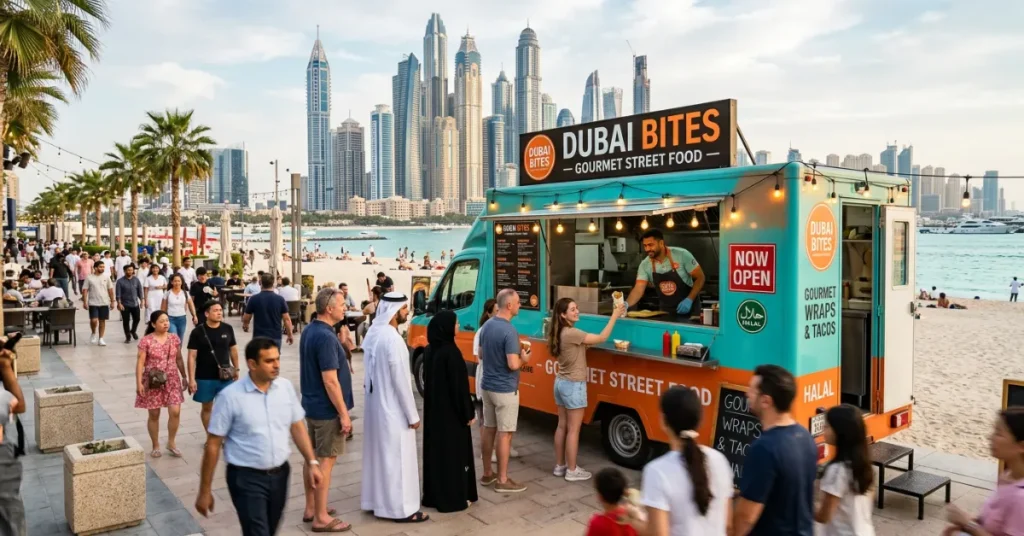
Location is everything in the food truck business. The right spot on the right day can mean the difference between a break-even week and a profitable one. Dubai’s best-performing areas for mobile food businesses include:
- Business Bay and DIFC: Heavy weekday lunch traffic from thousands of office workers; less active on weekends
- Dubai Marina and JBR Walk: Strong tourist and resident footfall, especially evenings and weekends year-round
- Jumeirah Lakes Towers (JLT): Established office cluster with consistent lunchtime demand and a food-truck-friendly community culture
- Kite Beach: A prime weekend and public holiday location with high energy and family crowds
- Exhibitions and Festivals: Dubai Food Festival, Ramadan markets, and GITEX-adjacent events create concentrated high-sales windows
- Tourist Hotspots: Areas near global attractions draw visitors willing to spend on food experiences
Best Food Truck Business Ideas for the Dubai Market
If you’re still deciding on a concept, these ideas are well-matched to Dubai’s current consumer preferences and demographics:
- Specialty Coffee Truck: High margins, fast service, repeat customers; ideal for office zones
- Gourmet Burger Truck: Evergreen category with strong appeal across nationalities
- Desi Street Food: Chaat, rolls, biryani cups; underserved in formal food truck formats with a massive built-in audience
- Arabic Snacks and Manakish: Culturally resonant, appeals to locals and curious visitors alike
- Dessert and Waffle Truck: Strong evening and weekend performer, especially near the beach and leisure areas
- Healthy Meal Truck: Growing segment driven by the city’s wellness-conscious professional demographic
Common Mistakes to Avoid When Starting a Food Truck in Dubai
Many new operators stumble on the same predictable issues. Being aware of them upfront saves time, money, and frustration:
- Skipping permit research: Operating without proper RTA or Municipality approval can result in fines and forced closure
- Poor location strategy: Choosing spots based on convenience rather than actual foot traffic data leads to slow sales
- Overspending on the truck build: An elaborate AED 200,000 truck doesn’t guarantee revenue; start lean and reinvest from profit
- Weak menu pricing: Pricing too low to attract customers often means operating below your cost of goods; do the math carefully
- Neglecting social media: Food trucks live and die by word-of-mouth and Instagram; your digital presence is your marketing department
Tips to Make Your Food Truck Business Successful in Dubai
- Build your Instagram presence before launch: Start posting truck build photos, menu teasers, and location previews weeks before you open
- Partner with delivery platforms: Talabat and Deliveroo partnerships extend your reach beyond your physical location
- Book event slots early: Apply for festival and corporate event catering spots months in advance; the best slots fill up fast
- Introduce a loyalty mechanism: Simple stamp cards or digital loyalty apps keep repeat customers coming back
- Rotate seasonal menus: Keeping the menu fresh during Ramadan, summer, and winter drives repeat visits and press coverage
Is a Food Truck in Dubai Profitable in 2026?
Yes, with the right concept, location, and operations discipline. A specialty coffee truck positioned near a busy office cluster can realistically serve 80–150 cups per day at AED 18–25 each, generating daily revenue of AED 1,500–3,750. A well-positioned fast-food truck at a weekend beach event can turn over AED 5,000–10,000 in a single day. These are not exceptional cases; they represent what operators achieve consistently once they’ve learned their locations and refined their service speed.
The business becomes more profitable as you reduce waste, tighten your menu, and build a loyal customer base that follows you across locations. Most operators report reaching break-even within 12–18 months and moving into consistent profitability in year two, provided they manage costs and marketing actively from day one.
“The food truck model works in Dubai because the city rewards a great product and a smart location. You don’t need a prime retail lease to build a loyal following; you need a consistent offering, a visible brand, and the discipline to show up in the right places.”
How Our Ripple Business Setup Team Supports Your Food Truck in Dubai
Starting a Food Truck in Dubai involves more than choosing a menu and buying a vehicle. We help simplify every step of the setup process, from selecting the right mainland business activity to securing Dubai Municipality approvals, food safety permits, and vehicle compliance requirements. Our team works closely with entrepreneurs, investors, and first-time business owners to reduce delays, avoid document rejections, and ensure a smooth launch process. Whether you need help with trade licensing, location approvals, or cost planning, we provide practical guidance tailored to Dubai’s 2026 regulatory environment. For expert assistance, contact Ripple Business Setup at +971 50 593 8101, email info@ripplellc.ae, or WhatsApp +971 4 250 0833.
Final Thoughts
Starting a food truck in Dubai in 2026 is one of the more accessible paths into the city’s competitive food and beverage industry. The regulatory framework is clear, the customer base is diverse and hungry for new experiences, and the overhead is dramatically lower than traditional restaurant setup costs. But success still requires planning, choosing the right concept, securing your licenses and permits correctly from the start, selecting high-footfall locations, and marketing your brand consistently from day one.
Disclaimer: This article is for general informational purposes only. Business setup costs, approvals, and licensing requirements may change based on updates from UAE authorities in 2026. Please confirm the latest regulations with the relevant government departments or professional advisors before proceeding.