Starting a dropshipping business can look simple: choose products, build an online store, promote them, and let a supplier handle fulfilment. But dropshipping in UAE involves more than setting up a Shopify store and finding a supplier.
If you plan to sell products online in the UAE, you need to understand licensing, permitted business activities, product approvals, consumer obligations, VAT, Corporate Tax, payments, and supplier arrangements. The UAE Government states that eCommerce businesses must obtain the appropriate licences and approvals from the relevant authority.
What Is Dropshipping and How Does It Work in the UAE?
Dropshipping is an eCommerce business model where you sell products without keeping physical inventory yourself. Instead, a third-party supplier stores and ships the product when a customer places an order through your online store.
For example, imagine you operate a UAE dropshipping store selling home accessories. A customer orders a product from your website for AED 150. You then purchase the product from your supplier for AED 90, and the supplier ships it to the customer. Your gross margin before shipping, payment, advertising, taxes and other costs is AED 60.
The basic process looks like this:
- Choose products and suppliers.
- Create your online store.
- List products with accurate descriptions and prices.
- Attract customers through digital marketing.
- Receive customer orders and payments.
- Send order details to your supplier.
- Supplier fulfils and ships the order.
- You manage customer service, returns and refunds.
The UAE’s eCommerce framework covers online sales through websites, mobile applications, social media platforms and digital marketplaces. It applies to both physical goods and digital products.
Is Dropshipping Legal in the UAE?
Yes, dropshipping is a legitimate eCommerce model. The important distinction is between using dropshipping as a business model and operating an online business without the required licence or approvals. The UAE Government states that online sellers must obtain the required licences and approvals, comply with applicable legal and technical requirements, sell permitted products and provide customers with accurate information.
Therefore, the goal should not be to find a way around licensing. Instead, choose the correct business activity and setup before accepting commercial orders.
Do You Need a Licence for Dropshipping in the UAE?
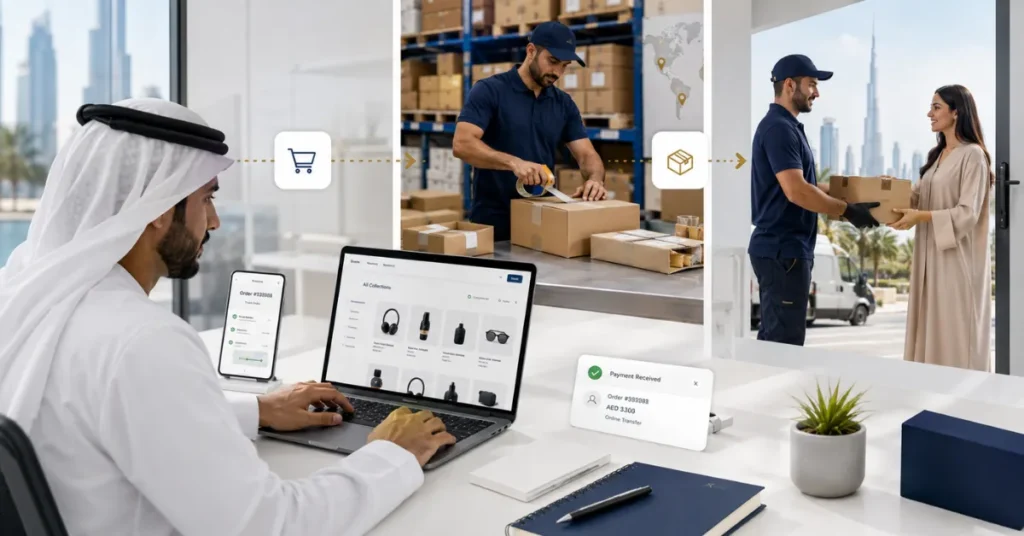
In most cases, yes. If you are operating an eCommerce business in the UAE, you need the appropriate licence and approvals for the activity you conduct. The UAE Government specifically states that businesses conducting eCommerce activities must have the appropriate licence. On the mainland, online sellers generally need a commercial licence that includes eCommerce activity, while free zones offer specialised online business licences.
Your exact requirements can depend on:
- The emirate where you establish the business
- Mainland or free zone structure
- Your selected business activity
- The products you sell
- Where your customers are located
- Whether products require additional approvals
- Your import, storage or fulfilment arrangements
Can You Do Dropshipping Without a Licence in the UAE?
This is one of the most important questions for beginners. Simply creating an Instagram account, Shopify store or TikTok shop does not automatically make commercial selling exempt from business licensing requirements. The UAE eCommerce framework covers sales conducted through websites and social media platforms, among other channels.
The safer approach is to determine your business activity and licensing requirements before launching paid sales.
Do not assume that having a supplier outside the UAE means your UAE-facing business has no obligations. Your business structure, sales activity, customers, imports and tax position can all affect your compliance requirements.
Which Licence Do You Need for Dropshipping in the UAE?
There is no single universal “dropshipping licence” that applies to every entrepreneur. Instead, you generally need a business licence that permits the relevant eCommerce or trading activity. The correct activity should reflect what your business actually does.
eCommerce Licence for Dropshipping
An eCommerce or commercial licence with the appropriate online selling activity can allow a business to operate an online store, subject to the terms of the issuing authority and any additional approvals.
The UAE Government notes that mainland businesses can obtain commercial licences that include eCommerce activity, while certain emirates may offer specific individual eCommerce licence categories. Free zones also offer specialised licences for online businesses.
Before selecting a licence, check:
- Exact business activity
- Permitted products
- Ownership structure
- Office or address requirements
- Visa eligibility
- Payment requirements
- Import and customs implications
- Mainland selling arrangements
- Renewal obligations
The UAE’s National Economic Register can also be used to check economic licences, business activities and trade-name availability.
Mainland vs Free Zone for Dropshipping
Both mainland and free zone structures can be relevant to an online business, but they are not identical.
| Factor | Mainland | Free Zone |
|---|---|---|
| Licensing authority | Relevant emirate authority | Relevant free zone authority |
| Online selling | Available with appropriate activity | Available with permitted activity |
| UAE market access | Depends on applicable rules and activity | Direct mainland sales may require additional arrangements |
| Setup options | Broad range of activities | Often specialised packages |
| Best choice | Depends on business model | Depends on business model |
The UAE Government explains that free zone companies can operate within their free zone and internationally, while direct mainland sales may require a local distributor or additional approvals or arrangements depending on the circumstances.
There is therefore no universal answer that a free zone is always cheaper or that mainland is always better. Choose based on your customers, products, operating model, and growth plans.
How to Start a Dropshipping Business in UAE Step by Step
Once you understand the licensing requirement, follow a structured setup process.
1. Choose Your Products and Business Activity
Start with the product, not the licence package.
Research:
- Customer demand
- Competition
- Selling price
- Supplier price
- Shipping cost
- Expected margin
- Return rate
- Product quality
- Product restrictions
The products you sell can affect your licensing and approval requirements. UAE eCommerce rules require sellers to offer permitted goods and obtain necessary approvals for regulated or restricted products.
For example, a store selling ordinary home accessories may face different considerations from a business selling products that require specific regulatory approval.
2. Choose Your UAE Business Jurisdiction
Decide whether mainland or a free zone fits your business. Consider where your customers are located, whether you plan to sell internationally, whether you need visas, how you will receive payments, and whether you expect to expand into other activities.
Do not select a jurisdiction based only on an advertised low starting price.
3. Obtain the Appropriate Business Licence
The licensing process generally starts with identifying the business activity and selecting an appropriate legal structure. For mainland businesses, the UAE Government lists steps such as identifying the business activity, selecting the legal form, registering the trade name, obtaining initial approval, arranging the business location, obtaining required approvals and paying the applicable fees.
The exact process varies according to the emirate, activity, and legal structure.
4. Set Up Your Online Store
After establishing the business structure, create your online store.
Your store should include:
- Clear product names
- Accurate descriptions
- Product images
- Prices
- Delivery information
- Return and refund policy
- Terms and conditions
- Privacy information
- Contact details
- Secure payment options
Platforms such as Shopify can simplify store management, but the platform itself does not replace your UAE business licensing requirements.
5. Select Reliable Dropshipping Suppliers
Your supplier directly affects your customer experience.
Before signing up, check:
- Product quality
- Supplier location
- Delivery times
- Stock availability
- Tracking capability
- Packaging
- Return process
- Refund policy
- Communication speed
Order samples before advertising products heavily. A product that looks excellent in a supplier’s catalogue may not meet your customer’s expectations.
6. Set Up Payments and Shipping
Choose payment and delivery arrangements that match your target market.
Your setup may involve:
- Payment gateway
- Business bank account
- Card payments
- Digital wallets
- Delivery partners
- International shipping
- Tracking systems
- Return handling
Keep business transactions separate from personal finances. This makes bookkeeping, tax reporting and financial management much easier as your store grows.
How Much Does Dropshipping Cost in the UAE?
There is no single fixed cost for starting a dropshipping business in the UAE.
Your actual budget can include:
| Cost Area | What It Covers |
|---|---|
| Business licence | Registration and licensing |
| Store | Platform, domain and technical setup |
| Products | Supplier and sample purchases |
| Shipping | Delivery and fulfilment |
| Payment processing | Gateway and transaction charges |
| Marketing | Advertising and content |
| Compliance | Accounting, tax and record keeping |
A common mistake is to compare only licence prices.
Suppose an entrepreneur spends AED 10,000 on business setup and then has no budget for product samples, advertising, website improvements or customer returns. The low licence price does not necessarily make the overall business inexpensive.
A realistic budget should consider both setup costs and operating costs.
VAT and Corporate Tax for Dropshipping Businesses in UAE
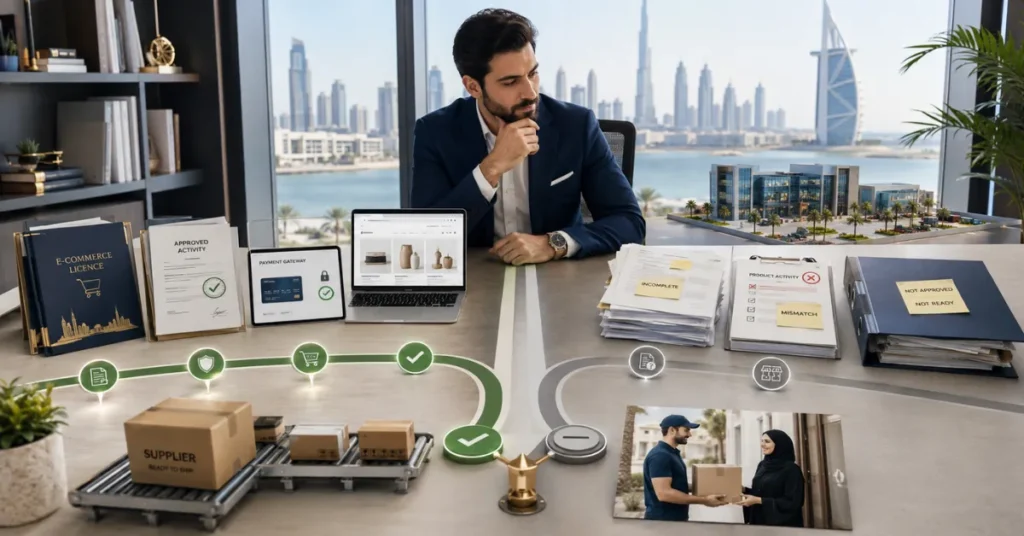
Taxes are another area where new online sellers often make mistakes.
VAT on Dropshipping in the UAE
For UAE-resident businesses, mandatory VAT registration generally applies when taxable supplies and imports exceed AED 375,000 over the previous 12 months or are expected to exceed that amount within the next 30 days. Voluntary registration may be available when the applicable threshold of AED 187,500 is exceeded.
However, dropshipping can involve cross-border transactions, imports and different supply arrangements. Therefore, do not determine your VAT position simply by looking at your Shopify sales total.
Maintain records of:
- Sales
- Supplier invoices
- Import documents
- Shipping charges
- Business expenses
- Customer refunds
- Payment gateway transactions
The Federal Tax Authority also states that VAT registration provisions can apply to persons conducting economic activity even where they do not hold a trade licence, which makes it important to consider tax obligations separately from licensing.
Corporate Tax for UAE Dropshipping Businesses
UAE Corporate Tax applies to taxable businesses under the applicable Corporate Tax legislation. The Ministry of Finance states that Corporate Tax applies to business profits for financial years starting on or after 1 June 2023.
Small businesses may also qualify for Small Business Relief where the relevant conditions are satisfied. The Ministry of Finance announced in August 2026 that the relief has been extended for tax periods ending on or before 31 December 2029, with the applicable revenue threshold remaining AED 3 million.
Do not assume that a small dropshipping store automatically pays no tax. Registration, filing and relief eligibility are separate questions that depend on the business’s circumstances.
Common Dropshipping Licensing Mistakes to Avoid in the UAE
Mistake 1: Selling Before Getting the Correct Licence
Launching paid advertisements and accepting commercial orders before confirming your licensing requirements can create avoidable compliance problems.
Mistake 2: Choosing the Wrong Business Activity
A cheap licence is not useful if it does not properly cover what you actually sell or do.
Confirm the permitted activity before paying for setup.
Mistake 3: Assuming Social Media Selling Needs No Licence
Selling through Instagram, TikTok, WhatsApp or another digital channel does not automatically remove eCommerce requirements. The UAE framework specifically covers social media-based commerce.
Mistake 4: Ignoring Product Restrictions
Some products may require additional approvals. Check this before listing them for sale.
Mistake 5: Choosing a Supplier Without Testing the Product
Poor quality, late deliveries and complicated returns can quickly damage your reputation.
Mistake 6: Ignoring VAT and Corporate Tax Records
Tax compliance becomes much easier when you maintain accurate records from the beginning.
Mistake 7: Mixing Personal and Business Money
Separate business income and expenses from personal transactions. This creates cleaner financial records and makes future accounting much easier.
Is Dropshipping Profitable in the UAE?
Dropshipping can be profitable, but profitability is not guaranteed.
Your actual profit depends on:
- Product margin
- Supplier pricing
- Advertising costs
- Shipping
- Payment fees
- Refunds
- Returns
- Customer acquisition costs
- Repeat purchases
For example, suppose you sell a product for AED 150.
Your simplified calculation could look like this:
AED 150 selling price
− AED 80 product cost
− AED 20 shipping
− AED 5 payment and transaction costs
− AED 25 advertising cost
= AED 20 remaining before other business expenses and taxes
This example shows why a high selling price does not automatically mean high profitability.
A successful dropshipping business in UAE needs strong product selection, reliable fulfilment, and disciplined cost management.
How to Stay Compliant After Launching Your UAE Dropshipping Business
Getting the licence is only the beginning.
Create a simple compliance routine:
- Keep sales invoices and supplier records.
- Monitor turnover for VAT purposes.
- Maintain accurate business expenses.
- Track refunds and returns.
- Keep payment gateway statements.
- Check product approval requirements.
- Renew your business licence on time.
- Maintain separate business finances.
- Review Corporate Tax obligations.
- Keep customer and business information secure.
UAE eCommerce businesses also have consumer-facing responsibilities. The UAE Government states that online sellers must provide accurate information, protect customer data, and issue digital invoices. Consumer protection requirements also cover information such as licensing details, product information, payment terms, warranties, and other relevant information.
How Ripple Business Setup Can Help With Your UAE Dropshipping Business
Starting a dropshipping business in the UAE involves more than creating an online store. Ripple Business Setup helps entrepreneurs understand their business setup options, select an appropriate licence and navigate the company formation process with greater confidence. From choosing a suitable jurisdiction to understanding licensing, accounting, VAT and Corporate Tax requirements, the team can help you avoid common setup mistakes and establish your online business on the right foundation.
If you are planning dropshipping in UAE and need guidance with business formation or compliance, contact Ripple Business Setup for professional assistance.
Contact Ripple Business Setup:
- Phone: +971 50 593 8101
- Email: info@ripplellc.ae
- WhatsApp: +971 4 250 0833
- Website: ripplellc.ae
FAQ
Is dropshipping legal in the UAE?
Yes. Dropshipping is a legitimate eCommerce model. However, businesses selling online in the UAE must comply with applicable licensing, regulatory, product, and consumer requirements.
Do I need a licence for dropshipping in the UAE?
If you are operating an eCommerce business in the UAE, you generally need the appropriate licence and approvals for your business activity. The exact licence depends on your structure, jurisdiction, and products.
Can I start dropshipping without a licence in the UAE?
You should not assume that you can commercially operate an online store without the required licence. UAE eCommerce rules apply to online sales through websites, social media and digital marketplaces.
How much does a dropshipping licence cost in the UAE?
There is no universal price. Costs vary according to the emirate, licensing authority, business activity, legal structure and selected package. Consider the full setup and operating costs rather than comparing licence fees alone.
Is Shopify dropshipping legal in the UAE?
Using Shopify as an eCommerce platform does not itself determine whether your business is compliant. You still need to meet applicable UAE licensing, tax, consumer and product requirements.
Do dropshipping businesses need VAT registration in the UAE?
A UAE-resident business generally must register when its taxable supplies and imports exceed AED 375,000 under the applicable rules. Voluntary registration can be available above AED 187,500. Cross-border transactions can require additional analysis.
Do I need a UAE bank account for dropshipping?
Your payment and banking requirements depend on your business structure and payment providers. A dedicated business account can make it easier to track sales, expenses and supplier payments.
Can foreigners start a dropshipping business in the UAE?
Foreign entrepreneurs can establish businesses in the UAE, subject to the applicable licensing, ownership, legal structure and regulatory requirements. The best structure depends on the planned activity and business model.
Final Checklist Before Starting Dropshipping in UAE
Before launching your store, make sure you have:
- Selected a suitable product niche.
- Confirmed the appropriate business activity.
- Selected mainland or free zone.
- Obtained the required business licence.
- Checked whether products require additional approvals.
- Selected and tested reliable suppliers.
- Built your online store.
- Set up payment and delivery arrangements.
- Created clear return and refund policies.
- Reviewed VAT requirements.
- Reviewed Corporate Tax obligations.
- Set up proper financial records.
- Separated personal and business finances.
Start Your Dropshipping Business in the UAE the Right Way
Dropshipping in UAE can be an attractive way to build an online business, but the easiest way to create problems is to treat licensing and compliance as an afterthought. Start by identifying your actual business activity, then choose the appropriate jurisdiction and licence. After that, build your store, verify suppliers, establish payment and fulfilment processes, and keep proper financial records from day one.
If you are unsure which setup fits your dropshipping model, consider obtaining professional UAE business setup and tax advice before committing to a licence or launching sales.
Disclaimer: This article provides general educational information about dropshipping in UAE and should not be treated as legal, tax, or financial advice. UAE licensing, eCommerce, VAT and Corporate Tax requirements can depend on the specific business structure, activities, products and transactions. Always confirm current requirements with the relevant UAE authority or a qualified professional before establishing or operating your business.