IFRS 18 Readiness, UAE Companies is becoming an important financial reporting consideration as businesses prepare for changes to the presentation and disclosure of financial performance. IFRS 18, Presentation and Disclosure in Financial Statements, is effective for annual reporting periods beginning on or after 1 January 2027, with earlier application permitted. For UAE businesses that prepare financial statements under IFRS, the transition is more than a formatting exercise. Companies may need to review their profit or loss presentation, management performance measures, aggregation and disaggregation of information, reporting systems, and comparative information.
The good news is that early preparation can make the transition much more manageable.
What Is IFRS 18 and Why Does It Matter in the UAE?
IFRS 18 is a new accounting standard issued by the International Accounting Standards Board (IASB) that focuses on how companies present and disclose information in their financial statements. It replaces IAS 1, while moving some existing requirements and introducing new presentation and disclosure requirements.
The standard aims to improve how financial performance is communicated and make it easier for users of financial statements to compare companies.
This matters in the UAE because IFRS plays an important role in the country’s corporate reporting environment. Under UAE Corporate Tax accounting rules, IFRS is the applicable accounting standard for taxable persons, while businesses with revenue not exceeding AED 50 million may use IFRS for SMEs as permitted by the relevant rules.
Therefore, UAE finance teams should determine which financial reporting framework applies to their business before planning an IFRS 18 transition.
IFRS 18 vs IAS 1: What Is Changing?
IFRS 18 introduces several important changes to the presentation and disclosure of financial performance.
| Area | IAS 1 | IFRS 18 |
|---|---|---|
| Profit or loss presentation | Existing presentation requirements | New defined categories and presentation requirements |
| Operating profit | No single IFRS-defined operating profit subtotal | Required operating profit subtotal |
| Management performance measures | Less specific requirements | New disclosure requirements |
| Aggregation and disaggregation | Existing principles | More specific requirements and guidance |
| Financial performance disclosures | Existing requirements | Greater transparency around selected measures |
The important point is that IFRS 18 primarily changes how information is presented and disclosed. It does not simply introduce a new method for calculating every accounting balance.
When Does IFRS 18 Become Effective?
IFRS 18 applies to annual reporting periods beginning on or after 1 January 2027. Companies may apply it earlier if they choose to do so. For many businesses, this means preparation needs to begin well before the first IFRS 18 financial statements are issued.
The transition also requires retrospective application. As a result, companies need to consider how comparative information will be presented under the new requirements.
Why Early IFRS 18 Preparation Matters
Starting early can help a UAE company:
- Identify gaps in its existing reporting format.
- Review its current profit and loss presentation.
- Identify management-defined performance measures.
- Assess whether existing KPIs need additional disclosures.
- Prepare comparative information.
- Update reporting templates.
- Review ERP and accounting-system requirements.
- Coordinate implementation with external auditors.
- Test new reporting processes before the first mandatory reporting period.
For finance teams, the biggest risk is often not understanding the standard too late but discovering reporting and data problems when the reporting deadline is already approaching.
Key IFRS 18 Changes UAE Companies Need to Understand
The most important IFRS 18 changes relate to the statement of profit or loss, operating profit, management-defined performance measures, and the way information is aggregated or disaggregated.
New Categories in the Statement of Profit or Loss
One of the major changes is the introduction of defined categories for income and expenses in the statement of profit or loss.
These categories include:
- Operating
- Investing
- Financing
- Income taxes
- Discontinued operations
The new structure is intended to give users a clearer picture of how different types of income and expenses contribute to financial performance. For a UAE company, this means the finance team should review how current income and expenses are classified.
For example, a manufacturing company may need to assess how operating costs, investment income, finance costs and other income are currently presented and whether the classification remains appropriate under IFRS 18.
New Operating Profit Subtotal
IFRS 18 introduces a defined operating profit subtotal. This is significant because companies often use terms such as “operating profit,” “adjusted operating profit” or “core operating profit” differently in management reports and external communications. Under IFRS 18, the required operating profit subtotal provides a more consistent starting point for understanding operating performance.
UAE businesses should therefore review their current income statement formats rather than assuming their existing operating profit calculation will automatically satisfy the new requirements.
Management-Defined Performance Measures
Management-defined performance measures, often referred to as MPMs, are another major area of IFRS 18. These are subtotals of income and expenses that a company uses in public communications outside the financial statements to communicate management’s view of financial performance, subject to the standard’s definition and scope.
Examples may include measures such as:
- Adjusted operating profit
- Adjusted profit
- Adjusted EBITDA
- Recurring profit
- Company-specific adjusted performance measures
The key issue is not simply whether management uses a particular KPI internally. Companies need to assess whether a measure falls within IFRS 18’s definition and disclosure requirements. Where an MPM is within scope, IFRS 18 introduces specific disclosure requirements, including reconciliation to the most directly comparable subtotal or total specified by IFRS Accounting Standards.
This makes it important for UAE companies to create a clear inventory of the performance measures they use in annual reports, investor communications, management commentary and other public communications.
IFRS 18 Aggregation and Disaggregation Requirements
Another important area is the way companies aggregate and disaggregate information. Financial statements need to contain information that is sufficiently detailed to help users understand the company’s financial performance and position. At the same time, excessive detail can make financial statements difficult to read.
IFRS 18 therefore strengthens the focus on providing useful information through appropriate aggregation and disaggregation.
What UAE Finance Teams Should Review
Finance teams should examine:
- Chart of accounts
- Profit and loss line items
- Revenue categories
- Operating expenses
- Investment-related income and expenses
- Financing costs
- Notes to financial statements
- Material accounting disclosures
- Management reporting categories
- Existing reporting templates
The goal should not be to add more information simply because IFRS 18 introduces new requirements. The goal is to present information in a way that gives users meaningful insight into the business.
How IFRS 18 Can Affect UAE Companies
The impact will vary depending on the company’s size, industry, reporting framework, and existing reporting practices.
Potentially affected businesses include:
- UAE mainland companies
- Free zone businesses
- Large private companies
- Listed companies
- Holding companies
- UAE subsidiaries of international groups
- Businesses with significant financing arrangements
- Companies with substantial investment income
- Businesses that frequently use adjusted performance measures
For example, a UAE group with multiple subsidiaries may need to review whether the presentation of operating, investing and financing items is consistent across entities.
A company with extensive management reporting may also need to reconcile internal performance measures with external financial reporting requirements.
The exact accounting impact should be assessed based on the company’s transactions and applicable reporting framework.
IFRS 18 Readiness Checklist for UAE Companies
A practical readiness review can start with the following checklist:
- Confirm whether IFRS 18 applies to the company’s reporting framework.
- Confirm the first reporting period affected.
- Review the current statement of profit or loss.
- Map income and expenses to the new categories.
- Review the operating profit subtotal.
- Identify management-defined performance measures.
- Review existing KPI definitions.
- Assess required MPM reconciliations.
- Review aggregation and disaggregation.
- Assess comparative information requirements.
- Review accounting and reporting policies.
- Assess ERP and reporting-system changes.
- Update financial reporting templates.
- Coordinate with external auditors.
- Test the revised reporting process.
This checklist can provide a starting point, but it should not replace a detailed technical assessment of the company’s financial statements.
IFRS 18 Implementation Steps for UAE Businesses
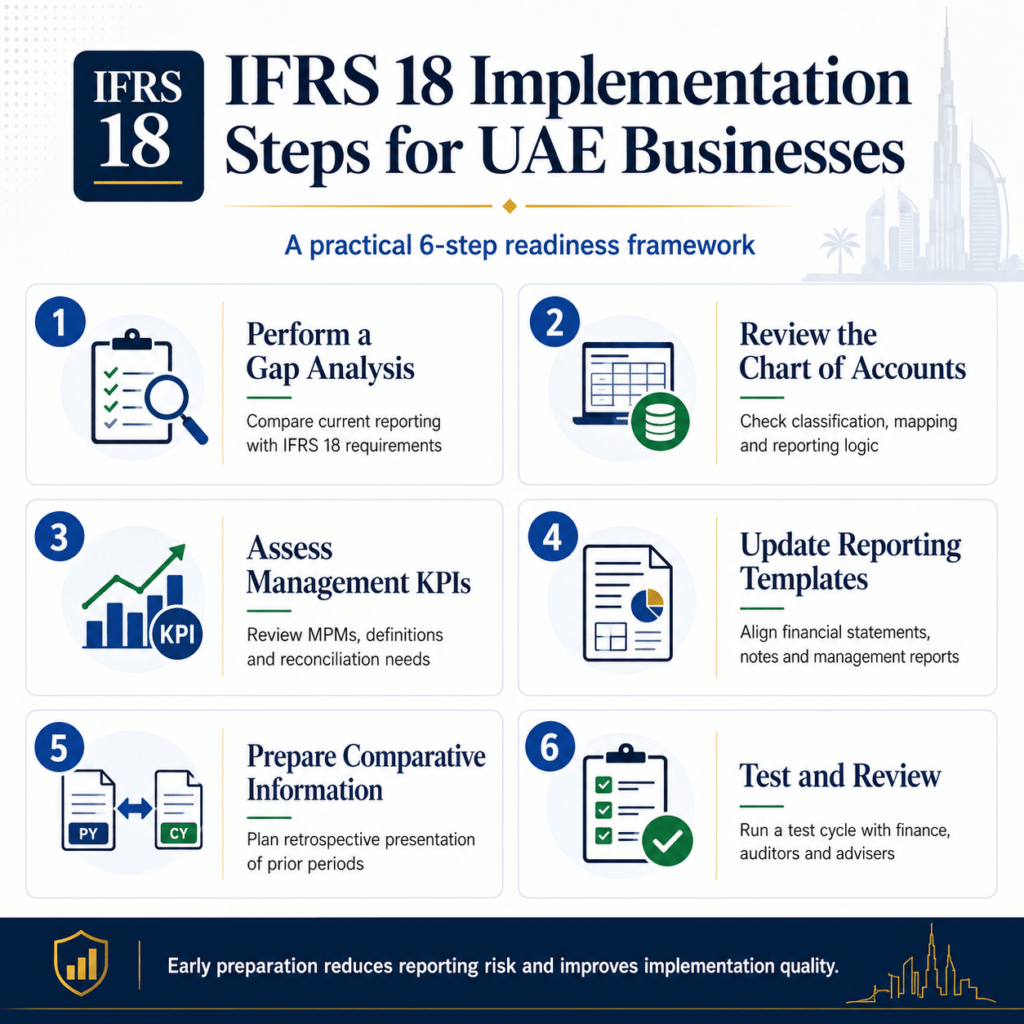
Step 1: Perform a Gap Analysis
Start by comparing your current financial statements with the IFRS 18 requirements. Identify differences in presentation, classification, subtotals, disclosures, and management performance measures.
The gap analysis should document both the requirement and the practical change needed.
Step 2: Review the Chart of Accounts
The chart of accounts provides the underlying data used to produce financial reports. Review whether existing accounts provide enough information to classify transactions appropriately under the new presentation requirements.
A company may need additional mapping or reporting logic even if its underlying accounting records do not fundamentally change.
Step 3: Assess Management KPIs
List the performance measures used by management and those communicated publicly.
For each potentially relevant measure, consider:
- How management defines it
- Where it is communicated
- Whether it falls within IFRS 18’s MPM requirements
- What IFRS-defined subtotal or total should be used for reconciliation
- What additional disclosures may be required
Step 4: Update Financial Reporting Templates
Review existing:
- Statement of profit or loss
- Financial statement notes
- Management reports
- Board reports
- Investor presentations
- Annual report templates
Consistency between internal and external reporting can help finance teams identify discrepancies before reporting deadlines.
Step 5: Prepare Comparative Information
Because IFRS 18 is applied retrospectively, companies need to plan for comparative information. This is one reason early preparation matters. Finance teams may need to establish how prior-period information will be presented under the new requirements.
Step 6: Test and Review
Before the first mandatory reporting period, run a test reporting cycle.
Involve the relevant stakeholders, including:
- Finance team
- Senior management
- External auditors
- Accounting advisers
- Reporting-system teams
Testing can identify classification, mapping, and disclosure issues before they become year-end problems.
Practical Example: IFRS 18 Readiness for a UAE Company
Consider a hypothetical UAE manufacturing company that currently presents its income statement as follows:
- Revenue
- Cost of sales
- Operating expenses
- Other income
- Finance costs
- Profit before tax
The company also reports “adjusted EBITDA” to management and investors.
Under an IFRS 18 readiness review, the finance team could assess how each income and expense item fits within the required categories. It would also review whether adjusted EBITDA qualifies as a management-defined performance measure and, if so, determine the required disclosures and reconciliation. The company could then update its financial statement template, reporting mappings and comparative information before its first IFRS 18 reporting period.
This example is illustrative only. The correct classification depends on the company’s specific facts and transactions.
How IFRS 18 May Affect Management Reporting and KPIs
IFRS 18 can also influence the relationship between internal management reporting and external financial reporting.
| Management area | Potential IFRS 18 consideration |
|---|---|
| EBITDA reporting | Determine whether the measure is an MPM |
| Operating profit | Review alignment with the defined subtotal |
| Board reporting | Assess consistency with external reporting |
| Investor reporting | Review publicly communicated performance measures |
| Financial dashboards | Review data classification and mapping |
| Annual reports | Update presentation and disclosures |
This does not mean companies must eliminate useful internal KPIs.
Instead, finance teams should understand which measures are subject to IFRS 18’s specific requirements and ensure the required information is available.
Common IFRS 18 Readiness Mistakes to Avoid
UAE companies should avoid treating IFRS 18 as a last-minute presentation update.
Common mistakes include:
- Waiting until the first reporting deadline.
- Treating IFRS 18 as only a formatting exercise.
- Ignoring management-defined performance measures.
- Failing to plan comparative information.
- Using inconsistent KPI definitions.
- Overlooking aggregation and disaggregation.
- Making system changes without testing.
- Failing to involve auditors early.
- Assuming existing subtotals automatically remain appropriate.
- Reviewing only the financial statements while ignoring public performance reporting.
A structured implementation plan can reduce these risks.
IFRS 18 Compliance and Financial Reporting in the UAE
IFRS 18 should also be considered alongside the broader financial reporting environment in the UAE. The UAE Ministry of Finance states that IFRS is the applicable accounting standard for Corporate Tax purposes, while eligible businesses with revenue not exceeding AED 50 million may use IFRS for SMEs under the applicable rules. The Ministry has also emphasised the importance of accurate and transparent financial reporting within the UAE’s broader financial framework.
However, companies should distinguish between financial reporting requirements and tax computation requirements. IFRS 18 changes financial statement presentation and disclosure; it does not by itself determine a company’s Corporate Tax liability.
Businesses should therefore assess IFRS 18 alongside their wider accounting, audit, and tax processes.
Frequently Asked Questions
What is IFRS 18?
IFRS 18 is an accounting standard covering the presentation and disclosure of information in financial statements. It introduces new requirements for the presentation of financial performance, including defined categories, subtotals, and disclosures relating to management-defined performance measures.
When does IFRS 18 become effective?
IFRS 18 is effective for annual reporting periods beginning on or after 1 January 2027. Earlier application is permitted.
Does IFRS 18 replace IAS 1?
Yes. IFRS 18 replaces IAS 1’s presentation requirements, while some requirements from IAS 1 have been moved to other standards or retained with modifications.
Does IFRS 18 apply to UAE companies?
It applies to entities that prepare financial statements under IFRS when IFRS 18 is applicable to their reporting framework. UAE companies should first confirm which accounting framework applies to them.
What are the main IFRS 18 changes?
The major changes include defined categories in the statement of profit or loss, required subtotals such as operating profit, new requirements for management-defined performance measures, and enhanced principles for aggregation and disaggregation.
What is the new operating profit subtotal under IFRS 18?
IFRS 18 introduces a defined operating profit subtotal in the statement of profit or loss. This is intended to improve consistency and comparability when users assess operating performance.
What are management-defined performance measures?
MPMs are certain company-defined subtotals of income and expenses used in public communications to communicate management’s view of financial performance. IFRS 18 introduces specific disclosure requirements for MPMs that fall within its scope.
Does IFRS 18 change EBITDA reporting?
It can affect the presentation and disclosure of EBITDA-related measures where they meet the definition of a management-defined performance measure. Companies should assess each measure based on its specific use and characteristics.
How should UAE companies prepare for IFRS 18?
Companies should begin with a gap analysis, review their profit or loss presentation, identify potentially relevant MPMs, assess comparative information, review reporting systems, and coordinate with their auditors.
Does IFRS 18 require changes to accounting software?
Not necessarily in every case. However, companies may need changes to account mapping, reporting logic, data extraction, or financial statement templates depending on their current systems and the complexity of their reporting.
How Ripple Business Setup Can Help With IFRS 18 Readiness
Preparing for IFRS 18 does not have to be a last-minute exercise. Ripple Business Setup can support UAE businesses with accounting and financial reporting requirements, including reviewing existing reporting processes and identifying areas that may need attention as companies prepare for changing standards. Businesses can seek support with accounting processes, financial statement preparation, bookkeeping, tax-related accounting coordination, and broader financial compliance requirements.
For a practical discussion about your company’s reporting requirements, contact the Ripple Business Setup team:
- Phone: +971 50 593 8101
- WhatsApp: +971 4 250 0833
- Email: info@ripplellc.ae
Conclusion
IFRS 18 introduces significant changes to how financial performance is presented and disclosed, making early preparation important for UAE companies that report under IFRS. A structured readiness review can help businesses identify changes to profit or loss presentation, operating profit, management performance measures, disclosures, and comparative information. Rather than waiting for the first reporting deadline, finance teams can use the period ahead to assess gaps, update processes, and coordinate with their auditors.
Disclaimer: This article provides general information and should not be treated as accounting, tax, audit, or legal advice. IFRS 18 requirements should be assessed based on the company’s specific circumstances and applicable reporting framework.