Selling through an online marketplace can give a small business access to customers across the UAE without requiring a traditional retail store. However, opening a marketplace account is only one part of the process. You also need to consider the right business activity, licence, product approvals, customs, payment arrangements, inventory, VAT and ongoing compliance. For anyone planning Marketplace Seller Setup UAE, the first step is to identify exactly what you will sell, where you will source it and how customers will place orders. The UAE Government states that eCommerce activities require the appropriate licence and that its eCommerce framework covers online sales through websites, apps, social media platforms and digital marketplaces.
Whether you plan to sell through Amazon, another marketplace, your own website or social media, this checklist can help you understand the main licensing and compliance considerations before launching.
Do You Need a Licence to Sell on a UAE Marketplace?
Yes, businesses conducting commercial eCommerce activities in the UAE need the appropriate licence and approvals for their activities. The exact licence depends on the business activity, legal structure, jurisdiction and products involved. The UAE Government explains that online businesses must obtain the required licences and approvals from the relevant authority and comply with applicable legal, regulatory and technical requirements.
This means a marketplace seller should not assume that creating an Amazon or social media seller account automatically gives the business permission to trade in the UAE.
When an Online Seller Needs a Business Licence
An online seller licence or appropriate commercial licence becomes particularly relevant when you:
- Sell products regularly for profit
- Import products for resale
- Maintain commercial inventory
- Sell through digital marketplaces
- Operate an online store
- Collect customer payments as a business
- Purchase products from suppliers for resale
- Build a branded online retail business
The important point is to match your licence activity with your actual business model.
Which Licence Is Suitable for Marketplace Seller Setup UAE?
There is no single licence that works for every marketplace seller. The appropriate route depends on what you sell and how your business operates. The UAE’s official business guidance states that identifying the business activity is a key step because it forms the basis for selecting the appropriate licence and legal form.
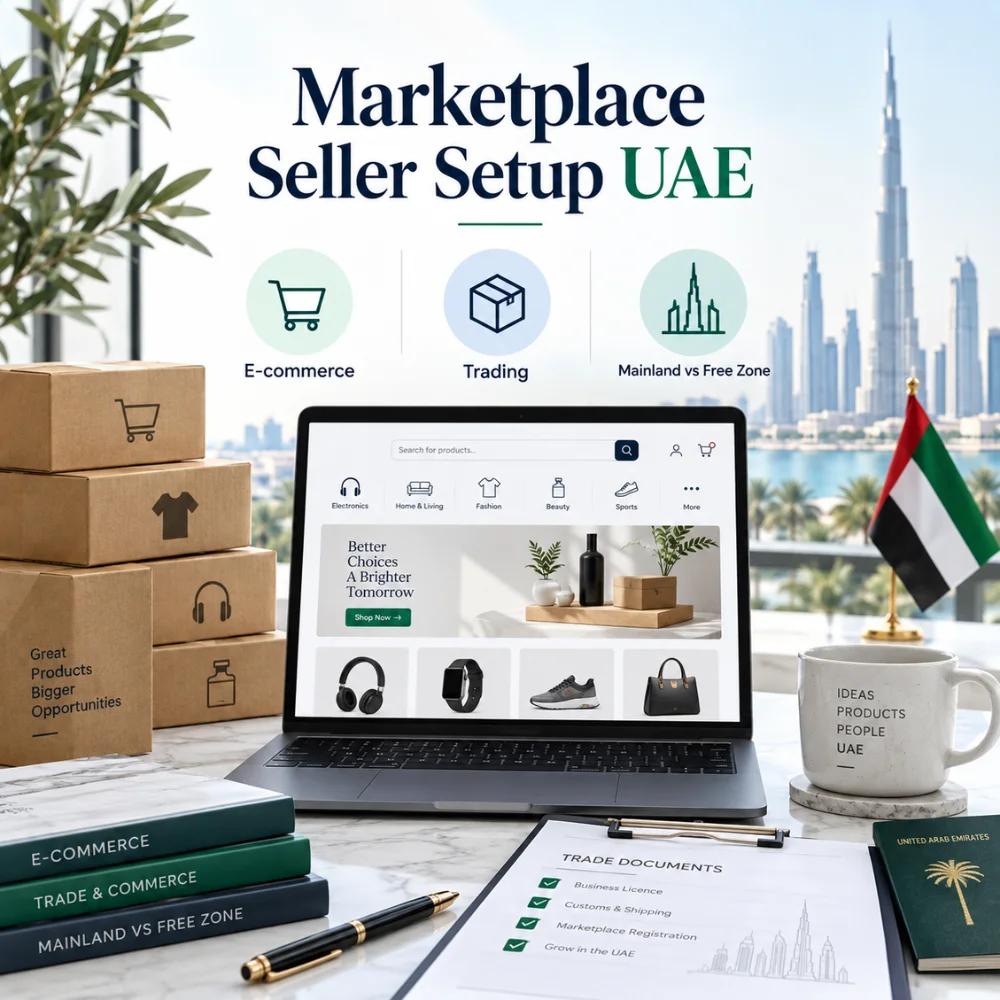
E-commerce Licence UAE
An ecommerce licence UAE setup can be suitable for businesses whose operations primarily involve selling goods or services through digital channels. The UAE Government states that mainland online businesses need a commercial licence that includes eCommerce activity. Depending on the emirate, the authority may issue a standalone eCommerce licence or a regular commercial licence that includes the relevant eCommerce activity.
Before applying, check:
- The exact permitted activity
- Product category
- Jurisdiction requirements
- Additional approvals
- Office or workspace requirements
- Marketplace operating model
This prevents a common problem: obtaining a licence that does not properly reflect the business you intend to operate.
Commercial or Trading Licence
A commercial or trading structure may be relevant when your business focuses on physical products, purchasing stock from suppliers, importing goods or distributing products. For example, an entrepreneur importing home accessories and selling them through a marketplace may need to consider more than the digital sales channel. The business must also consider product trading, inventory, customs and the movement of goods.
A small trading company therefore needs to consider its complete supply chain rather than looking only at the marketplace account.
Mainland vs Free Zone Setup
Both mainland and free zone structures can support different types of online businesses, but the rules and operating arrangements can differ.
When comparing options, consider:
- Business activity
- Product type
- Target customers
- Import requirements
- Warehousing
- Local UAE sales
- International sales
- Future expansion
- Overall operating requirements
Free zones offer specialised online business licences, but the UAE Government notes that free zone companies selling directly into the mainland may need a local distributor or additional approvals or arrangements depending on the circumstances.
The right choice should therefore follow your actual business model rather than simply choosing the lowest initial licence price.
Marketplace Seller Licence Checklist: What You Need Before Registration
Before starting your Marketplace Seller Setup UAE, work through the following checklist.
1. Choose Your Products and Business Activity
Start with the products you plan to sell.
Ask:
- What products will I sell?
- Will I sell one product category or several?
- Will I manufacture, import or purchase the products?
- Will I hold inventory in the UAE?
- Are any products regulated?
- Will I sell wholesale, retail or both?
Your answers help determine which business activity and approvals you may need.
2. Select the Appropriate Business Structure
Next, determine whether a mainland or free zone setup fits your intended operations.
Consider:
- Ownership requirements
- Business activities
- Location
- Product movement
- Importing
- Warehousing
- Local sales
- International sales
Do not select a structure solely because it advertises a low starting price. Review what is actually included and whether it supports your planned marketplace operations.
3. Prepare Your Business Documents
The exact requirements vary by authority and legal structure, but you should generally be prepared to provide relevant identification and company information.
Depending on the setup, this can include:
- Passport copies
- Emirates ID where applicable
- Proposed business name
- Business activity
- Application forms
- Company formation documents
- Lease or address documentation where required
- Additional approvals for regulated activities
For mainland businesses, the official setup process includes identifying the activity, selecting a legal form, applying for the trade licence, registering the trade name, obtaining initial approval and completing any required additional approvals.
4. Check Marketplace Requirements
Your UAE licence is only one part of seller onboarding.
A marketplace may also request:
- Business information
- Seller verification
- Bank details
- Payment information
- Product documentation
- Tax information
- Identity verification
- Supplier or brand documentation
This is particularly important for Amazon seller setup, where marketplace account requirements can exist alongside UAE licensing and product compliance obligations.
Product, Customs and Import Requirements for Online Sellers
A marketplace licence does not automatically mean every product can be imported and sold without additional checks. If you purchase inventory from outside the UAE, consider the complete import process before placing large orders.
When Customs Requirements May Matter
Customs considerations can become important when your business:
- Imports products
- Stores imported inventory
- Receives commercial shipments
- Uses international suppliers
- Re-exports products
- Uses fulfilment or logistics providers
Keep supplier invoices, shipping documents and product information organised.
You should also identify the correct customs and product classification requirements for the goods you intend to import.
Check Product-Specific Approvals
Some products may require additional approvals or compliance checks.
Examples can include:
- Food products
- Cosmetics
- Health-related products
- Certain electronics
- Personal-care products
- Other regulated goods
The UAE Government’s eCommerce guidance states that online sellers should sell only permitted products and obtain approvals for regulated or restricted products where required.
This makes product research an important part of your Marketplace Seller Setup UAE, especially before purchasing significant inventory.
VAT for UAE Marketplace Sellers
VAT is another important part of running an online selling business. For UAE-resident businesses, mandatory VAT registration generally applies when the value of taxable supplies and imports exceeds $375,000 over the previous 12 months or is expected to exceed that amount within the next 30 days. Voluntary registration may be available when taxable supplies, imports or taxable expenses exceed $187,500, subject to the applicable rules.
VAT Checklist for Marketplace Businesses
A marketplace seller should:
- Monitor taxable turnover
- Track taxable imports
- Keep sales records
- Maintain purchase invoices
- Record marketplace fees
- Track refunds and returns
- Maintain proper accounting records
- Assess VAT registration requirements
- Keep supporting documentation
The FTA’s current VAT registration service is handled through EmaraTax, and the authority lists trade licence and other supporting documentation among the documents that may be required.
Importantly, having a small business does not automatically remove VAT responsibilities. The registration test depends on the applicable rules and taxable activities.
Payment Gateway and Banking Setup for Marketplace Sellers
Once the business licence is in place, sellers also need a reliable method for receiving and reconciling business income.
Think of the process as:
Business licence → business banking/payment arrangements → marketplace sales → marketplace payouts → accounting records
What to Prepare for Payment and Banking
Depending on the provider, you may need:
- Valid business licence
- Company formation documents
- Business activity information
- Owner identification
- Bank account information
- Marketplace details
- Source-of-funds information where requested
A payment gateway may be relevant if customers pay through your own website, while marketplaces may handle customer payments and later transfer seller proceeds.
Why Payment Records Matter
Do not treat the amount deposited into your bank account as the only sales figure.
Your records may need to distinguish between:
- Gross sales
- Marketplace commissions
- Payment processing charges
- Refunds
- Discounts
- Shipping charges
- Taxes
- Net marketplace payouts
Good reconciliation makes VAT, accounting and financial reporting easier to manage.
Amazon Seller Setup in the UAE: Licence Checklist
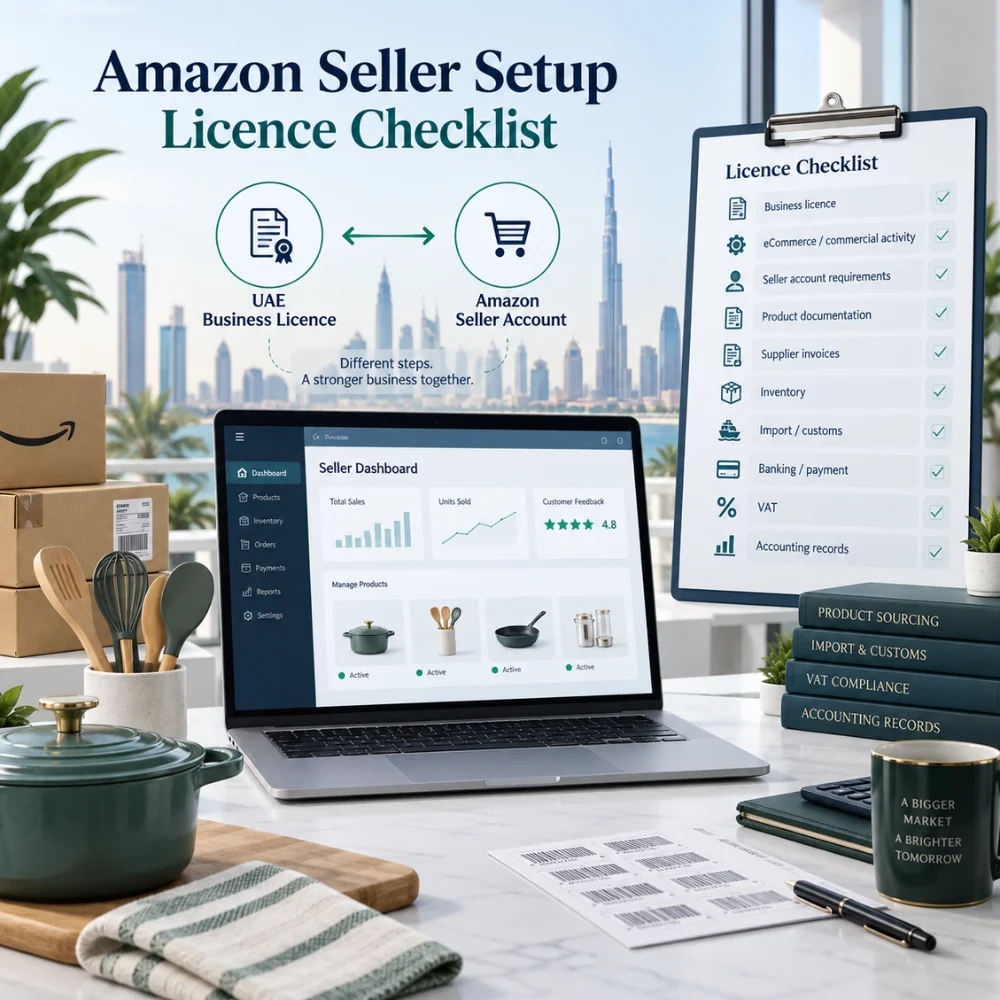
Many entrepreneurs search for Amazon seller setup when planning an online retail business in the UAE. The important distinction is that a marketplace seller account and a UAE business licence serve different purposes.
Before launching, consider:
- Appropriate UAE business licence
- Correct commercial/eCommerce activity
- Amazon seller account requirements
- Product documentation
- Supplier invoices
- Inventory arrangements
- Import/customs requirements
- Payment/banking arrangements
- VAT assessment
- Accounting records
If you intend to sell several types of products, check the permitted business activities before committing to inventory.
For example, a seller importing kitchen accessories may need to consider not only the online sales activity but also the trading activity, customs process, storage and product documentation.
What About Instagram and Social Media Sellers?
Selling through Instagram does not automatically create a separate legal category that replaces business licensing. The UAE’s eCommerce framework expressly covers sales through social media platforms as well as websites, applications and digital marketplaces.
Is an Instagram Business Account the Same as a Licence?
No. An Instagram business profile is a digital marketing and communication channel. It is not, by itself, a UAE trade or eCommerce licence.
If you operate a commercial online business, consider the appropriate licensing requirements regardless of whether customers find you through:
- Your website
- Amazon
- Another marketplace
This distinction is particularly important for entrepreneurs searching for an Instagram business licence when they actually need a broader commercial setup.
Small Trading Company vs Ecommerce Licence: What Should a Seller Consider?
The difference becomes clearer when you look at the business model.
An Ecommerce-Focused Setup May Suit Businesses That:
- Primarily operate through digital channels
- Sell permitted goods or services online
- Use marketplaces or their own website
- Have a digital-first business model
- Need an activity aligned with online commercial operations
A Trading Structure May Be Relevant When:
- The business regularly trades physical products
- It imports inventory
- It purchases goods from wholesalers
- It distributes products
- It maintains significant stock
- It plans broader commercial trading activities
However, there is no universal answer based only on the business name. The licensing authority, exact activity and products determine the appropriate setup.
Common Marketplace Seller Setup Mistakes in the UAE
Small sellers can overlook important details when they focus only on launching their marketplace account.
Common mistakes include:
- Choosing a licence without checking the actual product activity
- Assuming a marketplace account replaces a UAE business licence
- Ignoring customs requirements for imported inventory
- Selling regulated products without checking approvals
- Waiting too long to assess VAT obligations
- Mixing personal and business finances
- Failing to track marketplace fees and refunds
- Keeping incomplete inventory records
- Ordering large quantities before confirming compliance
- Assuming social media selling has no licensing implications
Avoiding these issues before launch can reduce operational problems later.
Marketplace Seller Setup UAE Checklist: Quick Action Plan
Use this checklist before launching your online store:
- Define the products you intend to sell
- Confirm the relevant business activity
- Choose mainland or free zone structure
- Check the ecommerce/trading activity requirements
- Prepare required identification and business documents
- Apply for the appropriate licence
- Review product-specific approvals
- Check customs requirements for imported products
- Arrange business banking/payment facilities
- Create your marketplace seller account
- Organise inventory and fulfilment
- Track sales and marketplace fees
- Assess VAT registration requirements
- Maintain proper accounting records
- Review Corporate Tax obligations
Corporate Tax should also form part of your compliance planning. The FTA states that taxable persons must register for Corporate Tax. In contrast, natural persons conducting a business or business activity generally must register when business revenue exceeds $1 million in a calendar year, subject to the applicable rules.
Example: Setting Up a Small UAE Marketplace Business
Consider an entrepreneur who wants to import home décor accessories and sell them through Amazon UAE and Instagram. The business should first identify its products and determine the appropriate commercial activity. It can then evaluate whether a mainland or free zone structure fits its intended operations.
Before ordering stock, the entrepreneur should review customs and any product-specific requirements. The business can then arrange its marketplace account, banking and inventory process.
As sales grow, the owner should monitor taxable turnover for VAT purposes and maintain records of marketplace sales, fees, refunds, purchases and inventory.
The key lesson is simple:
The marketplace account is only one part of the setup.
Licensing, products, customs, payments, inventory and tax compliance all need to work together.
How Much Does Marketplace Seller Setup UAE Cost?
There is no single cost that applies to every marketplace seller.
Your overall setup cost can depend on:
- Business licence
- Business activity
- Jurisdiction
- Legal structure
- Workspace requirements
- Additional approvals
- Customs and import costs
- Product registration where applicable
- Marketplace fees
- Payment processing fees
- Banking
- Accounting and compliance
Instead of comparing only the advertised licence price, calculate the expected total setup and operating cost.
A cheaper initial licence may not be suitable if it does not support the activities, products or operating model you actually need.
FAQ
Do I need a licence to sell on Amazon UAE?
If you are conducting commercial eCommerce activity in the UAE, you need the appropriate licence and approvals. The marketplace account itself does not replace the UAE licensing requirement.
What licence do I need to sell products online in the UAE?
The appropriate licence depends on your business activity, products, legal structure and jurisdiction. An eCommerce activity or commercial/trading activity may be relevant depending on the business model.
Is an ecommerce licence enough to sell physical products?
Not necessarily. You should also check the exact permitted activity, product requirements, customs obligations and any additional approvals that apply to your goods.
Can I sell on Instagram without a UAE business licence?
Using Instagram as a sales channel does not automatically remove licensing requirements. UAE eCommerce rules cover commercial activity conducted through social media platforms.
Does a marketplace seller need VAT registration?
VAT registration depends on the applicable VAT rules and taxable supplies/imports. For UAE-resident businesses, the mandatory threshold is generally $375,000, while the voluntary threshold is $187,500.
Do UAE marketplace sellers need customs registration?
Businesses importing products should assess the applicable customs and import requirements before bringing commercial inventory into the UAE. Requirements can vary according to the goods and import arrangement.
Can a small trading company sell through online marketplaces?
A trading business can use online marketplaces where its business activities and approvals support the intended sales model. The exact setup should be checked against the products and operations.
Can I sell imported products through a UAE marketplace?
Yes, subject to the applicable licensing, customs, product and regulatory requirements. Importers should confirm these requirements before purchasing or shipping commercial inventory.
About Ripple Business Setup
At Ripple Business Setup, we help entrepreneurs understand the practical steps involved in establishing and maintaining a UAE business. For marketplace sellers, we can help you consider the appropriate business activity, licensing route and related setup requirements based on your planned operations.
Before starting, share details about your products, marketplace, sourcing model and expected operations so the setup can be considered around your actual business needs.
Phone: +971 50 593 8101
Email: info@ripplellc.ae
WhatsApp: +971 4 250 0833
Website: www.ripplellc.ae
Final Takeaway
A successful Marketplace Seller Setup UAE involves much more than opening an online seller account. You need to align your business activity and licence with your products and operating model, while also considering customs, inventory, payments, VAT and ongoing tax compliance.
Disclaimer: This article provides general information about UAE marketplace business setup and compliance. Licensing, tax, customs and product requirements can vary according to the business activity, jurisdiction and products involved, so confirm the applicable requirements with the relevant UAE authorities before proceeding.