Introduction
The UAE has quietly become one of the world’s most attractive banking destinations and not just for people who live there. Investors sitting in London, freelancers working from Nairobi, and business owners managing operations from Singapore are all turning to UAE banking because of its stability, connectivity, and tax-friendly environment.
A non-resident bank account in the UAE allows individuals who do not hold a UAE residency visa to access the country’s robust financial services. Whether you are planning to invest in Dubai real estate, receive international client payments, or simply diversify your financial assets, having a UAE account gives you a direct link to one of the most liquid financial systems in the Middle East.
In 2026, the conversation around non-resident banking has grown more relevant than ever. Global compliance frameworks like FATCA and CRS have pushed banks to tighten their verification processes, and the UAE, with its commitment to transparency and anti-money laundering (AML) standards, has responded by building a cleaner, more credible banking ecosystem. This guide walks you through everything you need to know to open and manage a non-resident bank account in the UAE this year.
What Is a Non-Resident Bank Account?
A non-resident bank account is a bank account held in a country where you do not permanently reside. In the UAE context, it means a person without a UAE residency visa or an Emirates ID can still open and maintain a bank account at a UAE-licensed financial institution.
This is different from a standard UAE resident account, which requires proof of UAE residency, an Emirates ID, and a local employment or business link. Non-resident accounts come with certain limitations, such as restricted access to credit cards and personal loans, but they still offer core banking functions like multi-currency deposits, international wire transfers, and debit card access.
Most UAE banks support accounts in multiple currencies, including AED (UAE Dirham), USD, EUR, and GBP, making these accounts genuinely useful for people managing cross-border financial activity. Think of it as having a trusted financial address in one of the world’s most globally connected cities without the need to physically move there.
Key Features of Non-Resident Bank Accounts
- Multi-currency access: Hold and transact in AED, USD, EUR, GBP, and other major currencies from a single account.
- Online and mobile banking: Manage your account remotely through secure digital platforms, 24/7.
- Debit card availability: Most banks offer debit cards, though credit facilities are typically restricted for non-residents.
- Minimum balance requirements: Ranges vary by bank (typically AED 3,000–AED 50,000+), so choose a bank that matches your financial profile.
- International wire transfers: Send and receive payments globally, often at competitive exchange rates and low transfer fees.
- Interest-bearing options: Fixed deposit accounts for non-residents often carry competitive interest rates.
Benefits of Opening a Non-Resident Bank Account in the UAE
- Access to a stable financial system: The UAE Central Bank oversees a well-regulated, politically stable banking environment with strong reserves and international credibility.
- Tax-friendly environment: The UAE does not levy personal income tax or capital gains tax, making it appealing for wealth management and long-term asset holding.
- Efficient international money transfers: UAE banks have strong SWIFT networks and partnerships that make cross-border payments faster and more reliable.
- Wealth protection and diversification: Holding assets across multiple jurisdictions is a sound financial strategy, and a UAE account adds a stable, USD-pegged currency (AED) to your portfolio.
- Banking privacy standards: UAE banks follow international confidentiality norms, while still complying with global reporting requirements like CRS.
- Property investment gateway: If you are buying real estate in Dubai or Abu Dhabi, a local bank account significantly simplifies transactions and escrow management.
Eligibility Criteria for Non-Resident Bank Accounts in UAE
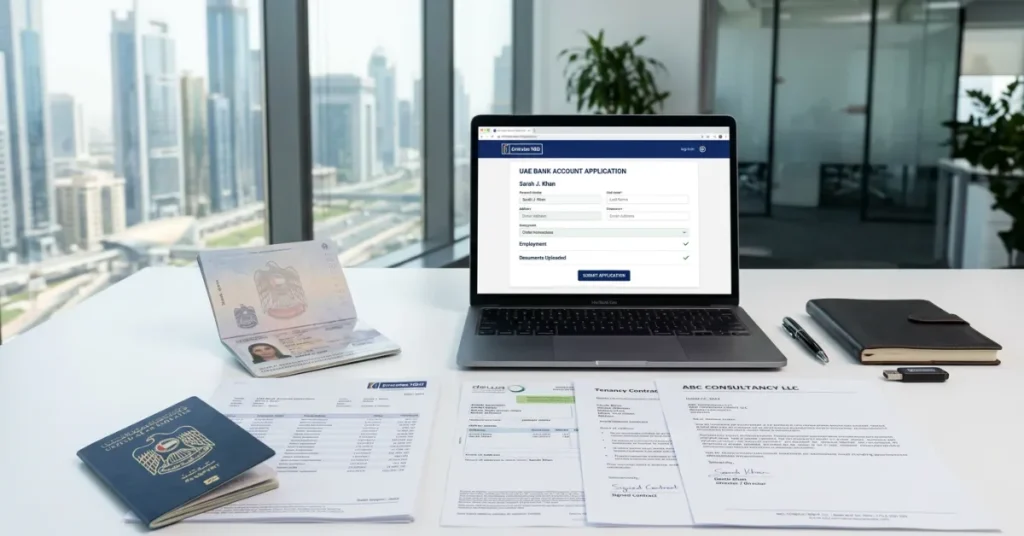
Not everyone qualifies automatically UAE banks take non-resident applications seriously and conduct thorough due diligence. The good news is that eligibility requirements are generally straightforward if you have a clean financial profile. Here is what banks typically look for:
- Valid passport (with at least 6 months’ validity)
- Proof of income or business activity (employment contract, business registration, or trade license)
- Bank reference letter from your current primary bank
- Minimum initial deposit (varies by bank, typically AED 25,000–AED 100,000 for non-residents)
- Source of funds verification banks must confirm where your money comes from (salary, business revenue, investments)
- No history of financial crime or adverse banking records
Good to know: UAE banks have discretion to accept or decline applications. Having a clear source of funds, a strong financial history, and a legitimate reason for banking in the UAE significantly improves your chances.
Documents Required to Open a Non-Resident Account
- Passport copy (notarised in some cases)
- Proof of address: utility bill, official bank statement, or government-issued document from your home country (usually not older than 3 months)
- CV or professional profile, especially for freelancers and self-employed applicants
- Bank statements for the last 3–6 months from your primary bank
- Reference letter from your existing bank, confirming good standing
- Company documents if opening as a business owner (trade license, Memorandum of Association)
Step-by-Step Process to Open a Non-Resident Bank Account
- Choose the right UAE bank: Research banks that actively welcome non-resident clients. Not all UAE banks offer this service.
- Submit the application form: Complete the bank’s official account opening form (online or in-branch during a visit).
- Provide required documents: Submit all the documents listed above in certified or notarised format as required.
- Undergo compliance checks; The bank’s compliance team will verify your identity, source of funds, and banking history (KYC/AML process).
- Fund the account: Transfer the required minimum opening deposit once the account is conditionally approved.
- Account activation: Receive account credentials, online banking access, and your debit card (if applicable).
The entire process can take anywhere from 2 weeks to 2 months, depending on the bank, your nationality, and the complexity of your financial profile. Patience and complete documentation are your best tools.
Best Banks in the UAE for Non-Resident Accounts (2026)

Several UAE banks have established dedicated processes for non-resident clients. Here is a quick overview of the most reputable options:
- Emirates NBD: One of the largest UAE banks. Strong digital banking platform and a wide range of account options for international clients.
- Mashreq Bank: Known for efficient onboarding and strong online banking. Popular among freelancers and remote professionals.
- ADCB: Abu Dhabi Commercial Bank offers solid multi-currency accounts and strong wealth management services.
- HSBC UAE: Ideal for internationally mobile professionals. Seamless global account linking through HSBC’s worldwide network.
- Standard Chartered UAE: Excellent for investors and high-net-worth individuals. Strong international compliance and private banking options.
Each bank has different minimum balance thresholds, fee structures, and documentation preferences. It is worth comparing two or three options before committing.
Types of Non-Resident Bank Accounts in the UAE
- Savings accounts: Standard accounts for holding funds and earning modest interest. Best for liquidity and everyday international transfers.
- Fixed deposit accounts: Lock in funds for a fixed term (3, 6, or 12 months) at higher interest rates. Ideal for passive income.
- Offshore accounts: Structured through free zones (like the DIFC), these offer enhanced privacy and flexibility for corporate or investment purposes.
- Investment-linked accounts: Available at premium banking tiers; combine banking with exposure to funds, equities, or structured products.
Costs and Minimum Balance Requirements
Understanding the cost structure before you open a non-resident account will help you avoid unexpected charges. Here is a general breakdown of what to expect in 2026:
- Minimum balance: AED 3,000–AED 100,000+ depending on the bank and account type (non-resident accounts typically require higher minimums)
- Monthly maintenance fee: AED 25–AED 150 if the balance falls below the required minimum
- International transfer fees: AED 25–AED 75 per outgoing international wire, with some banks offering fee waivers at premium tiers
- Currency exchange charges: Usually 0.5%–2.5% above the mid-market rate, depending on the currency pair and bank
- Account opening fee: Most UAE banks do not charge a setup fee, but some premium or offshore accounts may have one-time initiation charges
Challenges and Limitations to Consider
- Higher minimum balance: Non-resident accounts generally require significantly higher deposits than resident accounts.
- Limited credit access: Overdrafts, credit cards, and personal loans are typically unavailable without UAE residency.
- Strict compliance checks: Expect thorough KYC and AML screening, especially for applicants from certain countries on UAE risk lists.
- Longer approval timelines: Without a local presence, the verification process can take weeks longer than for residents.
- In-person visit requirement: Some banks still require at least one in-person visit to a UAE branch, though this is changing.
UAE Regulations and Compliance for Non-Residents
The UAE Central Bank regulates all licensed banks operating within the country and requires them to meet strict Know Your Customer (KYC) and Anti-Money Laundering (AML) standards. For non-residents, this means banks must verify not just your identity but also your financial background and the legitimate purpose of the account.
The UAE is a signatory to both FATCA (the US Foreign Account Tax Compliance Act) and CRS (the Common Reporting Standard). This means your UAE account information may be automatically shared with your home country’s tax authority if required under international agreements. This is not something to fear, it is simply how transparent, globally integrated banking works in 2026.
The UAE’s commitment to these global standards has significantly enhanced its banking reputation. Banks that once struggled with compliance perception now operate under internationally respected frameworks, making a UAE account a credible and clean financial tool.
Tips to Get Approval Faster
- Maintain a strong financial profile: A consistent income history and clean credit record across your home country accounts will work in your favour.
- Provide a crystal-clear source of funds: Banks reject applications most often due to unclear or unverifiable fund origins. Be specific and document everything.
- Choose the right bank for your profile: A freelancer’s profile suits Mashreq more than Standard Chartered Private. Match your profile to the bank’s client focus.
- Work with a business consultant: A UAE-registered consultant or business setup advisor can introduce you directly to relationship managers, bypassing standard cold application queues.
- Prepare documents in English: All supporting documents should be translated into English (certified) if originally in another language.
Non-Resident vs Offshore Bank Accounts in UAE
These two terms are often used interchangeably, but they refer to different banking structures with distinct characteristics. Here is a clear comparison:
| Feature | Non-Resident Account | Offshore Account (e.g. DIFC) |
|---|---|---|
| Who it’s for | Individuals without UAE residency | Companies or individuals in free zones |
| Regulatory body | UAE Central Bank | DIFC / ADGM Financial Authorities |
| Currency options | AED, USD, EUR, GBP and more | Primarily USD and international currencies |
| Privacy level | Standard (CRS compliant) | Enhanced (structured privacy provisions) |
| Ideal use case | Personal banking, property, freelancing | Corporate treasury, investment funds |
| Minimum balance | AED 25,000–100,000 typically | Often USD 100,000+ |
For most individual investors, freelancers, and business owners, a standard non-resident account is the practical starting point. Offshore structures become relevant at a higher tier of financial complexity or corporate need.
How We Help You Open a UAE Non-Resident Bank Account
Opening a non-resident bank account in the UAE can feel complex, especially with strict compliance checks and documentation requirements. We guide you through the full process, from choosing the right bank to preparing documents and improving approval chances.
Our team helps you understand bank requirements, minimum balance rules, and the best options based on your profile. We also assist in preparing KYC documents, reviewing your financial background, and coordinating with UAE banks to make the process smoother and faster.
If you are an investor, freelancer, or business owner, we make sure your application meets current UAE banking standards in 2026. For assistance, you can contact Ripple Business Setup at +971 50 593 8101, email info@ripplellc.ae, or WhatsApp +971 4 250 0833.
FAQs
Can a non-resident open a bank account in the UAE?
Yes, Several major UAE banks, including Emirates NBD, Mashreq, ADCB, HSBC UAE, and Standard Chartered, offer account opening options for non-residents. Requirements vary, but a valid passport, proof of income, and source of funds documentation are standard starting points.
What is the minimum balance required?
Minimum balance requirements for non-resident accounts typically range from AED 25,000 to AED 100,000 or more, depending on the bank and account type. Some premium or international banks may require higher thresholds. Failing to maintain the minimum usually results in a monthly maintenance fee.
How long does the process take?
The timeline varies significantly. In the best case, with complete documents, a clean financial history, and a bank-friendly profile, you can expect 2 to 4 weeks. More complex applications or those requiring additional compliance review may take 6 to 8 weeks or longer.
Can I open a UAE non-resident account remotely?
Some banks are moving toward digital-first onboarding for non-residents, but many still require at least one in-person visit to a UAE branch for identity verification. It is worth checking with each bank directly about their current remote opening policy in 2026, as this space is evolving quickly.
Is UAE banking safe for foreigners?
Yes, the UAE Central Bank regulates all licensed banks and maintains strict capital adequacy and liquidity standards. The UAE is also compliant with global frameworks like FATCA and CRS, making it a transparent and internationally respected banking jurisdiction. Deposits in UAE banks are generally considered very safe, particularly at the major listed institutions.
Conclusion
A non-resident bank account in the UAE is more than just a financial convenience it is a strategic asset in 2026’s globalised economy. Whether you are an investor eyeing Dubai property, a professional receiving multi-currency income, or a business owner managing a UAE entity from abroad, the UAE’s banking infrastructure gives you a genuinely useful and credible financial base.
Disclaimer: The information provided in this article is for general guidance only and does not constitute financial, legal, or banking advice. Banking policies, eligibility criteria, and requirements for non-resident accounts in the UAE may change depending on the bank and regulatory updates. Readers should consult with qualified professionals or directly with UAE banks before making any financial decisions.