

Introduction
Dubai is one of the most open and active trading hubs in the world, but that openness comes with a clear rulebook. Before any product reaches store shelves or a consumer’s hands, it must pass through a structured approval system designed to protect public safety and maintain market integrity.
If you’re planning to import, manufacture, or distribute goods here, understanding how to register products in Dubai is not optional. It’s a legal requirement. Products that skip this step face customs holds, financial penalties, and outright rejection at the border. Getting it right from the start saves time, money, and a lot of frustration.
What Does It Mean to Register Products in Dubai?
Product registration in the UAE is the process by which a product is officially reviewed, tested, and approved by relevant government authorities before it can be legally sold or distributed in the market. It’s not a formality; it’s a gatekeeping mechanism.
Dubai regulates products because consumer safety and import quality are national priorities. Whether it’s a skincare cream, an electrical appliance, or a packaged food item, every category carries specific standards it must meet. Dubai product approval essentially confirms that your product complies with UAE standards, has been tested appropriately, and carries accurate labeling that meets local requirements.
Why Product Registration is Mandatory in the UAE
UAE compliance rules exist to protect both the consumer and the integrity of the market. The country has implemented strict import control regulations that align with international safety benchmarks, and market surveillance teams actively check products already on shelves.
Selling an unregistered product carries real consequences. Shipments can be held at customs for extended periods. Products may be confiscated and destroyed. Businesses can face fines, and repeat offenders risk losing their trade license entirely.
Key Authorities Responsible for Product Registration in Dubai
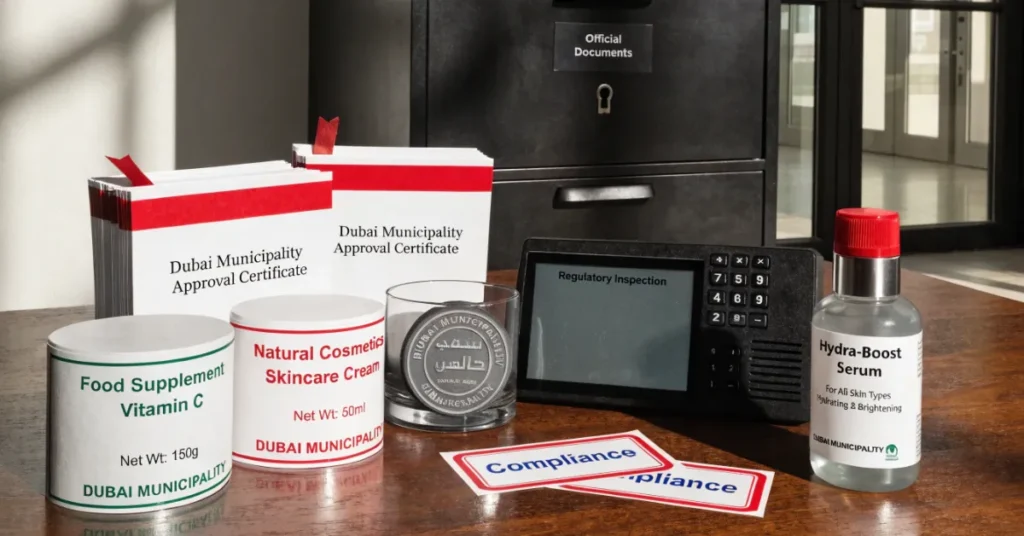
Depending on what you’re selling, one or more regulatory bodies will oversee your registration.
Dubai Municipality
The Dubai Municipality product control department handles food products, cosmetics, and personal care items. If you’re importing anything edible, drinkable, or applied to the skin, this is your primary authority. They review ingredient lists, labeling, packaging, and testing results before approving.
Ministry of Industry and Advanced Technology (MoIAT)
MoIAT certification in the UAE governs industrial goods, safety-critical products, and electrical and electronic equipment. This ministry is responsible for ensuring products meet national and international safety standards. It also issues conformity certificates and works in tandem with ESMA (Emirates Authority for Standardization and Metrology) for standardized product categories.
Civil Defense and Customs
The UAE Civil Defense Department has jurisdiction over certain product categories, including fire safety equipment, chemicals, and hazardous materials. Customs authorities, meanwhile, are the enforcement point. All approvals must be reflected in customs documentation, or the goods simply won’t clear.
Types of Products That Require Registration in Dubai
A wide range of product categories falls under the ECAS registration system in the UAE or the oversight of Dubai Municipality. The regulated products list in the UAE is broader than most importers initially expected. Categories that require formal registration include:
- Food and beverages
- Cosmetics and skincare products
- Electrical and electronic goods
- Children’s toys
- Chemical products
- Packaging materials used for food contact
If your product fits any of these categories, assume registration is required and plan accordingly. When in doubt, a pre-consultation with the relevant authority can clarify your obligations before you invest in inventory.
Step-by-Step Process to Register Products in Dubai (2026)
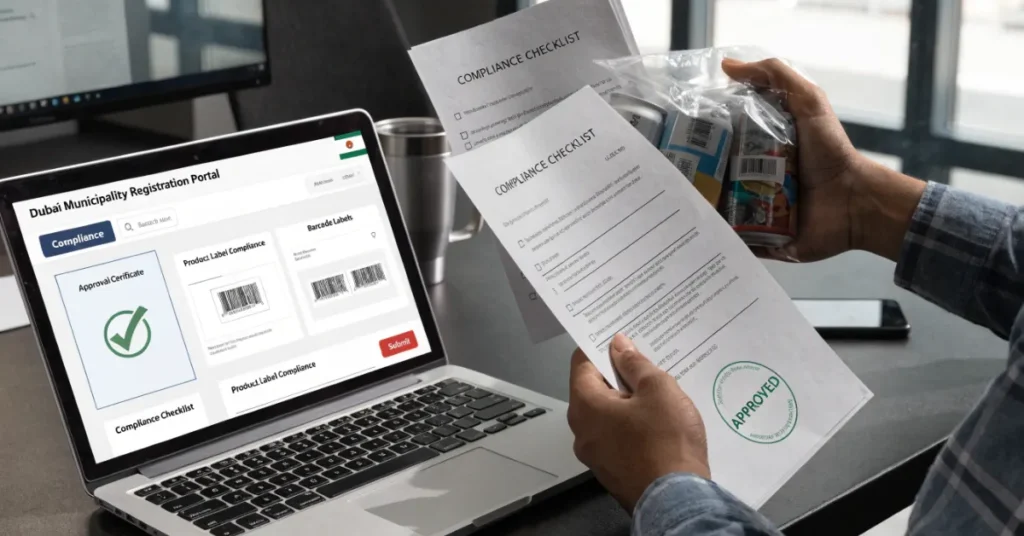
This is the practical heart of the matter. Here is how to register products in Dubai from start to finish.
Step 1 – Business Setup and Trade License
You must hold a valid UAE trade license before you can initiate any product registration. More importantly, your license activity must match the product category you’re registering. A trading license for electronics, for example, cannot be used to register food items. Make sure your business activity is correctly classified with the Department of Economic Development (DED) or your relevant free zone authority.
Step 2 – Product Classification
Once your business is properly set up, classify your product under the relevant UAE standards category. This determines which authority handles your registration and which testing regime applies. Misclassification is one of the most common causes of delays, so take the time to verify this step carefully.
Step 3 – Laboratory Testing and Certification
Most regulated products must undergo testing at an approved UAE laboratory before registration can proceed. The lab tests verify safety, ingredient accuracy, and performance against UAE or international standards. Ensure you use a UAE-accredited facility; test reports from non-recognized labs are rejected automatically.
Step 4 – Submit Application to Authorities
Applications are submitted through the official portals of the relevant authority. Dubai Municipality uses its own e-services platform; MoIAT and ESMA operate through separate systems. You’ll upload your business documents, test reports, product labels, and other supporting materials digitally.
Step 5 – Approval and Registration Certificate
Once your submission is reviewed and accepted, you will receive a compliance or registration certificate. This certificate has a validity period of typically one to three years, depending on the product category, and must be renewed before expiry. Selling products on an expired certificate carries the same risks as selling unregistered goods.
Documents Required for Product Registration in Dubai
Having your paperwork in order before you begin the application accelerates the entire process significantly. The documents required typically include:
- Trade license copy
- Product label (in both Arabic and English)
- Ingredient or component list (for consumables and cosmetics)
- Test reports from UAE-accredited laboratories
- Manufacturer’s certificate or factory approval letter
- Commercial invoice and packaging specifications
Some authorities may request additional documentation depending on the product type.
Common Challenges in Product Registration
Labeling is the most common obstacle. UAE regulations require Arabic alongside English on all product labels, and details, including ingredients, manufacturer name, country of origin, and shelf life, must be present. Missing or incomplete label information leads to immediate rejection.
Certification gaps are another common issue. Importers sometimes assume that a European CE mark or a US FDA certificate is sufficient. Often, additional UAE-specific certification is still required.
Lab testing timelines can also slow things down. If you book testing late in your import cycle, you may be paying for warehouse storage while waiting for results. Proactive scheduling matters.
Product misclassification, as mentioned earlier, leads to applications going to the wrong authority and having to restart the process. And customs clearance issues often trace back to one or more of these upstream problems, a domino effect that delays your entire supply chain.
Cost and Timeline of Product Registration in Dubai
ECAS cost in the UAE varies significantly by product category and complexity. Simple consumer goods may involve a few hundred dirhams in government fees, while more regulated items, such as medical devices, certain chemicals, and electrical equipment, can involve considerably more.
The product approval time in Dubai ranges from a few working days for straightforward submissions to several weeks for products requiring extensive lab testing or additional review. Speed is largely determined by how complete your documentation is when you submit. Incomplete applications are returned for correction, resetting the clock.
Compliance Tips to Speed Up Product Approval
A few practical habits make a meaningful difference:
- Prepare your full document set before starting the application. Don’t submit piecemeal
- Book your lab testing early, not as an afterthought
- Ensure all labels are in both Arabic and English before submission
- Verify the correct product category with the authority before applying
- Consider engaging a UAE compliance consultant if you’re registering multiple products or entering a new category
How Ripple Business Setup Helps You Register Products in Dubai
Setting up product registration in Dubai can feel complex, especially with changing compliance rules and authority approvals. Ripple Business Setup simplifies the entire process by handling documentation, product classification, and submission to the relevant authorities. Their team supports businesses with Dubai Municipality approvals, ECAS certification, and regulatory checks to ensure your products meet UAE standards. Whether you are importing cosmetics, food items, or electronics, they help reduce delays and avoid costly mistakes, so you can launch your products in the UAE market with confidence.
Contact Ripple Business Setup at +971 50 593 8101, email info@ripplellc.ae, or WhatsApp +971 4 250 0833 to get expert guidance on product registration and compliance in Dubai.
FAQs
Do I need product registration for all imports?
Not every product category requires formal registration, but most consumer goods do. Check with the relevant UAE authority for your specific product type before shipping.
How long does ECAS approval take?
Typically two to four weeks, depending on documentation completeness and product category complexity.
Can I sell without Dubai Municipality approval?
No. Selling regulated food, cosmetic, or personal care products without Dubai Municipality approval is a legal violation and carries penalties, including product confiscation.
What happens if products are not registered?
Unregistered products can be held at customs, confiscated, destroyed, or returned at your expense. Businesses may also face fines or trade license complications.
Conclusion
Product registration in Dubai is not bureaucratic friction; it’s the foundation of legitimate market access. The UAE has built a compliance system that protects consumers, maintains fair competition, and gives registered businesses a credible standing in one of the world’s most attractive retail markets.
Disclaimer: This content is for general informational purposes only and does not constitute legal or professional advice. Regulations for product registration in Dubai may change based on the UAE authorities. It is recommended to consult with qualified professionals, such as Ripple Business Setup, for accurate and up-to-date compliance guidance.