Hotels, serviced apartments, resorts, restaurants, and other hospitality businesses in the UAE manage more than room sales and food revenue. Their accounts may also include tourism-related charges, municipality fees, service charges, VAT and other government or regulatory amounts. Recording these transactions correctly is important because a guest charge does not automatically become hotel revenue. Depending on its legal and commercial nature, an amount may represent revenue, a liability, an expense, or a recovery of an expense. This guide explains how UAE Hospitality Accounting teams can classify, record and reconcile tourism and municipality-related fees while keeping VAT and financial reporting requirements in view.
What Are Municipality and Tourism Fees in the UAE?
Hospitality businesses can incur several charges related to tourism, accommodation, local authorities, and government services. The exact terminology and calculation method depend on the emirate and activity.
Municipality Fees
Municipality-related charges can arise from local authority requirements applicable to a hotel, restaurant, accommodation facility or other hospitality operation.
From an accounting perspective, the important question is not simply “What is this fee called?” Instead, the finance team should establish:
- Who imposed the charge?
- Who is legally responsible for paying it?
- Who ultimately bears the cost?
- Was it charged separately to the customer?
- Is it recoverable from the customer?
- Does VAT apply to the underlying transaction?
- Should the amount appear as revenue, expense or a payable?
Tourism Fees and Tourism Dirham
Dubai hospitality businesses may also deal with the Tourism Dirham system. The accounting team should maintain clear records of the amounts charged, collected and ultimately settled.
The key accounting principle is simple: do not automatically post every amount appearing on a guest folio to hotel revenue.
The underlying legal and contractual nature of the charge determines the appropriate accounting treatment.
Why Proper UAE Hospitality Accounting Matters
Hospitality businesses process a high volume of transactions every day. A small classification error repeated across hundreds of guest bookings can create a significant year-end difference.
Accurate hospitality accounting UAE processes help businesses:
- Separate hotel revenue from government-related charges
- Track amounts payable to authorities
- Apply appropriate VAT treatment
- Reconcile guest folios
- Match collections with bank settlements
- Prepare reliable financial statements
- Support tax return preparation
- Maintain an audit trail
- Identify unusual variances quickly
The FTA also distinguishes between reimbursements and disbursements for VAT purposes. Where a business incurs an expense itself and subsequently recovers it, the VAT treatment can differ from a genuine disbursement paid on behalf of another party.
The Risk of Treating Every Guest Charge as Revenue
Suppose a hotel collects AED 50 from a guest as a separately identified government-related charge. If the hotel simply credits the full AED 50 to room revenue, its reported revenue could be overstated if the amount is actually collected for settlement with an authority. This is why the accounting team should review the substance of the charge before selecting the ledger account.
The Risk of Recording Government Fees as General Expenses
The opposite problem can also occur. If a hotel pays a government-related amount on behalf of guests and records everything as a general operating expense, management may lose visibility over amounts that should be tracked separately. A dedicated chart of accounts makes these transactions easier to monitor.
How Should Hotels Record Tourism Fees in Accounting?
There is no single journal entry that applies to every tourism or municipality-related charge. The correct treatment depends on the nature of the transaction.
A practical accounting workflow is:
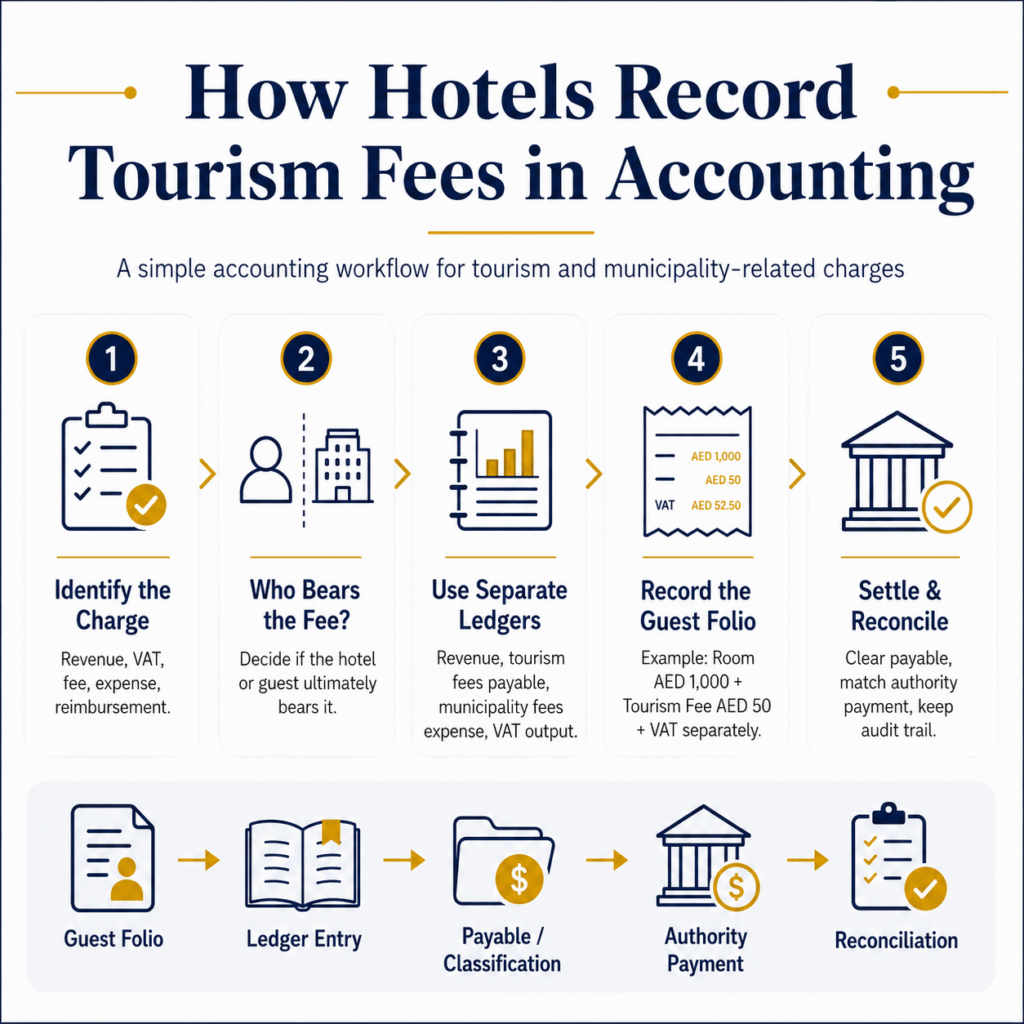
Guest transaction → Guest folio → Accounting ledger → Fee payable/revenue classification → Authority settlement → Reconciliation
Step 1: Identify the Nature of the Charge
Before posting the transaction, determine whether it is:
- Hotel accommodation revenue
- Food and beverage revenue
- Hotel service charge
- VAT
- Government fee collected from the guest
- Hotel operating expense
- Reimbursement
- Disbursement
- Other income or charge
This classification should be documented in the accounting policy.
Step 2: Determine Who Bears the Fee
Ask whether the hotel or the guest ultimately bears the charge.
For example, if the hotel incurs an expense in its own name and recovers it from the customer, the FTA’s reimbursement principles may become relevant. The FTA states that reimbursement generally relates to expenses incurred by the supplier as principal, while a disbursement relates to amounts paid on behalf of another person.
Step 3: Create Separate Ledger Accounts
A hotel can structure its chart of accounts with separate accounts such as:
| Account | Purpose |
|---|---|
| Hotel Room Revenue | Accommodation income |
| Food & Beverage Revenue | Restaurant and beverage sales |
| Service Charge Revenue | Applicable hotel service charges |
| Tourism Fees Payable | Amounts tracked for settlement where appropriate |
| Municipality Fees Expense | Applicable business costs |
| VAT Output | VAT collected on taxable supplies |
| Government Charges | Separate tracking where appropriate |
The exact account structure should match the hotel’s accounting policy and the nature of each transaction.
Step 4: Record the Guest Transaction
Consider an illustrative example where a hotel issues a guest folio containing:
- Accommodation: AED 1,000
- Tourism-related charge: AED 50
- VAT: calculated according to the applicable taxable supplies
The accounting system should not assume that all AED 1,050 represents hotel revenue.
Instead, the hotel should determine which portion relates to its supply and which amount should be tracked separately.
Step 5: Record Payment to the Relevant Authority
When the relevant amount is settled with the authority, the accounting team should clear the corresponding payable or other appropriate balance.
This creates a traceable connection between:
Guest folio → accounting entry → outstanding balance → authority payment → bank transaction
That audit trail becomes particularly useful during month-end closing.
Municipality Fee Accounting Treatment for Hospitality Businesses
The accounting treatment for municipality fees UAE can vary depending on the charge and the business arrangement. A hotel may incur a fee directly as part of operating its property. In that situation, it may be appropriate to recognise an operating expense when the relevant recognition criteria are met. However, a separately collected customer amount should not automatically receive the same treatment.
When Municipality Fees Are a Business Expense
If the hotel is legally responsible for the charge and bears the cost, the amount may need to be recognised as an operating expense.
The accounting team should retain:
- Authority invoices or statements
- Payment receipts
- Bank evidence
- Supporting calculations
- Contracts or licences where relevant
- Internal approval records
When a Charge Is Collected From the Guest
If the hotel collects an amount from the guest, the accounting team should first establish whether it is:
- Consideration for the hotel’s own supply
- A reimbursement
- A disbursement
- A separately regulated government charge
- Another type of customer-related amount
This distinction matters for both accounting and VAT analysis.
VAT Treatment of Tourism and Municipality Fees in the UAE
VAT is one of the areas where hospitality businesses should avoid assumptions. The FTA explains that where a business makes multiple supplies, it must determine the VAT treatment of each supply. Its guidance uses hotel accommodation as an example of a taxable hospitality supply and distinguishes it from other services supplied as part of a transaction.
Are Tourism Fees Subject to VAT in the UAE?
There is no safe blanket rule that every tourism or municipality-related amount is automatically subject to, or automatically outside, VAT.
The treatment depends on the nature of the amount and the underlying transaction.
A hotel should therefore assess:
- What is being supplied?
- Who is making the supply?
- Who is legally responsible for the charge?
- Is the amount consideration for the hotel’s supply?
- Is the amount a reimbursement or disbursement?
- What documentation supports the treatment?
The FTA’s public clarification on disbursements and reimbursements specifically states that the VAT treatment of recovered expenses depends on whether the recovery qualifies as a disbursement or reimbursement.
VAT on Hotel Accommodation and Related Charges
Hotels should separately review the VAT treatment of:
- Accommodation
- Food and beverages
- Room upgrades
- Transportation
- Spa services
- Events
- Service charges
- Other guest services
- Government-related charges
The FTA’s taxable-person guidance explains that multiple supplies can have different VAT treatments and that businesses need to determine the correct treatment for each supply.
Common VAT Accounting Errors
Hospitality businesses should watch for these mistakes:
- Applying one VAT treatment to every guest-folio line
- Treating government charges as hotel revenue without analysis
- Using incorrect tax codes
- Combining taxable supplies with separately treated amounts
- Failing to reconcile VAT reports with the general ledger
- Not retaining supporting documentation
- Posting manual adjustments without an audit trail
The FTA maintains current VAT legislation and guidance, so hospitality businesses should review official updates when regulatory requirements change.
Hotel Revenue Accounting: What Should Be Separated?
Effective hotel accounting UAE starts with a clear revenue structure.
Accommodation Revenue
Track room revenue separately from government charges and other income. This allows management to calculate indicators such as room revenue, occupancy-related performance, and average daily revenue more accurately.
Food and Beverage Revenue
Restaurant, bar, catering and room-service transactions should have appropriate revenue categories.
Service Charges
Where applicable, service charges should have their own accounting treatment rather than being automatically combined with room revenue.
Tourism-Related Guest Charges
Separately identify applicable tourism-related amounts so the finance team can reconcile collections and settlements.
Other Hotel Income
Additional income can include:
- Meeting rooms
- Events
- Parking
- Laundry
- Spa services
- Transfers
- Other ancillary services
A detailed chart of accounts makes management reporting considerably easier.
Hotel Bookkeeping UAE: Daily Controls for Fee Accuracy
Good hotel bookkeeping UAE is not simply about entering transactions. It is about connecting operational systems with accounting records.
Daily Reconciliation
A hotel should compare:
- Property management system (PMS) reports
- Guest folios
- POS reports
- Cash collections
- Card settlements
- Online booking transactions
- Accounting entries
Differences should be investigated rather than carried forward indefinitely.
Monthly Reconciliation
At month-end, review:
- Tourism-related fee balances
- Municipality-related charges
- VAT accounts
- Authority payments
- Bank settlements
- Refunds
- Cancellations
- Outstanding receivables
- Guest ledger balances
Supporting Documents
Keep appropriate evidence such as:
- Guest invoices
- Tax invoices
- Guest folios
- PMS reports
- POS reports
- Authority statements
- Payment receipts
- Bank statements
- Reconciliation schedules
Strong documentation helps finance teams explain unusual transactions during audits and tax reviews.
Example: Accounting for a Hotel Guest Stay in the UAE
Consider a simplified example.
A hotel issues a guest folio containing:
- Room charge: AED 1,000
- Tourism-related charge: AED 50
- Applicable VAT: calculated according to the relevant VAT treatment
The accounting team should first identify the nature of each line.
The AED 1,000 room charge represents the hotel’s accommodation supply.
The AED 50 tourism-related amount requires separate analysis based on the applicable rules and the hotel’s role in collecting the amount.
The accounting process should then follow this sequence:
1. Booking: The reservation enters the PMS.
2. Guest folio: Charges are added to the guest account.
3. Revenue recognition: The hotel recognises its accommodation revenue under its accounting policy.
4. Fee classification: The tourism-related amount is posted to the appropriate account based on its legal and accounting treatment.
5. VAT review: The hotel applies the appropriate VAT treatment to each relevant supply.
6. Collection: The guest settles the folio.
7. Authority settlement: Where applicable, the hotel settles the relevant amount with the authority.
8. Reconciliation: Finance matches the PMS, accounting ledger, bank transaction and authority records.
This process reduces the risk of overstated revenue and unexplained balances.
Common UAE Hospitality Accounting Mistakes
Common problems include:
- Recording every guest charge as revenue
- Posting all government-related amounts to one expense account
- Mixing VAT with tourism charges
- Failing to reconcile guest folios
- Ignoring cancelled bookings
- Not correcting refunded transactions
- Using incorrect VAT codes
- Failing to match authority payments with ledger balances
- Maintaining insufficient supporting documentation
- Assuming the same fee rules apply across every emirate
- Relying entirely on automated accounting entries without review
Automation can reduce manual work, but finance teams still need to validate the underlying accounting logic.
How to Reconcile Tourism Fees With Hotel Accounts
A structured reconciliation process can identify errors before they affect financial statements.
Compare PMS Reports With Accounting Records
Start with the operational report and compare it with the relevant general-ledger accounts.
Investigate differences caused by:
- Late postings
- Cancellations
- Refunds
- Manual adjustments
- Rate changes
- System mapping errors
Compare Guest Charges With Collections
Match guest folios against:
- Cash
- Credit cards
- Debit cards
- Online payment platforms
- Bank transfers
Match Payables With Authority Payments
Where the hotel maintains a payable for amounts due to an authority, compare the ledger balance with payment records and authority statements.
Investigate Variances
Do not simply post unexplained differences to miscellaneous income or expenses.
Identify the source first.
Maintain an Audit Trail
Every adjustment should have:
- Date
- Amount
- Reason
- Supporting document
- Authorisation
- Original transaction reference
UAE Hospitality Accounting Standards and Financial Reporting
Hospitality businesses should apply their accounting policies consistently and align financial reporting with the applicable accounting framework.
Three categories are particularly important:
| Classification | General purpose |
|---|---|
| Revenue | Income earned from the hotel’s supplies |
| Liability | Amounts owed to another party or authority |
| Expense | Costs incurred by the business |
The correct classification depends on the facts of the transaction.
For example, an amount collected from a customer may not automatically represent revenue if the business is acting in a different capacity. Similarly, a cost recovered from a customer may require VAT analysis based on whether it is a reimbursement or disbursement.
How Accounting Software Helps Hotels Manage Tourism Fees
Modern accounting systems can improve hospitality financial reporting when properly configured.
Useful capabilities include:
- PMS integration
- POS integration
- Automated journal posting
- VAT tax codes
- Bank feeds
- Automated reconciliation
- Custom chart of accounts
- Multi-property reporting
- User permissions
- Audit trails
- Management dashboards
What to Look for in Hotel Accounting Software UAE
Before selecting or configuring software, hospitality businesses should consider whether it supports:
- Multiple revenue streams
- Separate government-fee accounts
- UAE VAT requirements
- PMS and POS integration
- Bank reconciliation
- Multi-property reporting
- Detailed audit trails
- Custom tax mapping
- Automated financial reporting
Software should support the accounting policy rather than replace professional judgement.
Compliance Checklist for UAE Hospitality Businesses
Use this checklist as a monthly control:
- Identify all applicable municipality charges
- Identify tourism-related charges
- Review the legal nature of each charge
- Maintain separate ledger accounts
- Review VAT treatment
- Reconcile guest folios
- Reconcile bank collections
- Match authority payments
- Investigate outstanding balances
- Retain supporting documentation
- Review unusual adjustments
- Update accounting procedures when regulations change
The FTA’s official VAT legislation and guidance should remain the primary reference when assessing tax treatment.
How Ripple Business Setup Can Help With UAE Hospitality Accounting
Hospitality businesses often need accounting processes that connect daily hotel operations with financial and tax reporting. Ripple Business Setup can support businesses with bookkeeping, accounting, VAT-related accounting, reconciliations, and financial reporting. A structured approach can help hospitality operators separate revenue, government-related charges, expenses, and tax balances more clearly.
For professional support, contact Ripple Business Setup at +971 50 593 8101 or info@ripplellc.ae. Businesses can also review their existing accounting setup to identify reconciliation, VAT, or classification gaps.
FAQ
What is hospitality accounting in the UAE?
UAE hospitality accounting covers the recording, reconciliation, and reporting of transactions generated by hotels, restaurants, serviced apartments, resorts, and other hospitality businesses. It includes revenue, expenses, VAT, payroll, guest accounts, and relevant government or tourism-related charges.
How should hotels record tourism fees?
Hotels should first determine the legal and commercial nature of the tourism fee. Depending on the circumstances, it may need separate tracking from hotel revenue. The hotel should then reconcile the amount from the guest folio through its accounting system to the relevant settlement or payment record.
Are tourism fees subject to VAT in the UAE?
The answer depends on the specific fee and transaction structure. Businesses should not assume that every government-related amount receives identical VAT treatment. The FTA’s guidance distinguishes between different types of expense recovery and requires businesses to assess the underlying supply.
How are municipality fees recorded in accounting?
If a municipality charge is a cost incurred by the hotel, it may be recorded as an operating expense according to the applicable accounting treatment. If an amount is separately collected from a customer, the hotel should first determine whether it is revenue, a reimbursement, a disbursement, or another type of amount.
What is Tourism Dirham in Dubai?
Tourism Dirham is a tourism-related charge associated with stays in Dubai accommodation establishments. Hotels and other relevant accommodation businesses should maintain appropriate records of applicable charges and follow the current requirements of the relevant Dubai authority.
How often should hotels reconcile tourism fees?
Daily operational checks combined with a formal monthly reconciliation are good practice. High-volume properties may benefit from more frequent monitoring to identify errors before month-end closing.
What accounting records should hotels maintain for government fees?
Records can include guest folios, invoices, authority statements, payment receipts, bank statements, PMS reports, accounting entries, and reconciliation schedules. The exact records required depend on the transaction and applicable regulatory requirements.
Why should hotels separate tourism fees from hotel revenue?
Separating relevant amounts helps management understand actual hotel revenue, monitor outstanding obligations, reconcile authority payments, and prepare more reliable financial reports. It also reduces the risk of incorrect VAT and accounting treatment.
Conclusion
Accurate UAE Hospitality Accounting requires more than recording guest payments. Hotels should distinguish accommodation revenue, VAT, tourism-related charges, municipality costs, and amounts payable to authorities based on the nature of each transaction. A clear chart of accounts, regular reconciliation, and reliable supporting documentation can help hospitality businesses maintain cleaner books and reduce compliance risks. Because UAE tax and tourism requirements can change, businesses should regularly verify current official guidance before finalising their accounting treatment.
Important: Fee structures and regulatory requirements can differ by emirate, property type, and business activity. Businesses should verify the current requirements with the relevant authority and the Federal Tax Authority (FTA) before finalising their accounting treatment.