

Running a business in the UAE means staying on top of your tax obligations, and in 2026, that responsibility has never been more important. Since the introduction of the UAE Corporate Tax (9%), the Federal Tax Authority (FTA) has tightened compliance requirements across the board. One key document you may need, whether you’re closing a company, cancelling a visa, or exiting the market, is a Tax Clearance Certificate.
This certificate is the FTA’s official confirmation that your business has no outstanding tax liabilities. Without it, you cannot complete deregistration, business closure, or certain legal processes. Whether you’re a mainland company, a free zone business, a freelancer with VAT registration, or a foreign investor winding down operations, understanding how to obtain this certificate is essential to a smooth exit or transition.
What is a Tax Clearance Certificate in the UAE?
A Tax Clearance Certificate (TCC) is an official document issued by the Federal Tax Authority (FTA) that confirms a registered taxpayer, whether a company or an individual, has no pending or outstanding tax liabilities with the UAE government.
In plain terms, it is the FTA’s green light that says your tax affairs are in order. It does not simply mean your taxes are paid; it confirms that all tax returns have been filed, all dues are settled, and any applicable audits have been completed. The FTA UAE issues this certificate as part of its tax compliance framework, and it is typically required during the deregistration or business closure process.
Why is a Tax Clearance Certificate Important in 2026?
The UAE’s corporate tax landscape changed significantly when the 9% Corporate Tax came into effect for financial years starting on or after June 1, 2023. By 2026, all eligible businesses will be fully subject to this regime and the FTA’s compliance enforcement will follow suit.
Here is why a Tax Clearance Certificate matters more than ever this year:
- Business closure and liquidation: You cannot legally close a company in the UAE or cancel a trade license without clearing your tax obligations. The Department of Economic Development (DED) and free zone authorities require the FTA’s sign-off.
- Tax deregistration: Whether you are deregistering for VAT, Corporate Tax, or Excise Tax, the FTA requires that your records be clean before it removes you from the system.
- Mergers and acquisitions: Companies undergoing restructuring or pursuing mergers may need to demonstrate a clean tax slate to potential partners or regulators.
- Visa cancellation: In certain cases, particularly for company owners or investors, the visa cancellation process may be linked to business deregistration, making the TCC indirectly necessary.
- Legal protection: Without proper clearance, businesses risk accumulating penalties and legal complications that can follow them beyond the UAE.
Who Needs a Tax Clearance Certificate in the UAE?
Not every business needs a Tax Clearance Certificate at every stage, but if any of the following apply to you, this document is essential:
- Companies are closing operations or voluntarily winding down
- Businesses applying for VAT or Corporate Tax deregistration
- Free zone companies exiting their jurisdiction
- Mainland companies are cancelling their trade license
- Freelancers or sole proprietors with active VAT registration
- Foreign investors exiting the UAE market
- Companies involved in mergers, acquisitions, or restructuring
- Businesses that have undergone an FTA audit and need final clearance
Even if your business has been dormant for a period, you still need to fulfil your tax filing obligations before applying for clearance. The FTA does not grant certificates to businesses with missing or incomplete returns.
Types of Tax Clearance Certificates in UAE
One area that many guides overlook is the fact that the UAE does not issue a single, one-size-fits-all Tax Clearance Certificate. The type you need depends on which tax regime you are registered under:
- VAT Clearance Certificate: For businesses registered under the Value Added Tax system. Required when deregistering for VAT after meeting the conditions (e.g., taxable supplies falling below the threshold, or cessation of business).
- Corporate Tax Clearance Certificate: For companies registered under the UAE Corporate Tax regime (applicable to financial years from June 2023 onwards). This is becoming increasingly relevant in 2026 as the regime matures.
- Excise Tax Clearance Certificate: For businesses dealing in excise goods such as tobacco, energy drinks, or carbonated beverages that are deregistering from the Excise Tax system.
In some cases, a business may need clearance from multiple tax categories before full deregistration is approved. Working with a tax consultant helps ensure you identify the correct type and apply it accordingly.
Eligibility Criteria for Tax Clearance Certificate
Before submitting your application, you must meet the FTA’s eligibility requirements. Failing to meet these conditions is the most common reason for delays or rejections:
- Active tax registration: You must currently be registered with the FTA under the relevant tax type (VAT, Corporate Tax, or Excise Tax).
- All returns filed and submitted: Every tax return due, including any historical periods, must be submitted through the FTA portal. Incomplete returns will block your application immediately.
- No outstanding tax liabilities: All taxes owed, including penalties and late payment fees, must be fully paid. The FTA will not issue a certificate if any amount is due.
- Completed audits: If your business has been subject to an FTA tax audit, that process must be formally concluded and any resulting dues cleared before you can apply.
- Supporting documentation ready: You must have your financial records, trade license, and relevant company documents in order.
Documents Required for Tax Clearance Certificate
Preparing your documents in advance significantly reduces processing delays. Here is what you will typically need:
- Copy of the current trade license
- Emirates ID (for UAE nationals and residents) or a valid passport (for foreign nationals)
- VAT Registration Number (TRN) or Corporate Tax Registration Number
- Most recent audited financial statements
- Tax audit reports (if an audit has been conducted)
- Bank clearance or proof of account settlement (where applicable)
- Board resolution or authorisation letter (for corporate applicants)
- Deregistration application (submitted via the FTA portal)
| Tip: Create a document checklist before you begin. Missing even one item can delay the FTA’s review by several weeks. |
Step-by-Step Process to Apply for Tax Clearance Certificate
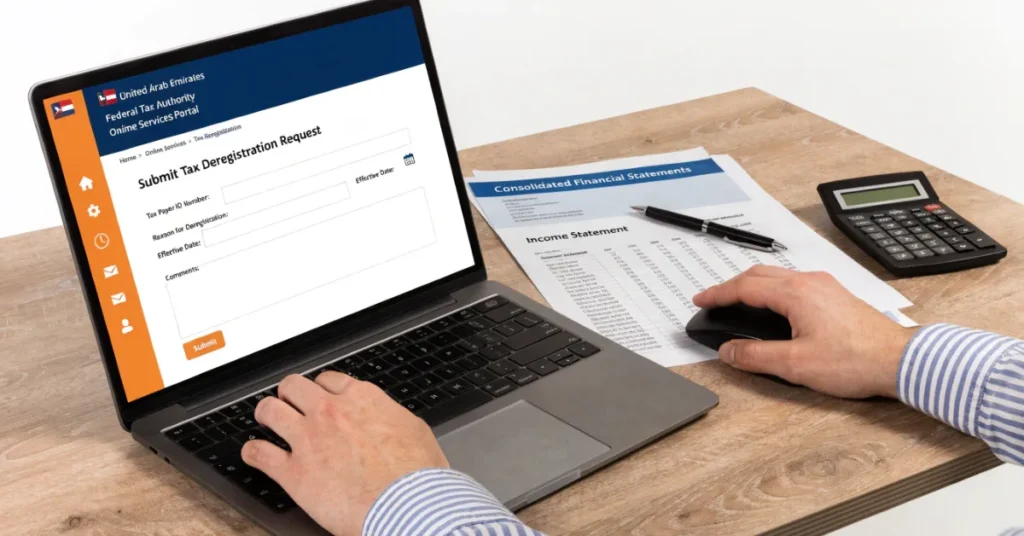
The application process runs through the FTA’s online portal. Here is how it works, step by step:
Step 1 – Log In to the FTA Portal
Visit the official FTA portal at eservices.tax.gov.ae and log in using your registered credentials. If you have not yet created an account, you will need to register first using your trade license and Emirates ID.
Step 2 – Submit a Deregistration Request
Navigate to the relevant tax section (VAT, Corporate Tax, or Excise Tax) and submit a formal deregistration request. This triggers the FTA’s review process and is the starting point for your Tax Clearance Certificate application.
Step 3 – Clear All Outstanding Liabilities
Before the FTA can proceed, your account must show a zero balance. Pay any pending taxes, penalties, or fees through the portal. Keep payment confirmation records for your files.
Step 4 – Upload Required Documents
Upload all the documents listed in the previous section through the FTA portal. Make sure each document is clear, valid, and in the required format (usually PDF). Incomplete or blurry uploads are a common cause of rejection.
Step 5 – FTA Review and Approval
Once your application and documents are submitted, the FTA will review your case. This includes verifying your tax history, confirming all returns are filed, and checking for outstanding amounts. If everything is in order, the FTA will issue the Tax Clearance Certificate electronically.
| Timeline: The standard processing time is 20 to 30 working days, though complex cases involving audits or multiple tax types may take longer. |
How Long Does It Take to Get a Tax Clearance Certificate?
Under standard conditions, the FTA processes Tax Clearance Certificate applications within 20 to 30 working days from the date of a complete and valid submission.
However, several factors can affect this timeline:
- Incomplete document submissions that require resubmission
- Outstanding liabilities that are disputed or under review
- Ongoing FTA audits that have not yet been formally closed
- High volume of applications, particularly at the end of fiscal quarters
- Errors in the deregistration request or TRN details
To avoid delays, submit a complete application on the first attempt, respond promptly to any FTA queries, and use a tax professional who is familiar with the portal requirements.
Cost of Tax Clearance Certificate in UAE
One of the most underreported aspects of this process is the cost structure. The FTA does not charge a direct application fee for a Tax Clearance Certificate the certificate itself is issued free of charge. However, the indirect costs involved can be significant:
- Accounting and bookkeeping fees: Getting your financial records up to date and accurate typically requires professional accounting support.
- Audit fees: If your business needs an audit report or if an FTA audit is triggered, audit firms charge fees based on company size and complexity.
- Tax consultancy charges: A qualified tax consultant’s fees for managing the full deregistration and clearance process can range from AED 2,000 to AED 15,000 or more, depending on complexity.
- Late payment penalties: If you have outstanding dues, the FTA charges a late payment penalty of 2% immediately, rising to 4% monthly. These can add up quickly.
Factoring in these indirect costs from the start helps you budget appropriately and avoid surprises.
Common Mistakes to Avoid
Many businesses run into avoidable problems during the Tax Clearance Certificate process. Here are the most common pitfalls and how to sidestep them:
- Missing tax filings: Submitting clearance applications before all tax returns are filed is the number one reason for rejection. Audit your filing history thoroughly before applying.
- Incorrect financial data: Discrepancies between your filed returns and your financial statements raise red flags with the FTA and trigger additional scrutiny.
- Delayed deregistration: Some companies wait too long after ceasing operations to apply for deregistration. The FTA continues to expect returns during this period, which can lead to penalty accumulation.
- Ignoring penalties: Businesses sometimes assume penalties will be waived. They usually are not pay them proactively rather than hoping for leniency.
- Uploading wrong documents: A common mistake is uploading outdated trade licenses or financial statements from the wrong fiscal year. Double-check every document before submission.
| Example: A Dubai-based retail business shut its doors in early 2024 but delayed filing its final VAT returns. By the time it applied for a Tax Clearance Certificate in late 2024, it had accumulated over AED 18,000 in penalties for late filing and non-payment. The lesson: begin the deregistration process as soon as you decide to close, not after. |
What Happens After Getting a Tax Clearance Certificate?
Receiving your Tax Clearance Certificate is not the final step; it is the gateway to completing your business closure. Once you have the certificate, here is what typically follows:
- Trade license cancellation: Submit the certificate to the Department of Economic Development (DED) or your free zone authority to cancel the trade license.
- Bank account closure: Most UAE banks require proof of tax clearance before closing a corporate account.
- Visa and immigration matters: Company owners and sponsored employees may need to cancel residency visas, which requires the license to be formally cancelled first.
- Commercial register deregistration: The company is removed from the UAE commercial registry, officially ending its legal existence.
Tax Clearance Certificate for Business Closure in UAE

Business closure in the UAE is a structured legal process, and the Tax Clearance Certificate is the linchpin of that process. The FTA’s involvement ensures that no company can simply walk away from its tax obligations by ceasing operations.
Whether you are liquidating voluntarily or under regulatory direction, the sequence is consistent: settle all liabilities, file outstanding returns, obtain the Tax Clearance Certificate, and then proceed with the formal closure through the relevant licensing authority. This sequence also applies to free zone companies; each free zone has its own closure requirements, but all ultimately require evidence of FTA clearance.
Getting this step right protects you legally and financially. Businesses that attempt to close without obtaining proper tax clearance can face frozen accounts, blacklisting with the authorities, and difficulties re-entering the UAE market in the future.
UAE Tax Clearance Certificate vs Tax Residency Certificate
These two certificates are often confused, but they serve entirely different purposes. Here is a clear comparison:
| Feature | Tax Clearance Certificate | Tax Residency Certificate |
| Purpose | Confirms no outstanding tax dues | Confirms tax residency status |
| Issued by | Federal Tax Authority (FTA) | Ministry of Finance |
| Primary Use | Business closure, deregistration | Avoid double taxation abroad |
| Who Applies | Registered businesses / freelancers | Individuals and companies |
| Processing Time | ~20–30 working days | ~5 working days |
The Tax Residency Certificate (TRC), also known as the Tax Domicile Certificate, is issued by the Ministry of Finance and is used primarily to benefit from the UAE’s double taxation avoidance agreements (DTAs) with other countries. It is not a substitute for the Tax Clearance Certificate.
Expert Tips to Get Your Certificate Faster
If you want to avoid the 30-working-day wait and minimise the risk of rejection, follow these practical steps:
- Keep accounting records updated throughout the year, not just at year-end. Monthly reconciliation makes tax filing straightforward.
- File all tax returns on time, even during periods of low or zero revenue. Nil returns still need to be submitted.
- Engage a qualified UAE tax consultant early in the process. A professional who knows the FTA portal and requirements can pre-empt issues before they become delays.
- Conduct an internal tax audit 3 to 6 months before you plan to close. This gives you time to identify and resolve discrepancies.
- Respond promptly to any FTA queries or requests for additional information. Delays in responding extend your processing time.
- Maintain a clean digital paper trail, save all payment confirmations, return submissions, and correspondence with the FTA.
How Ripple Business Setup Can Help You
Getting a Tax Clearance Certificate in the UAE can feel complex, especially with the newer corporate tax rules layered on top of existing VAT obligations. The paperwork, the portal, the timelines, and the risk of penalties all add up.
Our team at Ripple Business Setup guides businesses through the full tax deregistration and clearance process. From ensuring all your returns are filed to clearing outstanding liabilities and navigating the FTA portal, we handle the details so you can focus on what comes next.
Contact Ripple Business Setup today:
- Phone: +971 50 593 8101
- Email: info@ripplellc.ae
- WhatsApp: +971 4 250 0833
Frequently Asked Questions
Is a Tax Clearance Certificate mandatory in UAE?
Yes. A Tax Clearance Certificate is required for any business seeking to deregister from the FTA’s tax system or formally close its operations. Without it, authorities will not process your license cancellation or deregistration request.
Can I get a Tax Clearance Certificate without an audit?
It depends on your business size, the nature of your operations, and whether you have been selected for an FTA audit. Many small businesses obtain their certificate without a formal audit, provided their tax records are complete and accurate. Larger businesses or those with complex transaction histories may be required to submit audited financial statements.
How do I check my tax status in the UAE?
You can check your current tax standing, including any outstanding liabilities or missing returns, through your account on the FTA’s e-services portal at eservices.tax.gov.ae. Your registered tax agent can also request a tax status report on your behalf.
What happens if I don’t get a Tax Clearance Certificate?
Skipping this step has real consequences. You may face administrative penalties, be unable to cancel your trade license, experience delays in visa cancellations, have your bank accounts flagged or frozen, or find it difficult to re-enter the UAE market in the future. The FTA tracks registered taxpayers, and an unclosed registration will continue to generate filing obligations and penalties for missing them.
How much does a Tax Clearance Certificate cost?
The FTA does not charge a direct fee for issuing the certificate. However, associated costs such as accounting fees, audit fees, and consultancy charges can range from a few thousand to tens of thousands of AED, depending on business complexity.
Conclusion
A Tax Clearance Certificate is more than just a piece of paperwork; it is the formal conclusion of your tax obligations in the UAE and the legal gateway to business closure, deregistration, or market exit. In 2026, with corporate tax fully in force and the FTA’s compliance monitoring in full swing, obtaining this certificate correctly and promptly is not optional.
Disclaimer: The information provided in this article is for general guidance only and does not constitute legal or tax advice. Regulations in the UAE may change, and requirements can vary based on your business activity. It is recommended to consult qualified professionals or official authorities before making any decisions.