The UAE has become one of the most preferred destinations for global investors and entrepreneurs who want to protect assets, manage subsidiaries, and enjoy strong tax advantages. Setting up a UAE holding company is not as complicated as many people think.
What Is a UAE Holding Company?
A UAE holding company is a parent company that owns shares in one or more subsidiary companies. It does not typically run daily business operations itself. Instead, it holds assets such as shares, intellectual property, real estate, or investments under one legal entity.
Think of it like an umbrella. The holding company sits on top, while the businesses underneath it operate independently. This structure gives business owners better control, legal protection, and tax efficiency.
Why Investors Choose the UAE for Holding Structures
The UAE offers several strong reasons to set up a holding company here:
- 0% corporate tax on qualifying income (under UAE CT Law 2023)
- 100% foreign ownership in UAE Free Zones
- No capital gains tax on dividends from subsidiaries
- Strong legal framework with DIFC and ADGM courts
- Access to 140+ Double Tax Treaties (DTTs)
- Fast company registration often takes within 5 to 10 business days
- World-class banking infrastructure and financial services
Step 1: Choose the Right Jurisdiction for Your UAE Holding Company
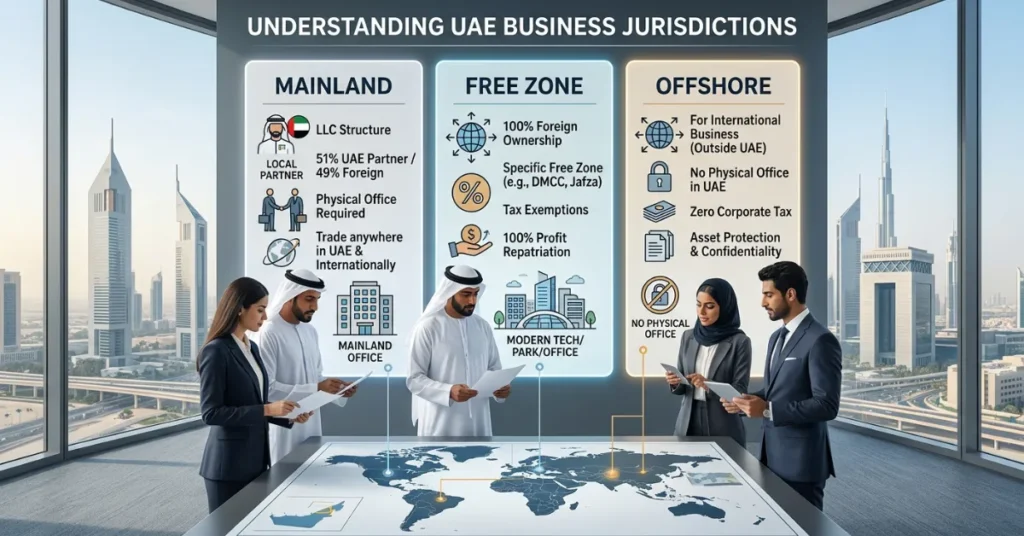
The first and most important step is deciding where to register your UAE holding company. The UAE gives you three main options: Mainland, Free Zone, or Offshore.
Mainland UAE Holding Company
A mainland holding company is registered under the UAE Ministry of Economy or a relevant emirate authority. Since the 2021 Foreign Ownership Law, foreigners can now own 100% of many mainland companies without a local sponsor.
Free Zone Holding Company
UAE Free Zones are special economic zones with their own regulatory authorities. Popular Free Zones for holding companies include:
- DIFC (Dubai International Financial Centre): Highly regulated, ideal for investment holding and fund structures.
- ADGM (Abu Dhabi Global Market): Strong for family offices and international holding structures.
- RAKICC (Ras Al Khaimah ICC): Cost-effective for pure holding and asset protection purposes.
- JAFZA (Jebel Ali Free Zone): Excellent for holding companies linked to trade and logistics.
Offshore UAE Holding Company
Offshore companies (like RAK ICC or JAFZA Offshore) are the most affordable option. They cannot trade inside the UAE directly, but are great for holding shares, IP rights, and international assets.
Pro Tip: Most international investors and family groups prefer DIFC, ADGM, or RAKICC for holding structures due to their legal certainty and global recognition.
Step 2: Select Your UAE Holding Company Structure and Business Activity
Once you choose your jurisdiction, the next step is deciding your company structure and defining your business activity. In the UAE, the most common legal forms for a holding company are:
- LLC (Limited Liability Company): Most common on the mainland. Requires at least 2 shareholders.
- Private Shareholding Company: Suitable for larger groups with multiple investors and share classes.
- Foundation: Commonly used in ADGM and DIFC for family wealth and succession planning.
- SPV (Special Purpose Vehicle): Used for ring-fencing specific assets or projects under the holding umbrella.
What Business Activities Can a UAE Holding Company Register?
The activity you list on your trade license should reflect what your holding company will actually do. Common approved activities include:
- Holding shares and equity interests in subsidiaries
- Management of investments and portfolios
- Intellectual property (IP) holding and licensing
- Real estate asset holding
- Providing inter-company loans and financial services (where permitted)
Make sure you list the correct activity from the official approved list of your chosen authority. An incorrect activity code can cause delays or compliance issues later.
Step 3: Prepare Your Documents and Submit the Application
This step is where most people feel overwhelmed, but it does not have to be. Here is a straightforward document checklist for registering a UAE holding company:
Documents Required for Individual Shareholders
- Passport copy (all shareholders and directors)
- UAE Visa and Emirates ID (if UAE resident)
- Proof of address: utility bill or bank statement (within 3 months)
- No Objection Certificate (NOC) from current employer (if applicable)
- Bank reference letter
Documents Required for Corporate Shareholders
- Certificate of Incorporation of the parent company
- Memorandum and Articles of Association (MOA/AOA)
- Board Resolution authorizing the UAE company setup
- Certificate of Good Standing (notarized and apostilled)
- Shareholder register
- UBO (Ultimate Beneficial Owner) declaration form
All foreign documents must be attested, either notarized, apostilled, or UAE embassy-attested depending on the country of origin. Work with a licensed business setup consultant to ensure your documents meet the specific authority’s requirements.
The Application Submission Process
- Submit the application to the relevant authority (DED, DIFC, ADGM, RAKICC, etc.)
- Pay the initial registration fee
- Receive Name Approval for your company
- Draft and sign the Memorandum of Association (MOA)
- Get the trade license issued
- Complete UBO registration (mandatory under UAE AML regulations)
Timeline: Most Free Zone holding companies are registered in 3 to 7 business days. Mainland registrations can take 7 to 14 business days, depending on approvals.
Step 4: Open a Corporate Bank Account and Activate Your Holding Company

Having your trade license issued is only part of the job. To make your UAE holding company fully operational, you need a corporate bank account. This is where many new business owners face delays but preparation makes it much smoother.
Choosing the Right Bank for Your Holding Company
UAE banks with strong corporate banking services include:
- Emirates NBD
- First Abu Dhabi Bank (FAB)
- Abu Dhabi Commercial Bank (ADCB)
- Mashreq Bank
- RAKBANK
For international holding structures, some investors also consider opening accounts with international banks that have UAE branches, such as HSBC or Standard Chartered.
What UAE Banks Require for Holding Companies
Banks in the UAE take compliance seriously. Be ready to present:
- Trade license and Certificate of Incorporation
- MOA and Share Certificate
- Passport copies and Emirates ID of all signatories
- Business plan explaining the purpose of the holding company
- Source of funds declaration
- UBO disclosure documents
- Audited financial statements (if the parent company is already operating)
Expect the bank onboarding process to take 2 to 6 weeks. Maintaining a minimum balance (typically AED 50,000 to AED 500,000 depending on the bank) may also be required.
Post-Registration Compliance You Must Not Ignore
After your UAE holding company is active, you must stay compliant with:
- Economic Substance Regulations (ESR): If your company earns income from certain activities like holding, you must meet ESR requirements and file annually.
- UBO Register: Maintain and update your UBO records as required by UAE law.
- UAE Corporate Tax (CT): Understand your CT obligations. Qualifying Free Zone Persons may benefit from a 0% rate on qualifying income.
Annual License Renewal: All UAE trade licenses must be renewed every year.
Why Choose Our Ripple Business Setup Support for a UAE Holding Company
Setting up a holding company in the UAE can look simple on paper, but the process involves legal structure selection, documentation, licensing, and regulatory approvals. Our team at Ripple Business Setup guides clients through each stage with a clear plan. We review business goals, recommend the right jurisdiction, and prepare all required documents to avoid delays. Our consultants handle company registration, license processing, and government coordination so business owners can focus on growth and investment planning.
We also help structure holding companies for asset protection, tax planning, and international expansion. Our experience with UAE company formation allows us to complete registrations efficiently while keeping compliance in place. If you want expert support, contact Ripple Business Setup at +971 50 593 8101, email info@ripplellc.ae, or WhatsApp +971 4 250 0833 to start the process.
FAQ
Can a foreigner own 100% of a UAE holding company?
Yes. In most UAE Free Zones and many mainland sectors (post-2021 law), foreigners can own 100% of a UAE holding company without needing a UAE national partner.
What is the minimum share capital for a UAE holding company?
It varies by jurisdiction. DIFC and ADGM holding companies typically require a minimum share capital of USD 1,000 to USD 50,000, depending on the structure. RAKICC and offshore entities often have no minimum paid-up capital requirement.
Is a UAE holding company subject to corporate tax?
Under the UAE Corporate Tax Law (effective June 2023), most holding companies that qualify as free zone entities and earn qualifying passive income (dividends, capital gains from subsidiaries) may benefit from a 0% CT rate. Always consult a UAE tax advisor for your specific situation.
How long does it take to set up a UAE holding company?
Free Zone holding companies are typically set up within 3 to 10 business days. Mainland companies may take 10 to 15 business days. Bank account opening adds another 2 to 6 weeks.
What is the difference between a UAE holding company and an operating company?
A holding company owns shares and assets. It does not conduct daily operations or sell goods/services directly. An operating company runs the actual business. The holding company protects assets from the liabilities of the operating company.
Conclusion
A UAE holding company gives you a powerful legal and financial tool to protect your assets, manage your subsidiaries, and grow your wealth internationally. The UAE’s zero-tax environment, political stability, and global connectivity make it one of the best places in the world to structure your business holdings.
Disclaimer: This content is for general informational purposes only and should not be considered legal, financial, or business advice. Regulations and requirements for UAE company formation may change. Always consult professional advisors before making business decisions.