

Most startups don’t fail because of bad ideas. They struggle because leadership does not evolve as the business grows. In the early stage, founders manage tasks. But as the team grows, leadership must shift toward building systems, trust, and accountability. If you want to scale your startup, you need more than hustle. You need a clear leadership framework that helps your team perform without constant supervision.
Why Leadership Matters When You Scale Your Startup
Scaling a business is not just about increasing revenue. It is about building a structure that can handle growth without breaking. This is where startup leadership skills play a critical role.
Many founders confuse managing with leading. Managing focuses on tasks and deadlines, while leadership focuses on people, direction, and decisions. When leadership is weak, teams lose clarity, execution slows down, and growth becomes unstable.
Poor leadership often leads to high employee turnover, low motivation, and poor communication. These issues directly impact startup culture and make scaling difficult. Strong leadership, on the other hand, improves hiring decisions, builds trust, and aligns the team with business goals.
If you want consistent growth, leadership must evolve alongside your business.
What Are the 5 Leadership Levels in a Startup?
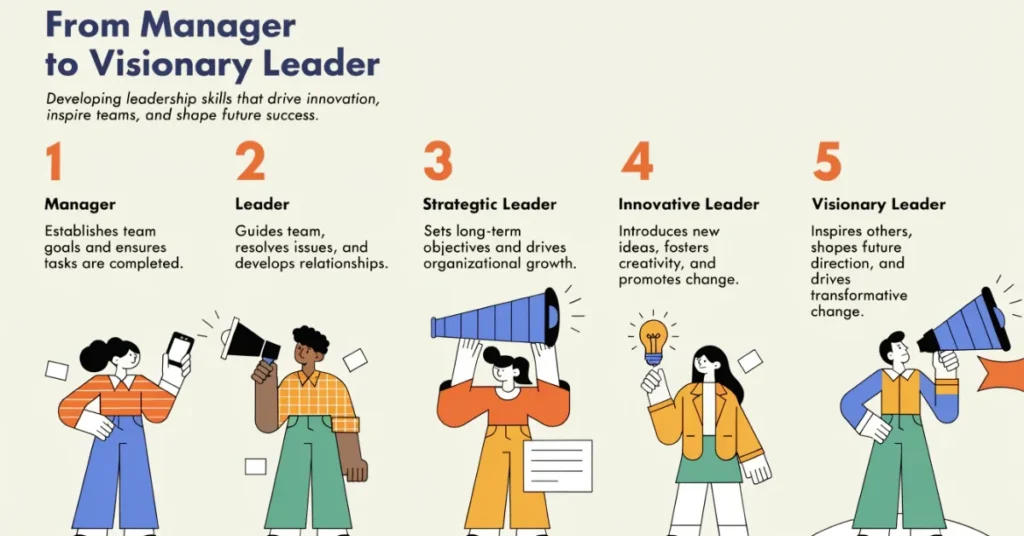
Leadership is not a fixed skill. It grows in stages. The 5 leadership levels act as a roadmap that helps founders move from control to influence and eventually to long-term impact.
Level 1 – Position Leadership
At the early stage, most founders operate at this level. You have authority because you started the company. Your team follows instructions out of necessity, not out of full engagement. This approach works in small teams, but it does not scale. Employees may complete tasks, but they rarely take initiative. Over time, this leads to low engagement and high turnover.
For example, a founder managing a small remote team may assign tasks daily but still struggle with missed deadlines and lack of ownership. This is a clear sign of position-based leadership.
To scale your startup, you must move beyond authority and start building trust.
Level 2 – Permission Leadership
At this stage, leadership shifts from control to connection. You focus on relationships, communication, and trust. Your team starts to follow you because they want to, not because they are told to. This level improves team management and strengthens startup culture. When employees feel heard and valued, they contribute more actively.
Quick ways to build this level:
- Practice active listening during meetings
- Create regular feedback loops
- Stay transparent about decisions and challenges
Emotional intelligence becomes a key skill here. Without trust, you cannot scale a business effectively.
Level 3 – Production Leadership
This is where real growth begins. At the production level, leaders focus on results, performance, and execution. You set clear goals and build systems that help your team deliver consistently. Instead of managing every task, you introduce KPIs, accountability, and structured workflows. This improves efficiency and allows your startup to grow faster.
For example, a startup that finds product-market fit often moves into this stage. Revenue increases because the team knows what to do and how to do it.
Strong performance leadership at this level directly supports scaling a business.
Level 4 – People Development
At this stage, leadership is no longer about your performance. It is about your team’s growth. You invest time in mentoring, training, and developing future leaders. This shift is critical if you want to scale your startup team. You cannot manage everything alone. You need people who can lead others and make decisions independently.
Key actions at this level:
- Coach team members regularly
- Delegate ownership, not just tasks
- Build a leadership pipeline inside your company
This level creates high-performing teams and reduces dependency on the founder.
Level 5 – Pinnacle Leadership
This is the highest level of leadership. Here, you focus on vision, culture, and long-term impact. The business runs smoothly even without your daily involvement. You build systems that last and a culture that attracts top talent. Your role shifts from operator to strategist.
For example, founders at this stage often step back from daily operations and focus on expansion, partnerships, or new ventures.
This level defines sustainable growth and long-term scaling success.
How to Move Between Leadership Levels Faster
Leadership growth does not happen automatically. You must work on it intentionally. Many founders stay stuck at one level because they do not invest in their development.
Action steps to grow faster:
- Invest in leadership training and learning
- Hire people who complement your weaknesses
- Build systems early to avoid chaos later
- Learn from experienced mentors
- Track leadership performance with clear metrics
Improving leadership is one of the most effective startup growth strategies.
Common Mistakes That Stop Founders from Scaling
- Micromanaging every task
- Hiring without checking culture fit
- Avoiding delegation
- Ignoring team feedback
- Scaling revenue without improving leadership
These mistakes slow down growth and create operational stress. Fixing them early makes scaling smoother.
Tools and Systems to Support Leadership Growth
- Project management tools help track tasks and deadlines
- Performance systems improve accountability
- Communication tools keep teams aligned
- HR frameworks support hiring and team development
These systems reduce chaos and support better team management.
How Leadership Directly Impacts Startup Revenue Growth

Strong leadership improves execution. When teams work efficiently, results improve. This leads to faster scaling and better revenue growth. Good leadership also reduces employee turnover, which lowers hiring costs and saves time. A stable team performs better and supports long-term business growth.
If you want to scale your startup revenue, focus on leadership before anything else.
Scale Your Startup with Ripple Business Setup Support
When we plan to scale your startup, strong leadership alone is not enough. We also need the right business structure, legal setup, and operational support. This is where Ripple Business Setup plays an important role in helping founders move faster with confidence. We simplify company formation, licensing, and compliance so we can focus more on building strong teams and improving leadership. With the right foundation in place, scaling a business becomes more structured and less risky.
Our approach supports entrepreneurs at every stage, from launching a startup to expanding operations across the UAE. We make sure our business setup aligns with our long-term growth goals, helping us build a stable and scalable company.
For expert support, contact Ripple Business Setup at +971 50 593 8101, email info@ripplellc.ae, or WhatsApp +971 4 250 0833 to get started.
FAQ
What is the fastest way to scale your startup?
Focus on building strong leadership and systems. Quick growth without structure often leads to failure.
Why do startups fail during scaling?
Most fail due to poor leadership, weak processes, and lack of team alignment.
How important is leadership in startup growth?
Leadership directly impacts team performance, decision-making, and overall business success.
Can a startup scale without strong leadership?
No. Without strong leadership, growth becomes unstable and difficult to sustain.
Conclusion
Startups do not fail because of ideas. They fail because leadership does not scale with growth. The 5 leadership levels provide a clear path to build stronger teams, better systems, and sustainable success. If you want to scale your startup, start by identifying your current leadership level. Then take small, consistent steps to improve. Growth becomes easier when your team grows with you.
Disclaimer: This content is for informational purposes only and does not constitute legal, financial, or business advice. Business setup requirements in the UAE may change based on government regulations. We recommend consulting with professional advisors or Ripple Business Setup for accurate and updated guidance tailored to your specific needs.