


Businesses often measure success by looking at sales volume, revenue growth, or the number of orders generated by each channel. But high sales do not always mean high profits. A marketplace can generate AED 100,000 in sales while commissions, fulfillment, advertising, returns, and payment fees consume a large part of the margin. Meanwhile, a direct-to-consumer channel may generate less revenue but produce more profit because the business has greater control over pricing, customer relationships, and selling costs. This is why Sales Channel Profitability matters. By comparing retail, marketplace, and direct sales using the same financial framework, businesses can identify where revenue is genuinely profitable and where margins are leaking.
What Is Sales Channel Profitability?
Sales Channel Profitability measures how much profit a business generates from a specific sales channel after accounting for the costs directly associated with that channel.
These channels may include:
- Physical retail stores
- Online marketplaces
- Company-owned websites
- Direct-to-consumer sales
- B2B or wholesale sales
- Social commerce channels
The basic idea is simple:
Net Sales − COGS − Channel Costs = Channel Contribution Profit
For example, suppose an online marketplace produces AED 100,000 in net sales. After deducting product costs, marketplace commissions, fulfillment, advertising, returns, and payment fees, the actual contribution may be considerably lower.
Looking only at AED 100,000 in revenue could therefore give management the wrong impression.
Revenue vs Profitability by Sales Channel
Revenue tells you how much money a channel generates.
Profitability tells you how much value remains after the costs required to generate that revenue.
A useful channel profitability analysis should consider:
- Net sales
- Cost of goods sold
- Marketplace commissions
- Payment processing fees
- Delivery and fulfilment
- Packaging
- Returns and refunds
- Advertising
- Customer acquisition costs
- Sales commissions
- Other channel-specific expenses
The objective is not simply to find the channel with the most sales. It is to identify the channel that creates sustainable profit.
Why the Highest-Revenue Channel May Not Be the Most Profitable
Consider a business with three channels:
- Retail sales: AED 80,000
- Marketplace sales: AED 100,000
- Direct sales: AED 70,000
At first glance, the marketplace looks like the strongest performer. However, if the marketplace has significantly higher commissions, advertising expenses, fulfilment fees, and returns, its contribution profit may be lower than the other two channels.
That is why businesses should track profit margin by sales channel, rather than relying on revenue alone.
How to Calculate Sales Channel Profitability
A consistent calculation makes it easier to compare different channels.
A practical formula is:
Channel Profit = Net Revenue − COGS − Channel Costs − Fulfilment Costs − Marketing Costs − Other Direct Costs
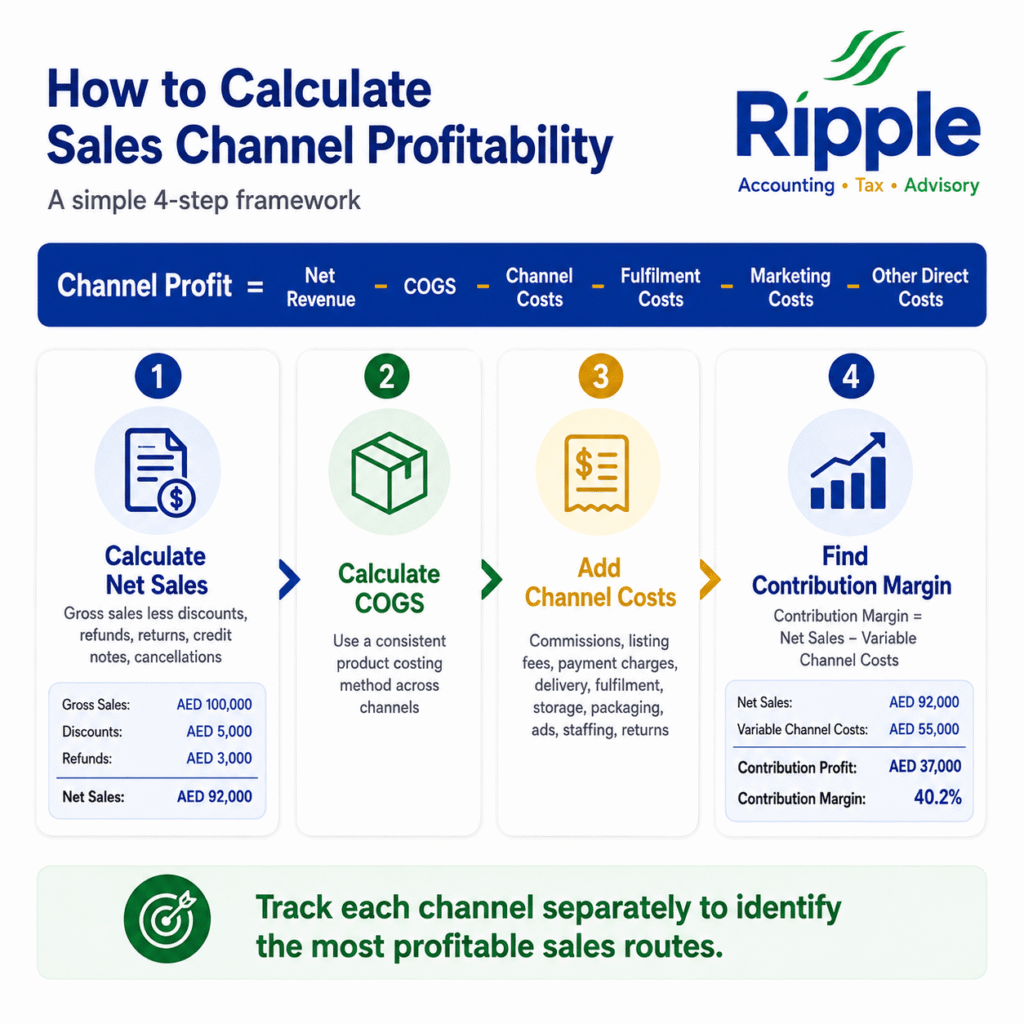
Start with net revenue rather than gross sales. Then deduct the costs directly connected to selling through that channel.
Step 1 — Calculate Net Sales Revenue
Start with total sales and adjust for:
- Discounts
- Refunds
- Returns
- Credit notes
- Cancellations
For example:
Gross Sales: AED 100,000
Discounts: AED 5,000
Refunds: AED 3,000
Net Sales: AED 92,000
This gives you a more realistic starting point for the profitability calculation.
Step 2 — Calculate Cost of Goods Sold
COGS represents the cost of products sold during the period. Businesses should use a consistent inventory and costing method across all channels. Otherwise, one channel may appear more profitable simply because product costs have been allocated differently.
For example, if the same product sells through a retail store and an online marketplace, the underlying product cost should be allocated consistently.
Step 3 — Add Channel-Specific Costs
This is where many profitability reports become incomplete.
Depending on the channel, costs may include:
- Marketplace commissions
- Listing fees
- Payment gateway charges
- Delivery fees
- Fulfilment fees
- Storage charges
- Packaging
- Advertising
- Sales commissions
- Retail staffing
- Store-related operating expenses
- Returns processing
Tracking these expenses separately helps reveal sales channel costs that may otherwise disappear inside general operating expenses.
Step 4 — Calculate Contribution Margin
Contribution margin shows how much remains after variable costs associated with generating sales.
Contribution Margin = Net Sales − Variable Channel Costs
For example:
Net sales = AED 92,000
Variable channel costs = AED 55,000
Contribution profit = AED 37,000
Contribution margin:
AED 37,000 ÷ AED 92,000 × 100 = 40.2%
This metric is particularly useful when comparing channels with very different operating structures.
Retail vs Marketplace vs Direct Sales Profitability
Each channel has a different cost structure and customer relationship.
| Factor | Retail | Marketplace | Direct Sales |
|---|---|---|---|
| Customer reach | Local/physical | Large platform audience | Business-controlled |
| Platform fees | Usually limited | Can be significant | Payment fees |
| Customer ownership | Limited | Usually restricted | Stronger |
| Fulfilment | Store-based | Often platform or third-party | Business-controlled |
| Pricing control | High | Can be restricted | High |
| Customer data | Limited | Limited | Greater control |
| Scalability | Moderate | High | High |
| Margin potential | Variable | Variable | Potentially strong |
There is no universal “best” channel. The right choice depends on the business model, product economics, customer acquisition costs, and operating structure.
Retail Profitability: Costs That Affect Your Margin
Retail profitability depends on much more than the selling price of products. A physical store may generate strong sales but carry substantial fixed and variable expenses.
Key Retail Sales Costs
Businesses should consider:
- Store rent
- Salaries and benefits
- Utilities
- Inventory holding costs
- Point-of-sale expenses
- Packaging
- Discounts
- Returns
- Local advertising
- Sales commissions
- Store maintenance
A useful retail sales accounting report can compare revenue and contribution profit by store, product category, location, or period.
Businesses can also track metrics such as:
- Sales per store
- Gross margin
- Contribution margin
- Average transaction value
- Inventory turnover
- Return rate
- Sales per employee
For UAE retailers, businesses should also consider applicable VAT treatment, inventory records, staffing costs, and location-related operating expenses when assessing retail performance. The UAE Federal Tax Authority provides current VAT guidance and related resources for businesses.
Marketplace Profitability: Are High Sales Really Profitable?
Marketplaces can provide businesses with access to a large customer base without requiring them to build all customer traffic themselves. However, marketplace profitability can vary significantly because multiple costs may be deducted from each sale.
Marketplace Costs Businesses Must Track
Include:
- Marketplace commissions
- Listing fees
- Payment processing
- Fulfilment
- Storage
- Advertising
- Promotional discounts
- Returns
- Refunds
- Packaging
- Delivery
A business that tracks only marketplace sales may underestimate its actual cost of acquisition and fulfilment.
Marketplace Profitability Example
Suppose a marketplace generates AED 100,000 in net sales.
| Cost | Amount |
|---|---|
| Net Sales | AED 100,000 |
| COGS | AED 50,000 |
| Marketplace fees | AED 10,000 |
| Fulfilment | AED 8,000 |
| Advertising | AED 7,000 |
| Returns and other costs | AED 3,000 |
| Contribution Profit | AED 22,000 |
The business generated AED 100,000 in revenue, but only AED 22,000 remained after the listed direct costs.
This “profit waterfall” gives management a much clearer picture than revenue reporting alone.
Direct Sales Profitability and Direct-to-Consumer Margins
Direct sales profitability can be attractive because the business controls more of the customer journey.
Direct-to-consumer sales may provide greater control over:
- Pricing
- Promotions
- Customer experience
- Customer data
- Repeat purchases
- Loyalty programmes
- Cross-selling
- Brand communication
However, direct sales are not automatically more profitable.
The business still needs to pay for website development, payment processing, marketing, fulfilment, customer service, and returns.
Costs Behind Direct Sales
Important expenses include:
- Website and technology
- Payment gateway fees
- Digital advertising
- SEO and content
- Customer support
- Warehousing
- Delivery
- Packaging
- Returns
- Customer acquisition
A direct channel may have lower platform fees but higher customer acquisition costs. Therefore, both sides of the equation need to be measured.
Customer Acquisition Cost vs Customer Lifetime Value
Customer acquisition cost, or CAC, helps businesses understand what they spend to acquire new customers.
CAC = Total Customer Acquisition Cost ÷ Number of New Customers
Suppose a company spends AED 20,000 on marketing and acquires 400 new customers.
CAC = AED 20,000 ÷ 400 = AED 50
But the first order does not tell the entire story.
If customers repeatedly purchase from the business, their lifetime value may justify the initial acquisition cost.
This is why businesses should consider customer lifetime value (CLV) alongside CAC when evaluating direct-to-consumer profitability.
How to Compare Profit Margin by Sales Channel
A monthly channel profitability report can make comparisons much easier.
Track the following metrics for every channel:
- Net revenue
- COGS
- Gross profit
- Gross margin %
- Channel costs
- Contribution profit
- Contribution margin %
- Customer acquisition cost
- Average order value
- Return rate
- Fulfilment cost per order
- Customer lifetime value
Example Sales Channel Profitability Table
The following figures are illustrative:
| Metric | Retail | Marketplace | Direct |
|---|---|---|---|
| Net Sales | AED 80,000 | AED 100,000 | AED 70,000 |
| Gross Profit | AED 32,000 | AED 35,000 | AED 31,500 |
| Channel Costs | AED 18,000 | AED 25,000 | AED 12,000 |
| Contribution Profit | AED 14,000 | AED 10,000 | AED 19,500 |
The marketplace generates the highest revenue in this example, but direct sales generate the highest contribution profit. That is the central lesson of Sales Channel Profitability: sales volume and profitability are not the same thing.
Sales Channel Analysis: Which Channel Should Your Business Prioritize?
Once businesses have accurate numbers, they can decide where to invest resources. However, profitability should not be the only consideration.
Keep a Channel When It Delivers Strategic Value
A lower-margin channel may still be valuable if it provides:
- New customer acquisition
- Brand exposure
- Geographic expansion
- Strong repeat purchases
- Cross-selling opportunities
- Access to a new customer segment
For example, a marketplace might introduce new customers to a brand who later become direct customers.
Reduce or Fix a Channel When
Consider reviewing a channel when:
- Margins remain consistently low
- Platform fees are rising
- Returns are unusually high
- Advertising costs exceed contribution profit
- Customers rarely return
- Operational complexity is excessive
- The channel consumes resources without sufficient return
Before abandoning a channel, investigate whether pricing, product mix, advertising strategy, fulfilment, or operational processes are causing the low profitability.
UAE Accounting Considerations for Sales Channel Profitability
For UAE businesses, channel-level accounting should connect operational sales data with accurate financial records. VAT is a consumption tax applied through the supply chain, and the Federal Tax Authority provides guidance on VAT obligations, records, and documentation. Businesses should therefore maintain appropriate records for sales, purchases, inventory, tax invoices, credit notes, and related transactions.
Why UAE Businesses Need Channel-Level Accounting
Good accounting can help identify:
- Profitable products
- Profitable sales channels
- Hidden selling costs
- Margin leakage
- Inventory issues
- Payment reconciliation differences
- VAT-related accounting issues
- Corporate Tax reporting considerations
UAE Corporate Tax also makes accurate financial reporting important. The FTA explains that taxable income starts from accounting net profit or loss, subject to the adjustments required under the Corporate Tax rules.
The FTA also publishes accounting and Corporate Tax guidance explaining the interaction between accounting standards and Corporate Tax requirements.
Businesses should therefore avoid treating channel profitability as a purely marketing exercise. It should form part of the wider accounting and financial reporting process.
Common Mistakes in Sales Channel Profitability Analysis
Even businesses with good accounting systems can overlook channel-specific costs.
1. Measuring Revenue Instead of Profit
A high-sales channel may produce low margins after fees and fulfilment.
2. Ignoring Marketplace Commissions
Marketplace fees should be included when assessing actual channel margins.
3. Excluding Advertising Costs
Advertising may be essential to generate marketplace or direct sales, so it should be considered when evaluating profitability.
4. Forgetting Returns and Refunds
Returns reduce revenue and can create additional shipping, handling, and processing costs.
5. Mixing Fixed and Variable Costs
Separate costs that change with sales volume from fixed operating expenses where appropriate.
6. Using Inconsistent COGS
Apply a consistent inventory costing approach across channels.
7. Ignoring Payment Fees
Payment processing can materially affect margins, especially for smaller transactions.
8. Reviewing Performance Too Infrequently
Annual reporting may hide problems that have been developing for months.
Best Practices for Improving Sales Channel Profitability
Once businesses identify their most profitable channels, they can improve performance further.
Negotiate Channel Costs
Review marketplace commissions, fulfilment contracts, logistics arrangements, payment processing costs, and supplier terms where possible. Even a small reduction in variable costs can improve contribution margin at scale.
Improve Product-Level Margins
Do not evaluate channels only at the overall level.
Identify products that:
- Generate high sales but low profit
- Have high return rates
- Require expensive fulfilment
- Depend heavily on discounts
- Generate strong repeat purchases
This can help businesses improve their product mix.
Shift Customers Toward More Profitable Channels
Businesses can build stronger direct relationships through:
- Loyalty programmes
- Email marketing
- Content marketing
- SEO
- Repeat-purchase campaigns
- Better website experiences
- Customer support
The objective should be to create value for customers rather than simply forcing customers away from another channel.
Review Channel Performance Monthly
A practical monthly dashboard can follow this structure:
Revenue → COGS → Channel Costs → Contribution Profit → Margin
Reviewing the same metrics every month makes trends easier to identify and allows management to act before profitability problems become serious.
Sales Channel Profitability Checklist
Use this checklist when reviewing your sales channels:
- Calculate net revenue by channel
- Allocate COGS consistently
- Record channel-specific fees
- Track fulfillment and delivery costs
- Include relevant marketing costs
- Calculate customer acquisition cost
- Account for returns and refunds
- Calculate contribution margin
- Compare channels monthly
- Identify margin leakage
- Review product-level profitability
- Reallocate resources toward stronger opportunities
How Ripple Business Setup Can Help With Business Accounting
Ripple Business Setup helps UAE entrepreneurs and companies manage their business setup, accounting, tax, and compliance requirements. Our team supports bookkeeping, accounting, VAT, Corporate Tax, audit, business setup, and company compliance services for businesses across the UAE. We help businesses maintain accurate financial records and better understand revenue, expenses, and profitability across different sales channels. For professional assistance with your UAE business and accounting requirements, contact Ripple Business Setup at +971 50 593 8101 or info@ripplellc.ae. You can also visit www.ripplellc.ae to learn more about our business and accounting support services.
FAQs
What is sales channel profitability?
Sales channel profitability measures how much profit a business generates from a specific sales channel after deducting product costs and the direct expenses required to generate sales.
How do you calculate profitability by sales channel?
Calculate net sales and subtract COGS, channel-specific fees, fulfillment, marketing, returns, payment costs, and other relevant direct expenses. The result represents the channel’s contribution profit.
Which sales channel has the highest profit margin?
There is no universal answer. Direct sales may provide stronger margins because businesses have greater control over pricing and customer relationships, while marketplaces and retail can provide valuable customer reach. Actual profitability depends on each business’s cost structure.
Are marketplaces profitable for small businesses?
They can be, but businesses should evaluate marketplace commissions, advertising, fulfillment, returns, payment costs, and COGS before deciding whether the channel is profitable.
How can I calculate marketplace profitability?
Start with net marketplace sales and deduct COGS, commissions, fulfillment, advertising, payment fees, returns, and other marketplace-related costs. This provides a clearer view of marketplace contribution profit.
What costs should be included in channel profitability?
Include COGS and costs directly associated with generating and fulfilling sales, such as commissions, payment processing, advertising, delivery, packaging, fulfillment, returns, and sales commissions.
What is the difference between gross margin and contribution margin?
Gross margin generally measures sales remaining after COGS. Contribution margin goes further by considering relevant variable costs associated with generating those sales.
How often should businesses review sales channel performance?
A monthly review is generally useful for active businesses because it can reveal changes in fees, advertising costs, returns, product mix, and margins before they significantly affect annual results.
Conclusion
Sales Channel Profitability gives businesses a more accurate view of where their revenue creates value. Retail, marketplace, and direct sales each have different costs, risks, customer relationships, and growth opportunities. Instead of asking which channel generates the most sales, businesses should ask which channel generates the strongest contribution profit and sustainable margin. By tracking COGS, channel fees, fulfillment, advertising, returns, CAC, and other direct costs consistently, businesses can make better decisions about pricing, marketing, inventory, and channel investment.
Disclaimer: This article provides general educational information and does not constitute accounting, tax, or legal advice. UAE businesses should obtain professional advice based on their specific circumstances and current FTA requirements.