

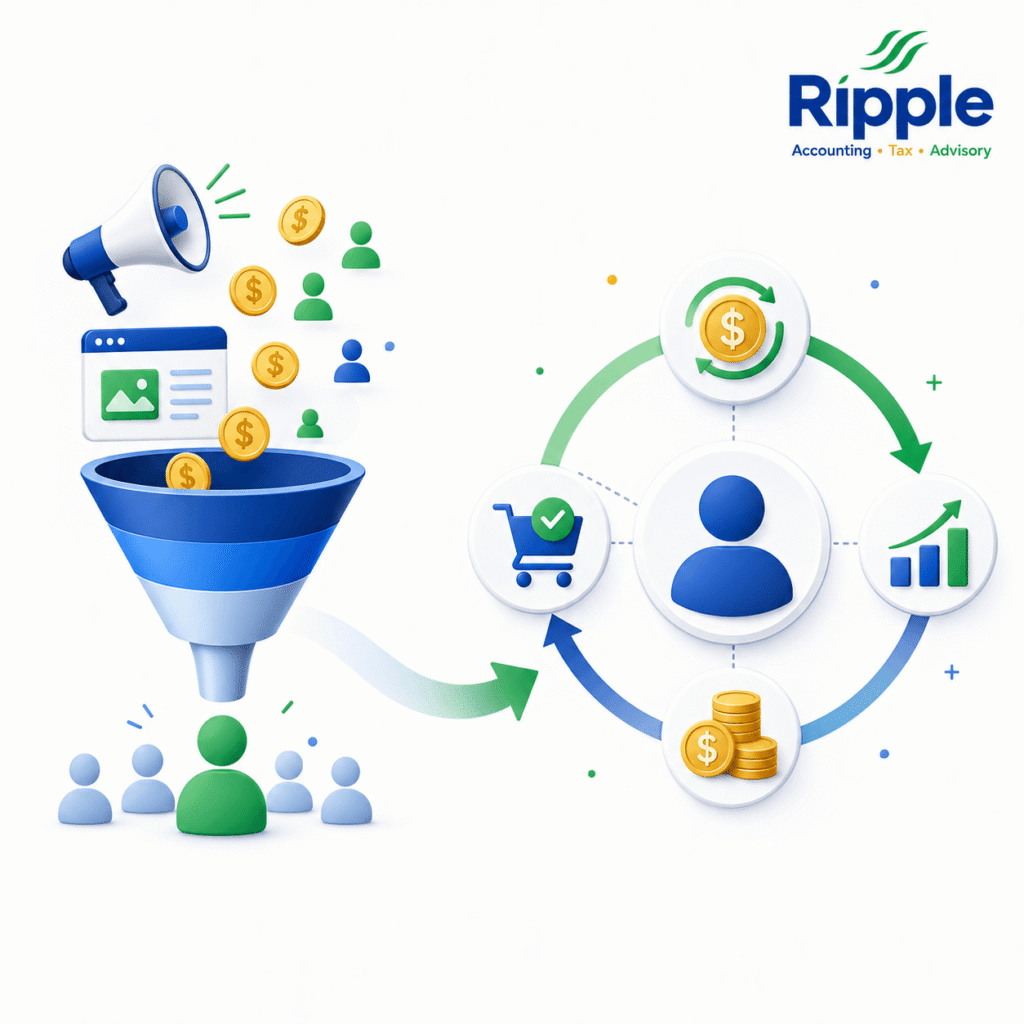
For a growing business, revenue alone does not tell the full story. A company can increase sales quickly and still struggle financially if it spends too much to acquire customers or fails to retain them. That is why Customer Acquisition Cost (CAC) and Lifetime Value (LTV) are important finance and growth metrics. CAC shows how much a business spends to gain a new customer, while LTV estimates the economic value a customer generates during the relationship. Comparing the two helps businesses evaluate unit economics, marketing efficiency, retention, and sustainable growth.
What Are Customer Acquisition Cost and Lifetime Value?
What Is Customer Acquisition Cost (CAC)?
Customer Acquisition Cost (CAC) measures the average cost required to acquire one new paying customer.
A basic formula is:
CAC = Total Sales and Marketing Costs ÷ Number of New Customers Acquired
Depending on the business, acquisition costs may include advertising, sales salaries, commissions, marketing software, creative work, agency fees, and other expenses directly associated with acquiring customers.
For example, if a company spends AED 50,000 on sales and marketing in one month and acquires 100 new customers, its CAC is:
AED 50,000 ÷ 100 = AED 500
This means the company spends an average of AED 500 to acquire each new customer.
What Is Lifetime Value (LTV)?
Lifetime Value, often called Customer Lifetime Value (CLV), estimates how much economic value a customer can generate throughout their relationship with a business.
A simple formula is:
LTV = Average Purchase Value × Purchase Frequency × Average Customer Lifespan
For businesses where gross margin is important, an adjusted calculation can provide a more useful measure of customer profitability. Subscription businesses often use average revenue per account, gross margin, and customer churn to estimate LTV.
Why CAC and LTV Should Be Measured Together
Looking at CAC alone can be misleading. A business may have a high CAC but still acquire highly profitable customers who stay for years. Likewise, a low CAC is not automatically good if customers make one small purchase and never return. Comparing Customer Acquisition Cost and Lifetime Value gives management a better view of whether acquisition spending is creating sustainable economic value.
How to Calculate Customer Acquisition Cost
The easiest way to calculate CAC is to identify all relevant sales and marketing expenses for a specific period and divide them by the number of new customers acquired during that same period.
CAC = Total Sales & Marketing Spend ÷ New Customers
What Costs Should You Include in CAC?
Depending on your calculation method, consider:
- Paid advertising
- Sales and marketing salaries
- Sales commissions
- Marketing software
- CRM costs
- Content and creative production
- Agency or consultant fees
- Lead-generation campaigns
- Promotional activities
- Sales-related technology and tools
The important point is consistency. If one month includes sales salaries and software while another includes advertising only, the CAC figures will not provide a reliable comparison.
Customer Acquisition Cost Example
Imagine a UAE-based professional services company spends AED 80,000 during a quarter on sales and marketing.
It acquires 160 new customers.
CAC = AED 80,000 ÷ 160 = AED 500
The company therefore spends AED 500 on average to acquire each new customer.
Management can then compare this figure with customer revenue, gross margin, retention, and LTV to determine whether the acquisition strategy makes financial sense.
How to Calculate Lifetime Value
The right Lifetime Value formula depends on the business model and the quality of available data.
For a straightforward transactional business, you can use:
LTV = Average Purchase Value × Purchase Frequency × Average Customer Lifespan
For example, suppose an online business has:
- Average purchase value: AED 250
- Average purchases per year: 4
- Average customer lifespan: 3 years
The estimated revenue-based LTV is:
AED 250 × 4 × 3 = AED 3,000
This is revenue-based LTV. It should not automatically be treated as profit because product costs, fulfilment expenses, payment fees, and other direct costs still matter.
For subscription businesses, an often-used simplified approach is:
LTV = ARPU × Gross Margin ÷ Churn Rate
This method is useful when revenue, margin, and churn data are sufficiently stable, but businesses should avoid treating the result as a precise forecast when customer behavior is changing.
LTV Example for a Growing Business
Suppose a subscription company generates AED 200 in average monthly revenue per customer.
Its gross margin is 70%, and monthly churn is 2.5%.
The estimated gross-profit-based LTV would be:
AED 200 × 70% ÷ 2.5% = AED 5,600
The figure provides a useful planning estimate, but management should validate it against actual customer retention and cohort performance.
CAC vs LTV: What Is the Difference?
CAC and LTV answer two different financial questions.
- Customer Acquisition Cost asks: “How much does it cost us to acquire a customer?”
- Lifetime Value asks: “How much economic value can that customer generate over time?”
CAC is therefore an acquisition-efficiency metric, while LTV is a customer-value metric. When combined, they help businesses understand unit economics.
For example, if CAC is AED 500 and LTV is AED 2,000:
LTV:CAC = AED 2,000 ÷ AED 500 = 4:1
That means the estimated customer value is four times the acquisition cost.
However, businesses should always clarify whether LTV represents revenue, gross profit, contribution margin, or another profitability measure.
What Is a Good LTV to CAC Ratio?
The LTV: CAC ratio compares lifetime customer value with the cost required to acquire that customer.
LTV:CAC Ratio = LTV ÷ CAC
A 3:1 ratio is widely used as a general benchmark, particularly in SaaS and subscription businesses. However, it should be treated as a reference point rather than a universal rule. Business model, gross margin, retention, growth stage, cash flow, and customer acquisition channel can all affect what represents healthy economics.
Understanding the 3:1 LTV to CAC Benchmark
If a business has:
- LTV of AED 3,000
- CAC of AED 1,000
Its ratio is:
AED 3,000 ÷ AED 1,000 = 3:1
This may indicate attractive unit economics, assuming the LTV calculation is realistic and includes appropriate costs.
What Does a Low LTV to CAC Ratio Mean?
A low ratio can indicate:
- High acquisition costs
- Weak customer retention
- Low average customer spending
- Poor channel performance
- Excessive discounting
- High delivery or servicing costs
Management should investigate the underlying cause instead of simply cutting the marketing budget.
What Does a Very High LTV to CAC Ratio Mean?
A very high ratio sounds positive, but it can also deserve investigation. The business may be highly efficient, or it may be underinvesting in customer acquisition and missing opportunities to grow. This is why CAC and LTV should be reviewed alongside growth rate, cash flow, retention, and capacity.
How CAC and LTV Affect Business Growth
These metrics influence more than marketing decisions.
They can help management make decisions about:
- Marketing budgets
- Sales hiring
- Pricing
- Customer retention
- Product development
- Cash flow planning
- Revenue forecasting
- Expansion into new markets
- Customer segmentation
CAC Payback Period and Cash Flow
The CAC payback period measures how long it takes to recover the acquisition cost through customer contribution margin.
A simplified subscription formula is:
CAC Payback Period = CAC ÷ Monthly Revenue per Customer × Gross Margin
For example, if CAC is AED 600 and monthly contribution margin is AED 120:
AED 600 ÷ AED 120 = 5 months
The business would need approximately five months to recover the acquisition cost through contribution margin.
Payback is particularly useful for growth companies because a strong LTV estimate can still hide a cash-flow problem if the company must wait a long time to recover acquisition spending.
How to Reduce Customer Acquisition Cost
Reducing CAC does not simply mean spending less on advertising. The goal is to acquire the right customers more efficiently.
Businesses can improve acquisition efficiency by:
- Improving website conversion rates
- Focusing on high-performing marketing channels
- Improving lead qualification
- Strengthening organic search visibility
- Optimizing paid campaigns
- Improving sales processes
- Automating repetitive tasks
- Testing landing pages and offers
- Reducing ineffective marketing spend
Improve CAC Without Sacrificing Customer Quality
A lower CAC is not necessarily better if the customers acquired have low retention or low LTV. For example, suppose Channel A produces customers at AED 300 CAC, while Channel B produces customers at AED 500 CAC.
At first glance, Channel A looks better. But if Channel A customers have an LTV of AED 600 and Channel B customers have an LTV of AED 2,000, Channel B may produce significantly stronger economics.
The goal is therefore profitable customer acquisition, not simply the lowest possible CAC.
How to Increase Customer Lifetime Value
Businesses can improve LTV by increasing the amount customers spend, increasing purchase frequency, or extending customer retention.
Increase Repeat Purchases
Businesses can encourage repeat purchases through:
- Personalized communication
- Loyalty programs
- Relevant product recommendations
- Customer education
- Email campaigns
- Subscription options
- Follow-up offers
Improve Retention and Reduce Churn
Retention has a direct impact on customer value. Businesses should identify why customers leave and address issues such as poor onboarding, weak customer service, product problems, or unclear value.
For subscription companies, even a small improvement in churn can materially change projected LTV because retention assumptions influence the estimated customer lifespan.
Use Upselling and Cross-Selling
Upselling encourages customers to move to a higher-value product or service. Cross-selling introduces complementary products or services. Both approaches can increase revenue from existing customers without requiring the business to acquire a completely new customer.
Customer Acquisition Cost & Lifetime Value by Business Model
CAC and LTV should not be interpreted identically across every industry.
SaaS and Subscription Businesses
SaaS companies commonly focus on:
- Monthly recurring revenue
- Customer churn
- Retention
- Gross margin
- CAC payback
- Expansion revenue
Because subscription revenue arrives over time, cash recovery and retention are particularly important.
eCommerce Businesses
eCommerce businesses often analyze:
- Average order value
- Purchase frequency
- Repeat purchase rate
- Gross margin
- Refunds
- Fulfilment costs
- Customer retention
An eCommerce company with a low first-order margin may still have attractive economics if customers make frequent repeat purchases.
B2B and Professional Services
B2B businesses often have longer sales cycles and higher acquisition costs.
They should consider:
- Sales team costs
- Contract value
- Contract duration
- Renewal rates
- Account expansion
- Referral acquisition
- Customer servicing costs
A business with a high CAC can still have strong economics when customers sign long-term, high-value contracts.
Customer Acquisition Cost & Lifetime Value Example
Consider a growing UAE consultancy that spends AED 120,000 on sales and marketing during a quarter.
It acquires 200 new customers.
CAC = AED 120,000 ÷ 200 = AED 600
Suppose its average customer generates AED 300 in monthly gross profit and stays for an estimated 10 months.
LTV = AED 300 × 10 = AED 3,000
The LTV:CAC ratio becomes:
AED 3,000 ÷ AED 600 = 5:1
At face value, the economics appear attractive.
However, management should not stop at this calculation. It should check whether the 10-month lifespan is supported by historical retention data and whether the gross-profit calculation includes all relevant direct servicing costs.
If the company discovers that newer customer cohorts stay for only six months, projected LTV would fall to AED 1,800 and the ratio would become 3:1.
This illustrates why cohort analysis and current customer behavior matter more than relying on a single historical average.
Common CAC and LTV Mistakes Businesses Make
Avoid these common mistakes:
- Measuring CAC using advertising spend only
- Ignoring sales salaries and commissions
- Using inconsistent cost categories each month
- Treating revenue as profit
- Ignoring refunds or direct customer costs
- Assuming customers will remain indefinitely
- Ignoring churn
- Mixing different customer segments
- Using old retention data for a changing business
- Comparing unrelated acquisition channels
- Treating industry benchmarks as universal rules
One of the biggest mistakes is creating a complicated LTV calculation that depends on unrealistic assumptions. A simpler, transparent model based on reliable data is often more useful for management decisions.
How Finance and Marketing Teams Can Work Together
CAC and LTV sit between marketing and finance.
Marketing teams often understand where customers come from, while finance teams understand the complete cost structure and profitability.
A useful reporting process should connect:
- CRM data
- Advertising platforms
- Sales records
- Customer retention data
- Revenue
- Gross margin
- Acquisition costs
- Customer cohorts
This allows management to move beyond questions such as “Which campaign generated the most leads?” and ask more valuable questions such as:
“Which acquisition channel produces customers with the strongest long-term economics?”
That shift can improve both marketing allocation and financial planning.
CAC and LTV Metrics to Track Monthly
A practical growth dashboard can include:
- Customer Acquisition Cost
- Customer Lifetime Value
- LTV:CAC ratio
- CAC payback period
- Customer retention rate
- Customer churn rate
- Average revenue per customer
- Average order value
- Conversion rate
- Gross margin
- Repeat purchase rate
Do not evaluate these metrics in isolation.
For example, an increase in CAC may be acceptable if it produces substantially higher LTV customers. Similarly, rising LTV may not represent genuine improvement if it comes from unrealistic assumptions rather than observed customer behavior.
How to Improve Your LTV to CAC Ratio
Use a structured approach rather than changing several variables at once.
Step 1: Identify your highest-CAC channels.
Find where acquisition spending is producing the weakest economics.
Step 2: Segment customers by acquisition source.
Compare LTV, retention, and CAC across channels.
Step 3: Measure retention and churn.
Determine whether customers acquired today behave differently from older cohorts.
Step 4: Identify high-LTV customer segments.
Study which industries, customer types, products, or plans produce stronger long-term value.
Step 5: Reallocate acquisition spending.
Increase investment in channels that consistently produce profitable customers.
Step 6: Improve retention and expansion revenue.
Increase customer value through better onboarding, service, upselling, and cross-selling.
Step 7: Review the metrics regularly.
Monthly monitoring can reveal changes before they become major profitability problems.
How Ripple Business Setup Can Support Your Business Growth
Ripple Business Setup helps entrepreneurs and companies manage business setup, financial, tax, and compliance requirements across the UAE. Our team provides practical support with company formation, accounting, bookkeeping, VAT, Corporate Tax, and other business services. We help businesses maintain accurate financial records and make informed decisions as they grow. For professional guidance tailored to your business needs, contact Ripple Business Setup today.
- Phone: +971 50 593 8101
- Email: info@ripplellc.ae
- Website: www.ripplellc.ae
FAQs
What is Customer Acquisition Cost?
Customer Acquisition Cost is the average amount a business spends to acquire one new customer. A typical calculation divides relevant sales and marketing expenses by the number of new customers acquired during the same period.
What is Lifetime Value in business?
Lifetime Value estimates the economic value a customer generates throughout their relationship with a business. Depending on the model, it may be measured using revenue, gross profit, or contribution margin.
How do you calculate CAC?
Use:
CAC = Total Sales and Marketing Costs ÷ New Customers Acquired
The exact costs included should remain consistent so that management can compare periods and channels reliably.
How do you calculate LTV?
A simple approach is:
LTV = Average Purchase Value × Purchase Frequency × Average Customer Lifespan
Subscription businesses may use an ARPU, gross-margin, and churn-based formula instead.
What is a good LTV to CAC ratio?
A 3:1 ratio is commonly used as a general benchmark, particularly for SaaS and subscription businesses. However, there is no universal ratio that applies to every company.
Why is LTV higher than CAC important?
When LTV exceeds CAC, the business may be generating more customer value than it spends to acquire that customer. However, the calculation must use realistic assumptions and appropriate cost measures.
What is CAC payback period?
CAC payback period estimates how long a business needs to recover its customer acquisition cost through customer contribution margin.
How can a business reduce CAC?
Businesses can reduce CAC by improving conversion rates, focusing on higher-performing channels, improving lead qualification, optimizing sales processes, and reducing inefficient acquisition spending.
How can a business increase LTV?
Businesses can increase LTV by improving retention, increasing repeat purchases, raising customer value through upselling and cross-selling, and delivering a stronger customer experience.
Should LTV be based on revenue or gross profit?
For profitability analysis, gross profit or contribution margin can provide a more meaningful view than revenue because revenue does not account for the direct costs required to serve customers.
Final Takeaway
Customer Acquisition Cost and Lifetime Value work best as a pair. CAC shows what it costs to acquire customers, while LTV helps estimate the value those customers can generate over time. By monitoring CAC, LTV, retention, churn, margins, and payback together, businesses can make better decisions about marketing investment and sustainable growth. The key is to use consistent formulas, reliable customer data, and realistic assumptions rather than relying on a single benchmark. If your business is growing rapidly, reviewing these metrics regularly can help you identify where acquisition spending creates the strongest long-term value.
Disclaimer: This article is for general informational purposes only and does not constitute professional financial, accounting, or tax advice.