


WPS Payroll Reconciliation is an important control for UAE businesses that want to keep payroll, salary payments, and accounting records accurate and consistent. It involves comparing the payroll register with the Wage Protection System (WPS) payment information, bank transactions, and accounting entries. The UAE’s WPS is designed to facilitate the electronic payment of employee wages through authorised financial institutions and help ensure wages are paid according to applicable requirements.
For finance and HR teams, however, making a salary payment is only part of the process. Businesses also need to confirm that the amount calculated in payroll matches the amount submitted through WPS, the amount actually processed by the bank, and the amount recorded in the general ledger.
A structured reconciliation process helps identify errors early, reduce salary disputes, and maintain reliable financial records.
What Is WPS Payroll Reconciliation?
WPS Payroll Reconciliation is the process of comparing payroll information with WPS-related payment records, bank transactions and accounting records to confirm that the figures agree. A typical monthly payroll cycle can involve several separate records. The payroll team may calculate employee salaries, prepare the relevant payment information, process salaries through an authorised channel and then record the payroll expense and liability in the accounting system.
These records should ultimately agree, except where a legitimate timing difference, rejected payment, or adjustment exists.
The Four Records You Need to Match
A practical WPS reconciliation should compare:
- Payroll register: Employee salary, allowances, deductions and net pay.
- WPS/SIF payment data: Information used to process salary payments through the applicable WPS channel.
- Bank records: Actual salary transactions, returned payments, and other related transactions.
- Accounting records: Payroll expense, salary payable, bank and relevant adjustment entries.
The goal is not simply to compare total amounts. Businesses should investigate significant differences at the employee level where appropriate.
Why Is WPS Payroll Reconciliation Important in the UAE?
Payroll errors can affect employees, finance teams, and management at the same time. A business might calculate payroll correctly but still have a problem if a payment is rejected, an amount is entered incorrectly, or the accounting entry does not match the actual bank transaction.
MoHRE states that the WPS supports payment of wages through authorised banks, exchange houses and financial institutions and is intended to help employees receive their wages in full and on time.
For employers, reconciliation provides an additional internal control over that process.
Key benefits include:
- Identifying salary payment discrepancies.
- Detecting incorrect employee payment amounts.
- Finding rejected or returned transactions.
- Matching payroll expenses with accounting records.
- Reducing unexplained payroll balances.
- Supporting accurate month-end reporting.
- Creating a clear audit trail.
- Helping finance and HR teams resolve employee queries.
MoHRE guidance also emphasises timely wage payment and the need for establishments to provide evidence of wage payment when requested.
WPS Payroll Reconciliation Process: Step-by-Step
A consistent reconciliation process makes it easier to find errors before they become larger accounting or payroll problems.
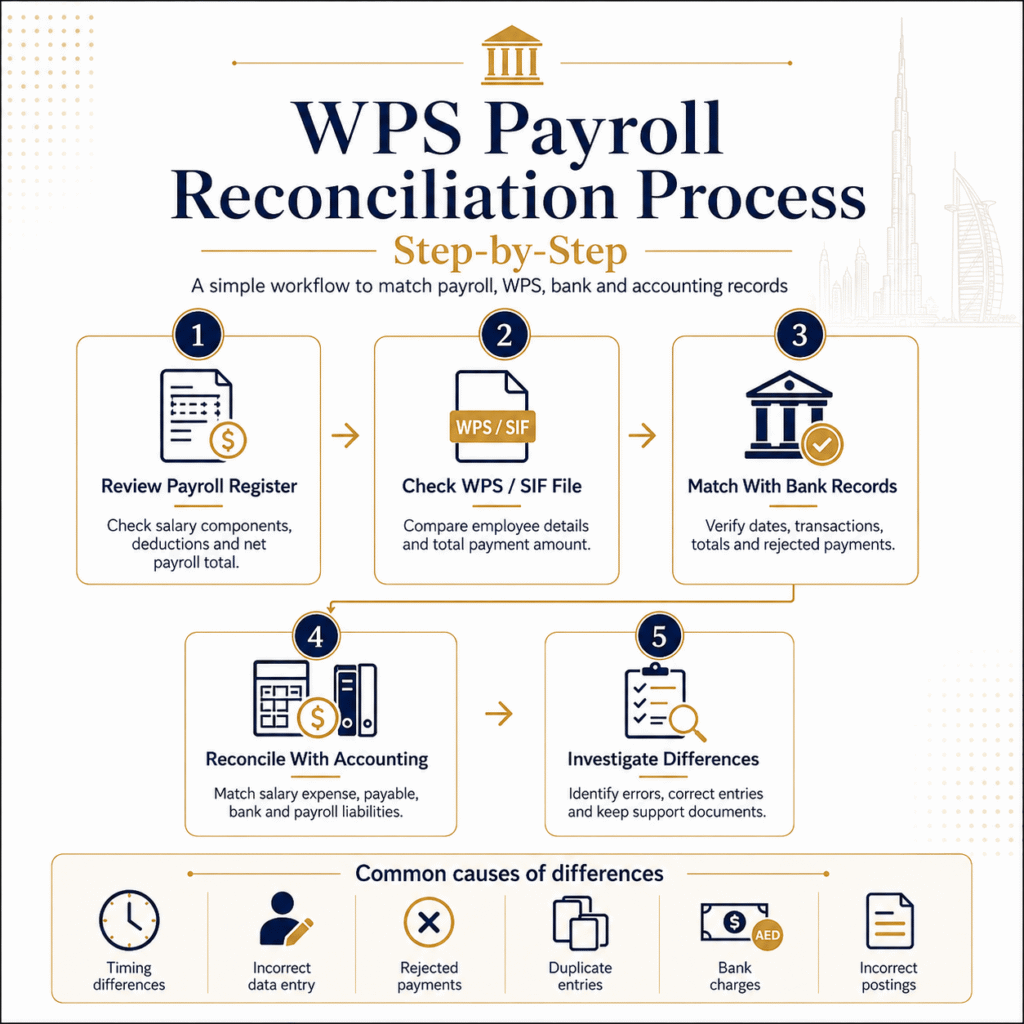
Step 1: Review the Payroll Register
Start with the approved payroll register.
Check employee details and the components that determine net salary, including:
- Basic salary
- Allowances
- Overtime
- Leave adjustments
- Deductions
- Other approved payroll adjustments
- Net salary
The total net payroll should be clearly documented before the payment file is processed.
Step 2: Check the WPS/SIF File
Next, compare the payroll register with the information prepared for WPS salary processing. Review employee-level information and the total payment amount. Look for differences caused by outdated employee information, incorrect salary figures or manual data-entry mistakes.
The exact technical requirements and procedures can depend on the applicable WPS channel and current regulatory requirements, so businesses should use the latest instructions from the relevant authorities and authorised payment provider.
Step 3: Match WPS Payments With Bank Records
After salary processing, compare the payment information with the bank statement or payment report.
Check:
- Payment date
- Employee payment amount
- Number of transactions
- Total salary payments
- Returned or rejected transactions
- Duplicate transactions
- Unusual bank charges or adjustments
A payroll register may show that an employee was paid, but the bank records may reveal that the transaction was rejected or returned. That difference needs investigation.
Step 4: Reconcile Payroll With Accounting Records
The next step connects payroll to the accounting system.
Common accounts to review include:
- Salary expense
- Payroll payable
- Bank account
- Employee-related deductions
- Payroll accruals
- Other relevant payroll liabilities
For example, if payroll records show AED 185,000 in net salary but the accounting system records AED 187,000, the finance team should identify why the AED 2,000 difference exists.
Step 5: Investigate and Correct Differences
Do not simply force the reconciliation to balance. Classify each difference and document the reason.
Common causes include:
- Timing differences
- Payroll adjustments
- Incorrect data entry
- Rejected payments
- Returned salary payments
- Duplicate entries
- Bank-related charges
- Incorrect accounting postings
Once the cause is confirmed, make the appropriate correction and retain supporting documentation.
How to Match Payroll, WPS Files, Bank and Accounting Records
A simple reconciliation framework can make monthly payroll reviews easier.
| Record | What to Compare | Common Issue |
|---|---|---|
| Payroll register | Employee net salary | Calculation or data error |
| WPS/SIF data | Employee and total payment amounts | File mismatch |
| Bank statement | Actual salary transactions | Rejection or timing difference |
| General ledger | Payroll expense and payable | Posting error |
The most important control is to establish a clear trail from the original payroll calculation to the final bank payment and accounting entry.
For larger organisations, employee-level reconciliation can provide stronger controls than relying only on the total payroll figure.
Common WPS Payroll Reconciliation Errors
Understanding common errors helps businesses build better payroll controls.
Incorrect Employee Salary Amount
An incorrect allowance, deduction, overtime figure or other payroll adjustment can change the employee’s final salary. If the payroll register and payment file contain different figures, the business should identify the source of the difference before processing or correcting the payment.
WPS File and Payroll Register Mismatch
Manual changes between payroll preparation and payment-file preparation can create inconsistencies. Businesses should compare the final approved payroll with the information used for salary processing rather than assuming both records are identical.
Rejected or Returned Salary Payments
A payment may not complete successfully even though it appears in the payroll register. Finance teams should identify returned transactions and determine whether the payment needs to be corrected and reprocessed.
Duplicate Salary Entries
Duplicate bank transactions or duplicate accounting postings can overstate salary payments and expenses. Automated duplicate checks and employee-level matching can help detect this issue.
Timing Differences
A payroll expense may be recorded in one accounting period while the bank transaction appears in another, depending on the payment and posting dates. Finance teams should document legitimate timing differences rather than treating every difference as an error.
Incorrect Accounting Entries
Payroll can be processed correctly while the accounting records remain wrong. For example, the bank payment may be accurate but posted to an incorrect expense or liability account. A payroll-to-general-ledger reconciliation can identify this type of issue.
WPS Payroll Reconciliation Example for a UAE SME
Consider a UAE SME with 25 employees.
At month-end, the finance team finds:
- Payroll register: AED 185,000
- WPS/SIF payment total: AED 185,000
- Successful bank salary payments: AED 182,500
- Payroll payable in accounting: AED 185,000
At first, the AED 2,500 difference appears to be a reconciliation problem.
The finance team reviews employee-level transactions and discovers that one employee’s AED 2,500 salary payment was returned by the bank.
The reconciliation now explains the difference:
AED 185,000 payroll liability − AED 182,500 successful payments = AED 2,500 outstanding payment
The finance team can document the returned transaction, investigate the reason, correct the payment and update the accounting records as appropriate.
This example shows why comparing only the payroll total is not enough. The finance team needs to understand what happened to each relevant payment.
How Often Should Businesses Perform WPS Payroll Reconciliation?
For businesses that process salaries monthly, payroll reconciliation should form part of every monthly payroll cycle.
A useful schedule is:
- Before payroll: Validate employee and salary information.
- After WPS preparation: Compare payment-file totals with approved payroll.
- After payment processing: Match successful and returned transactions.
- Before month-end close: Reconcile payroll with the general ledger.
- At year-end: Review outstanding payroll balances and unresolved differences.
Businesses should also perform an additional review when they make significant payroll adjustments, experience payment failures or identify unusual salary transactions.
Regular reconciliation is generally more effective than waiting until an audit or year-end review.
WPS Payroll Reconciliation Checklist
Use this checklist as a monthly internal control:
- Payroll register reviewed and approved
- Employee salary information verified
- Basic salary and allowances checked
- Deductions and adjustments reviewed
- WPS/SIF payment information checked
- Total payroll matched
- Bank salary transactions reviewed
- Rejected or returned payments identified
- Duplicate transactions checked
- Payroll payable reconciled
- General ledger reviewed
- Differences investigated
- Corrections documented
- Supporting records retained
Best Practices for Accurate WPS Payroll Reconciliation
Maintain One Source of Payroll Data
HR, payroll and accounting teams should work from consistent employee information. Uncontrolled spreadsheets and manual changes increase the possibility of mismatches.
Use Employee-Level Reconciliation
A total-to-total comparison can hide individual errors. Where practical, compare employee-level payroll amounts with the corresponding salary payment records.
Document Every Difference
A reconciliation should explain why a balance does not match.
Record:
- Difference amount
- Reason for difference
- Date identified
- Responsible reviewer
- Corrective action
- Date resolved
Separate Payroll Preparation From Review
An independent review can identify mistakes before salary payments are finalised. This becomes particularly valuable when the same team handles payroll preparation, payment processing, and accounting entries.
Automate Repetitive Checks
Payroll and accounting software can reduce manual work by standardizing calculations, reports, and reconciliation procedures. However, automation does not remove the need for review. Finance teams should still investigate unusual transactions and exceptions.
WPS Payroll Reconciliation vs Bank Reconciliation
WPS Payroll Reconciliation and bank reconciliation are related but serve different purposes. WPS Payroll Reconciliation focuses specifically on employee salary payments and compares payroll information with WPS-related payment records and actual transactions. Bank reconciliation compares the company’s accounting cash records with its bank statement across a wider range of business transactions.
For example, a bank reconciliation might confirm that the total salary payment left the bank account. It may not explain whether one employee received the wrong amount.
That is why businesses can benefit from using both controls.
What Records Should Businesses Keep for Payroll Reconciliation?
Businesses should maintain organised payroll and payment records that support their reconciliation process and applicable legal or regulatory requirements.
Depending on the business and circumstances, records may include:
- Payroll registers
- WPS/SIF-related records
- Bank statements
- Salary payment reports
- Payroll journal entries
- General ledger reports
- Reconciliation worksheets
- Records of returned payments
- Payroll adjustment approvals
- Evidence supporting corrections
MoHRE guidance notes that establishments may be required to provide information or evidence relating to wage payments.
Keeping records in a consistent format makes internal reviews, employee queries and external checks easier to manage.
When Should You Get Professional Payroll and Accounting Support?
Professional support can be useful when a business experiences recurring payroll discrepancies, has a growing workforce or finds it difficult to reconcile payroll with accounting records.
It can also help when businesses face:
- Frequent rejected salary payments
- Unexplained payroll balances
- Complex payroll adjustments
- Accounting integration problems
- Rapid employee growth
- Month-end reconciliation delays
- Audit preparation requirements
The objective should not simply be to make the numbers balance. A good reconciliation process should explain why the numbers balance and provide evidence for significant adjustments.
How Ripple Business Setup Can Help With Payroll and Accounting
Ripple Business Setup supports UAE businesses with accounting, bookkeeping, payroll-related processes, VAT, Corporate Tax and wider business administration requirements. For businesses that need help keeping payroll transactions and accounting records aligned, a structured reconciliation process can improve financial visibility and reduce avoidable errors. For professional guidance, contact Ripple Business Setup at +971 50 593 8101 or info@ripplellc.ae. You can also visit www.ripplellc.ae to learn more about its UAE business and accounting support services.
FAQ
What is WPS Payroll Reconciliation?
WPS Payroll Reconciliation is the process of comparing approved payroll records with WPS-related salary payment information, bank transactions, and accounting records. The purpose is to identify and explain differences so payroll payments and financial records remain accurate.
How do you reconcile WPS payroll?
Start by reviewing the approved payroll register, then compare employee and total amounts with the relevant WPS/SIF payment information. After processing, match successful and returned bank transactions and reconcile the final amounts with the accounting records.
What is checked during payroll reconciliation?
Businesses commonly check employee salary amounts, allowances, deductions, net pay, WPS/SIF payment totals, bank transactions, returned payments, payroll liabilities, and general-ledger entries.
How do you reconcile payroll with a bank statement?
Compare the approved payroll payment list with the corresponding bank transactions. Check employee amounts, payment dates, successful transactions, rejected or returned payments, and total values. Investigate any unexplained differences before closing the reconciliation.
What is an SIF file in UAE payroll?
SIF generally refers to the Salary Information File used in the UAE salary-payment process. Its specific requirements and processing procedures depend on the applicable WPS arrangements and payment provider, so employers should follow current official and provider guidance.
What causes WPS salary payment discrepancies?
Common causes include incorrect payroll calculations, employee-data changes, manual entry errors, rejected or returned payments, duplicate transactions, timing differences, and incorrect accounting postings.
How often should payroll be reconciled?
Businesses should normally reconcile payroll as part of each payroll cycle, particularly after salary payments are processed and before monthly accounts are closed. Additional reviews may be appropriate when payment problems or significant adjustments occur.
What happens when a WPS salary payment is rejected?
The business should identify the affected employee and transaction, determine the reason for the rejection, correct the underlying issue, and follow the applicable process for completing the salary payment. The accounting records should also reflect the actual status of the transaction.
Why should payroll match accounting records?
Matching payroll with accounting records helps ensure salary expenses and payroll liabilities are accurate. It also helps finance teams identify posting errors, outstanding payments and unexplained differences before they affect financial reporting.
What records are needed for payroll reconciliation?
Typical records include the payroll register, WPS/SIF-related information, bank payment reports, bank statements, payroll journal entries, general ledger records, and documentation supporting payroll adjustments or corrections.
Conclusion
Effective WPS Payroll Reconciliation connects four important stages: payroll → WPS/SIF → bank → accounting. By reviewing these records every payroll cycle, UAE businesses can identify discrepancies early, maintain accurate accounting records, and respond more effectively to payment issues. A documented reconciliation process also gives management greater confidence that payroll transactions are complete, accurate, and properly recorded. For businesses with recurring reconciliation challenges, professional accounting support can help establish stronger and more efficient controls.
Disclaimer: This article provides general information about WPS payroll reconciliation in the UAE and should not be treated as legal, tax, or regulatory advice. WPS procedures and applicable requirements can change. Businesses should verify current requirements with the relevant UAE authorities and authorised payment providers before acting.