


A correct Tax Invoice Format is essential for every VAT-registered business in the UAE. It helps businesses record taxable transactions properly, calculate VAT accurately, support input tax recovery, and maintain reliable accounting records. Under UAE VAT rules, a tax invoice must contain specific information, including supplier details, Tax Registration Number (TRN), invoice date, description of goods or services, VAT information, and transaction values. A full tax invoice requires more information than a simplified tax invoice.
For UAE businesses in 2026, invoice compliance has become even more important as the country continues its transition toward structured electronic invoicing. This guide explains the UAE Tax Invoice Format, mandatory details, full and simplified invoices, common mistakes, VAT calculations, and a practical compliance checklist.
What Is a Tax Invoice in the UAE?
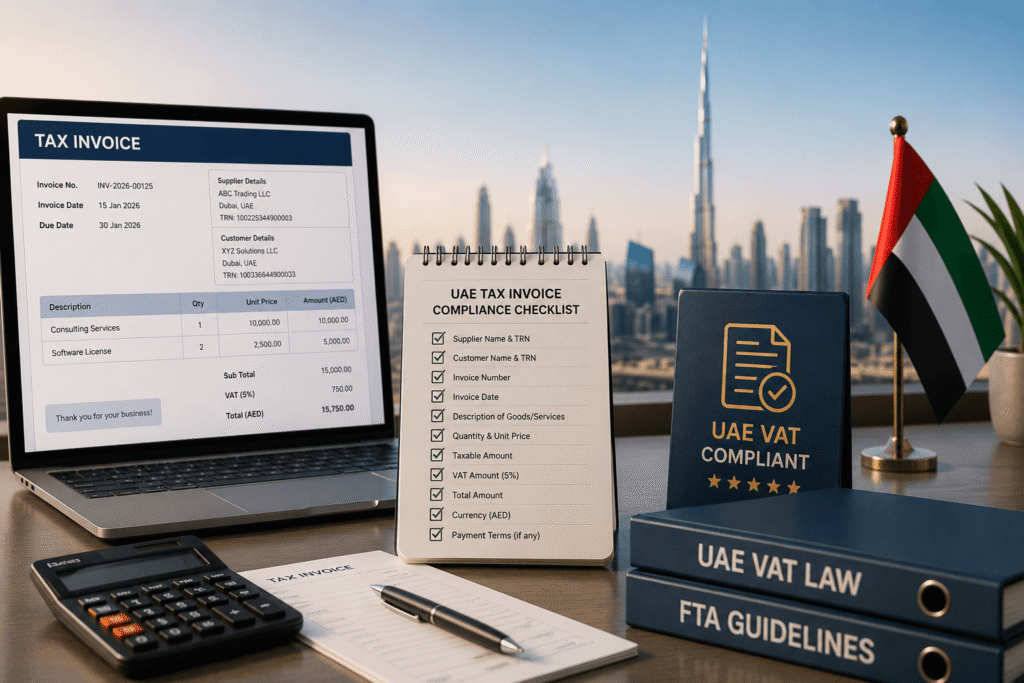
A tax invoice is an official VAT document issued by a VAT-registered supplier for a taxable supply of goods or services. It records important transaction details such as the supplier, customer, amount charged, VAT rate, VAT amount, and total payment due. Businesses use these invoices to support bookkeeping, VAT reporting, account reconciliation, and input tax recovery. A normal commercial invoice does not automatically qualify as a valid VAT tax invoice. To comply with UAE VAT requirements, the document must contain the information required under applicable VAT legislation.
VAT-registered businesses must generally issue a tax invoice within 14 calendar days from the date of supply.
Who Needs to Issue a Tax Invoice?
A VAT-registered business may need to issue tax invoices when it makes taxable supplies.
This commonly includes:
- Businesses charging the standard UAE VAT rate
- VAT-registered service providers
- Retailers and wholesalers
- Consultants and professional firms
- VAT-registered freelancers
- Companies supplying goods to other businesses
- Businesses making taxable B2B transactions
The exact VAT treatment depends on the nature and place of the supply, so businesses should review each transaction correctly before applying VAT.
Tax Invoice Format UAE: Mandatory Information
A full Tax Invoice Format UAE must contain several mandatory elements. Article 59 of the UAE VAT Executive Regulations sets out the information required on a full tax invoice.
Supplier Details
The invoice should clearly show:
- The words “Tax Invoice”
- Supplier’s legal name
- Supplier’s business address
- Supplier’s Tax Registration Number or TRN
The TRN is particularly important because it identifies the VAT-registered supplier.
Customer Details
Where the recipient is VAT registered, a full tax invoice should include:
- Customer’s legal name
- Customer’s address
- Customer’s TRN
Businesses should confirm these details before issuing important B2B invoices because incorrect customer information can create accounting and VAT reconciliation problems.
Invoice Identification Details
A compliant full invoice should include:
- Sequential or unique tax invoice number
- Tax invoice issue date
- Date of supply where different from the invoice date
Using a reliable invoice-numbering system helps businesses trace transactions during bookkeeping reviews, VAT return preparation, and tax audits.
Goods or Services Details
The invoice must identify the supply clearly.
Important information includes:
- Description of goods or services
- Unit price
- Quantity or volume
- Applicable VAT rate
- Amount payable
- Discounts, where applicable
- Gross amount payable
- VAT payable
Amounts required by the VAT rules should be expressed in AED. Where another currency is involved, the relevant AED tax information and exchange-rate requirements should also be considered.
Full Tax Invoice vs Simplified Tax Invoice UAE
One of the most common UAE VAT questions involves the difference between a full tax invoice and a simplified tax invoice. The main difference lies in how much information the invoice must contain.
Full Tax Invoice UAE
A full tax invoice contains detailed supplier, recipient, transaction, and VAT information.
It normally includes:
- “Tax Invoice” wording
- Supplier name, address, and TRN
- Recipient name, address, and TRN where the recipient is registered
- Unique or sequential invoice number
- Invoice date
- Date of supply where different
- Goods or services description
- Unit price and quantity
- VAT rate
- Discounts
- Gross amount
- VAT amount
- Other required tax statements where applicable
A full invoice is particularly important for detailed business-to-business transactions.
Simplified Tax Invoice UAE
The UAE VAT Executive Regulations allow a simplified tax invoice in certain circumstances.
A simplified tax invoice may be issued where:
- The recipient is not VAT registered, or
- The recipient is VAT registered, and the total consideration does not exceed AED 10,000.
A simplified VAT invoice must generally contain:
- The words “Tax Invoice”
- Supplier’s name
- Supplier’s address
- Supplier’s TRN
- Invoice issue date
- Description of goods or services
- Total consideration
- VAT amount charged
This format is often useful for retail and lower-value transactions.
UAE Tax Invoice Example
A practical example makes the required format easier to understand. Assume a fictional VAT-registered UAE consultancy provides business services worth AED 10,000 before VAT.
Sample Tax Invoice Format
Tax Invoice
Supplier: ABC Business Services LLC
Address: Dubai, UAE
TRN: 100XXXXXXXXXXXX
Invoice Number: INV-2026-00125
Invoice Date: 2 September 2026
Date of Supply: 2 September 2026
Customer: XYZ Trading LLC
Address: Dubai, UAE
Customer TRN: 100XXXXXXXXXXXX
Service: Business Consultancy Services
Taxable Amount: AED 10,000
VAT Rate: 5%
VAT Amount: AED 500
Total Amount: AED 10,500
This simple example demonstrates how the VAT invoice format UAE separates the taxable value, VAT amount, and final total.
Actual invoice requirements may vary depending on the transaction, VAT treatment, currency, customer status, or specific supply.
How to Calculate VAT on a UAE Tax Invoice
The standard UAE VAT rate is commonly 5% for standard-rated taxable supplies.
For example, if a business provides services worth AED 10,000 before VAT:
Taxable value: AED 10,000
VAT at 5%: AED 500
Invoice total: AED 10,500
The calculation is:
AED 10,000 × 5% = AED 500 VAT
The customer therefore pays AED 10,500 in total.
Businesses should also distinguish between VAT-inclusive and VAT-exclusive prices. Incorrectly treating a VAT-inclusive price as VAT-exclusive can result in an incorrect VAT amount.
Tax Invoice Requirements UAE: 2026 Compliance Checklist
Businesses can use the following checklist before issuing invoices.
Before Creating the Invoice
Check that you:
- Confirm the business’s VAT registration status
- Use the correct legal business name
- Include the correct TRN
- Confirm whether a full or simplified invoice applies
- Identify the correct VAT treatment
- Confirm the date of supply
Before Sending the Invoice
Review whether you have:
- Added the words “Tax Invoice”
- Used a unique or sequential invoice number
- Entered the correct invoice date
- Added customer details where required
- Described the goods or services clearly
- Applied the correct VAT rate
- Calculated VAT correctly
- Added discounts where applicable
- Shown the total payable
- Presented the required amounts in AED
- Stored the invoice in your accounting records
Creating a standard internal invoice checklist can reduce repeated errors across finance, sales, and accounting teams.
Common Tax Invoice Mistakes UAE Businesses Should Avoid
Even small invoicing errors can create unnecessary VAT and bookkeeping problems.
Missing or Incorrect TRN
Businesses sometimes use an outdated or incorrect TRN. Always confirm the supplier TRN and, where required, the customer’s VAT registration details.
Duplicate Invoice Numbers
Duplicate invoice numbers make transactions difficult to trace. Accounting systems should maintain a clear sequential or unique numbering process.
Incorrect VAT Rate
Not every transaction receives the same VAT treatment. A transaction may be standard-rated, zero-rated, exempt, or subject to other VAT rules depending on the supply. Businesses should identify the VAT treatment before issuing the invoice rather than automatically applying 5%.
Missing Date of Supply
The date of supply may determine when VAT becomes due. If it differs from the invoice issue date, the full tax invoice should show it.
Incorrect VAT Calculation
Common calculation mistakes include:
- Applying VAT to the wrong taxable amount
- Ignoring discounts
- Confusing VAT-inclusive and VAT-exclusive pricing
- Incorrect currency conversion
- Incorrect rounding
Automated accounting software can reduce calculation errors, but businesses should still review their VAT setup regularly.
Tax Invoice Format for Different UAE Businesses
Different businesses may use different invoice layouts, but the underlying VAT requirements remain important.
Small Businesses
Small businesses should use a simple, consistent invoice template that includes all mandatory VAT details. Cloud accounting software can help automate numbering, VAT calculation, customer records, and document storage.
Freelancers and Consultants
VAT-registered freelancers and consultants should clearly describe the service provided, including the taxable amount and VAT. Examples may include consulting, digital marketing, IT services, design, professional services, or management support.
Retail Businesses
Retailers often process many lower-value transactions. A simplified tax invoice may apply where the statutory conditions are met, including where the customer is not VAT registered or where a VAT-registered customer’s consideration does not exceed AED 10,000.
B2B Transactions
Detailed B2B invoices often require full supplier and recipient information. Businesses should maintain accurate customer TRNs, invoice dates, transaction descriptions, VAT amounts, and supporting records.
Free Zone Companies
Operating from a UAE free zone does not automatically mean every transaction is exempt from VAT. VAT treatment depends on factors such as the type of transaction, location, parties involved, and applicable UAE VAT rules. Free zone businesses should review each transaction rather than relying solely on their free zone status.
How Long Should UAE Businesses Keep Tax Invoices?
Good record-keeping supports VAT compliance and makes tax reviews easier. The FTA states that taxable persons must retain VAT invoices issued and received for at least five years.
Businesses should maintain organized records of:
- Sales invoices
- Purchase invoices
- Tax credit notes
- VAT-related accounting entries
- Customer and supplier records
- Supporting transaction documents
- VAT returns
- Adjustments and corrections
Digital document storage can make invoices easier to retrieve if the FTA requests supporting records.
Electronic Tax Invoices and UAE e-Invoicing in 2026
Electronic invoicing is one of the most important compliance developments for UAE businesses in 2026. The UAE Ministry of Finance states that an eInvoice is structured invoice data issued and exchanged electronically between supplier and buyer and reported electronically to the Federal Tax Authority. A PDF, Word file, scan, image, or emailed document by itself does not qualify as an eInvoice under the new system.
The UAE e-invoicing Pilot Programme started on 1 July 2026, and businesses can also adopt compliant electronic invoicing voluntarily from that date.
Mandatory implementation begins in phases.
Businesses with annual revenue of AED 50 million or more must implement the Electronic Invoicing System from 1 January 2027. Following a May 2026 amendment, the deadline for affected businesses to appoint an Accredited Service Provider was extended to 30 October 2026.
Businesses below AED 50 million are scheduled for mandatory implementation from 1 July 2027, subject to the applicable rules and exclusions.
Companies should therefore review whether their ERP, accounting software, invoicing workflows, and master data can support the coming structured e-invoicing requirements.
Tax Invoice vs Commercial Invoice UAE
A tax invoice and a commercial invoice serve related but different purposes.
Tax Invoice
A tax invoice supports VAT compliance and contains the information required under UAE tax rules.
It commonly records:
- Supplier TRN
- Customer TRN where required
- VAT rate
- Taxable value
- VAT amount
- Invoice and supply dates
Commercial Invoice
A commercial invoice primarily documents a sale between a seller and customer.
It may contain:
- Product or service information
- Quantity
- Price
- Payment details
- Shipping or trade details
However, a commercial invoice does not automatically become a valid VAT tax invoice unless it contains the mandatory information required under UAE VAT rules.
What Happens If a UAE Tax Invoice Is Incorrect?
An incorrect invoice can affect more than the document itself.
Possible consequences include:
- VAT return errors
- Incorrect accounting entries
- Customer payment delays
- Problems supporting input VAT recovery
- Reconciliation differences
- Additional correction work
- Compliance issues during an FTA review
Where a transaction value or tax treatment changes after an invoice has been issued, businesses may need an appropriate tax credit note or another legally correct adjustment rather than simply deleting or rewriting the original transaction.
How to Create a Compliant Tax Invoice in UAE
Businesses can follow a simple seven-step process.
Step 1: Confirm VAT Status
Confirm that the supplier is VAT registered and verify the customer’s VAT registration status where relevant.
Step 2: Choose the Correct Invoice Type
Determine whether the transaction requires a full tax invoice or qualifies for a simplified tax invoice.
Step 3: Add Supplier Information
Enter the correct legal name, address, and TRN.
Step 4: Add Customer and Transaction Details
Include customer information where required and clearly describe the goods or services supplied.
Step 5: Calculate VAT
Apply the correct VAT treatment and calculate VAT accurately.
Step 6: Review and Issue
Check invoice dates, numbering, calculations, currency, and required wording before sending the invoice.
Remember that VAT-registered businesses generally need to issue the tax invoice within 14 calendar days from the date of supply.
Step 7: Store the Invoice
Keep issued and received VAT invoices in organized records for the required retention period.
How Ripple Business Setup Can Help With UAE VAT Compliance
Managing UAE VAT involves more than simply adding 5% to an invoice. Businesses need accurate VAT registration records, proper invoicing, bookkeeping, transaction classification, and timely VAT reporting. Ripple Business Setup can support UAE businesses with VAT registration, VAT return filing, accounting and bookkeeping, corporate tax services, and general tax compliance support. If you want to review your existing Tax Invoice Format, accounting records, or VAT processes, you can contact the Ripple Business Setup team for professional guidance.
Phone: +971 50 593 8101
WhatsApp: +971 4 250 0833
Email: info@ripplellc.ae
FAQ
What is the correct tax invoice format in the UAE?
A UAE tax invoice should contain the information required by VAT legislation, including the words “Tax Invoice,” supplier name, address, TRN, invoice date, transaction details, VAT information, and other mandatory fields depending on whether it is a full or simplified invoice.
What details are mandatory on a full UAE tax invoice?
A full tax invoice generally includes supplier and registered customer details, their TRNs where applicable, a sequential or unique invoice number, invoice date, date of supply where different, goods or services description, unit price, quantity, VAT rate, discounts, gross amount, and VAT payable.
When can a simplified tax invoice be issued in the UAE?
A simplified tax invoice may be issued when the recipient is not VAT registered or when the recipient is VAT registered and the consideration does not exceed AED 10,000.
Is a TRN mandatory on a tax invoice?
The VAT-registered supplier’s TRN must appear on the tax invoice. A registered recipient’s TRN is also required on a full tax invoice.
Does a UAE tax invoice need an invoice number?
A full tax invoice must contain a sequential tax invoice number or another unique number that identifies the invoice and its sequence.
How quickly must a tax invoice be issued?
A VAT registrant generally needs to issue a tax invoice within 14 calendar days from the date of supply.
Can UAE tax invoices be electronic?
Yes. UAE VAT regulations allow electronic tax invoices where applicable record-storage, authenticity, and integrity requirements are satisfied.
However, the UAE’s newer e-invoicing regime uses structured electronic data, so a PDF or scanned invoice alone does not qualify as an eInvoice under that system.
How long should UAE businesses retain VAT invoices?
Taxable persons should retain VAT invoices issued and received for at least five years.
Is a tax invoice the same as a commercial invoice?
No. A commercial invoice records a sale, while a VAT tax invoice must satisfy the specific invoice requirements under UAE VAT legislation.
Conclusion
Using the correct Tax Invoice Format UAE helps businesses maintain accurate VAT records, reduce accounting errors, and support smoother tax reporting. Businesses should identify whether they need a full or simplified tax invoice, include all mandatory information, calculate VAT correctly, issue invoices within the required timeframe, and maintain proper records. With UAE e-invoicing implementation progressing through 2026 and 2027, businesses should also review their accounting systems and invoice processes now rather than treating invoicing as a purely administrative task.
Disclaimer: This article is for general informational purposes only and does not constitute legal, tax, or accounting advice. UAE VAT rules and e-invoicing requirements may change, so businesses should verify the latest FTA guidance or consult a qualified tax professional before making compliance decisions.