The UAE Economy Outlook points toward an increasingly diversified, technology-driven, and globally connected business environment. While hydrocarbons remain important, the UAE continues to expand sectors such as technology, tourism, logistics, finance, manufacturing, healthcare, and professional services. For entrepreneurs and investors, this shift matters because economic growth creates demand for new products, specialized services, digital solutions, and supporting businesses. The UAE Government itself highlights diversification, free zones, foreign direct investment, strong financial reserves, and government spending among the foundations of the country’s economy.
The opportunity beyond 2026, therefore, is not simply about finding the “next big industry.” It is about identifying businesses that align with long-term economic priorities and solving real problems for UAE customers.
UAE Economy Outlook: What Could Shape Growth Beyond 2026?
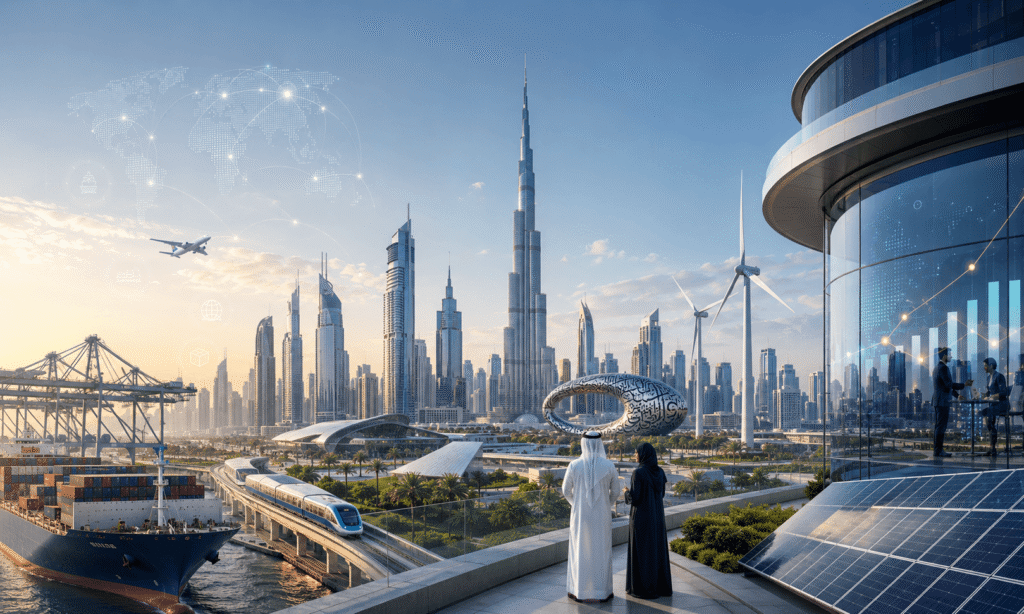
The UAE has spent years building an economy that can generate growth across multiple sectors. Government strategies focus on entrepreneurship, SMEs, digital transformation, exports, innovation, manufacturing, and economic diversification. This creates a broader base for future business activity. Entrepreneurs can increasingly serve local customers while also using the UAE as a platform for regional and international expansion.
From Oil-Led Growth to a Diversified Economy
Oil and gas continue to play an important role in the UAE economy, but non-oil activities have become increasingly significant. Official UAE data shows that non-oil GDP reached AED 1.43 trillion at current prices in 2023, with real non-oil GDP increasing 6.2% compared with 2022.
This diversification creates opportunities in areas such as:
- Technology and digital services
- Tourism and hospitality
- Financial services
- Manufacturing
- Logistics and trade
- Healthcare
- Real estate
- Professional business services
Why Non-Oil Sectors Matter for Future Businesses
A diversified economy creates opportunities beyond traditional energy-related businesses. It also creates demand for supporting companies.
For example, the growth of tourism can create opportunities for travel technology, hospitality services, transportation, events, and digital marketing. Similarly, manufacturing expansion creates demand for logistics, accounting, procurement, technology, and supply-chain services.
UAE Economic Growth After 2026: Key Trends to Watch
Understanding major economic trends can help entrepreneurs choose sectors with stronger long-term relevance.
Non-Oil Economic Growth
Economic diversification will remain an important theme beyond 2026. The UAE’s export policy specifically aims to open international markets and increase the contribution of non-oil sectors to GDP. For businesses, this means opportunities may increasingly come from sectors that support production, trade, services, technology, and international commerce.
Technology and Artificial Intelligence
AI and digital transformation are likely to remain major business themes. The UAE Digital Economy Strategy aims to increase the digital economy’s contribution to GDP from 9.7% in 2022 to 19.4% within 10 years.
This can create demand for:
- AI implementation
- Business automation
- Software development
- Cybersecurity
- Cloud services
- Data analytics
- Digital transformation consulting
The opportunity is particularly strong for businesses that help traditional SMEs adopt technology without requiring them to build complex systems themselves.
Foreign Direct Investment and Global Talent
The UAE continues to position itself as an international investment and business hub. Its economic framework combines free zones, foreign investment opportunities, infrastructure, and business-focused policies. As more international businesses enter the market, supporting demand can emerge for accounting, legal, recruitment, marketing, technology, compliance, and corporate services.
Trade, Logistics and Supply Chain Expansion
The UAE’s geographic position gives it an important role in international trade. Government policy also focuses on increasing exports and opening new international markets.
Potential opportunities include:
- Freight and logistics
- Warehousing
- E-commerce fulfillment
- Last-mile delivery
- Supply-chain technology
- Import and export support
- Procurement services
Tourism and Experience-Based Businesses
Tourism remains an important part of the UAE’s diversified economy. Beyond traditional hotels and restaurants, entrepreneurs can explore specialized experiences, travel technology, events, wellness, entertainment, luxury services, and destination-based businesses.
Infrastructure and Urban Development
Continued investment in infrastructure and urban development can create indirect opportunities for companies supplying construction, technology, facility management, professional consulting, and specialized services.
Top Business Opportunities in UAE Beyond 2026
The strongest future business opportunities in UAE will not necessarily be limited to one sector. Instead, businesses that combine technology with growing economic needs may have an advantage.
Artificial Intelligence and Technology Businesses
AI can help UAE companies reduce repetitive work, improve customer service, analyze information, and automate operations.
This creates opportunities for businesses offering practical solutions rather than generic AI products.
Potential areas include:
- AI automation services
- AI consulting
- Business software
- Cybersecurity
- Data analytics
- Cloud solutions
- Workflow automation
Example: A technology company could develop AI-powered customer support for SMEs, helping businesses manage routine customer queries without replacing human decision-making.
FinTech and Digital Financial Services
As businesses and consumers increasingly use digital financial services, fintech can create opportunities in payments, compliance technology, financial platforms, and specialized business solutions.
Potential areas include:
- Digital payments
- RegTech
- InsurTech
- Financial platforms
- Wealth technology
- SME financial tools
However, financial businesses often face specific regulatory requirements, so entrepreneurs should confirm licensing requirements before launching.
Tourism, Hospitality and Leisure
Tourism creates opportunities beyond hotel ownership.
Entrepreneurs can explore:
- Boutique hospitality
- Travel technology
- Tourism experiences
- Event management
- Luxury services
- Wellness tourism
- Destination management
The key is specialization. A business that targets a specific customer group or experience may have a clearer market position than a general service provider.
Logistics, E-Commerce and Supply Chain
E-commerce growth creates demand for businesses that help online sellers move products efficiently. Opportunities include fulfillment centers, inventory management, delivery technology, packaging, warehousing, and cross-border logistics.
A technology-enabled logistics business can also serve multiple markets from the UAE.
Healthcare and Wellness
Healthcare and wellness can benefit from population growth, increasing consumer awareness, and demand for specialized services.
Potential opportunities include:
- Health technology
- Wellness services
- Medical tourism support
- Elder-care services
- Digital health solutions
- Specialized healthcare services
Businesses in regulated healthcare activities should obtain the required approvals before beginning operations.
Renewable Energy and Sustainability
Sustainability is becoming increasingly relevant to businesses, governments, and consumers.
Opportunities can include:
- Energy-efficiency solutions
- Renewable energy services
- Electric vehicle infrastructure
- Green building solutions
- Waste management
- Recycling
- Water-efficiency technology
The UAE’s Circular Economy Policy also reflects the country’s focus on more efficient use of resources and sustainable economic activity.
Advanced Manufacturing and Industrial Businesses
Manufacturing is another important diversification opportunity. The UAE Government’s industrial initiatives include efforts to develop local production and supply chains. Its National Economic Clusters Policy also seeks to develop competitive, high-impact economic ecosystems.
Potential opportunities include:
- 3D printing
- Industrial automation
- Food manufacturing
- Smart manufacturing
- Specialized production
- Industrial technology
- Supply-chain services
UAE Investment Opportunities: Which Sectors Have Strong Potential?
Rather than asking which sector is guaranteed to succeed, investors should assess where demand, government priorities, technology, and customer needs overlap.
| Sector | Growth Driver | Potential Business Areas |
|---|---|---|
| AI & Technology | Digital transformation | AI, software, automation |
| Tourism | Visitor economy | Hospitality, experiences |
| Logistics | Global trade | Warehousing, fulfillment |
| FinTech | Digital finance | Payments, RegTech |
| Healthcare | Specialized demand | Healthtech, wellness |
| Sustainability | Resource efficiency | Clean technology |
| Manufacturing | Economic diversification | Industrial production |
| Professional Services | Business expansion | Accounting, consulting, compliance |
These are opportunity areas, not guarantees of profitability. Actual results depend on licensing, competition, capital requirements, customer demand, and execution.
Why SMEs Could Benefit From the UAE Economy Beyond 2026
Small and medium-sized businesses can benefit from economic growth because larger companies and new investors create demand for specialized suppliers.
The UAE Government maintains dedicated initiatives for entrepreneurship and SMEs as part of its broader economic strategy.
Growing Demand for Business Services
As companies enter the UAE, they often need support with accounting, taxation, HR, technology, marketing, compliance, and administration. This creates opportunities for specialized B2B companies.
Digital Transformation for SMEs
Many SMEs do not need expensive enterprise technology. They need practical tools that solve specific problems. For example, a small retailer may benefit from automated inventory management, while a professional-services company may need CRM automation and digital invoicing.
Opportunities for Niche and Specialized Businesses
Entrepreneurs can consider:
- B2B consulting
- Digital marketing
- Accounting and tax services
- HR solutions
- IT support
- AI automation
- Compliance services
- Business advisory
The strongest opportunity may come from becoming highly specialized rather than trying to serve everyone.
UAE Business Trends Entrepreneurs Should Watch
AI-Powered Business Models
Businesses will increasingly use AI to automate routine work, analyze data, and improve customer experiences.
Digital-First Customer Experiences
Customers expect fast communication, online payments, self-service options, and convenient digital experiences.
Sustainable Business Models
Energy efficiency, resource management, recycling, and sustainable products can become increasingly relevant as businesses respond to environmental priorities.
Cross-Border E-Commerce
The UAE can serve as a regional base for companies selling products across GCC and international markets.
Specialized B2B Services
As the business ecosystem becomes more sophisticated, companies may increasingly outsource specialized functions instead of building every capability internally.
Data-Driven Business Operations
Companies that use accurate financial, customer, and operational data can make better decisions and identify inefficiencies earlier.
UAE Free Zones vs Mainland: Where Should Future Businesses Set Up?
Choosing between a free zone and mainland structure depends on the business activity, target market, ownership structure, office requirements, and expansion plans. The UAE Government provides dedicated routes for starting and operating businesses in both mainland and free-zone environments.
When a UAE Free Zone May Make Sense
A free zone may be suitable for businesses that value:
- Sector-specific ecosystems
- International trade
- Specialized activities
- Export-oriented operations
- Certain professional services
When Mainland Business Setup May Be Better
Mainland setup can be appropriate when a company wants to operate directly within the UAE market and needs a structure suited to its specific commercial activity.
What Entrepreneurs Should Consider Before Choosing
Before registering a company, assess:
- Business activity
- Target customers
- Licensing requirements
- Office requirements
- Visa needs
- Tax and compliance obligations
- Future expansion plans
- Banking requirements
Do not select a jurisdiction based only on the advertised license price. The cheapest setup is not always the most suitable structure for long-term business growth.
Risks That Could Affect the UAE Economy Beyond 2026
A responsible UAE Economy Outlook should consider risks as well as opportunities. The IMF’s UAE country information currently projects real GDP growth of 3.1% for 2026 and consumer-price growth of 2.5%, while its country assessments also recognize that external conditions can affect the outlook.
Global Economic Slowdown
Slower global growth can reduce international trade, investment, tourism, and business spending.
Oil Price Volatility
Although diversification has reduced the economy’s reliance on oil, energy markets still matter to the wider UAE economy.
Geopolitical and Trade Risks
The UAE’s role as a global trading hub means changes in international trade conditions can affect businesses.
Real Estate Market Changes
Real estate is an important part of the UAE economy. Changes in property demand, financing conditions, or supply can influence related businesses.
Inflation and Financing Costs
Higher operating or borrowing costs can affect business margins, particularly for startups and SMEs.
The right approach is not to avoid these risks entirely but to build businesses with strong cash-flow management, diversified customers, realistic budgets, and adaptable operating models.
How Businesses Can Prepare for the UAE Economy After 2026
1. Choose a Sector With Long-Term Demand
Look beyond temporary trends. Ask whether customers will still need the product or service five years from now.
2. Validate the UAE Market Before Investing
Research competitors, customer needs, pricing, regulations, and potential demand before committing significant capital.
3. Build a Digital-First Business Model
Even traditional companies should consider digital sales, automation, CRM systems, online payments, and data-driven operations.
4. Understand Licensing and Compliance
Your business activity determines important licensing and regulatory requirements. Confirm these requirements before selecting a company structure.
5. Plan for Corporate Tax and VAT Compliance
Tax planning should form part of the business model from the beginning. Businesses should understand whether they have corporate tax, VAT registration, filing, record-keeping, or other compliance obligations.
6. Build for Regional Expansion
A UAE business can potentially serve customers beyond the domestic market. Consider GCC and international opportunities when designing your operations.
7. Invest in Talent and Technology
Technology creates value only when employees know how to use it. Combining skilled people with appropriate technology can create a stronger competitive advantage.
What Is the Best Business to Start in UAE After 2026?
There is no single best business to start in UAE for every entrepreneur. The right opportunity depends on your budget, experience, business activity, target customers, licensing requirements, competition, and growth strategy.
However, entrepreneurs can explore sectors aligned with major economic trends, including:
- AI and automation
- Technology services
- E-commerce
- Logistics
- Tourism
- Healthcare and wellness
- Sustainability
- Professional B2B services
- Specialized manufacturing
- Financial technology
Instead of choosing a business simply because it appears on a “most profitable businesses” list, evaluate the market problem you can solve and your ability to execute consistently.
UAE Economy Outlook: What Entrepreneurs Should Take Away
The UAE Economy Outlook beyond 2026 is increasingly shaped by diversification, technology, international trade, investment, tourism, manufacturing, and professional services. The country’s official economic strategies show a clear focus on developing non-oil sectors, expanding exports, supporting digital transformation, and strengthening entrepreneurship and investment. For entrepreneurs, this creates a broad opportunity landscape. The strongest businesses will likely be those that respond to genuine customer needs while aligning with long-term economic and technological changes.
The goal should not be to predict the next boom. It should be to build a business that can adapt as the UAE economy evolves.
How Ripple Business Setup Can Help
Starting a business in the UAE involves more than obtaining a trade license. Entrepreneurs need to select an appropriate activity, understand the setup structure, consider visa and banking requirements, and plan for ongoing compliance. Ripple Business Setup can support entrepreneurs with UAE company formation, business licensing, visa processing, bank account assistance, accounting, VAT, and corporate tax services. Whether you are exploring a technology startup, professional service company, trading business, or another opportunity, getting the structure right at the beginning can make future growth easier.
Ready to explore a business opportunity in the UAE? Contact Ripple Business Setup for guidance based on your business activity and growth plans.
Phone: +971 50 593 8101
Email: info@ripplellc.ae
WhatsApp: +971 4 250 0833
FAQ
What is the UAE economic outlook beyond 2026?
The UAE economy is expected to remain supported by diversification, non-oil activity, investment, trade, tourism, technology, and infrastructure. However, the actual outlook can change with global economic conditions, oil prices, trade developments, and geopolitical risks.
Which sectors are expected to grow in the UAE after 2026?
Potential growth areas include technology, AI, tourism, logistics, financial services, healthcare, manufacturing, sustainability, e-commerce, and professional business services. Entrepreneurs should assess specific demand and regulatory requirements before investing.
What are the best business opportunities in UAE for 2027?
AI and automation, technology services, logistics, tourism, e-commerce, healthcare, sustainability, specialized manufacturing, and B2B professional services are potential opportunity areas. The best choice depends on the entrepreneur’s skills, capital, licensing requirements, and target market.
Is the UAE economy still dependent on oil?
Oil remains important, but the UAE has significantly developed non-oil economic activities. Official UAE data shows strong growth in non-oil GDP, while government strategies continue to promote diversification, exports, technology, and other sectors.
Is the UAE a good place to start a business after 2026?
The UAE offers an established business ecosystem, free zones, investment opportunities, infrastructure, and access to international markets. However, entrepreneurs should assess their specific business activity, competition, setup costs, tax obligations, and regulatory requirements before starting.
Which non-oil sectors are growing in the UAE?
Important non-oil areas include tourism, financial services, manufacturing, construction, real estate, wholesale trade, technology, logistics, and professional services. The exact performance of individual sectors can vary over time.
What are the future industries in UAE?
AI, digital services, fintech, advanced manufacturing, clean technology, logistics technology, healthcare technology, and sustainability-related businesses are among the industries with long-term strategic relevance.
Should I choose a free zone or mainland company?
The appropriate structure depends on your activity, customers, ownership, office requirements, and expansion plans. Both free zones and mainland jurisdictions offer different advantages, so entrepreneurs should compare the complete setup and operating requirements rather than license cost alone.
Conclusion
The UAE’s economic story beyond 2026 is increasingly about diversification, innovation, technology, trade, and sustainable business growth. Opportunities are emerging across AI, tourism, logistics, fintech, healthcare, manufacturing, sustainability, and specialized B2B services. For entrepreneurs, the key is to choose an opportunity based on real market demand rather than short-term hype. With the right business structure, financial planning, licensing, and compliance strategy, businesses can position themselves to participate in the UAE’s evolving economy.
Disclaimer: This article provides general information for educational purposes and does not constitute financial, investment, tax, or legal advice. Economic conditions and regulations may change, so businesses should verify current requirements before making decisions.