
Starting an online business in the UAE can be an attractive option for a solo entrepreneur. You can sell products through your own website, a marketplace, or social media channels without building a large company from day one. However, turning an online selling idea into a real business involves more than creating an Instagram page or uploading products to a marketplace. You need to consider your UAE E-commerce Licence, business activity, jurisdiction, payment gateway, products, inventory, customs, VAT, and marketplace requirements.
The good news is that a one-person business can be structured to suit a solo entrepreneur. The key is choosing the right activity and licence before you start selling commercially.
What Is a UAE E-commerce Licence?
A UAE E-commerce Licence is a business licence that enables an entrepreneur or company to conduct approved commercial activities through electronic channels, subject to the requirements of the relevant licensing authority.
Your online business might operate through:
- Your own e-commerce website
- Amazon or another marketplace
- Instagram and other social media channels
- WhatsApp or other digital sales channels
- A combination of several platforms
The important point is that your selling channel does not determine everything about your licence. Your business activity and the products or services you intend to sell also matter.
For example, an entrepreneur selling fashion accessories may have different licensing considerations from someone importing electronics, cosmetics, food products, or other regulated goods.
Therefore, don’t select a licence simply because it is marketed as an “e-commerce licence.” First identify what you actually intend to sell and how you will operate.
Do You Need an Online Seller Licence to Sell Online in the UAE?

If you plan to operate an online business commercially, you should establish the appropriate business licensing structure rather than assuming that a social media account or marketplace profile is enough. An online seller licence is particularly relevant when you regularly advertise products, accept customer orders, collect payments, and operate the activity as a business.
There is an important difference between occasionally selling personal belongings and operating an organised commercial business.
Once your activity becomes a business, you should consider:
- Appropriate business activity
- Commercial licence
- Business structure
- Payment collection
- Product approvals
- Customer protection requirements
- Tax obligations
- Import and customs requirements
Does Selling on Instagram Require a Licence?
Instagram is a marketing and sales channel. Having an Instagram business profile does not automatically replace the need for appropriate business licensing. If you plan to sell online UAE customers through Instagram on a regular commercial basis, check which activity and licence apply to your business.
For example, someone selling a small collection of permitted accessories through Instagram may have a relatively straightforward setup. Someone importing cosmetics and selling them through Instagram may face additional product and regulatory requirements.
Do Amazon Sellers Need a Business Licence?
If you’re planning an Amazon seller setup, don’t look only at the marketplace account requirements.
You should also consider:
- Your UAE business licence
- Approved commercial activity
- Product eligibility
- Supplier documentation
- Import requirements
- Payment arrangements
- Inventory storage
- Returns and fulfilment
The exact requirements can depend on what you sell and how you source and fulfil your products.
Which Licence Is Best for a One-Person Online Business?
There isn’t one licence that is automatically best for every solo entrepreneur.
The appropriate option depends on your:
- Products
- Business activity
- Target market
- Selling platform
- Import requirements
- Expected turnover
- Office requirements
- Visa needs
- Expansion plans
A person selling locally sourced products through an online store may have different requirements from someone importing goods and operating a warehouse.
E-commerce Licence vs Trading Licence
This is an important distinction for anyone considering a small trading company. An e-commerce-focused activity can be suitable for a business whose commercial model centres on online selling. A trading activity may be more appropriate depending on the products and the way the business sources, distributes, imports, or sells them.
Before choosing between them, consider:
- What products will you sell?
- Will you import products?
- Will you hold physical inventory?
- Will you sell through marketplaces?
- Will you sell directly to UAE customers?
- Do your products require additional approvals?
- Will you expand into wholesale or distribution?
Don’t choose a licence based only on the lowest advertised price. A cheaper licence may not be suitable if its permitted activity doesn’t match your actual business model.
Can One Person Own the Business?
Yes, a business can be structured around a single entrepreneur, subject to the legal form and requirements of the selected jurisdiction. A one-person setup can be useful for entrepreneurs who want to start small and control the business themselves. However, one-person ownership does not mean one-size-fits-all licensing. You still need to select the correct activity and comply with the requirements of the relevant authority.
Mainland or Free Zone for an E-commerce Business?
One of the biggest decisions when obtaining an ecommerce licence UAE is whether to establish the business in the mainland or a free zone.
Neither option is automatically better. Your choice should reflect how you plan to operate.
Mainland E-commerce Setup
A mainland structure can be worth considering if your business model focuses heavily on the UAE domestic market.
You should evaluate:
- Permitted business activities
- Local market operations
- Office requirements
- Product-related approvals
- Distribution model
- Import and logistics requirements
The exact licensing process and requirements depend on the emirate and activity.
Free Zone E-commerce Setup
Free zones can provide various company formation packages designed for entrepreneurs and smaller businesses.
Depending on the selected free zone, you may find:
- E-commerce-related activities
- Flexible office solutions
- Different licence packages
- Visa options
- Business support services
However, don’t assume that every free zone licence provides the same commercial rights or operational flexibility.
Your planned customer base, product movement, import arrangements, and UAE mainland sales model should all be considered before selecting a jurisdiction.
What Documents Are Needed for a UAE E-commerce Licence?
The exact requirements vary according to the licensing authority, business activity, legal structure, and jurisdiction.
Common requirements may include:
- Passport copy
- Passport-size photograph, where applicable
- Proposed business/trade name
- Business activity details
- Application forms and company information
- Address or office-related documentation where required
- Additional approvals for regulated activities
- Corporate documents where applicable
Some product categories may require additional documentation or approvals.
Before submitting an application, confirm the current requirements with the relevant authority rather than relying on an old checklist found online.
How Much Does an Ecommerce Licence UAE Cost?
There is no single UAE-wide price for an ecommerce licence UAE because the total setup cost depends on several variables.
Your budget may need to account for:
- Business licence fees
- Trade name or registration charges
- Office or workspace requirements
- Visa-related costs
- Immigration or establishment-related charges
- Additional government approvals
- Customs-related registration where applicable
- Payment gateway charges
- Marketplace fees
- Accounting and tax compliance
What Affects the Total Cost?
The final cost can change depending on:
- Mainland or free zone
- Selected business activity
- Number of visas
- Office requirements
- Product category
- Importing arrangements
- Additional approvals
- Business structure
For this reason, avoid comparing licences purely by their headline promotional price. Compare the complete setup and operating cost against your actual business model.
How to Set Up a One-Person E-commerce Business in the UAE
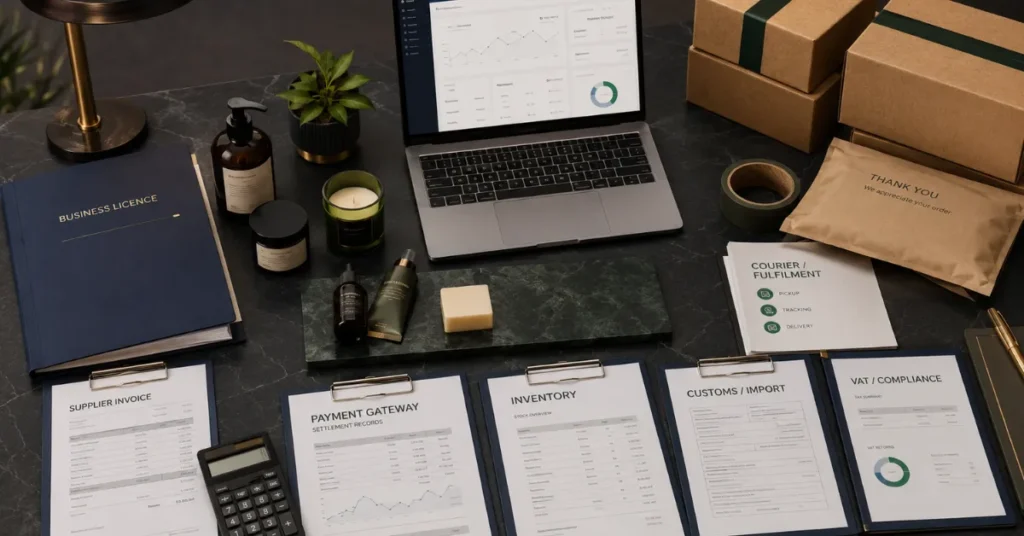
Once you’ve identified your business model, you can approach the setup systematically.
Step 1: Choose Your Products and Business Activity
Start with your products rather than the licence price. Write down exactly what you want to sell and determine whether the activity covers those products. This is especially important if you’re dealing with food, cosmetics, health-related products, electronics, or other categories that may have specific requirements.
Step 2: Select the Jurisdiction
Compare mainland and free zone options based on your:
- Target customers
- Business activity
- Product sourcing
- Import plans
- Office needs
- Budget
- Expansion plans
Step 3: Choose a Trade Name
Select an appropriate business name according to the rules of the relevant licensing authority. Make sure the name is suitable for your intended business and doesn’t conflict with applicable naming restrictions.
Step 4: Apply for the Licence
After selecting the activity, legal structure, jurisdiction, and trade name, complete the relevant registration and licensing process. Keep copies of your licence and company documents because you may need them when opening accounts, setting up payment services, or registering with marketplaces.
Step 5: Set Up a Business Bank Account and Payment Gateway
A payment gateway allows customers to pay electronically through your website or other supported channels.
Your setup may involve:
- Business bank account
- Payment gateway application
- Website integration
- Card and digital payment options
- Payment reconciliation
- Transaction records
Choose payment solutions that match your business structure and expected transaction volume.
Step 6: Set Up Your Marketplace or Website
You can sell through:
- Your own website
- Amazon
- Other marketplaces
- Social commerce channels
Your website should clearly communicate product information, pricing, delivery arrangements, returns, and customer support.
Step 7: Organise Inventory and Fulfilment
Inventory management becomes important even for a one-person business.
Track:
- Products purchased
- Products sold
- Available stock
- Damaged goods
- Returned products
- Supplier costs
- Delivery costs
Good inventory records help you understand your actual profit and prevent stock shortages.
Customs, VAT and Other Compliance for Online Sellers
Getting your licence is only the beginning. An online business may also have tax and import obligations.
Do E-commerce Businesses Need VAT Registration?
Not every new e-commerce business automatically needs VAT registration. For UAE-resident businesses, VAT registration becomes mandatory when taxable supplies and imports exceed AED 375,000 over the previous 12 months or are expected to exceed that amount within the next 30 days. Voluntary registration can generally apply when the relevant value exceeds AED 187,500, subject to the applicable rules.
This means an online seller should monitor turnover rather than assuming that being small automatically removes VAT responsibilities.
VAT rules can also depend on the nature and location of supplies, so businesses should assess their specific circumstances.
Do Online Sellers Need Customs Registration?
If you import products into the UAE, customs requirements become an important part of your operating model.
Consider:
- Import documentation
- Product classification
- Customs procedures
- Duties where applicable
- Shipping documents
- Restricted or regulated goods
- Storage and delivery
A seller who buys stock locally may have a very different customs process from a seller importing products from overseas.
Keep Proper Business Records
Even a one-person business should establish basic financial controls from the beginning.
Maintain records for:
- Sales
- Purchases
- Expenses
- Supplier invoices
- Inventory
- Bank transactions
- Marketplace fees
- Delivery charges
- Tax records
The Federal Tax Authority’s current VAT registration service also identifies supporting commercial and financial documents that may be required depending on the applicant and application.
Common Mistakes One-Person E-commerce Businesses Make
New online sellers often focus heavily on launching their products and overlook the business infrastructure behind the store.
Avoid these common mistakes:
- Choosing the wrong business activity
Your licence should reflect what you actually do. - Assuming Instagram replaces a licence
A social media account is a sales channel, not necessarily your business registration. - Ignoring product-specific approvals
Some products can have additional regulatory requirements. - Importing products without understanding customs
Check import procedures before placing large overseas orders. - Mixing personal and business finances
Separate business transactions wherever practical. - Ignoring VAT obligations
Monitor taxable supplies and imports against the applicable thresholds. - Not tracking inventory
Sales revenue alone doesn’t tell you how profitable your business is. - Choosing the cheapest licence automatically
The lowest initial cost may not provide the activity or structure you need. - Ignoring marketplace requirements
Marketplace onboarding can involve its own verification and product requirements. - Launching before arranging payment collection
Make sure customers can pay through a suitable and properly configured method.
UAE E-commerce Licence: Practical Example for a Solo Seller
Consider a UAE entrepreneur who wants to sell skincare products through Instagram and Amazon.
Instead of immediately purchasing the cheapest licence package, the entrepreneur should first:
- Identify the exact skincare products
- Confirm the appropriate business activity
- Check whether additional product approvals apply
- Compare mainland and free zone structures
- Obtain the appropriate licence
- Arrange business banking and payment collection
- Understand import and customs requirements if sourcing overseas
- Set up inventory records
- Review VAT obligations
- Establish proper accounting records
This approach reduces the risk of discovering later that the original setup doesn’t match the actual business.
Is an E-commerce Licence Worth It for a One-Person Business?
For an entrepreneur who intends to operate a genuine online business, proper licensing can provide a foundation for more organised growth.
It can support areas such as:
- Operating a legitimate commercial activity
- Business banking
- Payment processing
- Marketplace onboarding
- Professional credibility
- Business expansion
- Financial record keeping
- Tax and regulatory compliance
The key is not simply getting any licence. The goal is to establish a structure that matches your products, customers, selling channels, and future plans.
FAQ
Can one person get a UAE E-commerce Licence?
Yes. A solo entrepreneur can establish a one-person business structure, subject to the legal form, business activity, jurisdiction, and licensing requirements that apply to the chosen setup.
Can I sell products on Instagram without a licence in the UAE?
If you’re operating Instagram as a regular commercial selling channel, you should assess the appropriate business licensing requirements. Instagram itself does not replace business registration or licensing.
Do I need a licence to sell on Amazon UAE?
If you’re operating a commercial business through Amazon UAE, you should ensure that your business structure and licence meet the applicable requirements. You should also check Amazon’s current seller onboarding requirements.
What is the difference between an e-commerce licence and a trading licence?
An e-commerce activity focuses on conducting approved business through electronic channels, while trading activities relate to the buying and selling of specified goods. The correct option depends on your products and business model.
Do I need VAT registration for an online business?
Not automatically. UAE-resident businesses generally become mandatorily VAT registered when taxable supplies and imports exceed AED 375,000 under the applicable rules. Voluntary registration may be available above AED 187,500.
Do I need customs registration if I import products?
Importing products can involve customs procedures and requirements. The exact process depends on your business, goods, import route, and relevant customs authority.
Can I run an e-commerce business from a free zone?
Yes, depending on the selected free zone and approved business activity. However, you should assess how your business will sell, distribute, and deliver products into the UAE market before choosing the jurisdiction.
How much does an ecommerce licence UAE cost?
There is no universal price. Costs vary according to jurisdiction, business activity, office requirements, visas, approvals, and other setup requirements.
How Ripple Business Setup Can Help With Your UAE E-commerce Licence
Choosing an e-commerce structure can be confusing when you’re comparing business activities, mainland and free zone options, marketplace requirements, banking, and compliance. Ripple Business Setup can help entrepreneurs understand the available company formation options and identify a setup that aligns with their intended business activity. Support can include business setup, licensing, visa processing, bank account assistance, accounting, VAT, and tax-related services.
Before starting the application, it is useful to discuss what you plan to sell, where your customers are located, whether you will import products, and which platforms you intend to use.
Contact Ripple Business Setup:
📞 +971 50 593 8101
📧 info@ripplellc.ae
🌐 ripplellc.ae
Conclusion
A UAE E-commerce Licence can provide the foundation for a one-person online business, but the licence is only one part of the setup. Your products, business activity, jurisdiction, marketplace, payment gateway, inventory, customs requirements, and VAT obligations all need to work together. Whether you plan to build an independent online store, complete an Amazon seller setup, or sell through Instagram, take time to choose the right structure before launching.
A well-planned ecommerce licence UAE setup can help a solo entrepreneur start with a manageable structure while creating room for future growth.
Disclaimer: This article provides general information and should not be treated as legal, tax, or regulatory advice. UAE licensing, tax, customs, and e-commerce requirements can vary by activity, jurisdiction, and business circumstances. Always verify current requirements with the relevant UAE authority or a qualified professional before establishing your business.