Closing a company in the UAE involves more than cancelling a trade licence. A proper UAE company liquidation process may require shareholders’ approvals, employee settlement, visa and work permit cancellations, government clearances, tax compliance, and final licence cancellation. Businesses registered for VAT or Corporate Tax also need to address their tax position separately. For example, the Federal Tax Authority (FTA) currently provides dedicated procedures for both VAT and Corporate Tax deregistration.
What Is UAE Company Liquidation?
UAE company liquidation is the formal process of winding up a company’s affairs and bringing its business activities and legal registrations to an end. Liquidation generally involves reviewing the company’s assets and liabilities, settling outstanding obligations, dealing with employees, completing required government procedures, and cancelling the relevant business licence. Simply stopping business activity does not necessarily mean the company has been legally closed.
Depending on the business structure and licensing jurisdiction, the procedure can differ between mainland companies and free zone companies.
Why Do UAE Companies Go Into Liquidation?
Businesses may choose to liquidate for several reasons, including:
- The shareholders decide to close the business
- The company is no longer commercially viable
- The owners are restructuring their business activities
- The business has completed its intended project
- The shareholders want to exit the UAE market
- The company is being reorganised or replaced
- The business can no longer continue its operations
The correct closure procedure depends on the company’s legal structure, licensing authority, tax registrations, employees, liabilities, and other circumstances.
Mainland vs Free Zone Company Liquidation in the UAE
The company liquidation process in the UAE is not identical for every business. A mainland company normally deals with the relevant emirate’s licensing authority, while a free zone company follows the rules and procedures of its respective free zone.
Mainland Company Liquidation
A mainland company may need to complete steps such as:
- Shareholders’ resolution
- Liquidator appointment, where applicable
- Licence cancellation procedures
- Employee and visa cancellations
- Government clearances
- Tax compliance and deregistration
- Final closure documentation
The exact requirements depend on the emirate and legal structure.
Free Zone Company Liquidation
Free zones can have their own forms, fees, timelines, and documentary requirements.
A free zone company may need to address:
- Free zone authority approval
- Office or lease cancellation
- Employee and visa records
- Outstanding authority fees
- Tax registrations
- Clearance requirements
- Final licence cancellation
Important: Do not assume that a procedure used by one UAE free zone will automatically apply to another.
UAE Company Liquidation Process: Step-by-Step
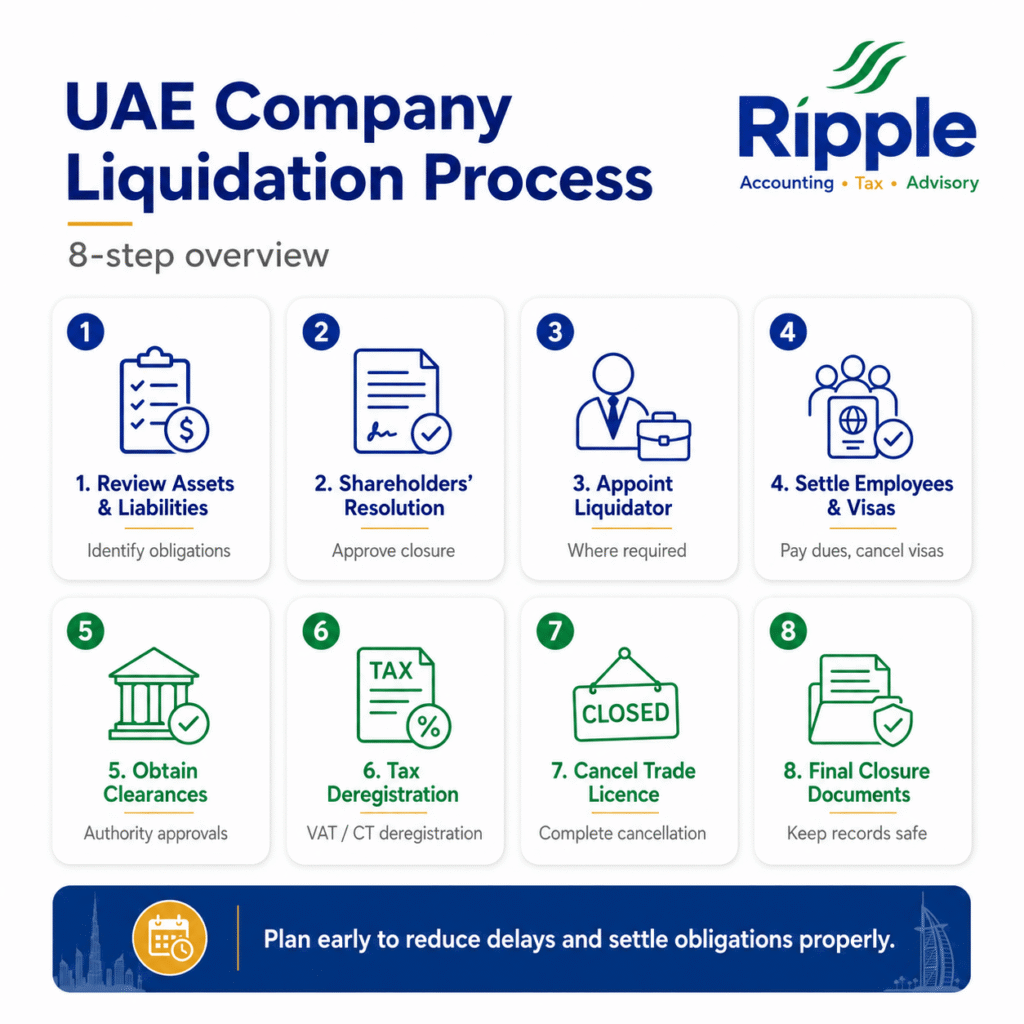
A well-planned liquidation can reduce unnecessary delays and help the business identify outstanding obligations early.
Step 1: Review the Company’s Assets and Liabilities
Before starting the closure process, review the company’s financial position.
Identify:
- Outstanding supplier invoices
- Customer balances
- Bank loans
- Government fees
- Tax liabilities
- Employee dues
- Lease obligations
- Company assets
- Pending contracts
- Other creditor claims
This review helps shareholders understand what must be settled before the business closes.
Step 2: Pass the Shareholders’ Resolution
The shareholders generally need to formally approve the company’s liquidation according to the applicable legal and licensing requirements. The resolution may cover the decision to liquidate and, where required, the appointment of a liquidator.
Keep the signed resolution with the company’s other closure records.
Step 3: Appoint a Liquidator Where Required
Depending on the company’s structure and authority requirements, a liquidator may need to handle the company’s winding-up process. The liquidator can help review the company’s financial position, assets, liabilities, and outstanding obligations and complete the relevant liquidation documentation.
Step 4: Settle Employees and Cancel Visas
Employee obligations should receive particular attention. Before completing the company closure, the business should review employee contracts, outstanding salary, accrued leave, end-of-service benefits where applicable, and other required entitlements. The business may also need to complete work permit and residence visa cancellation procedures.
UAE employment guidance recognises the final closure of an enterprise as one circumstance in which an employment contract may be terminated, subject to applicable legislation and procedures.
Step 5: Obtain Required Clearances
A company may need different clearances depending on its activities and registrations.
These can include:
- Immigration clearance
- Labour or work permit clearance
- Municipality clearance
- Customs clearance, where relevant
- Free zone clearance
- Landlord or lease-related clearance
- Utility clearance
- Tax-related documentation
- Other authority-specific approvals
Not every company will need every clearance.
Step 6: Complete Tax Deregistration
Tax registration should be treated as a separate compliance step. A company registered for VAT may need to apply for VAT deregistration, while a company registered for Corporate Tax may need to apply separately for Corporate Tax deregistration.
Step 7: Cancel the Trade Licence
After the relevant requirements and clearances have been addressed, the company can proceed with the applicable licence cancellation process. The exact procedure depends on the licensing authority.
Step 8: Obtain Final Closure Documentation
Keep the final licence cancellation, liquidation, or closure documents safely. These documents can help demonstrate that the business has formally completed its closure process.
Clearance Certificates Required for UAE Company Liquidation
A clearance certificate in the UAE is generally evidence that a business has resolved a particular authority’s outstanding requirements.
The exact certificate depends on the authority and the company’s circumstances.
What Is a Company Clearance Certificate?
A clearance certificate confirms that the relevant authority has no remaining requirement that prevents the next stage of the closure process, where such a certificate is required.
Businesses should not assume that one general “UAE clearance certificate” covers every government obligation.
Common Clearances Businesses May Need
Depending on the company, these may include:
- Immigration clearance
- Labour clearance
- Municipality clearance
- Customs clearance
- Free zone clearance
- Lease or landlord clearance
- Utility clearance
- Tax-related clearance or status documentation
The FTA also provides tax-related status and clearance services, with requirements depending on the reason for closure.
Employee Settlement During UAE Company Liquidation
Employee settlement is one of the most important parts of a company closure. A business should not treat employee cancellation as an afterthought because unresolved employment records can complicate the overall closure process.
What Happens to Employees When a Company Closes?
When a company permanently closes, the employer must follow the applicable employment termination and work permit procedures. The business should review each employee’s contract and calculate all applicable outstanding amounts before completing the cancellation process.
Employee Dues to Settle
Depending on the employee’s circumstances, this can include:
- Unpaid salary
- Accrued annual leave
- End-of-service benefits, where applicable
- Contractual payments
- Other legally required employee entitlements
Keep evidence of settlements and relevant cancellation documents with the company’s records.
Employee Visa and Work Permit Cancellation
The business may need to complete:
- Employment termination procedures
- Work permit cancellation
- Residence visa cancellation, where applicable
- Final settlement documentation
- Any required authority clearance
The exact process can vary depending on the employee’s status and the relevant authority.
VAT Deregistration During UAE Company Liquidation
Company closure does not automatically remove a business from the UAE VAT system. If the company is VAT registered, it should review whether VAT deregistration applies and complete its outstanding VAT obligations.
The FTA provides VAT deregistration through EmaraTax. For a business that is no longer making taxable supplies because its licence has been cancelled, the FTA lists documents such as the cancelled trade licence, liquidation letter or board resolution, and the latest financial statement among the supporting documents.
When Should a Company Deregister for VAT?
The appropriate timing depends on the circumstances and the applicable VAT rules. Businesses should avoid simply abandoning their VAT registration after stopping operations.
The FTA states that where mandatory deregistration applies, the application must be submitted within the prescribed timeframe.
VAT Obligations Before Company Closure
Before completing VAT deregistration, review:
- Outstanding VAT returns
- VAT payable
- Input and output VAT
- Final business transactions
- Supporting invoices
- Accounting records
- Deregistration documents
The FTA states that the final VAT return and payable tax should generally be submitted and settled within 28 days from the effective date of deregistration.
After approval, the FTA makes the VAT deregistration certificate available through the taxpayer’s e-Services account.
UAE Corporate Tax Deregistration After Company Closure
Corporate Tax has become an important part of the UAE company closure process. A company should not assume that cancelling its trade licence automatically cancels its Corporate Tax registration.
Does Company Liquidation Automatically Cancel Corporate Tax Registration?
No. Corporate Tax deregistration is a separate process with the FTA. The FTA specifically allows Corporate Tax deregistration for reasons including liquidation, bankruptcy, and closure of business.
Corporate Tax Obligations Before Deregistration
Before applying, businesses should review:
- Corporate Tax returns
- Outstanding Corporate Tax liabilities
- Administrative penalties
- Financial statements
- Tax records
- Licence cancellation documentation
For liquidation or business closure, the FTA currently lists the licence cancellation document and financial statements up to and including the licence cancellation date among the required documents.
The FTA’s current service information states that a completed Corporate Tax deregistration application is generally processed within 40 working days, although additional information can extend the process.
What Records Should a Liquidated Company Keep?
Keep important records such as:
- Financial statements
- Tax returns
- VAT records
- Corporate Tax records
- Invoices
- Bank statements
- Payroll records
- Employee settlement documents
- Contracts
- Licence cancellation documents
- Liquidation documents
Proper record retention can help if the authorities, former employees, shareholders or other parties later require supporting information.
Documents Required for UAE Company Liquidation
The exact document list depends on the authority, company structure and circumstances.
Common documents may include:
- Shareholders’ resolution
- Liquidator documents, where applicable
- Trade licence
- Memorandum and Articles, where required
- Shareholder identification documents
- Employee cancellation documents
- Lease cancellation documents
- Clearance certificates
- Tax registration documents
- Financial statements
- VAT deregistration documents
- Corporate Tax deregistration documents
- Final liquidation or closure documents
For Corporate Tax deregistration specifically, the FTA currently identifies the licence cancellation document and financial statements up to the cancellation date for liquidation or closure cases.
How Long Does Company Liquidation Take in the UAE?
There is no single timeline for every UAE company liquidation.
The duration can depend on:
- Mainland or free zone registration
- Company structure
- Number of employees
- Tax registrations
- Outstanding liabilities
- Required clearances
- Lease obligations
- Government processing times
- Disputes with creditors or employees
Tax deregistration can also add processing time. For example, the FTA currently states an estimated processing period of 40 working days for a completed Corporate Tax deregistration application, while VAT deregistration is currently listed at 20 business days.
Factors That Can Delay Company Liquidation
Common causes include:
- Unpaid government fees
- Uncancelled employee visas
- Outstanding tax returns
- Unpaid tax
- Missing documents
- Employee disputes
- Supplier claims
- Lease problems
- Bank-related issues
- Incorrect applications
Starting the preparation early can help identify these issues before the final cancellation stage.
UAE Company Liquidation Cost: What Should You Budget For?
There is no universal fixed company liquidation cost in the UAE.
Your total cost can depend on:
- Licensing authority fees
- Liquidator fees
- Public notice costs, where applicable
- Visa cancellation fees
- Employee settlements
- Tax compliance costs
- Accounting fees
- Outstanding licence fees
- Lease-related costs
- Clearance charges
- Other authority-specific expenses
A business with no employees, no outstanding liabilities and simple tax records may have a very different closure cost from a company with multiple employees, leases, debts and tax registrations.
What Happens to Company Debts During Liquidation?
Liquidation does not simply make company liabilities disappear. The business should identify outstanding obligations and deal with creditors as part of the winding-up process.
These may include:
- Supplier debts
- Bank loans
- Customer refunds
- Government dues
- Tax liabilities
- Employee claims
- Lease obligations
Where significant debts or disputes exist, professional legal and financial advice may be appropriate before proceeding.
What Happens to Company Assets?
Company assets should also be identified during the liquidation process. Depending on the circumstances, assets may need to be sold, transferred, or otherwise dealt with according to the applicable legal and contractual requirements. The important point is to reconcile the company’s assets and liabilities rather than simply closing its operating bank account or abandoning its licence.
Common Mistakes to Avoid During UAE Company Liquidation
1. Stopping Business Without Cancelling the Licence
Ceasing operations is not the same as completing legal closure.
2. Ignoring Employee Obligations
Unresolved employee dues or visa records can create unnecessary complications.
3. Forgetting VAT Deregistration
A company should review its VAT position rather than assuming that licence cancellation automatically handles VAT.
4. Assuming Corporate Tax Registration Ends Automatically
Corporate Tax deregistration requires a separate FTA process.
5. Leaving Government Fees Unpaid
Outstanding fees and penalties can interfere with closure.
6. Failing to Obtain Required Clearances
Different authorities may have separate requirements.
7. Closing the Bank Account Too Early
The business may still need the account to settle final liabilities and receive or make final payments.
8. Losing Financial Records
Keep tax, accounting, payroll, and closure records after liquidation.
UAE Company Liquidation Checklist
Use this checklist before starting the final closure process:
- Confirm the shareholders’ decision to liquidate
- Review company assets and liabilities
- Appoint a liquidator if required
- Settle employee dues
- Cancel work permits and visas
- Resolve lease obligations
- Obtain required clearances
- File outstanding VAT returns
- Complete VAT deregistration where applicable
- Complete Corporate Tax obligations
- Apply for Corporate Tax deregistration where applicable
- Settle government fees and penalties
- Cancel the trade licence
- Obtain final closure documentation
- Preserve accounting and tax records
UAE Company Liquidation Example
Consider a Dubai trading company with two shareholders, three employees, an active VAT registration and Corporate Tax registration.
The shareholders decide to stop trading.
First, they review the company’s outstanding supplier balances, employee dues, lease obligations, and tax records. They then complete the required shareholder and liquidation procedures.
Next, the company settles employee entitlements and completes the required work permit and visa cancellations. It also addresses the office lease and obtains the relevant clearances.
The company then deals with its VAT and Corporate Tax obligations. For Corporate Tax deregistration, the FTA currently requires a licence cancellation document and financial statements through the licence cancellation date for liquidation or closure cases.
Finally, the company completes the applicable licence cancellation and retains its liquidation, tax, and financial records.
The example shows why UAE company liquidation should be treated as a coordinated process rather than a single licence cancellation application.
How Ripple Business Setup Can Help With UAE Company Liquidation
Ripple Business Setup helps entrepreneurs and companies manage business setup and closure requirements across the UAE. Our team supports company formation, trade licence services, visa processing, accounting, VAT, and Corporate Tax compliance. We also assist businesses with documentation and administrative requirements during company liquidation and business closure. For professional guidance, contact Ripple Business Setup at +971 50 593 8101 or info@ripplellc.ae. Visit www.ripplellc.ae to learn more about our UAE business services.
Frequently Asked Questions
How do I liquidate a company in the UAE?
Start by reviewing the company’s legal, financial, employee, and tax obligations. Then follow the liquidation and licence cancellation procedure required by the relevant mainland or free zone authority.
What documents are required for company liquidation in the UAE?
Documents vary but may include shareholder resolutions, licence documents, liquidator documents, financial statements, employee cancellation records, clearances, and tax documents.
Do employees need to be settled before company closure?
Businesses should address applicable employee entitlements and employment cancellation requirements as part of the closure process.
Do I need to cancel employee visas before liquidation?
Where employees hold company-sponsored visas, the applicable work permit and visa cancellation procedures should be completed as required.
Is VAT deregistration required when closing a UAE company?
A VAT-registered business should review whether it is required to deregister and complete its final VAT obligations. The FTA provides a dedicated VAT deregistration service.
Do I need to deregister for Corporate Tax after liquidation?
If the company is registered for Corporate Tax and its business or legal existence ends, it should review and complete the applicable FTA Corporate Tax deregistration process.
What is a liquidation certificate in the UAE?
It is closure-related documentation showing that the company has completed the applicable liquidation or cancellation process. The exact document and terminology can vary by authority.
How long does company liquidation take in the UAE?
The timeline varies according to the company, authority, employees, liabilities, and tax position. Tax deregistration may also add processing time.
How much does it cost to liquidate a company in the UAE?
Costs vary according to government fees, liquidator charges, employee settlements, tax work, lease obligations, penalties and other requirements.
Can I liquidate a company with outstanding debts?
Outstanding debts can complicate liquidation. The company should identify and appropriately address creditor, tax, employee, and other liabilities as part of the winding-up process.
What happens if I do not cancel my UAE company?
Simply stopping operations does not necessarily complete the company’s legal and compliance obligations. Unresolved licensing, tax, employee, and government requirements may continue to create issues.
Conclusion
UAE company liquidation requires more than cancelling a trade licence. Businesses should properly settle employees, obtain required clearances, and complete VAT and Corporate Tax obligations before final closure. A structured process can help reduce delays and avoid unnecessary compliance issues.
Disclaimer: This article provides general information about UAE company liquidation and does not constitute legal, tax, or financial advice. Requirements can vary by emirate, licensing authority, free zone, and company circumstances. Always verify current requirements with the relevant authority or a qualified professional.