

Dubai has long been one of the world’s most attractive destinations for entrepreneurs, investors, and multinational corporations. In 2026, that appeal has only grown stronger. At the center of this business-friendly ecosystem sits a powerful government authority that shapes how businesses are born, regulated, and supported across the emirate.
The Department of Economy and Tourism Dubai, commonly referred to as DET, is the backbone of commercial activity in the city. Whether you are a first-time entrepreneur or an established company looking to expand into the UAE, understanding how this authority works is your first and most important step.
Dubai has been rolling out sweeping reforms in recent years: 100% foreign ownership for mainland businesses, digital licensing platforms, streamlined approvals, and investor protection frameworks that rival the world’s leading business hubs. In 2026, these policies will have matured further, making now an ideal time to explore your options.
What Is the Department of Economy and Tourism Dubai?
The Department of Economy and Tourism Dubai is the primary government authority responsible for regulating commercial activity, issuing trade licenses, and driving economic growth across Dubai’s mainland. Formed through the merger of Dubai Economy and Dubai Tourism, the unified authority now oversees both the business licensing landscape and the emirate’s positioning as a global tourism destination.
As a Dubai business authority, DET acts as the official regulator for all mainland commercial enterprises. It handles everything from business name registration and initial approvals to inspections, consumer protection, and economic policy development. For any entrepreneur setting up outside of a free zone, the Department of Economy is the central licensing authority in Dubai.
Its expanded mandate under the tourism umbrella also means that businesses in hospitality, travel, and leisure now deal with a single streamlined body rather than multiple agencies. This consolidation has significantly reduced bureaucratic friction for investors entering the UAE market.
Key Functions of the Department of Economy in 2026
The Department of Economy performs several critical functions that directly affect how businesses operate on Dubai’s mainland:
- Trade license issuance: The primary gateway for any business seeking legal authorization to operate in Dubai
- Business name registration: Ensuring trade names comply with UAE naming conventions and are unique within the registry
- Regulatory compliance and inspections: Monitoring businesses to ensure they meet legal, safety, and operational standards
- Consumer protection services: Handling complaints, enforcing fair trade practices, and protecting public interests
- Tourism licensing and promotion: Regulating and supporting travel agencies, tour operators, and hospitality businesses
- Economic policy development: Shaping long-term strategies to attract investment and diversify Dubai’s economy
These functions make DET a comprehensive Dubai licensing authority that touches nearly every phase of a business’s lifecycle from registration through ongoing compliance.
Types of Business Licenses Issued by the Department of Economy
Commercial License
A commercial license covers trading activities, buying and selling goods within or across borders. If you plan to run a retail shop, import/export operation, real estate brokerage, or general trading company, this is the license category for you. Dubai trade license types under the commercial category are among the most commonly issued, given the emirate’s position as a global trading hub.
Professional License
Service-based businesses require a professional license. This applies to consultants, lawyers, accountants, IT service providers, marketing agencies, and similar knowledge-economy businesses. The professional license recognizes individual expertise and is often the preferred route for freelancers and specialist firms operating in Dubai.
Industrial License
Businesses involved in the manufacturing, production, or processing of goods need an industrial license. This category applies to factories and production units that transform raw materials into finished products. Industrial businesses are subject to additional regulatory requirements around safety and environmental compliance.
Tourism License
Any business operating in the tourism sector, such as travel agencies, tour operators, event management companies serving tourists, and related services, must hold a tourism license issued through DET. This requirement ensures that visitors to Dubai receive services from regulated, accountable providers.
Step-by-Step Business Setup Process with the Department of Economy
Step 1: Choose Your Business Activity
Before anything else, you must identify and select your business activity from DET’s approved list. This step is critical because your chosen activity determines the type of license you need, the approvals required, and sometimes the physical space requirements. Selecting the wrong activity can cause delays or force you to restart the process, so it is worth consulting a local expert at this stage.
Step 2: Reserve Your Trade Name
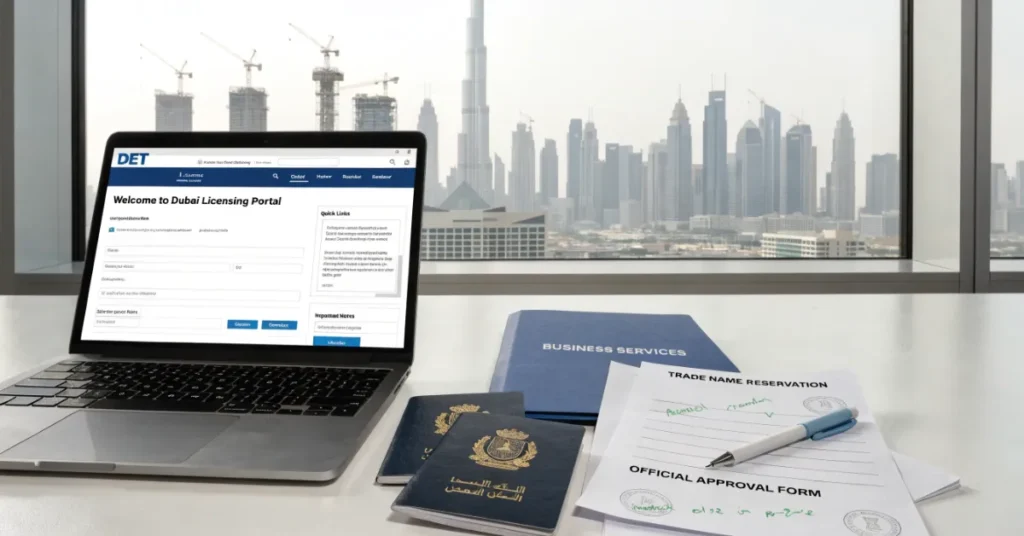
Your company name must comply with UAE naming guidelines. Names cannot include offensive language, references to religion or political entities, or abbreviations that misrepresent the business nature. You can reserve your trade name through the DET portal. Names must be unique within the registry, so having two or three alternatives ready is advisable.
Step 3: Apply for Initial Approval
Initial approval is the government’s preliminary clearance that your business activity is permissible in Dubai. Some activities such as those in healthcare, education, or finance, require approvals from additional regulatory bodies before DET issues the final license. This step confirms that your planned business is legally viable.
Step 4: Secure Office Space
Mainland businesses in Dubai require a physical business address. You must sign a tenancy contract and register it through Ejari, the UAE’s official rental contract registration system. Virtual offices may be accepted for certain professional activities, but manufacturing and commercial businesses typically need a dedicated space.
Step 5: Submit Documents and Pay Fees
At this stage, you compile and submit your application package. Required documents typically include:
- Passport copies of all shareholders and managers
- UAE visa details (or entry stamp for new applicants)
- Memorandum of Association (MOA), if applicable
- Ejari-registered tenancy contract
- Initial approval certificate
- Trade name reservation certificate
Step 6: Get Your Trade License
Once all documents are verified and fees are paid, DET processes the final application and issues your trade license. In many cases, this can be completed within a few business days through DET’s e-services platform. Your trade license is valid for one year and must be renewed annually.
Cost of Setting Up a Business in Dubai
Business setup costs in Dubai vary depending on your activity, company structure, and office requirements. However, understanding the approximate cost ranges helps you plan your budget effectively.
Office rent in Dubai mainland can range from AED 15,000 per year for a small shared space to AED 80,000 or more for a dedicated commercial unit, depending on the location. Government fees are relatively predictable and transparent.
Here is a simplified cost breakdown:
- License fee: AED 10,000 – AED 25,000 (varies by activity and structure)
- Registration charges: AED 2,000 – AED 5,000
- Visa costs: AED 3,000 – AED 5,000 per visa (including medical and Emirates ID)
- Office/Ejari: AED 15,000 – AED 80,000+ annually
- Notarization and PRO fees: AED 2,000 – AED 5,000
Dubai business setup cost in 2026 remains competitive compared to other global business centers, especially considering the tax advantages, no personal income tax, and no corporate tax for most small businesses under the AED 375,000 threshold.
Mainland vs Free Zone: Where Does the Department of Economy Fit?

Mainland Businesses
Mainland companies are registered and regulated by the Department of Economy. They have the right to conduct business anywhere in the UAE, including with government entities and across all seven emirates, without restrictions on client location. This broad market access is one of the most significant advantages of choosing the mainland route.
Free Zone Businesses
Free zone companies are governed by their respective free zone authorities, such as Dubai Multi Commodities Centre (DMCC), Dubai Silicon Oasis, or DIFC. These entities operate independently from DET and typically offer 100% foreign ownership, tax exemptions, and industry-specific ecosystems. However, free zone businesses are generally restricted to operating within the free zone, or internationally trading directly with UAE mainland clients requires a local distributor or a separate mainland license.
Key Differences
- Ownership structure: Both mainland and free zone now allow 100% foreign ownership for most activities, but the process and entity types differ
- Market access: Mainland offers unrestricted UAE-wide access; free zone is limited to zone boundaries or international markets
- Cost differences: Free zones often have all-inclusive packages but can be costlier for visa-heavy businesses; mainland costs vary based on office and activity
Benefits of Registering with the Department of Economy
Choosing to register a mainland company through DET comes with distinct advantages:
- 100% foreign ownership for the vast majority of business activities under the 2021 reforms, now fully implemented
- Unrestricted access to the UAE local market, including government contracts and tenders
- Strong legal framework backed by UAE commercial law, providing investor protection
- Streamlined visa processing for employees and dependents through a single authority
- Government support programs, including SME financing schemes and entrepreneurship initiatives from Dubai SME
Common Challenges and How to Avoid Them
Setting up a business in Dubai is relatively straightforward, but several avoidable mistakes can slow down the process or result in wasted costs.
Entrepreneurs often run into trouble in these areas:
- Choosing the wrong business activity: Selecting an activity that does not match your actual operations can lead to compliance issues later. Always verify your activity code carefully.
- Delays in approvals: Some activities require external approvals from ministries or sector regulators. Not accounting for this adds unexpected time to your timeline.
- Incomplete documentation: Missing a single document can stall your entire application. Always prepare a checklist before submission.
- Misunderstanding compliance rules: Trade licenses must be renewed annually, and operating with an expired license carries penalties. Set calendar reminders well before renewal deadlines.
Why Work with Business Setup Experts in Dubai
While DET’s digital platforms have made self-service registration more accessible, working with experienced business setup consultants still offers significant advantages. Consultants bring deep familiarity with activity classifications, helping you avoid costly mismatches. They also manage the coordination between multiple government entities when external approvals are involved.
Local expertise reduces the risk of documentation errors, which are among the most common causes of application delays. A good consultant also stays current with regulatory changes, and in a jurisdiction that evolves as quickly as Dubai, that knowledge has real value.
Our Support for Business Setup in Dubai
Starting a business in Dubai requires understanding the regulatory framework and licensing procedures. The Department of Economy and Tourism (DET) Dubai plays a central role in ensuring businesses comply with legal standards while promoting economic growth and tourism development. This guide explains the 2026 setup process, license types, costs, and practical steps to establish a business successfully.
Our team assists businesses with every step of the DET process, from activity selection to license issuance. Guidance ensures faster approvals and reduces the risk of legal complications. For assistance, contact Ripple Business Setup at +971 50 593 8101, email info@ripplellc.ae, or WhatsApp +971 4 250 0833.
FAQs
What is the role of the Department of Economy in Dubai?
The Department of Economy and Tourism Dubai is the government authority responsible for issuing trade licenses, registering businesses, enforcing commercial regulations, and supporting economic development across Dubai’s mainland. It also oversees tourism licensing following its merger with Dubai Tourism.
How long does it take to get a trade license?
For straightforward business activities, the process can be completed in as little as two to four weeks from start to finish. Activities requiring external approvals, such as those in healthcare, education, or financial services, may take six to ten weeks or longer, depending on the sector authority involved.
Can foreigners fully own a mainland company?
Yes. Following the UAE’s landmark 2021 commercial companies law amendments, foreigners can own 100% of a mainland company in the vast majority of business activities without needing a local Emirati partner. A small number of strategic sectors remain subject to ownership restrictions.
What documents are required for business setup?
- Passport copies of all shareholders and managers
- UAE entry stamp or a valid visa copy
- Proposed trade name reservation certificate
- Initial approval from DET
- Ejari-registered tenancy contract
- Memorandum of Association (for multi-shareholder companies)
- External approvals (if required by your business activity)
Is a physical office mandatory in Dubai?
For most mainland business activities, yes a registered physical address is required. Certain professional license categories may be eligible for flexi-desk or shared office arrangements. However, commercial and industrial licenses typically require a dedicated, inspectable space.
Conclusion
The Department of Economy and Tourism Dubai is more than a licensing authority; it is the foundation on which Dubai’s world-class business environment is built. From transparent regulations and investor-friendly policies to a digital-first setup experience, DET has made 2026 one of the best years to establish a business in the emirate.
Disclaimer: This article is for informational purposes only. Business setup requirements may change, and readers should verify details with official sources or professional consultants before proceeding.