
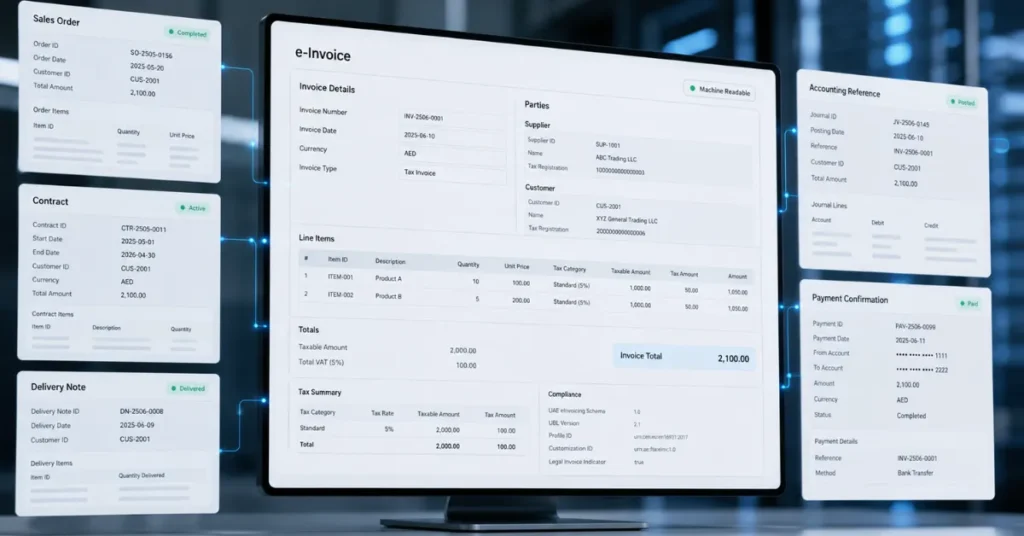
The E-Invoicing Audit Trail, Records, UAE businesses maintain will become increasingly important as the UAE moves toward mandatory electronic invoicing. An effective audit trail does more than store an invoice. It should allow a business, accountant, or tax authority to trace a transaction from its original business activity through invoicing, accounting, payment, and tax reporting. The UAE Ministry of Finance defines an e-invoice as structured invoice data issued and exchanged electronically and reported to the Federal Tax Authority (FTA). A PDF, Word document, scanned invoice, image, or email attachment on its own does not qualify as an e-invoice.
For businesses preparing for the new system, this means record keeping should be accurate, secure, complete and easy to retrieve. It also needs to support existing VAT and Corporate Tax compliance requirements.
What Is an E-Invoicing Audit Trail in the UAE?
An e-invoicing audit trail is the connected record of a transaction and its supporting information. It shows how an invoice was created, transmitted, received, recorded, adjusted, and settled.
Instead of treating an invoice as a standalone document, businesses should be able to establish a clear chain:
Business transaction → Order/contract → E-invoice → Accounting entry → Payment → Tax records
This traceability helps businesses demonstrate that their sales, purchases, VAT calculations, and accounting records are supported by genuine transactions.
The UAE’s e-invoicing framework uses the OpenPeppol standard and a decentralised model involving Accredited Service Providers (ASPs). The Ministry of Finance states that e-invoicing is intended to improve digitalisation, financial visibility, and compliance.
What Does an E-Invoicing Audit Trail Show?
A well-maintained audit trail can show:
- Who issued the invoice
- Who received it
- What goods or services were supplied
- When the transaction occurred
- The invoice number
- Taxable amount and VAT
- Total invoice value
- Payment information
- Credit or debit note adjustments
- Links to relevant accounting entries
- Supporting transaction documentation
The objective is simple: another authorised person should be able to understand the transaction without relying on the memory of the employee who created it.
Why UAE Businesses Need Strong E-Invoicing Records
Accurate records support more than e-invoicing. UAE businesses already have obligations to maintain financial and commercial records for tax purposes. The Ministry of Finance notes that businesses must keep financial records accurately and up to date, while VAT-registered businesses must maintain commercial records that enable verification of their transactions.
A reliable digital audit trail can help with:
- VAT return preparation
- Input VAT support
- Corporate Tax calculations
- Revenue reconciliation
- Expense verification
- Financial reporting
- Internal audits
- External audits
- Tax authority requests
- Business and customer disputes
Poor record keeping can create problems even when the underlying transaction was legitimate.
How Poor Record-Keeping Creates Compliance Risks
Common problems include:
- Missing original invoices
- Duplicate invoice numbers
- Unexplained invoice changes
- Missing credit notes
- Invoices that cannot be matched to accounting entries
- Unsupported business expenses
- Missing payment evidence
- Disconnected accounting and invoicing systems
- Inadequate backups
- Inability to retrieve records quickly
A business should therefore design its record-keeping process around traceability, not simply document storage.
What Records Should UAE Businesses Preserve for E-Invoicing?
The UAE Electronic Invoicing Guidelines state that persons subject to the e-invoicing system must retain electronic invoices, electronic credit notes, and associated data for the period required under the Tax Procedures Law. Records must remain accessible, reproducible, and verifiable when requested by the FTA.
Businesses should therefore consider the complete transaction file rather than only the final invoice.
Core E-Invoice Records
Depending on the transaction and applicable requirements, businesses should maintain:
- Original electronic invoices
- Electronic credit notes
- Relevant debit notes
- Invoice numbers and dates
- Supplier information
- Customer information
- Description of goods or services
- Taxable amounts
- VAT amounts
- Total amounts
- References to related transactions
- Relevant payment information
- Associated electronic invoice data
The precise mandatory fields depend on the applicable e-invoicing requirements and transaction type. The Ministry of Finance’s current guidance specifies that electronic invoices are issued, transmitted, and received in XML format under the UAE framework.
Supporting Documents Behind Each Invoice
An invoice often makes more sense when viewed alongside the documents that created the transaction.
Depending on the business, supporting evidence can include:
- Purchase orders
- Sales orders
- Contracts
- Delivery notes
- Goods received notes
- Service completion records
- Receipts
- Bank payment confirmations
- Customer correspondence
- Supplier correspondence
- Credit or refund documentation
This supporting evidence can help establish that an invoice reflects a real business transaction.
E-Invoicing Transaction Data UAE Businesses Should Retain
An important distinction exists between the invoice itself and the information needed to demonstrate its integrity and auditability. The UAE guidelines explain that associated data includes information necessary to support the integrity, authenticity and auditability of an electronic invoice or electronic credit note.
| Record or data | Why it matters |
|---|---|
| Invoice number | Identifies the transaction |
| Invoice date | Establishes timing |
| Supplier details | Identifies the seller |
| Customer details | Identifies the buyer |
| Taxable amount | Supports tax calculations |
| VAT amount | Supports VAT reporting |
| Total amount | Helps reconcile the transaction |
| Credit note reference | Tracks adjustments |
| Accounting reference | Connects invoice to the ledger |
| Payment evidence | Helps verify settlement |
The goal is to preserve enough information for the transaction to be understood and verified later.
How Long Must UAE Businesses Keep E-Invoicing Records?
Record retention is one of the most important parts of an e-invoicing audit trail in the UAE. The current UAE Electronic Invoicing Guidelines state that data relating to the issuance, transmission, and receipt of electronic invoices must generally be retained for five years following the relevant tax period for a taxable person. For persons other than taxable persons, the guideline refers to five years from the end of the calendar year in which the document was created. Real estate records have a seven-year period.
There are also circumstances where records need to be preserved for longer. For example, the guidelines state that taxable persons must retain relevant data for an additional four years where there is an FTA dispute, an ongoing tax audit, or an FTA notification of its intention to conduct a tax audit.
Records That May Need Longer Retention
Businesses should avoid automatically deleting records simply because the normal accounting period has ended.
Additional retention considerations can arise where there is:
- An FTA tax audit
- A tax dispute
- A refund claim
- A voluntary disclosure
- An unresolved tax matter
- A legal dispute
- A real estate transaction
- A specific statutory requirement
Always apply the retention period relevant to the record and current UAE legislation rather than relying on a generic company policy.
E-Invoicing Audit Trail and UAE VAT Compliance
E-invoicing and VAT compliance are closely connected because invoice data supports the calculation and reporting of taxable transactions. The Ministry of Finance explains that the e-invoicing system will facilitate electronic reporting of invoice tax data to the FTA and can support the pre-population of certain VAT return fields.
A strong audit trail can help businesses reconcile:
Sales invoices → Output VAT → VAT return
and:
Purchase invoices → Input VAT → VAT return
For VAT-registered businesses, maintaining commercial records that allow authorities to verify transactions is already an important compliance responsibility.
How the Audit Trail Supports Input VAT Claims
Consider a UAE company purchasing equipment for its business.
The company may have:
- A supplier agreement or purchase order
- An electronic invoice
- Delivery evidence
- An accounting entry
- A bank payment
- A VAT record supporting the transaction
Keeping these records connected makes it easier to demonstrate the commercial nature of the purchase and reconcile the VAT amount.
The FTA states that taxable persons must retain VAT invoices issued and received for a minimum of five years.
E-Invoicing Audit Trail and UAE Corporate Tax Records
E-invoicing also has relevance beyond VAT. Corporate Tax compliance requires businesses to maintain appropriate financial information supporting their tax position. Invoice records can contribute to the evidence supporting revenue, business expenses and other accounting information.
For example, a company claiming a business expense should be able to connect the expense to an appropriate invoice and, where relevant, supporting documents.
Why Invoice Evidence Matters for Deductible Expenses
Imagine a Dubai-based consultancy pays AED 25,000 for professional services.
Instead of keeping only the supplier invoice, the company can maintain a connected record containing:
- Service agreement
- Purchase or engagement documentation
- Electronic invoice
- Accounting entry
- Bank payment
- Relevant correspondence
- VAT information, where applicable
This creates a clearer evidence trail for the transaction and reduces the risk of relying on a single document.
How to Build an Effective E-Invoicing Audit Trail
Businesses do not need to wait for mandatory implementation to improve their processes.
Step 1 — Capture the Transaction at Source
Start with accurate transaction data. Use consistent customer and supplier records, appropriate invoice numbering and clear descriptions of goods or services. Errors at the source can flow into accounting and tax reporting.
Step 2 — Connect the Invoice With Accounting Records
Your accounting system should make it possible to trace an invoice to the relevant ledger entry.
A useful internal process is:
Invoice → General ledger → Customer/supplier account → Payment → Tax reporting
This makes reconciliation much easier.
Step 3 — Preserve Changes and Adjustments
Businesses should maintain a clear history of legitimate adjustments.
Credit notes, cancellations, and corrections should not destroy the original transaction history. The relationship between the original invoice and subsequent adjustment should remain understandable.
Step 4 — Reconcile Regularly
Do not wait for an audit to discover differences.
Regularly compare:
- Sales invoices against revenue records
- Purchase invoices against expenses
- VAT amounts against VAT returns
- Invoices against bank receipts and payments
- Credit notes against customer accounts
Regular reconciliation can identify missing or duplicated transactions before they become larger problems.
Step 5 — Secure and Back Up Records
The UAE e-invoicing guidance requires records to be maintained in a way that preserves their integrity and supports secure retention. It also requires businesses to be able to provide records promptly and in complete, readable form when required.
Businesses should therefore consider:
- Role-based access
- Secure backups
- Disaster recovery
- Audit logs
- Data integrity controls
- Document retrieval procedures
- Appropriate cybersecurity measures
Using an Accredited Service Provider for storage does not remove the business’s ultimate responsibility for meeting its retention obligations. The June 2026 guidance specifically clarifies this point.
Common E-Invoicing Audit Trail Mistakes UAE Businesses Should Avoid
Several record-keeping practices can create unnecessary compliance risks:
- Keeping only PDF invoices: A PDF may be useful as a document, but it is not itself an e-invoice under the UAE e-invoicing definition.
- Deleting the original after a correction: Businesses should preserve the relevant transaction history.
- Using duplicate invoice numbers: Consistent numbering helps maintain traceability.
- Failing to link credit notes: Adjustments should be connected to the relevant original transaction.
- Keeping invoices without supporting evidence: An invoice may not tell the complete commercial story.
- Separating invoicing from accounting: Disconnected systems can make reconciliation difficult.
- Ignoring backups: A record that cannot be retrieved is of limited practical value.
- Allowing uncontrolled changes: Businesses should maintain appropriate access controls and audit history.
- Failing to reconcile payments: Invoice and bank records should be explainable together.
- Waiting until an audit: Building the audit trail after receiving an FTA request can be much harder than maintaining it continuously.
E-Invoicing Audit Trail Example for a UAE Business
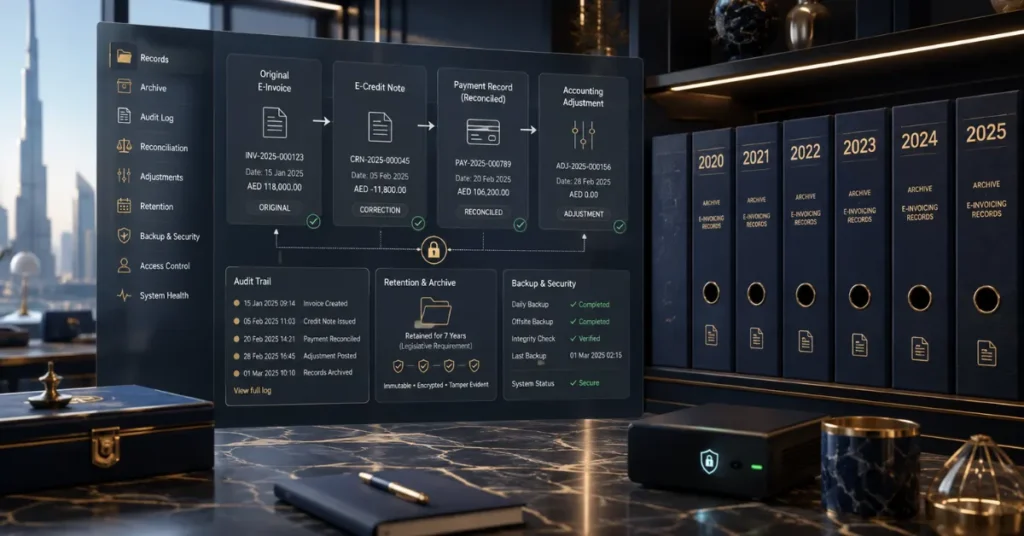
Consider a Dubai-based trading company selling equipment to another UAE business. The transaction begins with a customer order. The company processes the sale, issues the applicable electronic invoice through its e-invoicing system and records the transaction in its accounting software. The company then receives payment through its bank account.
Its audit trail should allow an authorised reviewer to connect:
Customer order → E-invoice → Accounting entry → Delivery evidence → Bank receipt → VAT records
If the company later issues a credit note because part of the order was returned, the credit note should remain connected to the original transaction.
This approach creates a much stronger audit trail than storing unrelated documents in separate folders.
How Technology Can Help Maintain E-Invoicing Records
Technology can reduce manual work and improve traceability when businesses configure their systems correctly.
A suitable accounting or e-invoicing environment can help with:
- Invoice generation
- Transaction numbering
- Document linking
- Credit note tracking
- Accounting integration
- Payment reconciliation
- User permissions
- Audit logs
- Data backups
- Record retrieval
The UAE’s e-invoicing framework is based on structured electronic data rather than simply converting paper or PDF invoices into digital files. The official guidelines state that electronic invoices are issued, transmitted, and received in XML format under the applicable UAE framework.
What to Look for in an E-Invoicing or Accounting System
Before selecting or upgrading a system, businesses should evaluate whether it can support:
- UAE e-invoicing requirements
- Required invoice fields
- OpenPeppol-based processes
- Accredited Service Provider connectivity
- Accounting integration
- Document attachments
- Audit history
- Access controls
- Secure backups
- Data retrieval
- Reconciliation
- Reporting
The Ministry of Finance maintains the official UAE e-invoicing portal and publishes the latest guidelines, legislation, and information on pre-approved service providers. Businesses should use this official source when checking current requirements.
E-Invoicing Audit Trail Checklist for UAE Businesses
Use this checklist when reviewing your current process:
- Original electronic invoices are preserved
- Electronic credit notes are retained
- Invoice numbering is consistent
- Customer and supplier information is accurate
- Required invoice data is captured
- Supporting transaction documents are retained
- Accounting entries can be traced to invoices
- Payments can be reconciled
- Credit notes and corrections remain linked to original transactions
- Access to records is controlled
- Data is securely backed up
- Records can be retrieved in a complete and readable format
- Retention periods are monitored
- VAT and accounting records are regularly reconciled
- The business monitors changes to UAE e-invoicing requirements
How Ripple Business Setup Can Support UAE E-Invoicing Compliance
Ripple Business Setup helps UAE businesses strengthen their accounting, bookkeeping, VAT and Corporate Tax compliance processes. Our team can assist with organising financial records, improving invoicing workflows, and preparing businesses for UAE e-invoicing requirements. We also support businesses with accounting and tax-related compliance so their records remain accurate, organised, and easier to review. Contact Ripple Business Setup for practical guidance tailored to your business needs.
Phone: +971 50 593 8101
WhatsApp: +971 4 250 0833
Email: info@ripplellc.ae
FAQ
What is an e-invoicing audit trail in the UAE?
It is the connected record showing how a business transaction moves from its original activity through electronic invoicing, accounting, payment, and relevant tax records.
What records should UAE businesses keep for e-invoicing?
Businesses subject to the UAE e-invoicing system must retain electronic invoices, electronic credit notes, and associated data for the applicable statutory period. Supporting commercial and accounting records should also be maintained where necessary to substantiate the transaction.
How long should businesses retain e-invoice records in the UAE?
The current UAE Electronic Invoicing Guidelines generally refer to five years for taxable persons, with additional retention requirements in specified circumstances such as an FTA dispute or audit. Real estate records have a seven-year period under the stated guidance.
Do businesses need to keep supporting documents with e-invoices?
Businesses should retain relevant supporting documentation needed to substantiate transactions and their accounting and tax treatment. The exact documents depend on the nature of the transaction.
How does e-invoicing affect UAE VAT records?
E-invoicing is designed to support electronic reporting of invoice tax data to the FTA and can facilitate more automated VAT reporting processes. Businesses must still maintain appropriate VAT and commercial records.
How does e-invoicing relate to UAE Corporate Tax?
E-invoice and supporting accounting records can provide evidence for revenue, expenses, and other financial information relevant to Corporate Tax compliance. Businesses should maintain records that support their tax position.
Can businesses store e-invoices electronically?
Yes. The UAE e-invoicing framework specifically requires electronic invoices and associated data to be retained electronically in a manner that preserves integrity, supports secure retention, and allows records to be retrieved and reproduced when required.
What happens if an e-invoice is corrected or cancelled?
The business should maintain an appropriate record of the adjustment and its relationship to the original transaction. Credit notes and other adjustments should not make the original transaction history impossible to trace.
How can a business prepare its accounting system for UAE e-invoicing?
Start by reviewing the current invoicing process, accounting integration, master data, document retention, reconciliation procedures, and system capabilities. Then assess the business’s requirements against the latest official UAE e-invoicing guidance.
Conclusion
An effective E-Invoicing Audit Trail, Records, UAE businesses maintain should tell the complete story of each transaction. The objective is not simply to save invoices but to preserve accurate, secure, and retrievable information connecting the transaction, invoice, accounting records, payment, and relevant tax reporting. The UAE’s e-invoicing program is being introduced in phases, making preparation increasingly important. The Ministry of Finance currently states that businesses with annual revenue exceeding AED 50 million must fully implement the system by 1 January 2027, while the deadline to appoint an Accredited Service Provider for this group was extended to 30 October 2026.
Businesses should review their invoicing and accounting processes now, identify record-keeping gaps, and ensure their systems can preserve and retrieve the information required under the applicable rules.
Disclaimer: This article provides general information and is not legal, tax, or accounting advice. UAE e-invoicing, VAT and Corporate Tax requirements may change. Businesses should verify current requirements with the UAE Ministry of Finance, Federal Tax Authority or a qualified tax professional before making compliance decisions.