Dubai has built a global reputation as one of the most business-friendly cities in the world. With over 40 free zones, a zero personal income tax policy, and a strategic location connecting East and West, the emirate attracts hundreds of thousands of entrepreneurs every year. In fact, Dubai’s Department of Economy and Tourism registered over 40,000 new business licenses in 2023 alone a clear sign of growing investor confidence.
But before you set up your company, one critical decision stands between your vision and launch day: should you go with a Mainland license or a Free Zone license? Both options offer distinct advantages, and the right choice depends entirely on your business goals, target market, and operational needs. This guide breaks it all down so you can decide with clarity.
Understanding Dubai Business Licenses
Every business operating in Dubai requires a license, and that license falls into one of three broad categories:
Commercial licenses cover trading activities buying and selling goods or services. Professional licenses apply to service-based businesses, such as consultancies, marketing agencies, and IT firms. Industrial licenses are issued for manufacturing or production operations.
What makes the Dubai setup unique is that these license types are issued differently depending on whether you operate on the Mainland or inside a Free Zone. Each jurisdiction has its own regulatory body, cost structure, and operating rules, and understanding these differences is the first step toward making the right call.
What Is a Mainland License in Dubai?
A Mainland license is issued by the Department of Economic Development (DED) and allows you to operate anywhere within Dubai and the broader UAE. Think of it as a full-access pass to the local market.
Under recent UAE legal reforms, foreign investors can now hold 100% ownership in most Mainland business categories removing the long-standing requirement for a local sponsor in many sectors. This has made the Mainland option far more attractive than it once was.
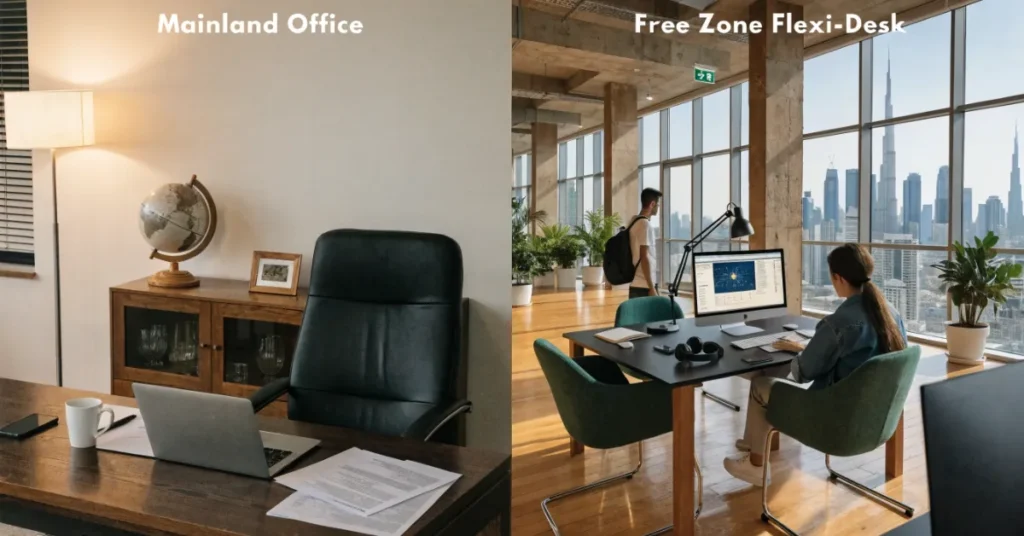
However, a Mainland setup does require a physical office. You cannot operate from a virtual address alone, which means higher overhead costs upfront. On the upside, you can freely bid on government contracts, set up multiple branches across the UAE, and serve the local retail or B2B market without restrictions.
Example: A management consultancy firm working with UAE-based corporates and government entities would benefit greatly from a Mainland license. It allows the firm to sign contracts directly, employ staff freely, and build a credible local presence.
What Is a Free Zone License in Dubai?
A Free Zone license is issued by a specific Free Zone authority, such as DMCC (Dubai Multi Commodities Centre), IFZA (International Free Zone Authority), or DIFC (Dubai International Financial Centre), rather than the DED. Each Free Zone caters to particular industries and offers a self-contained business ecosystem.
The major draw of Free Zones is the combination of 100% foreign ownership, zero corporate tax in most zones, and full repatriation of profits. You don’t need a local partner, and setup is often faster and more affordable than on the Mainland.
However, Free Zone companies face a key limitation: they cannot directly trade in the UAE local market without appointing a local distributor or agent. If your primary market is international or even within Free Zone borders, this may not matter at all. But if you plan to sell directly to UAE-based consumers or businesses outside the zone, it creates an extra step.
Example: A tech startup building a SaaS product for international clients would thrive in a Free Zone like Dubai Internet City. The low setup cost, tax advantages, and global-friendly infrastructure make it an ideal launchpad.
Advantages of a Free Zone license at a glance:
- 100% foreign ownership
- 0% corporate tax (zone-specific)
- Full profit repatriation
- Faster company registration
- Access to industry-specific communities and networks
- Flexi-desk and co-working options available in many zones
Key Differences Between Mainland and Free Zone Licenses
| Feature | Mainland License | Free Zone License |
|---|---|---|
| Ownership | 100% foreign (most sectors) | 100% foreign ownership |
| Business Scope | UAE-wide trading | Free Zone + international only |
| Office Requirement | Physical office mandatory | Flexi-desk options available |
| Corporate Tax | Standard UAE rate (9% above threshold) | 0% in most Free Zones |
| Government Contracts | Eligible | Not eligible |
| Setup Cost | Generally higher | Often lower |
| Visa Allocation | Higher quota, more flexible | Zone-dependent quota |
Factors to Consider When Choosing Your License
Choosing between Mainland and Free Zone is not a one-size-fits-all decision. Here are the key factors you should evaluate before committing:
- Your target market matters most: If your customers are primarily UAE-based businesses or consumers, a Mainland license gives you direct access. If you’re targeting international clients or operating in e-commerce, a Free Zone may be more cost-effective.
- Your business activity determines your options: Some activities, such as real estate brokerage or certain retail categories, are only available on the Mainland. Others, like financial services, are better suited to specific Free Zones like DIFC.
- Capital and overhead play a big role: Free Zones often have lower initial costs and don’t mandate a physical office. Mainland setup requires a lease, which adds to your monthly burn rate but signals credibility to local partners and clients.
- Long-term growth plans should guide your decision: If you plan to expand across UAE cities, hire a large team, or eventually list as a public company, the Mainland typically offers more scalability.
Quick checklist:
- Are your clients in the UAE local market or international?
- Do you need a physical storefront or office visible to walk-in clients?
- Is 0% corporate tax a significant financial advantage for your model?
- Do you plan to hire more than 5 staff within the first year?
Cost Comparison: Mainland vs. Free Zone

Cost is often the deciding factor especially for startups and solo entrepreneurs.
- Free Zone setup costs: Typically range from AED 5,500 to AED 25,000 for registration and licensing, depending on the zone and activity. Affordable Free Zones like IFZA and SHAMS are popular among small businesses and freelancers.
- Mainland setup costs: Tend to be higher, often ranging from AED 15,000 to AED 50,000+, primarily due to office lease requirements and DED fees. However, the expanded market access frequently justifies this investment for trading and service companies.
Annual renewal fees, visa costs, and professional services (like PRO services and accounting) also differ between the two. Always calculate the total cost of ownership over a 3-year period rather than just the initial setup fee.
Visa and Workforce Advantages
The license type you choose directly affects how many employees you can sponsor and how easily you can manage your workforce.
- Mainland companies: Generally enjoy higher visa quotas tied to the size of their office space. The larger the office, the more visas you can apply for. This makes the Mainland ideal for businesses planning to grow their team quickly or hire specialists from overseas.
- Free Zone companies receive a visa allocation based on the type of package you purchase. Many zones offer 1–6 visas with standard packages, with the option to add more. Some Free Zones also offer investor visas and remote worker permits, making them flexible for lean teams.
Key considerations:
- Mainland: flexible visa quota based on office size, employee-friendly sponsorship
- Free Zone: fixed visa packages, investor visas available, some zones offer UAE Golden Visa pathways
- Both types allow dependent visas for family members
Pros and Cons of Each License
Mainland License
Pros:
- Direct access to the UAE local market
- Eligible for government tenders and contracts
- No restriction on trading partners or clients
- 100% foreign ownership now available in most sectors
- Higher visa quota
Cons:
- Higher setup and operational cost
- Mandatory physical office lease
- More regulatory steps and government touchpoints
Free Zone License
Pros:
- Fast and affordable setup
- 100% foreign ownership guaranteed
- 0% corporate tax in most zones
- Full profit repatriation
- Flexi-desk options reduce overhead
Cons:
- Cannot trade directly in the UAE local market
- Requires a local distributor to sell to UAE customers
- The visa quota may be limited in basic packages
- Activity restrictions vary by zone
Common Mistakes to Avoid
Many first-time business owners make avoidable mistakes when setting up in Dubai. Here are the most common ones:
- Not checking activity restrictions before choosing a zone. Some Free Zones only permit specific industries. If your activity isn’t allowed in your preferred zone, you’ll need to switch losing time and money.
- Ignoring office requirements. Assuming a Free Zone flexi-desk suffices for a Mainland license is a costly error. The DED requires a dedicated, leased commercial space.
- Overlooking visa quota limits. If you plan to hire a team of 10 from day one, a Free Zone package with 3 visa slots won’t serve you. Plan your workforce first, then select the package accordingly.
- Choosing based on cost alone. The cheapest setup isn’t always the best fit. A Free Zone license that saves you AED 10,000 upfront could cost you clients if you can’t serve the local market directly.
FAQ
Q: What is the difference between Mainland and Free Zone in Dubai?
A Mainland license (issued by the DED) allows trading anywhere in the UAE. A Free Zone license is issued by a specific zone authority and restricts direct trading to that zone or international markets.
Q: Can a Free Zone company trade in the UAE local market?
Not directly. A Free Zone company needs a local distributor or agent to sell to UAE-based customers outside the Free Zone.
Q: Which license is cheaper for startups in Dubai?
Free Zone licenses are generally more affordable to set up, with options starting from around AED 5,500. Mainland setups typically cost more due to office requirements.
Q: Can foreigners own 100% of a Mainland company in Dubai?
Yes, the UAE’s 2021 foreign ownership reforms allow 100% foreign ownership in most Mainland business activities, removing the need for a local sponsor in the majority of sectors.
Q: How do visa rules differ between Mainland and Free Zone companies?
Mainland companies have a flexible visa quota tied to office size. Free Zone companies receive a fixed number of visas based on their chosen package, though additional visas can often be purchased.
Ripple Business Setup – Get Expert Guidance
Navigating Dubai’s licensing landscape is far easier with the right support. Whether you’re leaning toward Mainland or Free Zone, a professional setup advisor can help you compare zones, calculate true costs, and handle the paperwork from start to finish.
Contact Ripple Business Setup at +971 50 593 8101, email info@ripplellc.ae, or WhatsApp +971 4 250 0833 to get personalized guidance tailored to your industry and goals. Their team helps entrepreneurs and SMEs choose the right license structure without the guesswork.
Disclaimer: This content is for informational purposes only and does not constitute legal or financial advice. Business owners should consult official authorities or licensed business setup consultants for personalized guidance.