Ajman may be the smallest emirate in the UAE, but it punches well above its weight when it comes to business opportunities. With some of the lowest setup costs in the country, a fast-improving regulatory environment, and a strategic location just 25 kilometres from Dubai, more entrepreneurs are turning their attention to Ajman in 2026. Whether you are a first-time founder or an established operator looking to expand, this guide walks you through everything you need to know.
Why Choose Ajman for Your Business in 2026
Ajman has quietly become one of the most entrepreneur-friendly destinations in the UAE. The emirate’s government has invested heavily in simplifying business registration, reducing bureaucratic delays, and creating competitive fee structures, particularly at the Ajman Free Zone (AFZ), which has grown into a busy hub for trading, logistics, and professional services companies.
The UAE’s broader business climate also helps. The country’s zero federal income tax policy, world-class infrastructure, and gateway position between Europe, Asia, and Africa make it a natural choice for international expansion. Ajman benefits from all of that, while adding its own layer of cost advantage. Office and warehouse spaces here are considerably cheaper than in Dubai or Abu Dhabi, which makes a real difference when you are managing early-stage cash flow.
- Affordable spaces: Office and warehouse rental rates are 30–50% lower than comparable Dubai locations.
- Fast registration: Business licenses can be issued in as little as 2–5 working days at the Ajman Free Zone.
- Tax-friendly environment: No corporate tax on qualifying small businesses below the AED 375,000 threshold; zero personal income tax.
- Strategic location: Direct access to Ajman Port, Sharjah Airport, and proximity to Dubai’s Jebel Ali Free Zone corridor.
- 100% foreign ownership: Permitted in the Free Zone and, since the 2021 reforms, in many mainland activities too.
Types of Business Licenses in Ajman
Before you register, you need to choose the right license category. Ajman issues three primary types, and selecting the wrong one can cause delays and additional costs down the line. Each license type corresponds to a specific set of permitted business activities.
Commercial License
For businesses involved in buying and selling goods whether physical products, e-commerce, or import/export trading.
- Retail and wholesale trade
- E-commerce stores
- General trading companies
- Import/export operations
Professional License
For service-based businesses where the value lies in expertise, advice, or skilled labour rather than physical goods.
- Management consultancy
- IT services and software
- Marketing agencies
- Legal and accounting firms
Industrial License
For businesses involved in manufacturing, processing, or production, a dedicated factory or workshop space.
- Food processing units
- Garment manufacturing
- Packaging and printing
- Light engineering
Some activities may fall under more than one category, or may require special approval from a relevant UAE regulatory authority. For example, a food business requires approval from the Ajman Municipality’s Food Control Department. When in doubt, verify your activity code before submitting your application.
Step-by-Step Process to Register a Business in Ajman

The Ajman government has significantly streamlined the registration process in recent years. Many steps are now handled through online portals, cutting down the time and paperwork involved. Here is what the typical journey looks like in 2026.
1. Choose Your Business Activity
Start by identifying the precise activity you want to operate. Ajman’s Department of Economic Development (DED) and the Ajman Free Zone both maintain official lists of permitted activities. In 2026, high-demand sectors include logistics and freight forwarding, IT services, e-commerce, food trading, and consultancy. Choose your activity carefully, as it determines your license type, required approvals, and in some cases, your minimum capital requirement.
2. Select Your Business Structure
Your legal structure affects ownership, liability, and visa quotas. The main options available in Ajman are:
- Free Zone Company (FZC/FZCO): 100% foreign ownership, simple setup, but limited to operating within the Free Zone or internationally, not for direct local UAE trade without a local agent.
- Mainland LLC: Since the 2021 reforms, foreigners can hold 100% ownership in most sectors. Allows direct trading with the UAE market. Requires a local service agent for certain professional activities.
- Sole Establishment: Suitable for individual professionals. The owner bears full personal liability.
- Branch of a Foreign Company: Allows an overseas company to operate in Ajman without forming a separate legal entity.
3. Reserve Your Trade Name
Your trade name must be unique, not identical or similar to an existing registered name, and must not include offensive language or references to religious institutions. Names cannot include the words “UAE,” “National,” “Federal,” or similar unless government-approved. Apply for name reservation through the Ajman DED portal or the AFZ portal. Reservation is typically confirmed within one to two working days.
4. Submit Documents and Apply for Your License
Once your name is reserved, submit your application along with the required documents. Standard requirements include:
- Passport copies of all shareholders and managers
- Completed application form (available online)
- Memorandum and Articles of Association (for LLCs)
- No Objection Certificate (NOC) if you are currently employed in the UAE
- Passport-sized photographs
- Business plan (required for some activities)
5. Lease Office or Warehouse Space
All businesses in Ajman require a registered address. In the Free Zone, you can choose from flexi-desk packages (shared spaces starting from AED 5,000–7,000 per year), private offices, or full warehousing facilities. Mainland businesses must lease a physical office that meets the minimum space requirements set by the DED, typically 200 square feet for most activities. The AFZ also offers purpose-built industrial units for manufacturing businesses, which represent excellent value compared to equivalent facilities in Sharjah or Dubai.
6. Obtain Approvals and Register with Authorities
Depending on your activity, you may need approvals from external bodies before your license is issued. For example, a healthcare business needs approval from the Ajman Health Department, a food business from the Municipality, and a financial services firm from the UAE Central Bank or Securities and Commodities Authority. After all approvals are in place, register with the Ajman Chamber of Commerce to complete the setup and gain access to certificates of origin and chamber membership benefits.
Ajman Free Zone vs. Mainland Business Setup
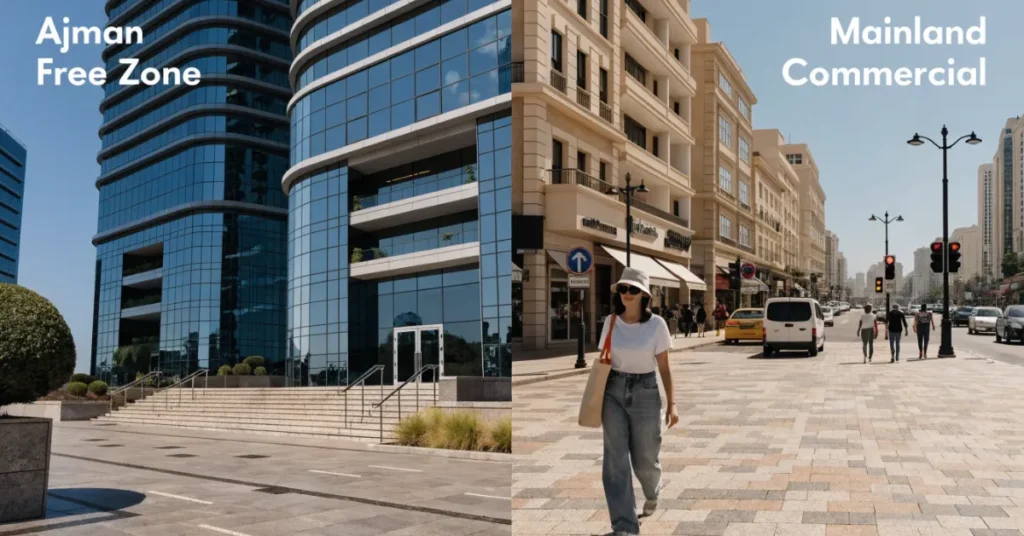
This is the decision that most new business owners find most confusing. Both routes are legitimate, but they serve different commercial needs. The right answer depends on who your customers are and how you plan to operate.
| Factor | Ajman Free Zone | Local retail, services, and government contracts |
|---|---|---|
| Foreign ownership | 100% permitted | 100% in most sectors (since 2021) |
| Trade with UAE market | Requires a local distributor or agent | Direct trading permitted |
| Visa allocation | Based on office package (2–6+ visas) | Based on office space (per sq. ft.) |
| Office requirement | Flexi-desk options available | Physical office mandatory |
| Setup cost | Generally lower | Generally higher |
| Best suited for | International trade, import/export, online business | Local retail, services, government contracts |
If your primary customers are based outside the UAE or if you plan to sell to other UAE companies that can handle their own local compliance, a Free Zone setup often makes better financial sense. If you want to walk into a UAE government tender, retail to consumers directly, or open a physical storefront, opt for the mainland.
Visa and Immigration Requirements for Entrepreneurs
Setting up a business in Ajman gives you the right to apply for UAE residency visas — for yourself as an investor, and for employees you hire. The process is manageable, but it requires attention to documentation and sequencing.
Investor / Partner Visa
Once your trade license is issued, you can apply for an investor or partner residency visa, typically valid for two to three years and renewable. The process involves a medical fitness test, Emirates ID registration, and biometric data collection at an immigration centre. Most applicants complete the process within five to seven working days.
Employee Visas
Your visa quota depends on your office size and license type. Free Zone companies with a flexi-desk package typically qualify for two to three visas; companies with a private office can apply for more. For mainland companies, the quota is calculated by the physical size of your office space. Each employee visa requires their passport copy, an employment contract, the company’s trade license, and their educational qualifications attested where required.
- Investor visa: passport copy, company license, tenancy contract, NOC (if applicable), medical test, Emirates ID
- Employee visa: employment contract, educational certificates, medical fitness test, and Emirates ID registration
- Processing time: typically 5–10 working days for standard applications
- Cost per visa: AED 3,000–5,000 inclusive of medical, Emirates ID, and immigration fees
Banking and Financial Setup
Opening a corporate bank account is one of the most important steps after receiving your trade license and one that many new business owners underestimate in terms of time and documentation required. UAE banks have strong compliance requirements under Central Bank and FATF guidelines, which means the process can take anywhere from two to eight weeks, depending on the bank and your business profile.
Most major UAE banks, including Emirates NBD, Mashreq, RAK Bank, and ADCB, offer business accounts. RAK Bank has historically been more accessible for smaller businesses and startups. When approaching a bank, come prepared with your audited accounts (if available), a clear business plan, evidence of shareholder funds, and a credible explanation of your expected transaction flows. Avoid vague descriptions of activity banks want to understand exactly how money moves in and out of your business.
If your annual taxable supply of goods or services in the UAE exceeds AED 375,000, you are legally required to register for VAT. Registration is done through the Federal Tax Authority (FTA) online portal. Consider setting up a payment gateway early. Options like Telr, PayTabs, and Network International are widely used by UAE-based e-commerce and services businesses.
Common Mistakes to Avoid When Starting a Business in Ajman
Most early stumbles in UAE company formation come from a small set of avoidable errors. Here are the ones that come up most often.
- Choosing the wrong license type before registration: Adding activities to a license after registration is possible, but it costs time and fees. Map your full range of business activities before applying, not after.
- Ignoring the Free Zone vs. Mainland distinction: A Free Zone company trying to sell directly to UAE retail consumers without a local distributor arrangement is technically non-compliant. Understand the rules before you start trading.
- Underestimating ongoing operational costs: First-year setup costs are only part of the picture. Factor in annual license renewal, accountant fees, visa renewals, and potential VAT compliance costs in your financial projections.
- Leaving bank account opening to the last minute: Compliance checks can take weeks. Apply for your corporate account immediately after receiving your license, and do not wait until you have a transaction to process.
- Not accounting for activity-specific approvals: Healthcare, food, education, and financial services all require approvals from sector regulators in addition to the standard trade license. Missing this step delays your launch significantly.
How Ripple Business Setup Supports Business in Ajman
For entrepreneurs looking to establish a business in Ajman efficiently, Ripple Business Setup offers comprehensive support. Services include company registration, license processing, PRO services, visa assistance, and office leasing. Assistance ensures compliance with all government requirements while saving time and avoiding common pitfalls. Contact Ripple Business Setup at +971 50 593 8101, email info@ripplellc.ae, or WhatsApp +971 4 250 0833 for personalised guidance.
Frequently Asked Questions
What is the fastest way to register a business in Ajman?
The Ajman Free Zone offers the quickest turnaround for straightforward applications with a flexi-desk package, and a single activity can be approved in as little as two to three working days. Mainland registrations through the DED typically take five to ten working days. Using a business setup service can cut the time further by ensuring your documents are complete before submission.
Can foreigners own 100% of a company in Ajman?
Yes. In the Ajman Free Zone, 100% foreign ownership has always been permitted. On the mainland, the UAE’s 2021 Commercial Companies Law amendments removed the local ownership requirement for most business activities, allowing full foreign ownership. A small number of strategic sectors such as oil and gas exploration and certain defence activities, still require Emirati participation, but these are exceptions.
How long does the business setup process take?
From initial inquiry to receiving your trade license, plan for two to four weeks for a standard Free Zone company and three to six weeks for a mainland LLC. If your activity requires external regulatory approvals healthcare, food, or financial services, add another two to four weeks for those clearances. Bank account opening runs parallel to, or after, this process and can take an additional four to six weeks.
What are the ongoing compliance requirements?
All Ajman companies must renew their trade license annually. LLCs are required to have their accounts audited by a UAE-registered audit firm each year and to file those accounts with the relevant authority. If registered for VAT, you must file quarterly VAT returns with the FTA. Corporate tax filings are required for businesses above the AED 375,000 taxable income threshold. Your office tenancy contract must also be kept current, as it is required for visa renewals.
Conclusion
Ajman offers a genuinely compelling combination for entrepreneurs in 2026: competitive setup costs, a business-friendly regulatory environment, excellent infrastructure, and the full benefits of operating within the UAE’s legal and financial framework. Whether you are launching an e-commerce operation, a consultancy, a trading company, or a light manufacturing business, the emirate has a structure that fits.
Disclaimer: This guide provides general information for starting a business in Ajman. Regulations may change, and professional advice is recommended for personalised guidance.