

For many UAE businesses, VAT Voluntary Registration can be useful before the business reaches the mandatory VAT registration threshold. However, registering voluntarily also creates ongoing VAT compliance responsibilities. The right decision depends on your taxable turnover, business expenses, customer base, expected growth, and ability to maintain accurate accounting records.
In the UAE, a resident business can generally apply for voluntary VAT registration when its taxable supplies, imports, or taxable expenses exceed the voluntary registration threshold of د.إ187,500 over the previous 12 months or are expected to exceed it within the next 30 days. Mandatory VAT registration applies when the relevant taxable supplies and imports exceed د.إ375,000, subject to the applicable rules.
What Is VAT Voluntary Registration in the UAE?
VAT Voluntary Registration allows an eligible UAE business to register for VAT even when it has not reached the mandatory registration threshold. The Federal Tax Authority (FTA) currently states that a UAE-resident business may voluntarily register when the total value of its taxable supplies and imports, or taxable expenses, exceeds د.إ187,500 during the previous 12 months or is expected to exceed that amount during the next 30 days.
This gives growing businesses an option to enter the VAT system before registration becomes mandatory.
Once approved, the business receives a Tax Registration Number (TRN) and must follow the applicable VAT rules, including maintaining appropriate records and filing VAT returns according to its assigned tax period.
Voluntary VAT Registration vs Mandatory Registration
The main difference is why the business enters the VAT system.
Mandatory registration:
- Applies when the applicable mandatory threshold is exceeded.
- The current mandatory threshold for UAE-resident businesses is د.إ375,000.
- A business that becomes required to register must follow the applicable registration deadline.
Voluntary registration:
- Applies when the business qualifies but has not reached the mandatory threshold.
- The current voluntary threshold is د.إ187,500.
- The business chooses to register based on its circumstances and eligibility.
What Is the VAT Registration Threshold in the UAE?
Understanding the thresholds is the first step in deciding whether VAT registration UAE makes sense for your company.
| Registration type | Current threshold |
|---|---|
| Mandatory VAT registration | د.إ375,000 |
| Voluntary VAT registration | د.إ187,500 |
The FTA assesses the relevant taxable supplies, imports, and, for voluntary registration, taxable expenses according to the applicable rules. Businesses should not simply compare total bank deposits with the threshold because not every transaction necessarily forms part of the relevant calculation.
Does a Business Have to Register Below د.إ375,000?
Not necessarily. If a UAE-resident business does not meet the mandatory registration criteria but meets the voluntary threshold, it may be eligible to apply for VAT registration.
For example, suppose a Dubai consulting company has taxable supplies of د.إ210,000 and has not reached the mandatory threshold. If it satisfies the voluntary registration requirements, it may apply for registration rather than waiting until mandatory registration becomes applicable.
Is VAT Voluntary Registration Useful for a Small Business?
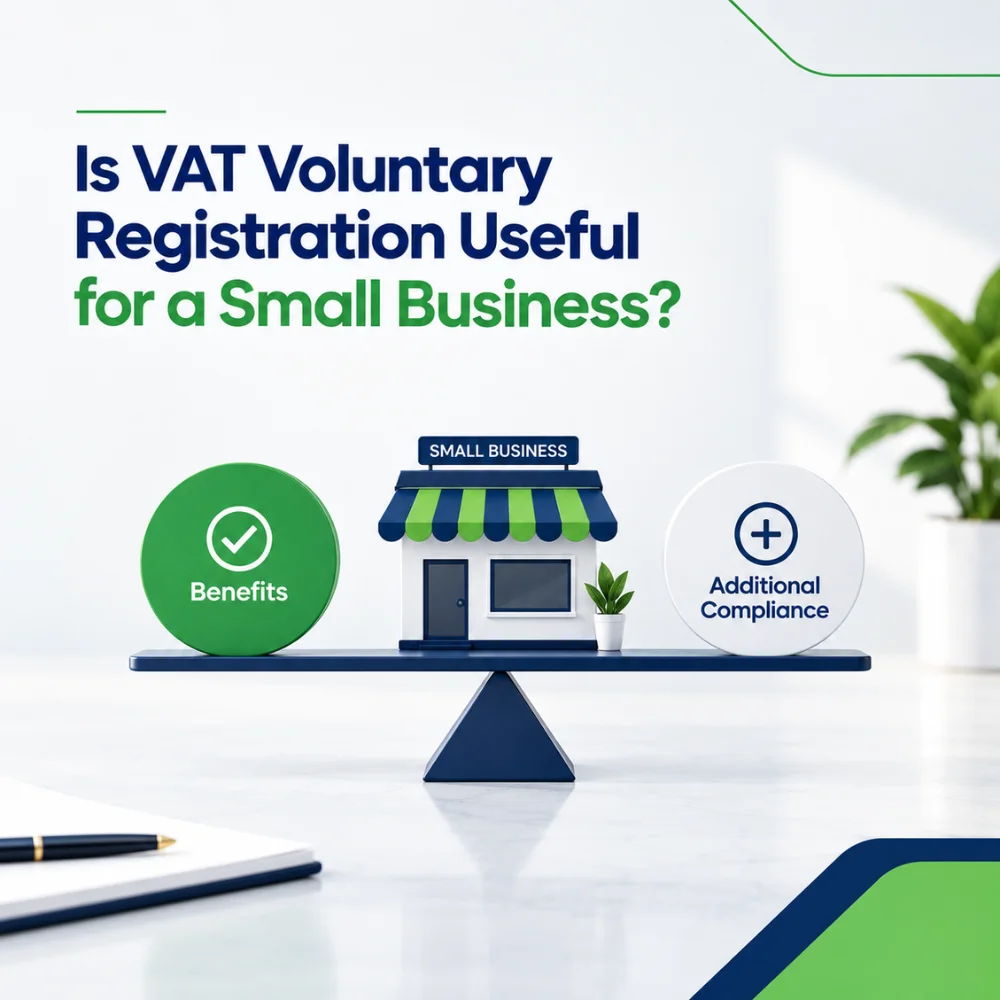
Voluntary registration can be useful, but it is not automatically the right choice for every small business. A business should consider both the potential advantages and the additional compliance work before applying.
When Voluntary VAT Registration May Make Sense
Voluntary registration may be worth considering when:
- Your business is approaching the mandatory threshold.
- You expect taxable sales to grow quickly.
- You regularly incur VAT on eligible business expenses.
- Most of your customers are VAT-registered businesses.
- Your business has substantial taxable purchases.
- You work with larger corporate clients.
- You already maintain organized accounting records.
- You want to establish VAT processes before rapid expansion.
For example, a technology company may spend heavily on software, professional services, equipment, office costs, and other taxable expenses. If the business qualifies for voluntary registration, the potential recovery of eligible input VAT may form part of its decision.
When Voluntary Registration May Not Be Practical
Registration may create additional administrative work for a very small business.
Consider the following:
- Your taxable turnover remains relatively low.
- You have limited VAT-bearing expenses.
- Most customers are consumers who cannot recover VAT.
- Your accounting records are incomplete.
- You do not have a reliable invoicing process.
- Your business does not expect significant growth soon.
In these circumstances, the business should compare the potential financial benefits with the cost and effort of ongoing compliance.
This is where proper small business accounting Dubai practices become particularly important.
Benefits of VAT Voluntary Registration
1. Potential Recovery of Eligible Input VAT
One of the main reasons a qualifying business may consider VAT registration is the ability to account for eligible input VAT under the applicable rules. For example, a registered business may incur VAT on qualifying business purchases. Properly maintained purchase invoices and accounting records can help the business determine the amount of input VAT that may be recoverable.
However, not every expense automatically qualifies. The business should verify the applicable VAT rules and maintain the required supporting documentation.
2. Easier Transition as Your Business Grows
If your company is growing quickly, voluntary registration can allow you to establish VAT processes earlier.
You can build systems for:
- VAT-compliant invoicing
- Sales recording
- Purchase recording
- Input and output VAT tracking
- Reconciliation
- VAT return preparation
This can reduce the operational disruption that may occur when a growing company suddenly becomes required to register.
3. Better Preparation for B2B Operations
Businesses that mainly serve other registered businesses may find VAT administration easier to incorporate into their normal commercial processes. Corporate customers may already operate with VAT invoices and structured procurement systems. A registered supplier can therefore build VAT handling into its normal invoicing and accounting workflow.
This does not mean VAT registration automatically creates more customers or guarantees commercial benefits. The value depends on the business model and customer requirements.
What Are the Downsides of Voluntary VAT Registration?
The biggest consideration is that registration creates continuing compliance responsibilities.
Ongoing VAT Compliance
After registration, a business needs to manage its VAT obligations accurately.
This can include:
- Issuing appropriate tax invoices
- Recording taxable transactions
- Tracking input and output VAT
- Maintaining supporting documents
- Preparing VAT returns
- Paying VAT where applicable
- Completing regular reconciliation
The FTA provides VAT registration through EmaraTax, and the VAT registration service is currently free. The FTA states that a completed application may take up to 20 business days for processing.
More Accounting Work
VAT registration makes accurate UAE bookkeeping even more important. Your accounting system should correctly record sales, purchases, expenses, VAT amounts, bank transactions, and other relevant financial information.
A weak bookkeeping process can make VAT return preparation more difficult and increase the risk of errors.
VAT Registration UAE: How to Apply Through EmaraTax
The FTA currently provides VAT registration through the EmaraTax platform.
Step 1: Prepare Your Business Information
Depending on the legal form of the business, the FTA may require documents such as:
- Valid trade licence
- Certificate of incorporation or relevant formation document
- Commercial registration information
- Emirates ID and passport copies of owners or authorized signatories
- Authorization documents where applicable
- Taxable supply and sales information
- Supporting business and financial information
The exact documentation can vary according to the applicant’s legal structure and circumstances.
Step 2: Create or Access Your EmaraTax Account
The FTA’s current process requires the applicant to access EmaraTax, create a taxable person profile, access the taxable person account, select VAT registration, and complete the application.
Step 3: Submit the Application
Review the information carefully before submitting it.
Incorrect or misleading financial information can create problems, so your turnover calculations and supporting records should be accurate.
Step 4: Receive Your VAT Registration Certificate
Once the application is approved, the VAT registration certificate becomes available through the taxpayer’s electronic services account.
What Records Should You Maintain After VAT Registration?
VAT registration should work together with a reliable accounting system.
Maintain organized:
- Sales invoices
- Purchase invoices
- Credit notes
- Expense records
- Bank records
- VAT calculations
- Import documentation where relevant
- Other supporting financial records
Why Reconciliation Matters for VAT Compliance
Reconciliation helps identify differences between your accounting records, bank transactions, invoices, and VAT figures before you submit a VAT return.
For example, your monthly bookkeeping process can compare:
Sales records → VAT output → Accounting ledger → Bank receipts
and:
Purchase records → VAT input → Supplier invoices → Accounting ledger
Regular reconciliation can help identify missing invoices, duplicated entries, incorrect VAT treatment, or other discrepancies.
Payroll records should also remain organized as part of your broader accounting system, although payroll itself is not simply treated as a VAT expense.
VAT Voluntary Registration and Corporate Tax Registration Are Different
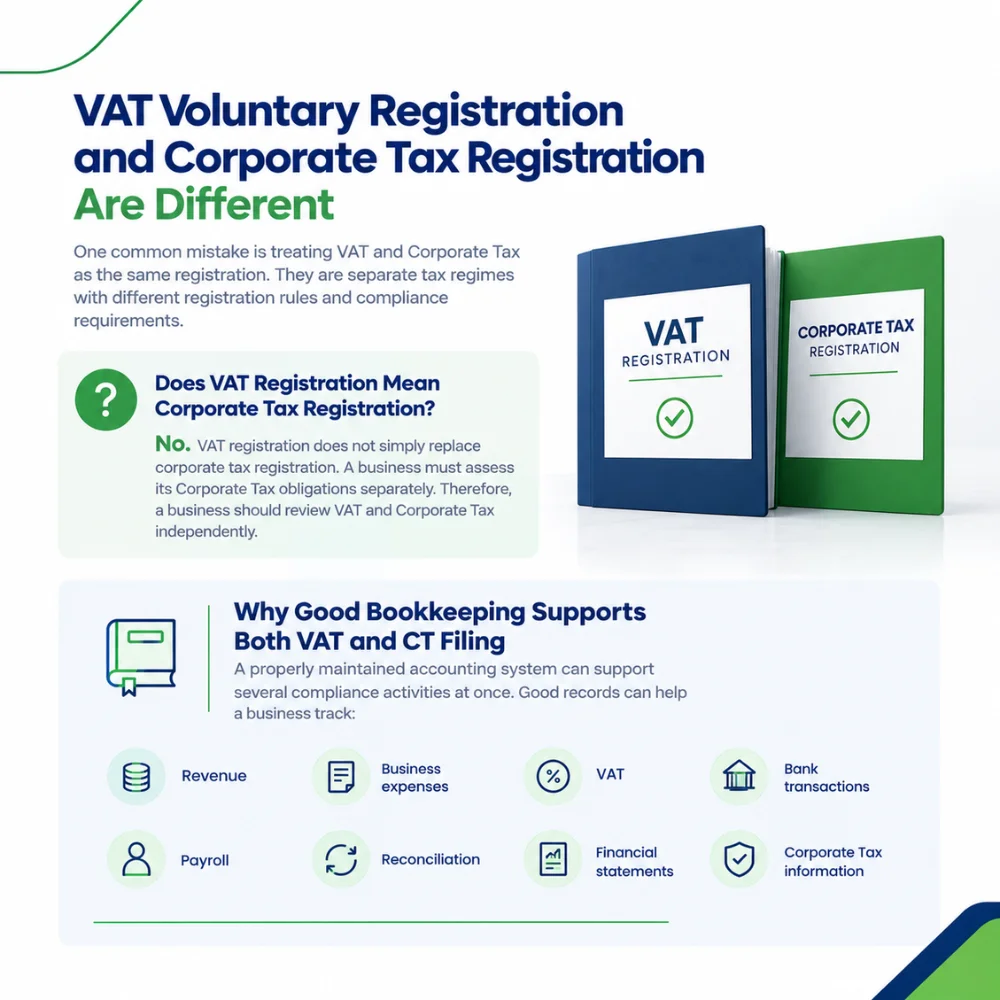
One common mistake is treating VAT and Corporate Tax as the same registration. They are separate tax regimes with different registration rules and compliance requirements.
Does VAT Registration Mean Corporate Tax Registration?
No. VAT registration does not simply replace corporate tax registration. A business must assess its Corporate Tax obligations separately. The FTA provides a separate Corporate Tax registration service through EmaraTax. The current FTA service states that persons subject to Corporate Tax can apply to obtain a Corporate Tax Registration Number, with requirements depending on the type of taxpayer.
Therefore, a business should review VAT and Corporate Tax independently.
Why Good Bookkeeping Supports Both VAT and CT Filing
A properly maintained accounting system can support several compliance activities at once.
Good records can help a business track:
- Revenue
- Business expenses
- VAT
- Bank transactions
- Payroll
- Reconciliation
- Financial statements
- Corporate Tax information
This makes CT filing and VAT compliance easier to manage because the underlying financial data remains organized.
Practical Example: Should a New UAE Business Register Voluntarily?
Consider a Dubai-based consulting company with taxable supplies of د.إ210,000 over the relevant period. The business has not crossed the mandatory VAT threshold of د.إ375,000 but may qualify for voluntary registration because its taxable supplies exceed the voluntary threshold of د.إ187,500.
Before registering, the owner should review:
- How much eligible VAT the business pays on expenses.
- Whether most customers are businesses or consumers.
- Whether taxable turnover is likely to increase.
- Whether bookkeeping records are complete.
- Whether the company can manage VAT returns and reconciliation.
- Whether registration fits its overall compliance plan.
The important point is that crossing the voluntary threshold creates an option, not necessarily a reason to register without considering the business’s circumstances.
VAT Voluntary Registration Checklist
Before Registration
- Check your taxable supplies and relevant expenses.
- Determine whether you meet the voluntary threshold.
- Review your expected growth.
- Identify your customer profile.
- Estimate VAT-bearing business expenses.
- Check the quality of your financial records.
- Prepare the required documentation.
- Understand your future VAT compliance responsibilities.
After Registration
- Use appropriate tax invoices.
- Record VAT accurately.
- Track input and output VAT.
- Maintain financial records.
- Complete regular reconciliation.
- Monitor your tax period.
- Prepare VAT returns accurately.
- Keep supporting documents organized.
Common VAT Voluntary Registration Mistakes
Businesses should avoid several common mistakes:
- Registering without understanding ongoing VAT obligations.
- Assuming VAT registration and Corporate Tax registration are the same.
- Using incomplete accounting records.
- Failing to reconcile transactions.
- Claiming input VAT without adequate supporting documentation.
- Applying the wrong VAT treatment to transactions.
- Ignoring VAT return deadlines.
- Treating registration as a one-time administrative task.
A structured bookkeeping process can help prevent many of these issues.
How Ripple Business Setup Can Help!
At Ripple Business Setup, we help UAE businesses understand their business setup, accounting, VAT, and Corporate Tax compliance requirements with practical guidance tailored to their circumstances. Our approach focuses on keeping compliance processes clear, organized, and manageable as your business grows.
Phone: +971 50 593 8101
Email: info@ripplellc.ae
WhatsApp: +971 4 250 0833
Website: www.ripplellc.ae
If you are considering voluntary VAT registration, reviewing your current turnover, expenses, and bookkeeping records first can help you make a more informed compliance decision.
FAQ
What is VAT Voluntary Registration in the UAE?
VAT Voluntary Registration allows an eligible UAE-resident business to register for VAT before it reaches the mandatory VAT registration threshold. The current voluntary threshold is د.إ187,500 based on the applicable taxable supplies, imports, or taxable expenses rules.
What is the voluntary VAT registration threshold in the UAE?
The current voluntary VAT registration threshold is د.إ187,500. The FTA states that the relevant value can relate to taxable supplies and imports or taxable expenses, based on the applicable registration rules.
Is VAT registration mandatory below د.إ375,000?
Not necessarily. A UAE-resident business below the mandatory threshold may qualify for voluntary registration if it meets the applicable voluntary registration conditions.
Can a new company voluntarily register for VAT?
A new company may be able to register voluntarily if it meets the applicable requirements, including the threshold based on relevant past or expected taxable supplies, imports, or taxable expenses. The FTA may request supporting documents and financial information.
How do I register for VAT through EmaraTax?
The current FTA process involves accessing EmaraTax, creating a taxable person profile, opening the taxable person account, selecting VAT registration, completing the application, and submitting it for review.
Does VAT registration mean I am registered for Corporate Tax?
No. VAT and Corporate Tax are separate tax regimes. Businesses should assess their VAT obligations and corporate tax registration requirements separately. The FTA provides separate registration services for each.
What records should I maintain after VAT registration?
Maintain accurate sales and purchase invoices, expense records, bank records, VAT calculations, and other relevant supporting documents. Regular bookkeeping and reconciliation can help keep VAT information accurate.
Final Takeaway
VAT Voluntary Registration can be useful for a growing UAE business, but the decision should not depend on the threshold alone. Consider your taxable turnover, eligible business expenses, customer profile, expected growth, accounting systems, and ability to manage ongoing VAT compliance. A business that regularly incurs eligible VAT and expects rapid growth may have different considerations from a small consumer-focused business with limited taxable expenses.
Disclaimer: This article provides general information about UAE VAT and Corporate Tax compliance and is not a substitute for professional tax advice. VAT rules and administrative requirements can change, so businesses should verify current requirements with the FTA or a qualified tax professional.