Choosing between offshore vs onshore banking UAE is one of the most important decisions for any business owner in 2026. Your choice directly affects how easily you can open a UAE business bank account, manage transactions, and meet compliance rules. Many entrepreneurs assume both options work the same, but in reality, banks treat them very differently.
In recent years, UAE banks have tightened regulations due to AML and KYC requirements. This has made it harder, especially for offshore companies, to open and maintain accounts. As a result, many applications get delayed or rejected due to weak documentation or unclear business activity.
What Is Offshore vs Onshore Banking in UAE?
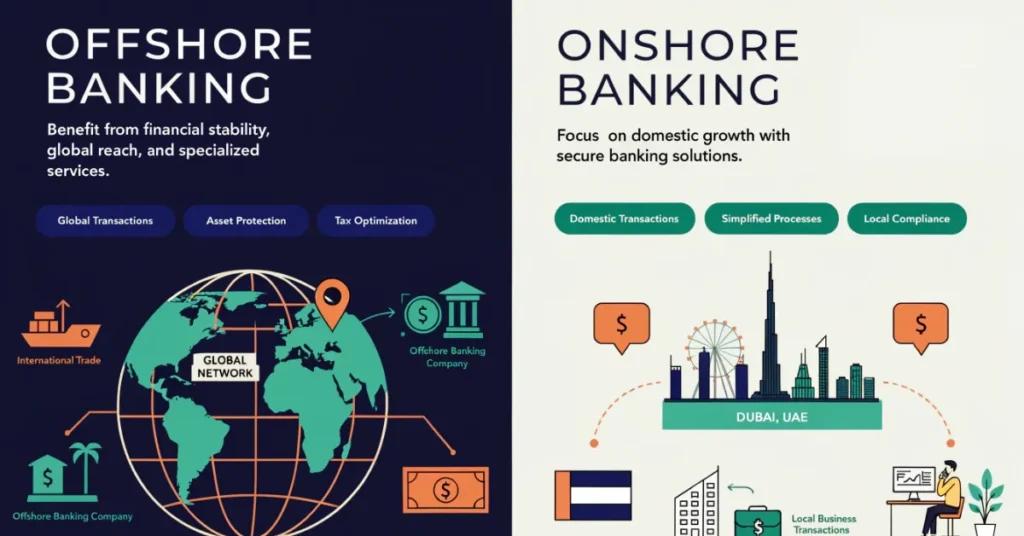
An onshore bank account UAE is linked to a mainland or free zone company that operates within the UAE. These businesses can trade locally, issue invoices, and maintain a physical presence such as an office or warehouse. A mainland company bank account UAE is often preferred by banks because it shows active business operations inside the country.
An offshore bank account UAE, on the other hand, is connected to a company registered for international business only. These companies cannot trade within the UAE market. Popular offshore jurisdictions include JAFZA Offshore and RAK ICC, both designed for holding assets or conducting global transactions.
Why Banking Structure Matters in UAE
Your banking structure matters more than ever due to evolving regulations. The UAE bank account approval process has become stricter as banks follow global AML standards and local compliance rules. This means every business must clearly show its purpose, activity, and financial flow.
Based on recent UAE banking trends, banks now prefer companies with real operations, physical presence, and transparent ownership. The introduction of UAE corporate tax offshore companies at 9 percent has also pushed authorities to monitor business structures more closely.
If your setup does not match your banking needs, you may face delays, high costs, or even rejection.
Offshore vs Onshore Banking UAE: 5 Key Differences
1. Account Opening Ease
Opening a bank account for an onshore company is generally more straightforward. Banks prefer businesses with a UAE office, active trade license, and clear operations. This increases approval chances and reduces processing time. When you try to open offshore bank account in the UAE, the process becomes more complex. Banks require detailed documentation, proof of international business activity, and a clear reason for choosing an offshore structure. In many cases, offshore applications face higher rejection rates.
Banks require strong documentation for offshore structures, which many businesses fail to provide.
2. KYC and Compliance Requirements
Compliance is a major factor in UAE banking. The UAE KYC requirements for 2026 are strict for all businesses, but offshore companies face deeper checks. Banks often review ownership structure, source of funds, and international transactions in detail.
For onshore companies, AML compliance UAE banking is still important, but the process is smoother if the business operates locally and maintains proper records. A clear office presence and business activity make compliance easier.
3. Transaction Flexibility
Transaction needs differ based on your business model. Offshore accounts are often designed for international transactions UAE bank account usage. They are useful for businesses dealing with global clients, cross-border payments, and foreign investments. Onshore accounts, however, are better suited for local operations. If your business deals with UAE clients, suppliers, or government entities, an onshore account offers better flexibility and access.
This is one of the key offshore banking benefits UAE, but only if your business is truly international.
4. Minimum Balance and Banking Costs
Every UAE bank has minimum balance requirements, but offshore accounts often come with higher thresholds. The UAE bank minimum balance business account can range from moderate to high, depending on the bank and risk profile. In addition, offshore banking fees UAE may include compliance charges, international transfer fees, and account maintenance costs. These hidden expenses can increase your overall banking cost.
Onshore accounts usually offer more flexible options, especially for small and medium businesses.
5. Business Credibility with UAE Banks
Credibility plays a major role in account approval. A mainland company bank account UAE is seen as more reliable because the business operates within the UAE and follows local regulations. Offshore companies, on the other hand, are often viewed as higher risk. Banks may question the purpose of the structure, especially if there is no strong international activity. This affects not only approval chances but also transaction limits and long-term banking relationships.
Why Offshore Bank Accounts Get Rejected in UAE

Many businesses face offshore bank account UAE rejection due to common issues. Understanding these problems can help you avoid delays.
- No physical office or presence in UAE
- Weak or unclear business activity
- High-risk industry or nationality profile
- Incomplete or inconsistent KYC documents
- No clear transaction history or business plan
These are some of the most common UAE bank account opening issues faced by offshore companies.
Onshore vs Offshore Banking UAE – Which One Is Right for You?
Choosing between offshore vs onshore banking UAE which is better depends on your business model and goals.
Best for Onshore Banking:
- UAE trading businesses
- Service providers
- E-commerce sellers targeting UAE customers
These businesses benefit from easier approvals and better local transaction support.
Best for Offshore Banking:
- International trading companies
- Holding or investment companies
- Asset protection structures
These setups work well when business activity is outside the UAE and requires global transactions.
Understanding UAE business bank account requirements helps you choose the right option from the start.
Key Mistakes to Avoid When Opening a UAE Bank Account
Avoiding common UAE bank account mistakes can improve your approval chances.
- Choosing an offshore structure for local business operations
- Not preparing proper documentation
- Ignoring AML and compliance requirements
- Selecting the wrong bank for your business type
Planning ahead is key when applying for a business bank account UAE 2026.
How Our Team at Ripple Business Setup Helps You Open the Right UAE Bank Account
Choosing between offshore and onshore banking in the UAE can feel confusing, especially with strict compliance rules and changing banking policies. Our team at Ripple Business Setup works closely with you to understand your business model, transaction needs, and long-term goals. We guide you in selecting the right structure, prepare strong documentation, and support you through the full UAE bank account approval process. This approach helps reduce delays and improves your chances of success. Contact Ripple Business Setup at +971 50 593 8101, email info@ripplellc.ae, or WhatsApp +971 4 250 0833.
FAQs
What is the difference between offshore and onshore banking in UAE?
Onshore banking is linked to businesses operating within the UAE, while offshore banking is used for international business activities without local trading.
Can offshore companies open bank accounts in UAE?
Yes, offshore companies can open bank accounts, but the process is stricter and requires strong documentation and clear business activity.
Which is better: offshore or onshore banking in UAE?
It depends on your business model. Onshore is better for local operations, while offshore suits international business and holding structures.
Why do UAE banks reject offshore accounts?
Banks reject offshore accounts due to compliance risks, unclear business activity, or incomplete KYC documentation.
What documents are required for UAE business bank account?
- Trade license
- Shareholder documents
- Business plan
- Proof of address
- Bank statements
Conclusion
Understanding offshore vs onshore banking UAE is essential for any business planning to operate in or through the UAE. Each option has its own advantages, but the right choice depends on your business activity, target market, and compliance readiness.
Onshore banking offers easier approval and stronger credibility, while offshore banking supports international operations when structured correctly. Making the right decision early can save time, reduce costs, and improve long-term banking success.
Disclaimer: This content is for general informational purposes only and does not constitute legal, financial, or banking advice. Banking requirements and approval processes in the UAE may vary based on individual business activities, risk profiles, and regulatory updates. We recommend consulting with a qualified advisor before making any business or banking decisions.