Dubai continues to attract fintech founders who want a regulated, globally respected base. If you plan to launch a fintech company in the UAE, getting a Dubai Fintech License is essential. However, approval depends on more than just submitting forms; it requires clarity, compliance, and the right regulatory approach.
What is a Dubai Fintech License?
A Dubai fintech license allows businesses to legally offer financial technology services such as payments, lending, robo-advisory, or digital banking. Most regulated fintech companies operate in DIFC and are supervised by DFSA. The license ensures that companies follow strict fintech regulations in the UAE, including anti-money laundering (AML), data protection, and risk management.
You typically need this license if you:
- Handle or transfer customer funds
- Provide financial advisory or investment services
- Operate digital wallets, payment gateways, or lending platforms
If your business only builds technology (without handling funds), you may qualify for a lighter setup.
Why Dubai is a Global Fintech Hub in 2026
Dubai has built a strong ecosystem for fintech startups. It combines regulation with innovation, which attracts both startups and investors.
Key advantages:
- 0% personal income tax
- Access to global investors and venture capital
- Strong regulatory framework under DFSA
- Government-backed fintech initiatives
- Advanced digital infrastructure
Dubai also offers the Dubai fintech sandbox, allowing startups to test products before full licensing.
Types of Fintech Licenses in Dubai
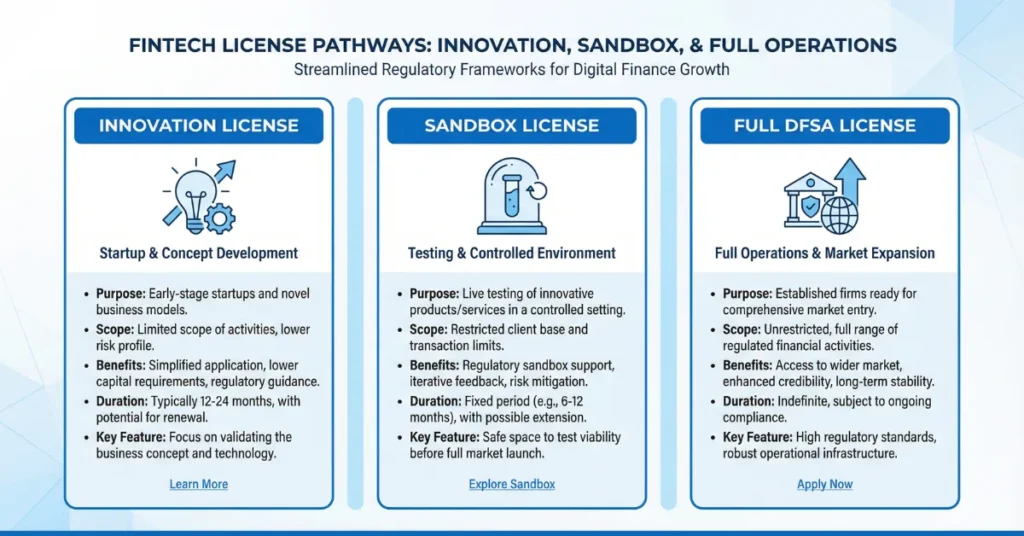
Understanding license types is critical before applying. Your business activity determines your license, not your company name.
Innovation License
This license suits early-stage startups. It allows you to operate in DIFC with reduced costs while developing your product. You cannot provide full financial services under this license, but it is ideal for building your MVP.
Innovation Testing License
Also known as the innovation testing license UAE, this option allows startups to test financial products in a controlled environment. It is useful if your fintech model involves real users but still needs regulatory validation.
Full DFSA License
A full DFSA license Dubai is required if you:
- Process payments
- Manage investments
- Offer lending or crowdfunding services
This license involves strict compliance and higher capital requirements. It is suitable for scaling fintech companies.
Dubai Fintech License 2026: 4 Proven Steps to Get Approved
Step 1: Define Your Fintech Business Model
Start by clearly defining your business activity. Regulators focus on what your company actually does.
You should identify:
- Your target market (B2B or B2C)
- Revenue model
- Whether you handle customer funds
- Your technology vs financial role
A clear model helps regulators assess risk and speeds up approval.
Step 2: Choose the Right License Type
Selecting the correct license is one of the most important decisions.
Choose based on your stage:
- Early-stage idea → Innovation License
- Product testing → Sandbox license
- Full operations → DFSA license
Applying for the wrong license often leads to rejection or delays.
Step 3: Engage with DFSA Early
DFSA encourages early engagement before formal application.
This step helps you:
- Validate your licensing approach
- Understand DFSA requirements
- Identify compliance gaps
Early communication reduces risk and improves approval chances. It also shows regulators that you are serious and prepared.
Step 4: Complete Compliance & Company Setup

Once your model is validated, move to formal setup.
Key requirements include:
- DIFC business setup and company registration
- AML and KYC compliance framework
- Risk management policies
- Appointment of compliance officers
- Office space in DIFC
Regulators will review your business plan, financials, and internal controls before approving.
Documents Required for Fintech License in Dubai
Prepare these documents carefully to avoid delays:
- Detailed business plan
- Financial projections (3–5 years)
- Shareholder and director details
- AML/KYC policies
- Corporate structure chart
- Passport copies and proof of address
- Technology and security framework
Accurate documentation improves approval speed.
Cost of Dubai Fintech License in 2026
The fintech license cost Dubai depends on your business activity and license type.
Costs typically include:
- License fees
- Company registration fees
- Office and infrastructure costs
- Compliance and legal expenses
- Minimum capital requirements
Estimated ranges:
- Innovation License → Lower cost, startup-friendly
- Sandbox License → Moderate cost
- Full DFSA License → Higher investment required
You should plan your budget based on long-term growth, not just initial setup.
Timeline for Approval
Approval time varies depending on the complexity of your application.
Typical timelines:
- Innovation License → 2–4 weeks
- Sandbox License → 1–3 months
- Full DFSA License → 3–6+ months
Incomplete applications or unclear business models often cause delays.
Common Mistakes to Avoid
Many fintech startups struggle due to avoidable errors.
Avoid these common mistakes:
- Choosing the wrong license type
- Weak compliance framework
- Poorly defined business model
- Ignoring DFSA consultation
- Submitting incomplete documents
Fixing these issues early can save months of delay.
Our Ripple Business Setup Support for Dubai Fintech License
We guide founders and investors through every step of securing a Dubai Fintech License with clarity and confidence. Our team helps define the right business model, choose the correct license type, and align with DFSA requirements from the start. We also assist with DIFC company formation, compliance frameworks, documentation, and regulator communication to reduce delays and improve approval chances. Contact Ripple Business Setup at +971 50 593 8101, email info@ripplellc.ae, or WhatsApp +971 4 250 0833 to discuss your fintech setup in Dubai.
FAQs
What is a Dubai fintech license?
It is a regulatory approval that allows companies to offer financial technology services in Dubai under DFSA supervision.
How to start a fintech company in UAE?
You need to define your business model, choose the right license, meet compliance requirements, and complete DIFC registration.
What is the DIFC fintech license?
It refers to licenses issued within DIFC, regulated by DFSA, for fintech businesses.
How much does a fintech license cost in Dubai?
Costs vary depending on the license type, business activity, and compliance requirements.
Conclusion
Getting a Dubai Fintech License in 2026 requires careful planning, strong compliance, and the right strategy. Dubai offers one of the most supportive environments for fintech startups, but approval depends on how well you prepare. If you follow the four proven steps define your model, choose the right license, engage regulators early, and build a strong compliance framework, you significantly improve your chances of success.
Disclaimer: This content is for informational purposes only and does not constitute legal, financial, or regulatory advice. Licensing requirements in Dubai may change based on DFSA regulations. Always consult a qualified business setup or legal professional before making decisions.