The UAE’s freelance economy has grown at a remarkable pace. Thousands of independent professionals, from software developers to content creators to financial consultants, now call Dubai home, not just for the lifestyle but for the genuine business infrastructure the city offers. If you’re considering making the move, or are already in Dubai and want to formalize your work, a Dubai Freelance Visa is the legal foundation you need.
What Is a Dubai Freelance Visa?
A Dubai Freelance Visa (also called a freelance permit) is an official authorization that allows self-employed professionals to legally live and work in Dubai without being tied to a single employer or corporate entity. Unlike a standard employment visa, it lets you operate independently, bill multiple clients, and build your own practice.
The permit is issued through various free zones and government authorities, depending on your industry. Creatives typically apply through Dubai Media City (DMC) or Dubai Design District (D3). Tech professionals often opt for the Dubai Multi Commodities Centre (DMCC). Consultants and business professionals may explore options through Dubai Silicon Oasis or IFZA. Each free zone covers specific activity categories, so choosing the right one matters.
Benefits of a Dubai Freelance Visa
Getting your freelance permit isn’t just about ticking a legal box; it genuinely opens doors that being “on a tourist visa and hoping for the best” simply does not. You gain full legal authorization to work and invoice clients in the UAE. You can open a UAE business bank account in your name, which makes receiving international payments and managing finances significantly easier. You become eligible for private health insurance plans, access coworking spaces that require valid UAE residency, and, critically, you can sponsor family members for residency visas once you meet the income threshold.
There’s also a professional credibility dimension. Registered freelancers with valid permits can enter formal contracts with UAE-registered companies and government entities, which translates directly into higher-value work.
Eligibility Criteria for a Dubai Freelance Visa in 2026
Most professionals in skilled fields qualify for a freelance visa, but there are a few baseline requirements to be aware of. You need a valid passport with at least six months of remaining validity. You must be 18 or older. Some free zones require proof of relevant qualifications or a demonstrable professional portfolio, especially for creative and media categories.
Key requirements typically include:
- Passport copy (valid for 6+ months)
- Proof of professional skills: a portfolio, certifications, or prior work samples
- No criminal record (a clearance certificate may be required depending on nationality and free zone)
- Educational certificates, particularly for technical or regulated fields like engineering or healthcare consulting
Certain industries may have additional requirements; for instance, media-related permits through DMC may ask for a sample of published or produced work.
Step-by-Step Process to Apply for a Dubai Freelance Visa
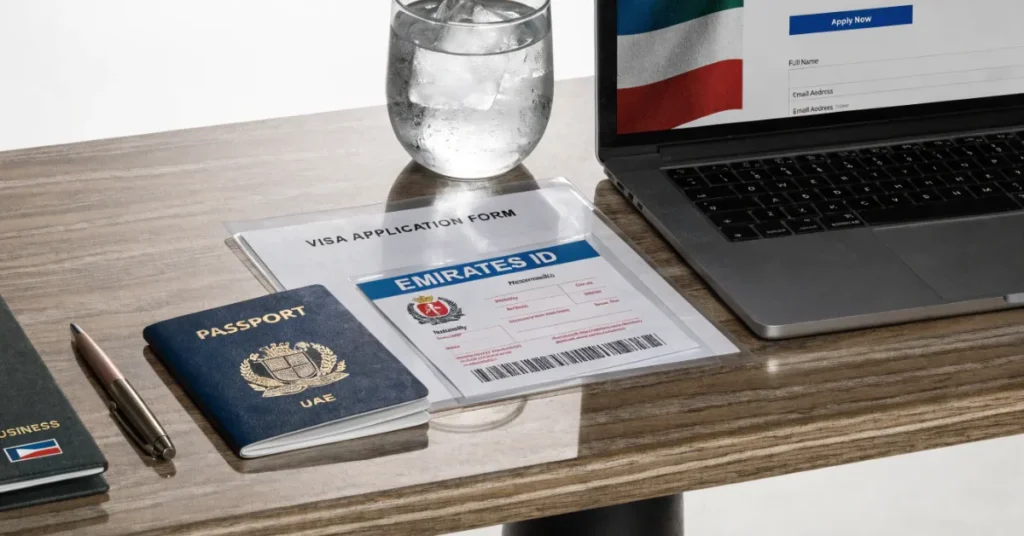
The process is more straightforward than many people expect, as long as you go in prepared.
Step 1 – Choose a Free Zone or Authority
This is arguably the most important decision, because your free zone determines your activity category, your cost structure, and your visa type. Dubai Media City is the go-to for journalists, filmmakers, and PR professionals. Dubai Design District suits graphic designers, architects, and fashion professionals. DMCC is popular with traders and commodity consultants. IFZA and Shuraa are known for being cost-competitive for general consultancy.
Spend time confirming that your professional activity falls within the permitted categories of your chosen free zone before proceeding.
Step 2 – Prepare Required Documents
Once you’ve selected your free zone, gather the following:
- Passport copy (all pages, clear scan)
- Recent passport-sized photographs (white background, as per UAE specs)
- Proof of professional experience portfolio, published work, references, or contracts
- Educational certificates (attested if required by your free zone)
- Bank statements showing financial stability (required by some free zones)
- No-objection letter if you’re currently on another UAE visa type
Having everything ready before you start the application avoids delays that can push your timeline back by weeks.
Step 3 – Submit Application and Pay Fees
Most free zones now offer online application portals where you submit your documents digitally. Processing typically begins within a few business days of submission. Fees vary by free zone and cover the freelance permit itself, the visa application, and medical testing.
A rough breakdown of typical 2026 costs:
- Freelance permit fee: AED 7,500–15,000, depending on the free zone
- Visa processing fee: AED 3,000–5,000
- Medical fitness test: AED 300–500
- Emirates ID registration: AED 370
- Optional virtual office: AED 1,500–3,000/year (required by some free zones as a registered address)
Total all-in costs typically range from AED 12,000 to AED 25,000+ for the first year, with renewal costs generally lower.
Step 4 – Medical Fitness Test and Emirates ID
After your application is accepted, you’ll be directed to a UAE-approved medical testing center. The test checks for communicable diseases and is mandatory for all residence visa applicants. It’s usually straightforward, and results come within a few days.
Following a clean medical result, you register for your Emirates ID at a Federal Authority for Identity and Citizenship (ICA) center. This involves biometric data (fingerprints and a photograph) and is a legal identity document you’ll use for everything from banking to healthcare.
Step 5 – Receive Your Freelance Visa and Permit
Once medical clearance and Emirates ID registration are complete, your visa is stamped into your passport. The standard duration is one year, renewable annually. Your freelance permit confirms the specific activities you’re authorized to conduct. Keep both documents up to date letting either lapse while you continue working, puts you in an irregular legal position.
How Long Does It Take to Get a Dubai Freelance Visa?
The complete process, from document submission to visa stamping, typically takes 3 to 6 weeks. Initial application review usually takes 5–10 business days. Document verification, medical testing, and ID registration add another 1–2 weeks. Visa stamping is usually completed within a week after all clearances come through.
Peak periods around UAE public holidays can add a few extra days. Working with an experienced consultant can shorten the process by helping you avoid document rejection on the first submission.
Common Mistakes to Avoid When Applying
The most common reason applications get delayed or rejected is avoidable:
- Incomplete documents: Missing an attested certificate or a passport page are the top culprits. Double-check your document list against your free zone’s specific requirements before submitting.
- Wrong free zone selection: Applying through a free zone that doesn’t cover your professional activity means rejection and restarting from scratch. Confirm your activity category in writing before paying any fees.
- Missing renewal deadlines: A freelance visa must be renewed before expiry. Overstaying is a fineable offense in the UAE.
- Continuing to work on a tourist or cancelled visa: This is the most serious error. If you’re waiting for your permit to be processed, you need a valid legal status (a visit visa, tourist visa, etc.) in place during that period.
- Not accounting for all costs upfront: The permit fee is not the only expense. Budget for visa fees, medical tests, Emirates ID, and possible virtual office requirements from the start.
Working Legally in Dubai on a Freelance Visa

Once your permit is active, you can invoice UAE and international clients directly. From a tax perspective, the UAE has no personal income tax, which is a significant advantage. However, if your business revenue crosses AED 375,000 annually, VAT registration becomes mandatory, and you’ll need to charge and remit 5% VAT on qualifying services.
You can work across multiple projects and clients simultaneously; that’s the whole point of the freelance permit. If a UAE company wants to put you on a retainer or long-term contract, that’s permitted under a freelance visa structure as long as they aren’t acting as your legal employer (which would require a standard employment visa instead).
Maintaining accurate records of your income and client contracts is a good practice both for VAT compliance and for visa renewal purposes, where some free zones request evidence of active business activity.
How Ripple Business Setup Can Help
Navigating free zone requirements, document preparation, and government portals is manageable but having expert support makes the process significantly faster and less stressful, particularly for first-time applicants. Ripple Business Setup specializes in freelance visa processing, free zone selection, and document handling for professionals relocating to or setting up in Dubai. You can reach their team at:
- Phone: +971 50 593 8101
- Email: info@ripplellc.ae
- WhatsApp: +971 4 250 0833
Their services include guiding you through free zone selection based on your specific professional activity, preparing and reviewing your documentation, and managing the full application process on your behalf.
Frequently Asked Questions
Can I sponsor family members on a freelance visa?
Yes, provided you meet the minimum income threshold required by the free zone or UAE immigration authorities (typically AED 4,000–10,000 per month, depending on the number of dependents).
Can I switch free zones after getting my permit?
Yes, but it involves canceling your existing permit and reapplying under the new free zone. Costs apply, and the timeline restarts. It’s worth getting the free zone decision right from the beginning.
Can I work full-time for a company with a freelance visa?
Not in a formal employment capacity. If a company wants you as an employee, they would need to sponsor you on a standard employment visa. A freelance permit is for independent professional work, not for replacing an employment contract.
Is a freelance visa the same as a business license?
Not exactly. A freelance permit authorizes you as an individual to work in specific activities. A business license is issued to a company entity. Some professionals later upgrade to a company structure as their work grows, but a freelance permit is a fully valid and recognized legal status on its own.
Conclusion
Getting a Dubai Freelance Visa in 2026 is a practical, well-defined process once you understand the steps. Choose the right free zone for your profession, prepare your documents carefully, complete the medical and biometric requirements, and you’ll have a legal foundation to work, live, and grow in one of the world’s most professionally active cities.
Disclaimer: This guide is for informational purposes only and may not reflect the most recent legal changes. Always consult official UAE government sources or licensed service providers before making decisions.