The UAE has long been a destination of choice for working professionals, entrepreneurs, and skilled workers from across the globe. Once you settle in, the next natural step is bringing your family along. Whether you want your spouse by your side, your children in a good school, or your parents close to home, a family visa in the UAE makes that possible legally, securely, and with a relatively straightforward process.
In 2026, the UAE continued to simplify its residency and sponsorship rules. The updated policies offer more flexibility around eligible professions, salary thresholds, and dependent categories than ever before. This guide walks you through everything you need to know, from eligibility and documents to costs and common rejection reasons, so you can bring your family to the UAE with confidence.
What Is a Family Visa in the UAE?
A family visa in the UAE officially called a UAE residence visa for family or a dependent visa allows UAE residents to sponsor their immediate family members for legal residency in the country. It is not a tourist permit or a temporary arrangement; it grants your dependents the right to live, study, and access services in the UAE for the full duration of the visa.
The visa is typically issued for two or three years, depending on the type of residency held by the sponsor. For example, if a sponsor holds a two-year employment visa, the family visa will align with that validity. Business owners or investors on a longer-term visa may secure three-year family visas. Crucially, the family visa is tied to the sponsor if the sponsor’s visa status changes, dependents must update their residency accordingly.
Who Can Sponsor a Family Visa in the UAE in 2026?
In 2026, the UAE removed many of the profession-based restrictions that previously made sponsorship difficult for certain job categories. Today, the eligibility criteria are far more inclusive. Here is what the UAE immigration authorities currently require from sponsors:
The minimum monthly salary to sponsor a family is AED 4,000, or AED 3,000 plus company-provided accommodation. This threshold applies to employees sponsoring a spouse and children. For parents, the salary requirement is higher and may require additional approval.
The sponsor must hold a valid UAE residence visa and an active Emirates ID. Expired documents will immediately disqualify an application. Additionally, the sponsor must provide a valid tenancy contract (Ejari-registered) or proof of company accommodation to demonstrate suitable housing for the sponsored family members.
Which Family Members Can You Sponsor?
The UAE permits sponsorship for a defined set of family relationships. Here is a clear breakdown of who qualifies and any conditions that apply:
- Spouse: Husband or wife. Requires an attested marriage certificate.
- Sons: Up to age 25. Must be financially dependent on the sponsor.
- Daughters: Unmarried daughters of any age, with no upper age limit applied.
- Stepchildren: Eligible in certain cases; additional supporting documents may be required.
- Parents: Requires special approval and a higher minimum salary from the sponsor.
- Special needs dependents: Children with disabilities may be sponsored without the standard age cap.
Sponsoring parents remain the most complex category. UAE authorities evaluate these on a case-by-case basis, and the sponsor often needs to demonstrate a significantly higher monthly income, along with evidence that the parents have no alternative means of support. It is advisable to consult an immigration professional for parent sponsorship specifically.
Documents Required for Family Visa in the UAE
Preparing your documents accurately is the single most important step in the UAE family visa process. Missing or incorrectly attested paperwork is the most common reason for rejection or delays. Below is the standard UAE family visa documents checklist for 2026:
- Passport copies of both the sponsor and all dependents (minimum 6 months validity)
- Copy of the sponsor’s UAE residence visa
- Original Emirates ID of the sponsor
- Salary certificate or employment contract (on company letterhead)
- Valid tenancy contract registered on Ejari (or company accommodation letter)
- Attested marriage certificate (for spouse sponsorship)
- Attested birth certificates for each child being sponsored
- Medical fitness test results (for all applicants above 18 years of age)
- Recent passport-sized photographs of all applicants
- For parents: additional income proof and official approval documentation
Attestation reminder: Documents issued outside the UAE, including marriage and birth certificates, must be properly attested by the UAE embassy in the country of origin and then by the UAE Ministry of Foreign Affairs. Unattested documents are not accepted.
Step-by-Step Process to Apply for a Family Visa in the UAE
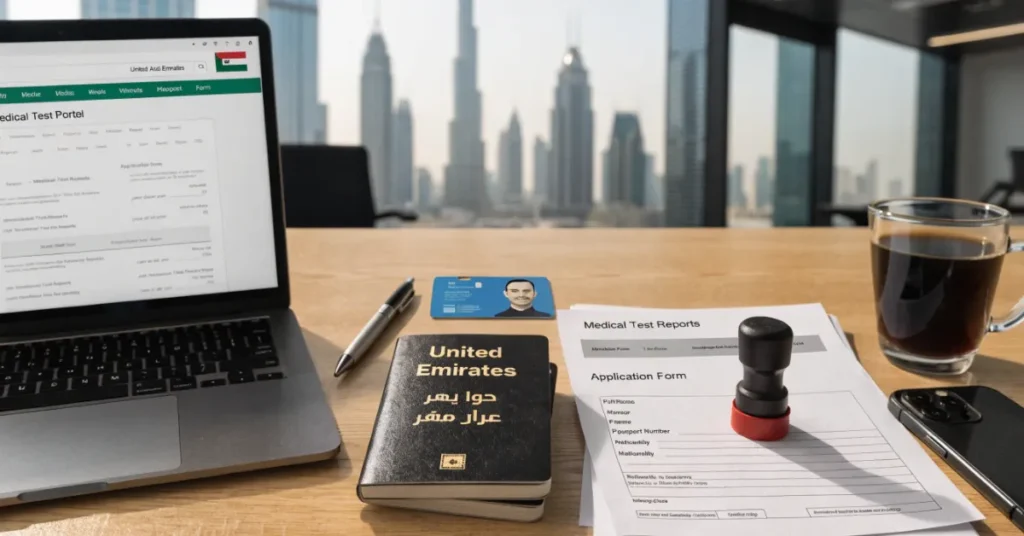
Understanding the process from start to finish helps you plan the timeline and avoid unexpected delays. The UAE family visa process follows five main steps, all of which can be initiated through the General Directorate of Residency and Foreigners Affairs (GDRFA) in Dubai, or the Federal Authority for Identity, Citizenship, Customs & Port Security (ICP) in other emirates.
1. Entry Permit Application
The sponsor applies for an entry permit on behalf of the dependent. This can be done online through the GDRFA app, the ICP portal, or at an authorized typing centre. The entry permit allows the dependent to enter the UAE legally and begin the residency process. Processing typically takes two to five working days.
2. Status Change or Entry
If the dependent is already in the UAE on a visit or tourist visa, a status change can be processed without them needing to exit the country. If they are outside the UAE, they will enter using the entry permit issued in Step 1. Either way, this step must be completed within the entry permit’s validity period — typically 60 days.
3. Medical Fitness Test
All dependents aged 18 and above must undergo a mandatory medical fitness test at a government-approved health centre. The test includes a blood screen and a chest X-ray. Results are usually ready within one to two working days and are submitted directly to the immigration authority electronically.
4. Emirates ID Application
Once the medical test clears, the dependent attends a biometric registration appointment at an ICP centre to apply for their Emirates ID. This involves fingerprinting and a photograph. The Emirates ID is a mandatory identity card for all UAE residents and is required for almost every government and private service.
5. Visa Stamping
The final step is the issuance of the residence visa. In 2026, many applicants will receive a digital visa directly on their ICP profile, though a physical stamp in the passport is still available upon request. Once stamped or issued digitally, the family member holds full UAE resident status linked to the sponsor’s visa.
Cost of Family Visa in the UAE
The total cost of a UAE family visa varies depending on the number of dependents, the emirate, and whether you use a typing centre or apply directly. Below is a general breakdown of the fees involved per person:
| Typing centre/service charges | Estimated Cost (AED) |
|---|---|
| Entry permit application | 500 – 750 |
| Status change (if in UAE) | 600 – 900 |
| Medical fitness test | 250 – 400 |
| Emirates ID issuance | 370 – 570 |
| Visa stamping fee | 500 – 750 |
| Typing centre / service charges | 150 – 300 |
| Estimated total per person | AED 3,000 – AED 7,000 |
These are estimates and can vary slightly by emirate and visa type. Dubai typically has slightly higher processing fees than other emirates. It is wise to budget at the higher end if you are sponsoring multiple family members simultaneously.
Processing Time for UAE Family Visa
Under normal circumstances, the entire UAE family visa process from entry permit to final visa stamping takes between seven and fifteen working days. However, several factors can extend this timeline.
Incomplete documents are the most common cause of delays. Medical test queues, especially during peak periods, can also add two to three extra days. Applications involving parents or step-children, which require additional approvals, may take up to four weeks. Applying during UAE national holidays or year-end periods can further slow processing.
To avoid unnecessary delays, submit a complete, attested document set from day one and use an authorised typing centre familiar with the GDRFA or ICP submission process.
Common Reasons for Family Visa Rejection
Understanding why applications get rejected helps you avoid the same mistakes. The following are the most frequently cited causes in 2026:
- Sponsor’s monthly salary falls below the AED 4,000 minimum threshold
- Missing documents from the checklist, or documents submitted in an incorrect format
- Marriage or birth certificates that are not properly attested
- The dependent failed the mandatory medical fitness test
- Tenancy contract (Ejari) has expired, is unregistered, or the accommodation is too small per UAE housing standards
- Expired sponsor visa or Emirates ID at the time of application
- Application submitted to the wrong authority (e.g., GDRFA vs ICP jurisdiction)
How Long Is a Family Visa Valid in the UAE?
The validity of a UAE family visa is directly linked to the sponsor’s own residence visa. If the sponsor holds a two-year employment visa, the family visa will also be issued for two years. If the sponsor has a three-year investor or Golden Visa, dependents can receive a three-year residence visa as well.
Renewal follows the same process as the initial application, updated documents, a fresh medical test for adults, and re-registration of Emirates IDs. It is important to begin the renewal process at least 30 days before the current visa expires to avoid overstaying fines. As of 2026, overstay fines in the UAE are AED 25 per day after a grace period of 30 days.
New UAE Family Visa Rules and Updates for 2026
The UAE government has consistently updated its family sponsorship framework to align with its vision of making the country a long-term home for talent and their families. The most notable changes entering 2026 include:
The profession restrictions that once prevented workers in certain job categories from sponsoring dependents have been substantially lifted. Today, nearly all legal residents with a qualifying salary are eligible to sponsor family members, regardless of their job title.
The age limit for sponsored sons has been extended in some circumstances. Male children studying full-time at a UAE university can now often remain on their parents’ sponsorship until the age of 25, up from the previous limit of 18 in certain visa categories.
Working mothers can now more easily sponsor their own children independently in the UAE, even when the father is abroad or holds a different residency status. The ICP has also continued expanding its digital services, meaning a larger portion of the application, including status updates, document submission, and visa delivery, now happens entirely online or through the UAE Pass app.
Can Business Owners Sponsor Family Members in the UAE?
Yes, UAE investors, company owners, and licensed freelancers are all eligible to sponsor family members, provided they can demonstrate sufficient income. For business owners, proof of income typically comes in the form of an audited financial statement, a bank statement showing regular salary transfers to the owner’s personal account, or a trade licence alongside a salary certificate from the company.
Free zone businesses and mainland businesses are both eligible, though the documentation requirements may differ slightly. Freelancers holding a UAE freelance permit from a recognised authority, such as those issued by Dubai Media City, twofour54, or similar bodies, can also sponsor dependents, provided they meet the income threshold.
Tips to Avoid Delays in the UAE Family Visa Process
- Get all foreign documents attested well before starting the visa application. Attestation alone can take one to three weeks
- Start the process at least 45 to 60 days before your family intends to arrive or before your current visa expires
- Double-check all names on documents match exactly; even minor spelling differences between a passport and a birth certificate can cause rejections
- Use an authorised ICP or GDRFA typing centre rather than informal agents to ensure forms are submitted correctly
- Keep digital and physical copies of every document submitted for your own records
Why Work with a UAE Family Visa Specialist?

The UAE family visa process is manageable when you follow each step carefully and prepare your documents well. That said, for families with complex situations, sponsoring parents, step-children, or dealing with a rejected application, working with an experienced UAE immigration consultant can make a significant difference.
A qualified visa specialist will review your eligibility upfront, prepare a complete and correctly formatted document set, liaise with GDRFA or ICP on your behalf, and track the application status throughout. This reduces the risk of rejection, saves time, and gives you peace of mind, especially if your family is waiting abroad.
How Ripple Business Setup Supports Your UAE Family Visa Process
At Ripple Business Setup, we make the UAE family visa process simple and clear. Our team handles document review, application filing, and coordination with authorities to avoid delays. We guide you on eligibility, salary criteria, and certificate attestation so your application meets the latest 2026 rules. Whether you are sponsoring your spouse, children, or parents, we ensure a smooth experience from start to finish. For assistance, contact Ripple Business Setup at +971 50 593 8101, email info@ripplellc.ae, or WhatsApp +971 4 250 0833.
Frequently Asked Questions
What is the minimum salary for a family visa in the UAE?
The minimum monthly salary required to sponsor a family visa in the UAE is AED 4,000. If your employer provides accommodation, the threshold drops to AED 3,000. This applies to sponsoring a spouse and children. Sponsoring parents require a higher income and additional approval from the relevant immigration authority.
Can I sponsor my parents in the UAE?
Yes, but parent sponsorship is more complex than sponsoring a spouse or children. It requires a higher minimum salary, special approval from the UAE immigration authorities, and additional supporting documents proving financial dependency. Each case is reviewed individually, so it is advisable to seek professional guidance before applying.
How long does a UAE family visa take?
The typical processing time for a UAE family visa is seven to fifteen working days under normal conditions. This covers the entry permit, medical fitness test, Emirates ID registration, and visa stamping stages. Delays can occur due to missing documents, medical test queues, or additional approvals needed for certain family categories.
Can a woman sponsor her family in the UAE?
Yes. Female UAE residents who meet the salary and documentation requirements can sponsor their children and, in certain circumstances, their spouse. As of 2026, the UAE has made it easier for working mothers to independently sponsor their children, even when the father is not a UAE resident.
Is medical insurance required for a family visa in the UAE?
Yes. Health insurance is mandatory for all UAE residents, including family visa holders. In Dubai, employers are generally required to provide health insurance for sponsored dependents. In Abu Dhabi, the Daman HAAD scheme covers many residents. When applying for a family visa, you will need to ensure valid medical insurance is in place, particularly in Dubai, before or immediately after the visa is issued.
Conclusion
Bringing your family to the UAE is one of the most meaningful steps you can take as an expat living and working in the country. The process while detailed, is well-structured and achievable when you approach it with the right information and proper preparation.
Disclaimer: This content is for general informational purposes only and should not be considered legal or immigration advice. UAE visa regulations may change over time. It is recommended to confirm the latest requirements with official authorities or consult a qualified professional before proceeding.