
Dubai’s appetite for delivered food is not slowing down. By 2025, the UAE food delivery market had grown into a multi-billion-dirham sector, powered by platforms like Talabat, Deliveroo, and Careem. At the centre of this transformation sits one of the most disruptive concepts in the hospitality industry: the cloud kitchen.
A cloud kitchen, also called a ghost kitchen or virtual kitchen, is a delivery-only food operation with no physical dining area. Customers order online, food is prepared in a commercial kitchen, and delivery riders bring it to their door. The concept strips away the cost and complexity of a traditional restaurant while keeping the revenue potential intact.
Dubai is one of the best cities in the world to launch one. The city has a tech-savvy population, a robust delivery infrastructure, a relatively straightforward business setup process, and zero income tax for entrepreneurs. If you have been thinking about starting a cloud kitchen in Dubai, 2026 is a strong moment to act. This step-by-step guide tells you exactly how to do it.
What Is a Cloud Kitchen in Dubai?
A cloud kitchen is a fully licensed food production facility that operates without a front-of-house. There are no seats, no waiters, and no walk-in customers. The entire business model depends on digital orders placed through food delivery apps or a branded website.
In Dubai’s context, this means your orders come through Talabat, Deliveroo, or Noon Food, and riders pick up orders directly from your kitchen. You manage your brand, your menu, and your ratings entirely online. The kitchen itself can be a standalone unit you lease, a bay within a shared commissary kitchen, or a purpose-built aggregator facility.
The UAE food delivery market was valued at over USD 1.7 billion in 2024 and continues to grow as residents increasingly prefer ordering in over dining out. That shift in consumer behaviour is exactly what makes the ghost kitchen Dubai model so commercially attractive right now.
Why Start a Cloud Kitchen in Dubai in 2026?
Dubai offers a uniquely favourable environment for delivery-only restaurant businesses. Here is why the timing makes sense:
- High food delivery demand: Dubai residents order food online at one of the highest per-capita rates in the MENA region. Working professionals, tourists, and families all rely heavily on delivery apps.
- Lower startup costs: You skip expensive retail fit-outs, front-of-house staff, and prime-location rents. A cloud kitchen can be launched for a fraction of what a traditional restaurant costs.
- No need for a high-footfall location: Your kitchen can sit in an industrial zone with low rents, since customers never visit in person.
- Zero income and corporate tax advantages: UAE’s tax environment remains one of the most business-friendly globally, with the standard 9% corporate tax only applying above AED 375,000 in profit.
- Diverse customer base: Dubai’s population of over 3.6 million includes tourists, expats, and residents representing hundreds of nationalities, giving virtually any cuisine a ready market.
- Seamless delivery platform integration: Talabat and Deliveroo provide established logistics networks, so you do not need to build your own delivery fleet from scratch.
Types of Cloud Kitchen Models in Dubai
Before you register your business, decide which operating model fits your budget, ambitions, and risk appetite. There are four main structures.
Independent Cloud Kitchen
You lease your own kitchen space, set up equipment, and operate entirely under your own brand. This gives you full control over menu, branding, and operations but also means you bear all setup and running costs yourself. Best for entrepreneurs with prior food service experience.
Shared Kitchen / Commissary Kitchen
Multiple food brands share one commercial kitchen facility, often paying by the hour or monthly. This dramatically reduces equipment and rental costs and is ideal for testing a concept before committing to a dedicated space. Several commissary kitchen UAE providers operate in areas like Al Quoz and Al Barsha.
Aggregator-Owned Kitchens
Platforms like Deliveroo Editions invite established brands to operate from their purpose-built kitchen hubs. These facilities come pre-equipped and are strategically located in high-demand delivery zones. In return, Deliveroo takes a commission on every order. This is a low-friction way to expand an existing brand’s delivery reach in Dubai.
Multi-Brand Kitchen
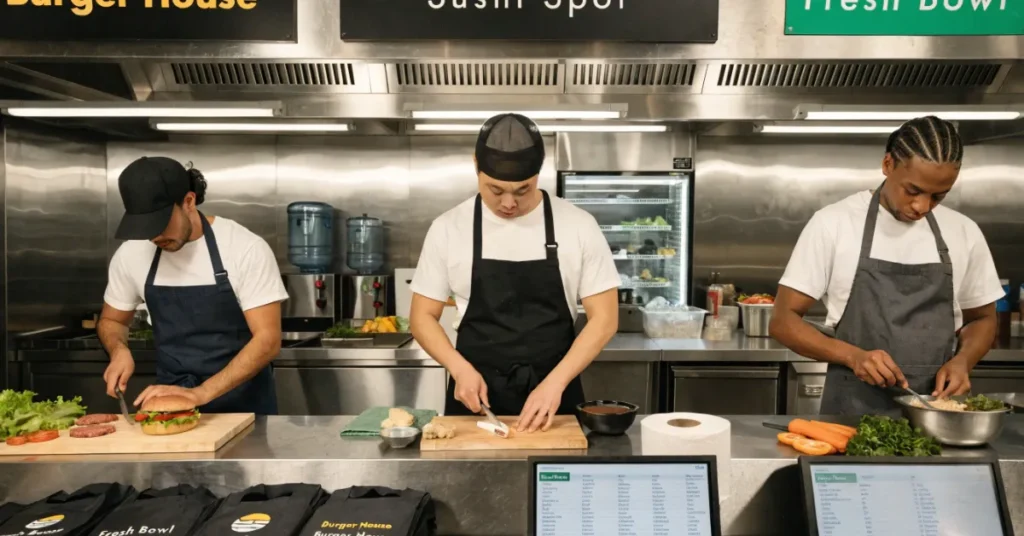
One kitchen, multiple virtual restaurant brands. You might run a burger concept, a salad brand, and a breakfast menu all from the same kitchen, appearing as separate restaurants on delivery apps. This multi-brand kitchen model maximises revenue per square metre and is increasingly popular among experienced operators in Dubai.
Step-by-Step Process to Start a Cloud Kitchen in Dubai

1. Choose Your Business Activity and Concept
Start with your cuisine concept and target customer. Think practically: delivery-friendly food travels well and arrives in acceptable condition. Burgers, wraps, rice bowls, sushi, and baked goods all perform well on Dubai’s delivery platforms. Dishes that depend heavily on presentation or temperature, like soufflés or fresh salads with dressing, are harder to deliver at quality. Define your target audience clearly: office workers, families, fitness-conscious residents, or a specific nationality community. Your niche will shape everything from your menu to your marketing.
2. Select the Right Location
Your kitchen location should sit within the delivery radius of your target customers, even if those customers never visit you.
- Prioritise proximity to dense residential or corporate zones
- Look at areas like Al Quoz, Business Bay, Deira, Al Barsha, and Dubai Investment Park for affordable industrial kitchen space
- Check the delivery time estimates on Talabat and Deliveroo for your shortlisted areas. Kitchens too far from demand zones hurt your ratings
- Compare rental costs: Al Quoz and DIP typically offer lower rents than Business Bay, with comparable delivery access
3. Choose Your Jurisdiction: Mainland vs Free Zone
This is one of the most important decisions you will make. A mainland licence (issued by Dubai’s Department of Economy and Tourism, formerly DED) lets you trade across the UAE without restriction and operate from any commercial kitchen location. A free zone licence offers potential cost savings and 100% foreign ownership, but may limit where you can physically operate and who you can sell to directly. For a cloud kitchen in Dubai that plans to list on Talabat or Deliveroo and serve the general public, a mainland licence is usually the more practical choice.
4. Register Your Trade Name and Apply for a Licence
Submit your trade name to the Department of Economy and Tourism for approval, making sure it reflects your food activity and is not already registered. Once approved, you apply for a food and beverage trade licence. The licence category for a cloud kitchen typically falls under “food and beverage preparation” or “food manufacturing and preparation” depending on your specific activity.
5. Get Approvals from Relevant Authorities
- Dubai Municipality: Inspect and approve your kitchen premises before you begin operations. They check layout, ventilation, drainage, and hygiene infrastructure
- Food Safety Department: All food handlers must hold valid food safety certificates. HACCP (Hazard Analysis and Critical Control Points) compliance is required for most commercial food operations
- Civil Defence: Your kitchen must pass a fire safety inspection and obtain Civil Defence clearance. This covers fire exits, suppression systems, and extinguisher placement
6. Set Up Kitchen Infrastructure
- Purchase or lease commercial-grade equipment suited to your menu: ovens, grills, fryers, refrigeration units, prep tables
- Install adequate dry and cold storage to maintain stock and hygiene standards
- Follow Dubai Municipality’s guidelines on surface materials, drainage, and pest control to pass inspection without delays
- Invest in proper packaging: spill-proof, insulated containers protect food quality during delivery and reinforce brand perception
7. Partner with Delivery Platforms
Talabat, Deliveroo, and Careem are the three major food delivery apps in Dubai. Each has a vendor onboarding process that includes menu submission, photography guidelines, pricing structure, and commission agreements. Commission rates typically range from 20% to 30% of each order’s value. Negotiate where possible, especially if you are launching multiple brands or bringing significant order volume. Consider running your own website or WhatsApp ordering channel to capture direct orders at zero commission. This becomes increasingly valuable as your brand builds recognition.
8. Launch and Market Your Cloud Kitchen
- Optimise your listings on Talabat and Deliveroo with professional food photography and clear, keyword-rich menu descriptions
- Build a social media presence on Instagram and TikTok, and food content performs exceptionally well in Dubai
- Run introductory promotions and platform-sponsored ads to generate early reviews and ratings
- Partner with micro-influencers in the Dubai food scene for authentic content
- Collect and respond to customer reviews actively; ratings directly impact your visibility in search results on delivery apps
Cost of Starting a Cloud Kitchen in Dubai (2026)
Costs vary depending on your model, location, and cuisine type, but here is a realistic breakdown for an independent cloud kitchen setup in Dubai.
| Expense Item | Estimated Cost (AED) |
|---|---|
| Trade licence (DET / Free Zone) | 10,000 – 20,000 / year |
| Kitchen rental | 30,000 – 100,000 / year |
| Kitchen equipment | 50,000 – 150,000 (one-time) |
| Interior fit-out & Dubai Municipality compliance | 20,000 – 50,000 |
| Staff salaries (3–5 staff) | 15,000 – 35,000 / month |
| Delivery platform setup & ongoing commissions | 20–30% of order revenue |
| Marketing & branding (initial) | 10,000 – 30,000 |
| Total estimated startup investment | AED 150,000 – 350,000+ |
A shared commissary kitchen arrangement can reduce your upfront costs significantly, potentially to AED 80,000–120,000, by eliminating the need to purchase equipment or fit out a dedicated space.
Licences and Legal Requirements for a Cloud Kitchen in Dubai
Operating without the right approvals is not just a legal risk it can result in the Dubai Municipality closing your operation entirely. Make sure you have the following in place before you begin trading:
- Trade licence: Issued by the Department of Economy and Tourism (mainland) or your chosen free zone authority
- Food licence: Specific approval for food preparation activity, required from the Dubai Municipality
- Food safety training certificates: All food handlers must hold valid certificates from an accredited provider
- HACCP compliance: A documented Hazard Analysis and Critical Control Points plan is required for commercial food operations
- Civil Defence clearance: Fire safety inspection and approval before commencing operations
- Waste management compliance: Dubai Municipality guidelines mandate proper food and packaging waste disposal procedures
Best Locations for a Cloud Kitchen in Dubai
Choosing the right area balances delivery zone coverage with affordable rent. These five areas consistently attract cloud kitchen operators in Dubai:
- Al Quoz: Industrial units, low rents, central location with access to Business Bay and Downtown delivery zones
- Al Barsha: Near Mall of the Emirates, good residential density, strong Deliveroo and Talabat demand
- Deira: Dense urban population, affordable rents, excellent reach for budget-friendly food concepts
- Business Bay: Premium zone, slightly higher rent, strong lunch and dinner demand from office workers and residents
- Dubai Investment Park: Lower rent, suitable for high-volume production, good for multi-brand kitchen setups
Technology and Tools for Your Cloud Kitchen
Running a delivery-only restaurant business in Dubai requires the right tech stack. Operational efficiency is everything when you have no physical storefront to manage customer experience directly.
- POS system: A cloud-based point-of-sale system like Square, Lightspeed, or a UAE-specific provider lets you manage orders, track sales, and analyse performance in real time
- Order management software: Tools like Deliverect or Snoonu aggregate orders from multiple platforms into one screen, reducing errors and streamlining kitchen workflow
- Inventory tracking: Use software that alerts you to low stock levels and monitors food cost percentages critical for maintaining margins in a volume-driven business
- Delivery platform integrations: Connect your kitchen display system directly to Talabat and Deliveroo portals to receive and confirm orders without manual re-entry
Marketing Strategies for Cloud Kitchen Success in Dubai
- Optimise your delivery app listings: High-quality photos, strategic pricing, and keyword-rich menu descriptions all improve your ranking within Talabat and Deliveroo search results
- Invest in food photography: Dubai’s food delivery audience is highly visual. Poor imagery costs you orders. Professional photography is not optional; it is infrastructure
- Run platform-sponsored promotions: Talabat’s and Deliveroo’s paid advertising tools push your listing higher in results, especially during launch
- Build a social media presence: Instagram Reels and TikTok videos showcasing food preparation, packaging, or behind-the-scenes content perform well and build brand loyalty
- Manage customer reviews actively: Respond to every review, positive and negative. Platforms reward engaged restaurants with better visibility
- Launch a direct ordering channel: A simple website or WhatsApp Business setup allows you to take orders at zero commission, improving net margins as your brand grows
Common Challenges and How to Overcome Them
- High competition on delivery apps → Focus on a clear niche rather than competing broadly. A well-defined cuisine concept with strong branding and consistent ratings will outperform generic menus.
- Delivery delays hurting ratings → Set realistic prep-time estimates and choose a kitchen location within optimal delivery radius. Consistently accurate timing builds the rating history that elevates your ranking.
- High platform commission rates → Develop a direct ordering channel early. Even if 80% of orders stay on platforms, the 20% that come directly improve your overall margin meaningfully.
- Customer retention → Food quality and packaging consistency matter more than discounts for long-term retention. Use loyalty promotions sparingly and invest in consistent product quality instead.
Is a Cloud Kitchen in Dubai Profitable in 2026?
Yes, but profitability depends heavily on volume, efficiency, and margin management. A well-run cloud kitchen in Dubai with AED 150,000–200,000 in monthly revenue can achieve net margins of 15–25% after platform commissions, food costs, and overheads. The break-even timeline for a standalone setup typically falls between 12 and 24 months, depending on initial investment and how quickly you build rating and order volume on delivery platforms.
The key levers are food cost (target 28–33% of revenue), labour efficiency, and delivery commission management. Operators who run multiple brands from one kitchen and invest in direct ordering channels consistently outperform single-brand operations on profitability metrics. Dubai’s high average order value, often AED 90–150 per delivery, also helps unit economics compared to lower-spending markets.
How Ripple Business Setup Supports Your Cloud Kitchen in Dubai
Starting a cloud kitchen in Dubai can feel complex, especially when dealing with licenses, approvals, and compliance. Ripple Business Setup simplifies the entire process by offering end-to-end support, from choosing the right business structure to securing your food license and handling government approvals. Their team ensures your setup is smooth, cost-effective, and aligned with UAE regulations so you can focus on launching and growing your food delivery brand. To get expert assistance, contact Ripple Business Setup at +971 50 593 8101, email info@ripplellc.ae, or WhatsApp +971 4 250 0833.
FAQs
How much does it cost to start a cloud kitchen in Dubai?
A standalone cloud kitchen setup in Dubai typically requires between AED 150,000 and AED 350,000, covering the trade licence, kitchen rental, equipment, fit-out, and initial marketing. A shared commissary model can reduce this to AED 80,000–120,000 for early-stage operators.
Do I need a food licence for a cloud kitchen?
Yes, all food businesses in Dubai, including delivery-only cloud kitchens, require a trade licence and a food licence issued by Dubai Municipality. You also need HACCP compliance, Civil Defence approval, and valid food safety certificates for all staff.
Can foreigners start a cloud kitchen in Dubai?
Yes, Foreign nationals can own 100% of a cloud kitchen business in Dubai, either through a free zone licence or a mainland licence under Dubai’s 2021 Companies Law amendments, which removed the requirement for a local Emirati sponsor for most business activities.
Which is better for a cloud kitchen, the mainland or the free zone?
For most cloud kitchen operators serving the Dubai public through Talabat or Deliveroo, a mainland licence (DET) offers greater operational flexibility, as you can locate your kitchen anywhere in Dubai and trade directly with any customer. Free zone licences can offer cost advantages but may add complexity around physical operations and trade. A business setup consultant can help you evaluate the right structure for your specific concept.
Disclaimer: This content is for general informational purposes only and does not constitute legal or financial advice. Business setup requirements, costs, and regulations in Dubai may change. It is recommended to consult with professional advisors or relevant authorities before making any business decisions.