
Why Excellent Customer Service Matters in 2026
Customer expectations have changed dramatically over the last few years. People no longer compare your service only to your direct competitors; they compare it to the best experience they have had anywhere. That means your customer experience now competes with global standards, even if you run a local business in Dubai or Sharjah.
Research consistently shows that customer retention is far more cost-effective than acquiring new clients. A strong customer support system does not just solve problems; it builds loyalty, drives referrals, and protects your brand reputation. In the UAE, where word of mouth travels fast across WhatsApp and social networks, poor service quality can damage a business within days.
Digital communication channels have also multiplied. Customers now reach businesses via email, live chat, Instagram DMs, and WhatsApp, often expecting responses within minutes. Companies that adapt their service quality to match this speed will consistently outperform those that do not.
1. Improve Response Time Across All Channels
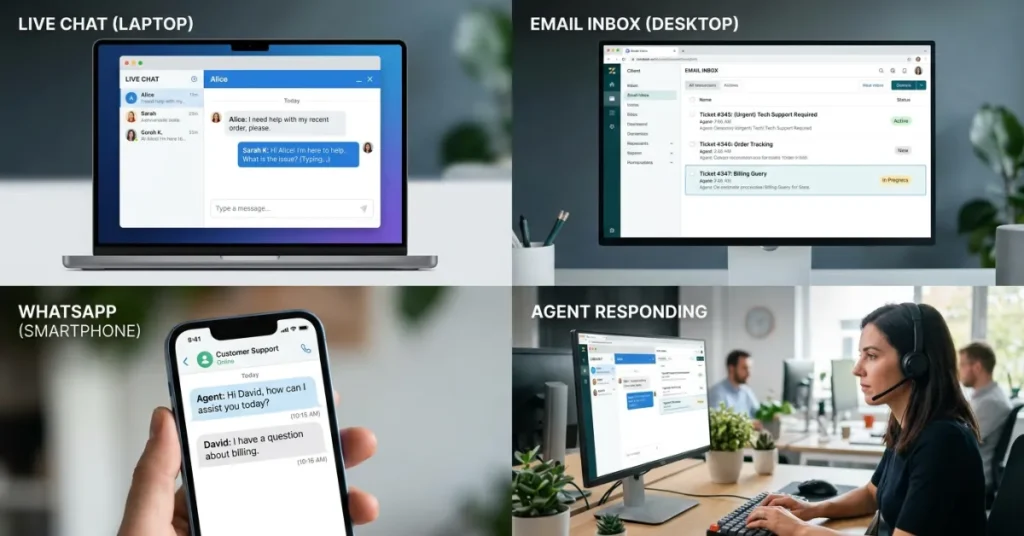
Use omnichannel support systems
When a customer reaches out, whether through email, WhatsApp, live chat, or social media, they expect a consistent and fast reply. An omnichannel support system connects all these platforms into one dashboard, so no message falls through the cracks. Tools like Freshdesk, Zendesk, and Intercom let your team manage all customer touchpoints from a single interface.
Set clear response time standards
Your team needs defined benchmarks to work toward. Without them, response times are inconsistent, and customers feel ignored. A practical starting point:
- Live chat: respond within 2–5 minutes
- WhatsApp and social DMs: respond within 30–60 minutes
- Email: respond within 2–4 business hours
- Phone: answer within 3 rings or offer a callback
Use automation wisely
Chatbots and auto-responders handle routine queries well, FAQs, order status updates, and store hours. However, complex or emotional issues still need human agents. The key is knowing where to draw that line. A hybrid model of automation for speed and humans for empathy delivers the best results for service quality.
Example: A Dubai-based retail brand integrated WhatsApp Business with a CRM-linked chatbot. By automating initial responses and routing complex queries to agents within five minutes, they improved conversion rates by 30% and reduced cart abandonment. This is a practical illustration of how fast customer response directly affects revenue.
2. Personalize Every Customer Interaction
Use CRM systems effectively
A CRM (customer relationship management) system is one of the most powerful tools for delivering personalized customer experiences. Platforms like HubSpot, Zoho CRM, and Salesforce store each customer’s purchase history, preferences, past complaints, and communication style. When your team has this information at hand, they can skip the repetitive questions and go straight to solving the issue or making a relevant recommendation.
Segment your customers
Not all customers have the same needs. A loyal repeat buyer deserves a different conversation than a first-time visitor. Segmenting your customer base by behavior, purchase frequency, or service history allows you to send targeted communication and relevant offers. This reduces friction and significantly improves customer satisfaction scores.
Humanize every touchpoint
Using a customer’s name, referencing a past interaction, or acknowledging a previous issue shows that you see them as a person, not a ticket number. These small gestures build trust at scale, especially in markets like the UAE where personal relationships drive business decisions.
Example: A real estate agency in Dubai began using CRM-based follow-up sequences after property viewings. Agents sent personalized messages referencing the specific properties each client had visited. Within six months, repeat client referrals increased noticeably, and their average deal closure time shortened. Personalized customer experience, in their case, was a direct growth driver.
3. Train Staff for Better Communication and Empathy

Build customer-handling skills
Technical product knowledge is not enough on its own. Your team also needs to communicate clearly, stay calm under pressure, and respond to complaints without becoming defensive. Tone, pacing, and word choice can turn an angry customer into a loyal one or make a small complaint spiral into a public review.
Teach problem-solving, not transfer culture
A common mistake in customer service teams is defaulting to “let me transfer you” at the first sign of difficulty. Training staff to own the problem and gathering enough information to resolve it, or escalating effectively, dramatically reduces customer frustration. Empower your agents with decision-making authority for common scenarios so they do not need to escalate every small issue.
Run regular training programs
Customer support training should not be a one-time onboarding exercise. Monthly role-play scenarios, recorded call reviews, and workshops on emotional intelligence keep skills sharp. The best-performing service teams treat training as an ongoing investment, not a checkbox.
Example: Several hospitality businesses in Abu Dhabi began incorporating emotional intelligence training into their quarterly staff development cycles. Guest satisfaction scores measured through TripAdvisor and Google Reviews improved significantly within two review periods. Guests noted staff responsiveness and genuine care as standout qualities, attributes that are directly tied to employee communication skills.
4. Collect and Use Customer Feedback Effectively
Use surveys and feedback forms
Post-purchase or post-service surveys are one of the simplest ways to identify gaps in your customer experience. Keep them short, three to five questions, and send them immediately after a transaction while the experience is still fresh. Net Promoter Score (NPS) surveys and CSAT (customer satisfaction) scores give you clean, trackable data over time.
Monitor online reviews actively
Google Reviews, Trustpilot, and social media comments are a real-time window into how your customers feel. Designate a team member to monitor these channels daily. Responding to reviews, especially negative ones, shows both the reviewer and future customers that you take service quality seriously. A prompt, professional response to a complaint often does more for your reputation than ten positive reviews.
Act on feedback quickly and visibly
Collecting feedback means nothing if it does not drive change. When customers see that their input led to an actual improvement, a faster delivery, a revised process, or a new policy, it builds extraordinary loyalty. Sharing these changes (“Based on your feedback, we now…”) turns a service interaction into a relationship.
Example: A logistics company in Sharjah began analyzing Google Reviews and post-delivery SMS surveys after noticing a pattern of complaints about late updates. They built a simple automated SMS notification triggered at each delivery stage. Within three months, their average review rating rose by nearly a full star, and repeat business from corporate clients increased. Customer feedback, applied systematically, directly improved their bottom line.
Common Mistakes Businesses Make in Customer Service
Even well-intentioned teams fall into patterns that quietly erode the customer experience. Watch out for these:
- Ignoring or deleting negative reviews
- Slow response times with no acknowledgment
- One-time staff training with no follow-up
- No system to collect or act on feedback
- Over-reliance on automation for sensitive issues
- Generic, copy-paste replies with no personalization
Tools That Support Excellent Customer Service in 2026
The right tools make execution consistent and scalable. Here are categories worth investing in:
- CRM platforms (HubSpot, Zoho CRM)
- Helpdesk systems (Freshdesk, Zendesk)
- Live chat tools (Intercom, Tidio)
- AI chat assistants
- Social media monitoring tools
- Survey tools (Typeform, SurveyMonkey)
- WhatsApp Business API
- Review management platforms
Ripple Business Setup – Trusted Support for Business Formation in the UAE
Ripple Business Setup helps entrepreneurs and companies start and manage their business in the UAE with clear guidance and smooth processes. The focus is on company formation, trade license support, visa assistance, and ongoing business setup services for startups and established firms. The team supports clients through each step, making the process simple and less time-consuming, especially for foreign investors entering the UAE market.
For direct assistance, contact Ripple Business Setup at +971 50 593 8101, email info@ripplellc.ae, or WhatsApp +971 4 250 0833 for quick support and consultation.
Conclusion
Delivering excellent customer service is one of the strongest ways to grow and sustain a business in 2026. Companies that focus on fast response times, personalized communication, well-trained staff, and continuous feedback improvement build stronger trust with their customers. These practices not only improve satisfaction but also increase loyalty and long-term revenue.
Disclaimer: This content is for informational purposes only. Business regulations in the UAE may change, so it is recommended to confirm all requirements with official authorities or licensed consultants before making any business decisions.