Introduction
The UAE has long been one of the world’s most dynamic trade corridors. Sitting at the crossroads of Asia, Europe, and Africa, cities like Dubai and Abu Dhabi have evolved into powerhouse logistics hubs that process billions of dollars in goods every single year. In 2024 alone, UAE non-oil trade surpassed AED 3 trillion, and that number continues to climb.
But here is what many businesses learn the hard way: moving goods across UAE borders is only as smooth as your paperwork. A missing certificate, an incorrectly classified HS code, or an expired trade license can bring an entire shipment to a standstill at customs. In a market where speed and reliability drive competitive advantage, documentation is not a formality; it is your first line of business continuity.
What is Import Export in the UAE?
At its simplest, import and export refer to the movement of physical goods across international borders, goods arriving in the UAE (imports) and goods leaving it (exports). This happens daily through major ports like Jebel Ali in Dubai, Khalifa Port in Abu Dhabi, and Sharjah and Ras Al Khaimah ports, as well as through cargo terminals at Dubai International Airport and Abu Dhabi International Airport.
Why UAE is a Global Trade Hub
The UAE’s position as a global trade hub is not accidental; it is the result of deliberate investment in infrastructure, policy, and geography.
The country sits at a strategic midpoint between Asia, Europe, and Africa, making it a natural re-export centre. Over 40 free zones, including Jebel Ali Free Zone (JAFZA) and Dubai Multi Commodities Centre (DMCC), offer tax incentives, full foreign ownership, and simplified customs procedures that attract logistics companies and trading businesses from around the world. Combine this with world-class port infrastructure and 24/7 customs processing at major entry points, and you have an ecosystem built for high-volume international trade.
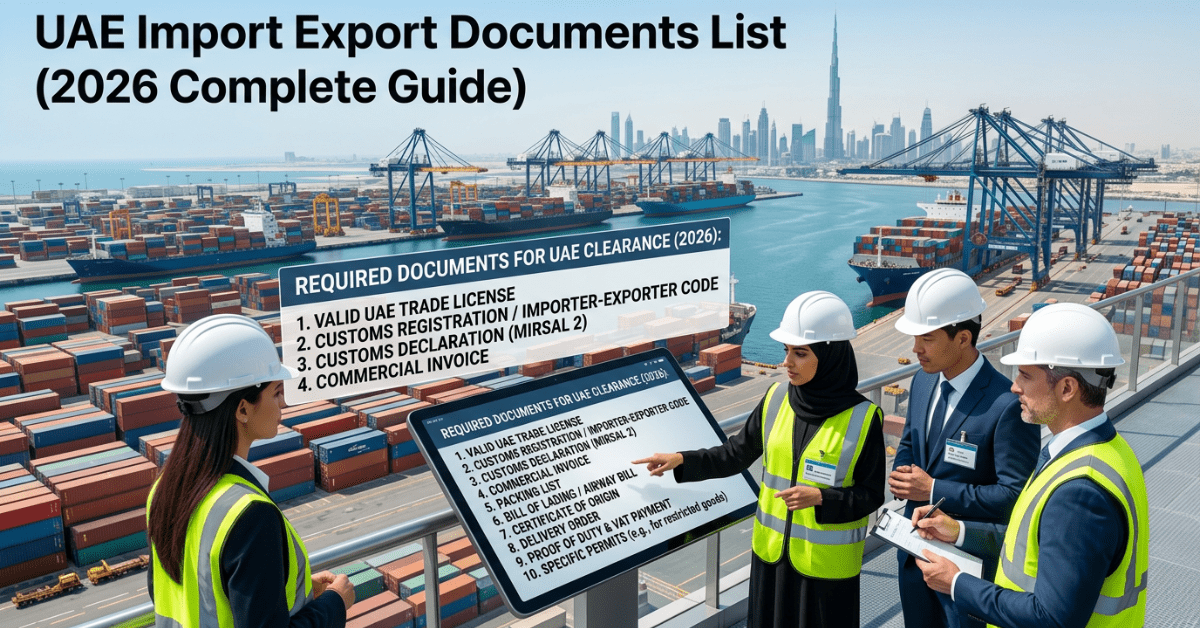
Complete UAE Import Export Documents List (2026)

Basic Required Documents for Import
When goods arrive in the UAE, the Federal Customs Authority and emirate-level customs bodies require a standard set of documents before releasing any shipment. Understanding each one helps you prepare accurately and avoid delays.
The commercial invoice is the foundation of any import declaration. It must include the seller’s and buyer’s full details, a clear description of goods, unit pricing, total value, and the currency of the transaction. Customs uses this document to assess duties, so any inconsistency between the invoice and the actual shipment will trigger an inspection or hold.
The packing list works alongside the invoice and provides the physical breakdown of the shipment, including the number of packages, weight, dimensions, and contents of each box or pallet. While it carries no monetary value itself, it allows customs officers to verify that the goods match what was declared.
The bill of lading (for sea freight) or air waybill (for air cargo) is the contract of carriage between the shipper and the carrier. It serves as proof of ownership during transit and is required to take possession of goods upon arrival. Original bills of lading are often needed for sea shipments; copies are typically sufficient for air.
The certificate of origin confirms in which country the goods were manufactured. In the UAE, this is particularly important because the Gulf Cooperation Council (GCC) has preferential trade agreements with several countries, and duty rates can differ significantly based on origin. The certificate is usually issued by the Chamber of Commerce in the exporting country.
Finally, an import permit is required for specific categories of goods, including controlled foodstuffs, medical devices, telecoms equipment, and items subject to Ministry of Health or Telecommunications and Digital Government Regulatory Authority (TDRA) approvals. Not every shipment needs a permit, but if your product category falls under a regulated sector, you must obtain one before the goods arrive.
Basic Required Documents for Export
Exporting from the UAE follows a parallel but distinct documentation trail.
The export declaration is filed electronically through the UAE’s customs systems (such as Dubai Trade or ADJD for Abu Dhabi) and formally registers the outbound shipment. It captures the exporter’s details, commodity codes, destination country, and declared value.
The commercial invoice and packing list are required on the export side as well, serving the same verification and valuation purposes they do for imports. The shipping instructions communicate to the freight carrier exactly how the goods should be handled, routed, and labelled including any special handling requirements.
A certificate of origin is also commonly required for exports, particularly when the destination country needs to verify UAE origin to apply any applicable preferential duty rates under trade agreements.
Special Documents Based on Goods Type
Certain product categories require additional clearances beyond the standard set:
- Food products: A health certificate from the UAE’s Ministry of Climate Change and Environment, confirming the goods meet safety and hygiene standards.
- Electronics: A conformity certificate from the Emirates Authority for Standardisation and Metrology (ESMA) or relevant body, confirming the product meets UAE technical standards.
- Chemicals: A Safety Data Sheet (SDS) and, in some cases, approval from the Ministry of Climate Change and Environment for hazardous materials.
- Pharmaceuticals: Approvals from the UAE Ministry of Health and Prevention (MOHAP), as well as import permits for controlled substances.
- Weapons and dual-use goods: Strict licensing from the Strategic Goods Regulation is mandatory.
UAE Import Export License Requirements
You cannot legally trade goods commercially in the UAE without a valid trade license. This is not simply a bureaucratic formality operating without one exposes you to penalties, shipment seizures, and potential deregistration.
The UAE differentiates between mainland and free zone licensing structures, and each has different implications for where you can operate and what documentation applies.
Types of Trade Licenses
A mainland trade license is issued by the Department of Economic Development (DED) in each emirate and allows you to conduct business anywhere in the UAE and internationally. For most general trading activities, this is the most flexible option. Mainland companies are also required to have a UAE national partner holding at least 51% ownership in certain sectors, though this requirement has been relaxed in many industries following the 2020 foreign ownership law reforms.
A free zone trade license is issued by the free zone authority of the specific zone where you establish your business, such as JAFZA, DMCC, or DIFC. Free zone companies benefit from 100% foreign ownership, full profit repatriation, and customs duty exemptions within the zone. However, to sell directly to the UAE mainland market, they typically need to work through a local distributor or appoint a mainland agent.
An offshore company license allows for international business and asset holding but does not permit trading activities within the UAE directly.
Choosing the right license type affects your customs clearance process, VAT registration obligations, and the documents you will need for each shipment.
Customs Clearance Process in UAE (Step-by-Step)
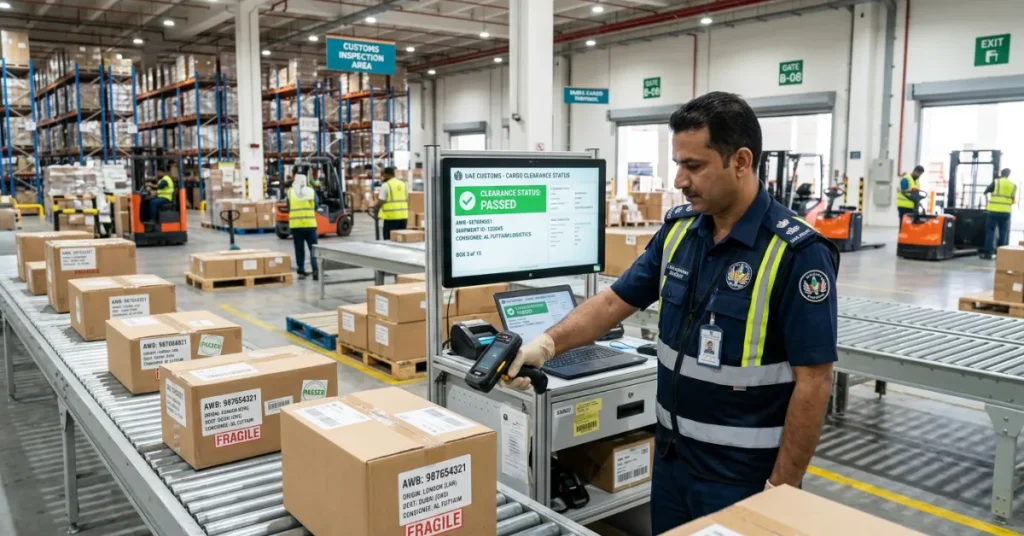
The UAE customs clearance process is well-structured and largely digital, but each stage has requirements that must be met in order.
Step 1: Submit Documents
The importer or their licensed customs clearance agent submits the required documents electronically through the relevant emirate customs portal Dubai Trade for Dubai shipments, or ADJD for Abu Dhabi. This includes the commercial invoice, packing list, bill of lading or air waybill, certificate of origin, and any permits or approvals relevant to the goods category.
Step 2: Inspection by Customs
Once documents are submitted and the declaration is registered, customs officers assess whether a physical inspection is needed. Many shipments clear based on documentation alone using the UAE’s risk-based clearance system. However, if the goods are flagged due to the commodity type, origin country, or declared value, a physical or scanning inspection will be conducted at the port.
Step 3: Duty Payment
Standard customs duty in the UAE is 5% of the CIF (cost, insurance, and freight) value of goods for most products. Certain items attract higher rates of alcohol; for instance, they carry a 50% duty, and tobacco products face 100%. Once the duty is assessed, the importer pays through the customs portal before goods can be released.
Step 4: Release of Goods
After payment confirmation, customs issues a release order and the goods can be collected from the port or airport. The full process for standard shipments can take anywhere from a few hours to two or three working days, depending on whether an inspection is required and how quickly documentation is in order.
Key Authorities Involved in UAE Import Export
Several government bodies share oversight of UAE import export activities, and knowing who is responsible for what can save you significant time when resolving issues.
The Federal Customs Authority (FCA) sets the overarching customs policy and coordinates between the UAE’s individual emirate-level customs departments. Dubai Customs operates under the Roads and Transport Authority framework and handles one of the highest volumes of any customs body in the region. Abu Dhabi Customs (under ADJD) oversees the capital’s ports and land entry points. The Ministry of Economy UAE governs trade policy, free trade agreement implementation, and oversees import/export permit requirements for regulated sectors.
Common Mistakes in UAE Import Export Documentation
Even experienced traders run into documentation problems. The most frequent ones include:
- Missing or incomplete commercial invoice details, such as no HS code, vague product descriptions, or no declared origin
- Incorrect HS (Harmonised System) code classification, which can lead to the wrong duty rate being applied or a shipment being flagged for inspection
- A certificate of origin that does not match the goods description on the invoice
- A packing list that does not reconcile with the invoice quantities or weights
- Expired or missing import permits for regulated goods categories
- Delayed trade license renewals, which can pause all customs transactions linked to the company
These are not edge cases; they are the most common reasons for shipment delays and customs fines in the UAE.
UAE Import Export Regulations You Must Know
The regulatory landscape for UAE trade continues to evolve. A few key areas deserve attention for businesses operating in 2026.
- VAT on imports applies at the standard 5% rate and is calculated on the declared customs value. Businesses registered for VAT in the UAE can recover import VAT through their regular VAT return filing, making VAT registration a practical necessity for most trading companies.
- Customs duty remains 5% for most goods under the GCC Common Customs Law, but rates for excise goods (tobacco, sweetened beverages, energy drinks) have been revised upward in recent years. Always verify current rates for your specific HS code before shipping.
- Country of origin rules are increasingly scrutinised, particularly for goods arriving via third-party logistics hubs. If goods are substantially transformed in a transit country, the origin declaration must reflect the final country of transformation, not the original manufacturing source.
- Economic Substance Requirements and anti-money laundering regulations also affect how trading companies must structure and document their transactions, especially in free zones.
Benefits of Proper Import Export Documentation
Getting your documentation right is not just about avoiding problems; it actively supports business growth.
- Faster customs clearance shortens your supply chain cycle and improves delivery reliability
- Accurate paperwork reduces the risk of fines, penalties, and potential shipment confiscation
- Clean compliance records make it easier to obtain future permits and licenses
- A well-documented trade operation builds credibility with suppliers, buyers, and banks, who provide trade finance
Checklist for UAE Import Export Documents
Before your next shipment, confirm you have the following in order:
- Valid and current UAE trade license
- Commercial invoice with HS code, full product description, and declared values
- Packing list matching the invoice quantities and weights
- Bill of lading or air waybill
- Certificate of origin (issued by the Chamber of Commerce in the exporting country)
- Import or export permits (where applicable to your product category)
- Any sector-specific approvals (ESMA, MOHAP, TDRA, etc.)
How Ripple Business Setup Can Help
Navigating UAE import export requirements takes time, local knowledge, and attention to detail that can be difficult to manage alongside the demands of running a business. Ripple Business Setup specialises in helping companies get their trade licensing, customs documentation, and compliance frameworks in place from day one.
Whether you are setting up a new trading company, dealing with a customs query, or preparing documentation for a regulated goods shipment, the team at Ripple Business Setup can guide you through the process efficiently.
Get in touch:
- 📞: +971 50 593 8101
- 📧: info@ripplellc.ae
- 💬: +971 4 250 0833
FAQs
What are the main documents required for UAE import?
The core documents for UAE imports are the commercial invoice, packing list, bill of lading or air waybill, and certificate of origin. Depending on the goods category, you may also need import permits, ministry approvals, or conformity certificates.
Do I need a license for import export in UAE?
Yes, you need a valid UAE trade license, either a mainland license from the relevant emirate’s DED or a free zone trade license, before you can legally carry out import or export activities commercially.
How long does customs clearance take in UAE?
For standard shipments with complete and accurate documentation, UAE customs clearance typically takes between a few hours and two working days. Shipments that require physical inspection or are missing documents can take considerably longer.
What is the certificate of origin used for?
The certificate of origin confirms the country in which the goods were manufactured. UAE customs uses it to determine the applicable duty rate, particularly under GCC preferential trade agreements, and to verify that goods comply with import origin requirements.
Conclusion
Successful UAE import export operations rest on one foundation: accurate, complete, and timely documentation. The UAE’s customs system is sophisticated and largely digital, which means it processes compliant shipments quickly and flags non-compliant ones efficiently. Businesses that invest time in understanding the document requirements for their specific goods category, maintaining valid licenses, and staying current with regulatory updates will consistently outperform those who treat paperwork as an afterthought.
Disclaimer: The information provided in this article, “UAE Import Export Documents List (2026 Complete Guide)”, is for general informational purposes only. While every effort has been made to ensure accuracy and reliability, rules, regulations, and requirements related to import and export in the UAE may change over time based on government updates and policy changes.