


Introduction
Value Added Tax (VAT) in the UAE is not just about filing returns; it is equally about maintaining accurate and complete records. Every VAT-registered business must follow strict rules set by the Federal Tax Authority (FTA) to ensure transparency, accuracy, and compliance.
Poor record-keeping can lead to penalties, rejected VAT claims, and even audits that disrupt business operations. This is why understanding VAT Records, Compliance, Accounting is essential for every business owner, accountant, and financial manager in the UAE.
What Are VAT Records in the UAE?
VAT records are all financial and transactional documents that support a business’s VAT activities. These records show how VAT is collected, calculated, and paid to the government.
In simple terms, VAT records act as proof of every taxable transaction your business performs.
These include:
- Sales invoices issued to customers
- Purchase invoices from suppliers
- VAT returns filed with FTA
- Import and export documents
- Accounting books and ledgers
Under UAE VAT law, these records must clearly support every number reported in VAT returns. Without proper documentation, your business risks compliance issues during an FTA review.
Why VAT Record-Keeping is Important for Compliance
Maintaining proper VAT records is not optional; it is a legal requirement under UAE tax regulations. The Federal Tax Authority requires businesses to ensure transparency in all financial reporting.
Strong record-keeping helps businesses:
- Stay fully compliant with UAE VAT laws
- Avoid penalties and fines from FTA audits
- Support accurate VAT return filing
- Improve financial transparency and credibility
- Make business accounting more structured and reliable
Good records also make it easier to identify errors early, reducing the risk of tax disputes or incorrect filings.
Mandatory VAT Records UAE Businesses Must Maintain
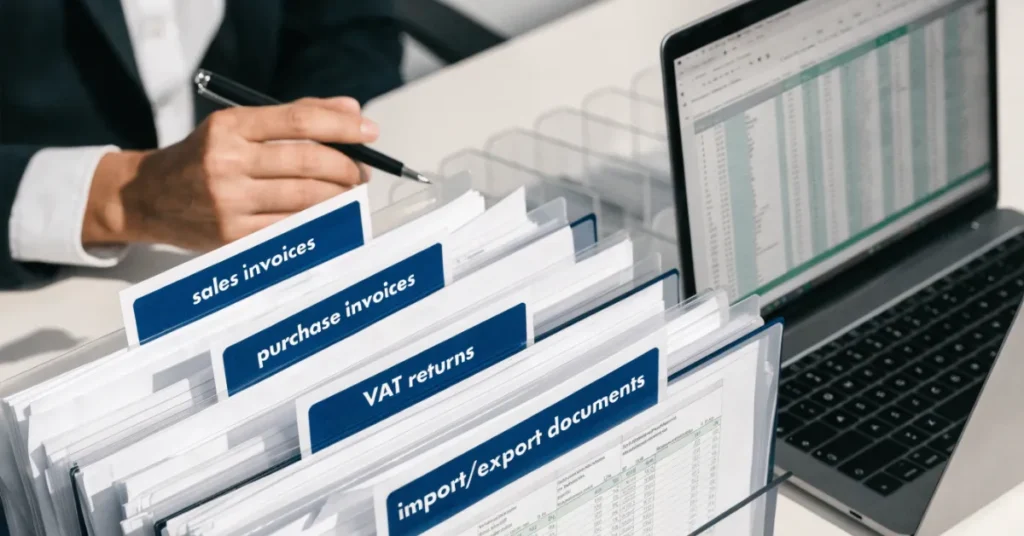
To remain compliant, UAE businesses must maintain several categories of VAT-related documents. Each document plays a key role in supporting tax filings.
Sales and Purchase Invoices
Invoices are the foundation of VAT compliance. Every transaction must be backed by a valid tax invoice.
- Sales invoices show VAT charged to customers
- Purchase invoices show VAT paid to suppliers
- All invoices must follow FTA formatting rules
Accurate invoicing ensures correct VAT calculation and prevents reporting errors.
VAT Returns and Adjustments
VAT returns summarize your business’s tax activity over a specific period. These must be carefully stored along with supporting documents.
- Quarterly VAT return filings
- Adjustments for corrections or errors
- Refund or penalty records
These documents are often reviewed during FTA audits.
Import and Export Documents
Businesses involved in international trade must maintain customs and shipping records.
- Import declarations and customs documents
- Export invoices and shipping bills
- Proof of VAT paid on imports
These records ensure correct treatment of cross-border VAT.
Accounting Books and Ledgers
Accounting records provide a complete financial overview of your business.
- General ledger
- Profit and loss statements
- Balance sheets
These records help reconcile VAT filings with actual business performance.
Credit and Debit Notes
Credit and debit notes are used when invoice corrections are required.
- Credit notes reduce VAT liability
- Debit notes increase VAT liability
- Both must be properly documented and linked to original invoices
These adjustments must always be traceable in accounting systems.
How Long Should VAT Records Be Stored in UAE?
According to UAE VAT law, businesses must retain VAT records for a minimum of five years. However, some cases require longer retention periods.
Key rules include:
- Standard businesses: 5 years minimum
- Real estate businesses: up to 15 years
- Capital assets: longer retention depending on usage
Best practice:
- Store both digital and physical copies
- Use cloud accounting systems for backup
- Ensure records are easily accessible during audits
Proper storage ensures compliance and protects your business during FTA inspections.
Common VAT Record-Keeping Mistakes UAE Businesses Make
Many businesses unintentionally fail compliance due to poor accounting practices. These mistakes can lead to penalties and audit issues.
Common mistakes include:
- Missing or incomplete invoices
- Poor or outdated bookkeeping systems
- Mixing business and personal expenses
- Delayed record updates
- Ignoring digital accounting tools
Even small errors can lead to major compliance risks during VAT filing.
Best Practices for VAT Compliance and Accounting Accuracy
Maintaining accurate VAT records becomes easier with the right systems and habits.
Use Digital Accounting Software
Modern accounting tools automate VAT tracking and reduce human error. They also generate real-time financial reports.
Maintain Monthly Record Updates
Updating records monthly prevents backlog and makes VAT filing smoother.
Separate Business and Personal Transactions
This ensures clean financial reporting and avoids confusion during audits.
Conduct Regular Internal Audits
Internal checks help identify errors before FTA reviews them.
These practices improve financial accuracy and strengthen compliance.
VAT Audit Process in the UAE

The Federal Tax Authority may conduct audits to verify VAT accuracy and compliance.
During an audit, businesses may be required to provide:
- Sales and purchase invoices
- VAT return filings
- Accounting books
- Import/export documents
- Bank statements
The FTA checks whether reported VAT matches actual business records. Any mismatch can result in penalties or further investigation.
Impact of Poor VAT Record-Keeping on Businesses
Weak record management can seriously affect business operations.
Possible consequences include:
- Heavy financial penalties
- VAT return rejection or correction requests
- Legal compliance issues
- Delays in VAT refunds
- Loss of business reputation
In extreme cases, repeated non-compliance may trigger deeper tax investigations.
VAT Records Checklist for UAE Businesses
To stay compliant, ensure you maintain the following:
- Sales invoices
- Purchase invoices
- VAT returns
- Import/export documents
- Credit and debit notes
- Financial statements
- Bank statements
- Accounting ledgers
This checklist ensures your business remains audit-ready at all times.
Expert Tip for Better VAT Compliance
Many UAE businesses improve compliance by working with professional accountants or VAT consultants. Expert support ensures:
- Accurate VAT filing
- Proper record classification
- Reduced risk of errors
- Better financial planning
Using cloud-based accounting systems further improves efficiency and transparency.
Ripple Business Setup – Expert Business Formation & Compliance Support in UAE
Ripple Business Setup provides professional support for business formation, VAT compliance, accounting, and corporate tax services across the UAE. Whether you are starting a new company or managing ongoing tax obligations, their expert consultants help ensure smooth setup and full regulatory compliance with UAE laws.
For assistance, contact Ripple Business Setup at +971 50 593 8101, email info@ripplellc.ae, or WhatsApp +971 4 250 0833 for quick consultation and support tailored to your business needs.
FAQs
1. What are VAT records in the UAE?
VAT records are financial documents that support a business’s taxable transactions, including invoices, receipts, VAT returns, and accounting ledgers required by the FTA.
2. How long should VAT records be kept in the UAE?
Businesses must keep VAT records for at least 5 years. Some sectors, like real estate, may require longer retention periods as per UAE tax regulations.
3. What documents are required for VAT compliance?
Key documents include sales and purchase invoices, VAT returns, credit and debit notes, import/export records, and complete accounting books.
4. What happens if VAT records are not maintained properly?
Poor record-keeping can lead to penalties, VAT return rejection, audit issues, delayed refunds, and legal compliance problems with the Federal Tax Authority.
5. Who is responsible for maintaining VAT records?
The business owner is ultimately responsible, but accountants or tax consultants usually manage VAT record-keeping and ensure compliance with UAE VAT laws.
6. Can digital records be used for VAT compliance in the UAE?
Yes, digital records are accepted as long as they are accurate, complete, and accessible during audits. Many businesses use accounting software for better compliance.
7. Why is VAT compliance important for businesses?
VAT compliance ensures businesses avoid fines, maintain legal standing, improve financial accuracy, and build trust with authorities and stakeholders.
Conclusion
Understanding and maintaining proper VAT Records, Compliance, Accounting is essential for every UAE business. Accurate record-keeping not only ensures legal compliance but also strengthens financial control and business credibility. With proper systems, regular updates, and awareness of FTA requirements, businesses can avoid penalties and operate with confidence in the UAE tax environment.
Disclaimer: The information provided in this article is for general educational purposes only and does not constitute legal, tax, or financial advice. Businesses should consult a qualified tax advisor or the Federal Tax Authority (FTA) for specific compliance requirements.