


The UAE has established itself as one of the world’s leading business destinations. With thousands of companies operating across Free Zones and the Mainland, regulatory compliance has become increasingly important. One of the key compliance frameworks introduced in recent years is the Economic Substance Regulations (ESR).
Understanding ESR is essential for businesses that engage in specific activities within the UAE. Whether you operate a Free Zone company or a Mainland business, compliance with ESR can directly impact your accounting practices, VAT obligations, and overall regulatory standing.
What Are Economic Substance Regulations (ESR) in the UAE?
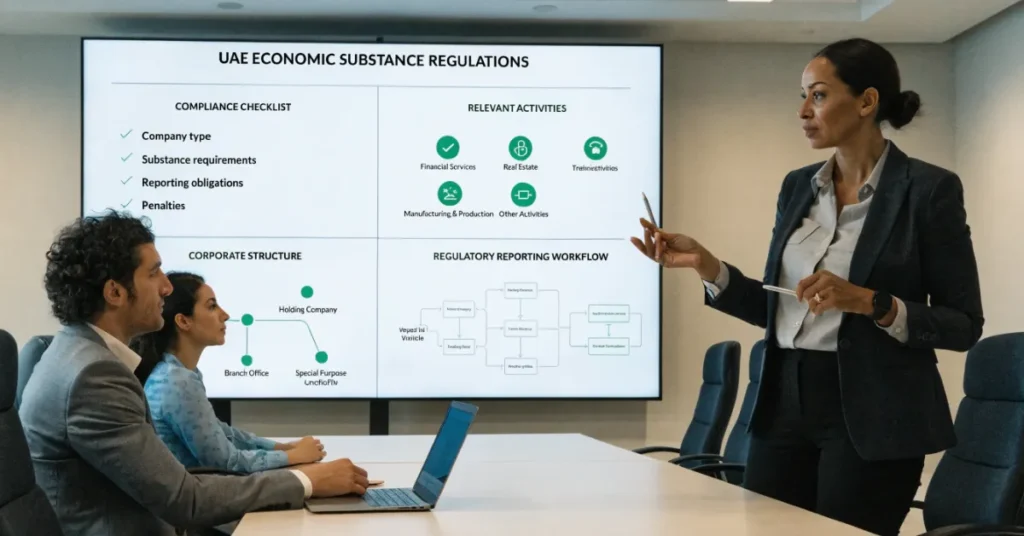
Economic Substance Regulations (ESR) are compliance requirements introduced by the UAE government to ensure that businesses conducting certain activities maintain adequate economic presence within the country.
The regulations were implemented in response to international tax transparency initiatives led by organizations such as the Organisation for Economic Co-operation and Development (OECD) and the European Union. The objective is to prevent companies from shifting profits to low-tax jurisdictions without conducting genuine economic activities.
Under ESR, businesses carrying out specific “Relevant Activities” must demonstrate that they have sufficient employees, expenditures, management activities, and physical presence in the UAE.
The regulations apply to both Free Zone and Mainland entities, depending on the nature of their activities.
Why Were Economic Substance Regulations Introduced?
The introduction of ESR was part of the UAE’s commitment to maintaining international tax compliance standards.
Several key objectives led to the implementation of ESR:
- Improve tax transparency.
- Prevent harmful tax practices.
- Reduce artificial profit shifting.
- Enhance investor confidence.
- Strengthen the UAE’s global business reputation.
- Align with OECD and international compliance frameworks.
ESR Development Timeline
| Year | Development |
|---|---|
| 2019 | ESR introduced in the UAE |
| 2020 | Updated ESR guidance and amendments |
| 2022 | Increased focus on compliance reviews |
| 2023+ | Alignment with Corporate Tax framework |
Today, ESR forms an important part of the UAE’s broader regulatory environment alongside VAT and Corporate Tax requirements.
Which Businesses Must Comply with ESR in the UAE?
Not every business is required to meet Economic Substance Test requirements. ESR applies primarily to entities conducting specific Relevant Activities.
Relevant Activities Under ESR
Businesses involved in the following activities may fall within ESR requirements:
- Banking Business
- Insurance Business
- Investment Fund Management Business
- Lease-Finance Business
- Headquarters Business
- Shipping Business
- Holding Company Business
- Intellectual Property Business
- Distribution and Service Centre Business
If a company earns income from any of these activities, it may need to submit ESR notifications and reports.
Exempted Entities
Certain entities may qualify for exemptions, including:
- Government-owned entities
- Certain investment funds
- Tax resident entities outside the UAE
- Foreign branches whose income is taxed abroad
- Other entities meeting exemption criteria under UAE regulations
Businesses should conduct an annual ESR assessment to determine whether they fall under reporting obligations.
ESR Requirements for Free Zone Companies
Many entrepreneurs assume that Free Zone companies are automatically exempt from ESR requirements. This is a common misconception.
Free Zone businesses conducting Relevant Activities must comply with ESR unless they qualify for a specific exemption.
ESR Compliance Requirements for Free Zone Businesses
Free Zone companies may need to:
- File annual ESR notifications.
- Assess Relevant Activities.
- Maintain adequate accounting records.
- Demonstrate economic substance.
- Submit ESR reports where applicable.
- Maintain supporting documentation.
Common Compliance Challenges
Many Free Zone companies face issues such as:
- Misinterpreting exemption criteria.
- Poor bookkeeping practices.
- Missing filing deadlines.
- Insufficient operational evidence.
- Inadequate record retention.
Maintaining proper accounting systems is critical for successful ESR compliance.
ESR Requirements for Mainland Companies
Mainland businesses are also subject to ESR regulations when they engage in Relevant Activities.
Although Mainland companies generally have broader market access within the UAE, they must meet the same substance requirements as Free Zone entities when ESR applies.
Mainland Business Obligations
Companies may be required to:
- Conduct annual ESR assessments.
- File notifications on time.
- Submit reports when required.
- Maintain accounting documentation.
- Demonstrate management and operational substance.
Common Compliance Mistakes
Mainland businesses frequently encounter challenges such as:
- Incorrect activity classification.
- Lack of supporting evidence.
- Weak internal accounting controls.
- Failure to maintain proper records.
- Late ESR submissions.
A proactive compliance strategy helps businesses avoid unnecessary penalties.
Free Zone vs Mainland, Accounting, VAT – How ESR Impacts Business Operations

One of the most overlooked aspects of ESR is its connection to accounting and VAT compliance.
Although ESR, VAT, and Corporate Tax are separate regulations, they all depend on accurate financial reporting and documentation.
Accounting Requirements Under ESR
Proper accounting plays a critical role in demonstrating economic substance.
Businesses should maintain:
- Accurate bookkeeping records.
- Financial statements.
- Expense documentation.
- Revenue records.
- Payroll information.
- Management meeting records.
Without reliable accounting systems, proving compliance can become difficult during regulatory reviews.
VAT Compliance and ESR Connection
VAT compliance supports ESR by creating a clear financial audit trail.
Businesses should maintain:
- VAT registration certificates.
- VAT return submissions.
- Tax invoices.
- Input and output VAT records.
- Supporting transactional documents.
Strong VAT compliance demonstrates operational activity and enhances transparency.
Corporate Tax and ESR Relationship
The UAE Corporate Tax regime has increased the importance of financial transparency.
Both ESR and Corporate Tax require businesses to maintain:
- Proper accounting records.
- Financial reporting systems.
- Documentation supporting business activities.
- Evidence of commercial substance.
Companies that establish robust accounting processes can manage ESR, VAT, and Corporate Tax requirements more efficiently.
Compliance Comparison: Free Zone vs Mainland
| Compliance Area | Free Zone | Mainland |
|---|---|---|
| ESR Filing | Applicable if Relevant Activities exist | Applicable if Relevant Activities exist |
| VAT Registration | Threshold-based | Threshold-based |
| Accounting Records | Mandatory | Mandatory |
| Corporate Tax Compliance | Applicable | Applicable |
| Annual Record Maintenance | Required | Required |
Understanding these similarities helps businesses build a unified compliance framework rather than managing each regulation separately.
Understanding the Economic Substance Test in the UAE
The Economic Substance Test is the core requirement under ESR. It determines whether a business has a real economic presence in the UAE rather than just a legal registration.
To pass the test, companies must show that they carry out core business activities within the country and are not merely using the UAE as a nominal base.
Core Income Generating Activities (CIGA)
CIGA refers to the essential activities that generate income for a business. These activities vary depending on the nature of the business but generally include:
- Strategic decision-making by directors or management
- Business operations and execution of key functions
- Revenue generation and client management
- Contract negotiation and approval
- Risk management and operational control
These activities must physically take place in the UAE to meet ESR requirements.
Adequate Substance Requirements
To satisfy ESR, businesses must demonstrate sufficient economic presence through:
- A physical office or commercial space in the UAE
- Qualified employees performing core activities
- Operational expenditure within the UAE
- Effective management and control from within the country
Companies that fail to meet these requirements may be considered non-compliant.
ESR Notification and Reporting Requirements
All in-scope entities must comply with ESR filing obligations annually.
ESR Notification
Businesses must first submit an ESR notification, which includes:
- Confirmation of whether Relevant Activities are conducted
- Basic company information
- Financial year details
- Declaration of exemption (if applicable)
The notification is mandatory even if the company has no income from Relevant Activities.
ESR Report Submission
If a company is in scope, it must also submit an ESR report, which includes:
- Detailed financial and operational information
- Evidence of core income generating activities
- Employee and expense details
- Supporting documentation for substance testing
Failure to submit accurate reports may lead to regulatory action.
Penalties for Non-Compliance with ESR
Non-compliance with ESR regulations can result in serious consequences for businesses operating in the UAE.
Financial Penalties
Companies may face:
- Fixed administrative fines for late or missing notifications
- Higher penalties for failure to submit ESR reports
- Increased fines for inaccurate or false information
Business Risks
Beyond financial penalties, ESR non-compliance can also lead to:
- License suspension or restrictions
- Increased regulatory scrutiny
- Reputational damage in the market
- Difficulties in banking or financial transactions
Maintaining compliance is essential for long-term business stability.
Practical Case Study: ESR Compliance for a UAE Trading Company
Consider a Free Zone trading company engaged in import and export activities.
Business Scenario
The company is registered in a Free Zone and generates income from distribution services across international markets. It also holds a valid VAT registration.
ESR Assessment
Since the company conducts “Distribution and Service Centre Business,” it falls under Relevant Activities.
Compliance Requirements
The company must:
- Submit ESR notification annually
- Maintain proper accounting records
- Demonstrate operational substance in the UAE
- Maintain employee and expense records
- Keep VAT and financial documentation aligned
Outcome
If the company maintains real office operations, staff, and financial activity in the UAE, it is likely to pass the Economic Substance Test successfully.
This example shows how accounting, VAT, and ESR compliance work together in real business operations.
Best Practices to Maintain ESR Compliance
To ensure smooth compliance, businesses should adopt a structured approach:
- Maintain accurate and updated accounting records
- Conduct annual ESR classification reviews
- Keep VAT documentation organized and audit-ready
- Monitor changes in business activities regularly
- Track ESR deadlines and filing requirements
- Maintain proper corporate governance records
- Ensure physical presence in the UAE where required
- Work with qualified accounting or compliance professionals
A proactive compliance system reduces regulatory risks significantly.
ESR, VAT, Corporate Tax & Accounting: A Unified Compliance Framework
ESR should not be treated as a standalone requirement. It is part of a broader compliance ecosystem that includes VAT and Corporate Tax.
Importance of Integrated Accounting
Strong accounting systems help businesses:
- Maintain accurate financial records
- Support VAT filings with correct data
- Provide evidence for ESR compliance
- Prepare for Corporate Tax assessments
Why Integration Matters
When ESR, VAT, and Corporate Tax are aligned:
- Compliance becomes easier and faster
- Risk of penalties is reduced
- Financial transparency improves
- Audit readiness increases
Businesses in the UAE should invest in structured bookkeeping and compliance systems to manage all three frameworks efficiently.
FAQ
Does every UAE company need to file ESR?
No. Only companies conducting Relevant Activities under ESR are required to file.
Are Free Zone companies exempt from ESR?
Not automatically. Free Zone companies must comply if they perform Relevant Activities.
What happens if ESR requirements are ignored?
Companies may face financial penalties, license restrictions, and regulatory action.
Is ESR linked with VAT compliance?
Indirectly yes. Both require accurate financial and operational records.
Does ESR apply to small businesses?
It depends on the type of activity, not company size.
What records should be maintained for ESR?
Financial statements, employee records, operational documents, and accounting data.
Conclusion
Economic Substance Regulations play a crucial role in ensuring that UAE businesses maintain genuine operational presence within the country. Whether a company operates in a Free Zone or on the Mainland, ESR compliance is closely linked with accounting accuracy, VAT reporting, and Corporate Tax obligations.
Disclaimer: This article is for informational purposes only and does not constitute legal or tax advice. Businesses should consult qualified professionals for compliance guidance.