AI bookkeeping is changing how businesses manage financial records, from invoice processing and transaction categorization to bank reconciliation and reporting. For small businesses and growing companies, automation can reduce repetitive work and help finance teams process transactions faster. However, faster processing does not automatically mean better bookkeeping. The strongest approach combines AI bookkeeping and automation with human review. AI can handle repetitive, predictable tasks, while accountants and finance professionals review exceptions, unusual transactions, significant adjustments, and areas that require professional judgment.
For UAE businesses, this distinction is especially important. Companies need reliable financial records and supporting documentation for tax and compliance purposes. The Federal Tax Authority (FTA) expects taxable persons to maintain financial statements and records supporting information reported in Corporate Tax filings.
What Is AI Bookkeeping and How Does Automation Work?
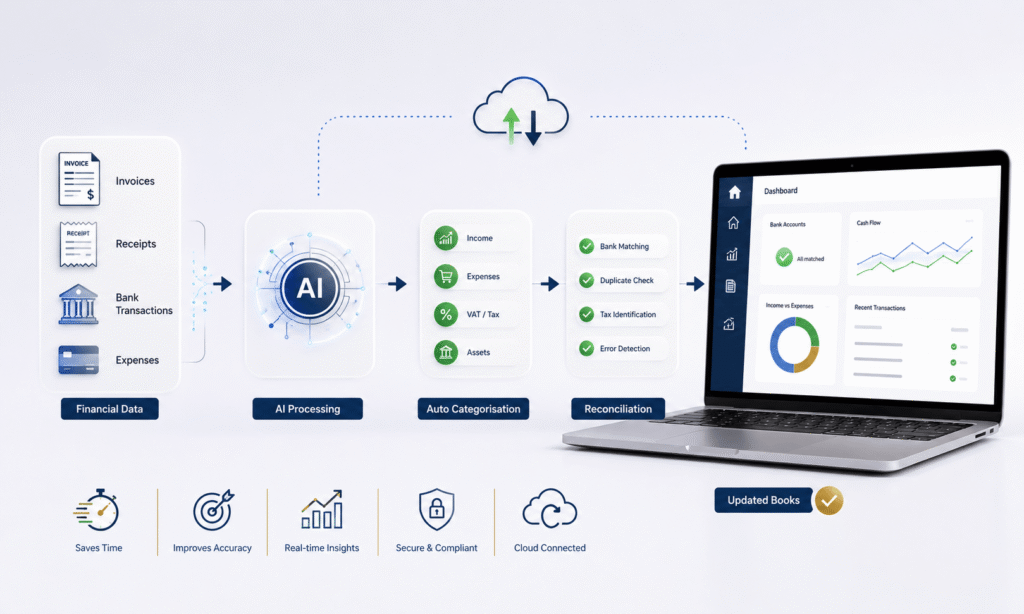
AI bookkeeping uses artificial intelligence, machine learning, data extraction, rules, and accounting integrations to automate parts of the bookkeeping process. Traditional bookkeeping often requires employees to manually enter invoices, classify transactions, reconcile accounts, and prepare recurring reports. AI-powered systems can automate or assist with many of these repetitive activities.
The goal is not to remove accountants from the process. Instead, businesses can use bookkeeping automation to reduce manual work while allowing finance professionals to focus on review, exceptions, analysis, and financial decisions.
What Tasks Can AI Bookkeeping Automate?
Depending on the software and configuration, AI bookkeeping tools can assist with:
- Invoice and receipt data extraction
- Automated data entry
- Transaction categorization
- Bank-feed processing
- Bank reconciliation
- Invoice matching
- Accounts payable workflows
- Accounts receivable reminders
- Expense classification
- Duplicate transaction detection
- Recurring transaction processing
- Financial reporting
- Exception identification
For example, an AI accounting system may read an invoice, extract the supplier name and amount, suggest an expense category, and match the transaction with a bank payment.
The accountant can then review the result rather than manually entering every field.
Why Businesses Are Moving Toward Bookkeeping Automation
Businesses increasingly deal with large volumes of invoices, bank transactions, receipts, expenses, and payment records. Processing every transaction manually can consume significant time, particularly as a company grows. Accounting automation helps finance teams handle repetitive processes more efficiently. The main benefit is not simply speed. A well-designed automated accounting workflow can create a more consistent process and give accountants more time to investigate transactions that actually need attention.
Key Benefits of AI Bookkeeping
AI bookkeeping automation can help businesses achieve:
- Faster transaction processing
- Less repetitive data entry
- More consistent transaction categorization
- Faster bank reconciliations
- Better cash-flow visibility
- More efficient month-end procedures
- Easier invoice processing
- Improved bookkeeping scalability
- More time for financial analysis
However, businesses should avoid assuming that automation guarantees perfect accuracy. AI systems depend heavily on the quality of the data, rules, integrations, and review process behind them.
Where AI Bookkeeping Can Go Wrong Without Human Review
AI bookkeeping can process large amounts of information quickly, but it does not understand every business transaction in the same way an experienced accountant does. An unusual transaction may look similar to a routine transaction even though it requires different accounting treatment. For this reason, businesses should treat AI-generated accounting results as information that may require validation—not as unquestionable decisions.
Common AI Bookkeeping Risks
Some common risks include:
- Incorrect transaction categorization
- Duplicate entries
- Incorrect invoice information
- Misclassified business expenses
- Missing supporting documents
- Incorrect treatment of unusual transactions
- Integration failures
- Poor-quality source data
- Incorrect automated rules
- Overreliance on AI recommendations
For example, an AI system may categorize a payment based on historical transactions. If the nature of the payment has changed, the system may continue applying the previous classification.
Without review, the error could flow into management reports or other accounting processes.
Why Human Review Still Matters
Human review provides the professional judgment that automation cannot reliably replace. An accountant can investigate why a transaction is unusual, determine whether supporting documentation exists, assess the accounting treatment, and decide whether an adjustment is appropriate. This approach is often described as human-in-the-loop accounting.
The principle is simple:
Let automation process routine transactions while people review transactions that require judgment.
How to Build Strong AI Bookkeeping Controls
Businesses should not simply activate every available automation feature. They should first establish clear bookkeeping controls that determine what the system can process automatically and what requires human approval.
A good control framework creates boundaries around automation.
1. Define Which Tasks AI Can Handle
Not every accounting activity has the same level of risk. Routine, predictable activities are generally better candidates for automation. Complex or judgment-based activities need stronger human oversight.
For example:
Lower-risk tasks
- Data extraction
- Recurring transactions
- Basic transaction matching
- Routine invoice processing
Higher-risk tasks
- Complex journal entries
- Significant accounting adjustments
- Unusual transactions
- Tax-sensitive transactions
- Related-party transactions
- Material financial adjustments
This risk-based approach allows businesses to benefit from automation without giving an AI system unnecessary authority over sensitive accounting decisions.
2. Set Review and Approval Rules
Businesses should define circumstances that automatically trigger human review.
For example, a company could require review when:
- A transaction exceeds a defined amount
- A new supplier appears
- A transaction has an unusual description
- A payment does not match an invoice
- A reconciliation fails
- A significant expense changes unexpectedly
- A manual journal entry is created
- A tax-sensitive transaction is identified
These accounting controls create a second layer of protection between automated processing and finalized financial information.
3. Use Exception-Based Review
One of the most effective ways to balance automation and review quality is exception-based review. Instead of manually checking every routine transaction, accountants can focus on transactions that fall outside established rules.
For example, the system may automatically process hundreds of routine bank transactions but flag:
- An unusually large payment
- A duplicate invoice
- A new vendor
- An unmatched transaction
- An unexpected account balance
- A significant month-on-month variance
This approach allows accountants to spend their time where professional judgment provides the greatest value.
4. Maintain an Audit Trail
Automation should make accounting records easier to understand—not harder.
Businesses should be able to identify what happened during the accounting workflow, including:
- What information the system processed
- What classification it suggest
- What changes were made
- Who approved an adjustment
- When the change occurred
- What supporting document was used
A reliable audit trail helps finance teams investigate errors and demonstrate how financial records were prepared.
This is particularly relevant in the UAE, where businesses must maintain accounting records and supporting documents that enable tax obligations to be verified. The UAE’s tax procedures framework includes requirements around accounting records, commercial books, supporting documents, and retention.
The FTA also issued Decision No. 4 of 2026 concerning rules and requirements for maintaining information contained in accounting records and commercial books, showing why businesses should keep their record-keeping processes current.
5. Reconcile Accounts Regularly
Automation should not replace reconciliation. Bank reconciliation remains an important control because it helps identify differences between accounting records and actual bank activity.
Businesses should consider regular review of:
- Bank accounts
- Credit-card accounts
- Accounts receivable
- Accounts payable
- General ledger balances
- Payment platforms
An automated reconciliation tool may identify a potential match, but an accountant should investigate unmatched or unusual items.
How to Balance Automation With Accountant Review
The best model is not AI versus accountants. It is AI plus accountants.
A practical rule is:
Automate routine and predictable work. Review unusual, material, and judgment-based work.
For example, an AI system can process recurring supplier invoices. The accountant can then review unusual invoices, significant changes, missing documentation, and transactions that do not match established rules.
Create a Human Review Checklist
A simple review checklist can include:
- Review exception reports
- Check unusual transactions
- Verify bank reconciliations
- Review material journal entries
- Check aged receivables
- Review aged payables
- Investigate significant variances
- Verify supporting documents
- Review financial reports
- Confirm important accounting adjustments
This creates a repeatable process rather than relying on individual judgment each month.
AI Bookkeeping for Small Businesses and SMEs
AI bookkeeping can be particularly useful for SMEs because smaller finance teams often have to manage many accounting responsibilities with limited resources. A small business may not need employees to manually enter every receipt or match every routine bank transaction. Automation can handle repetitive work while the owner, accountant, or finance manager reviews important exceptions.
Best Uses of AI Bookkeeping for SMEs
Common applications include:
- Invoice processing
- Expense tracking
- Receipt management
- Bank reconciliation
- Cash-flow monitoring
- Accounts payable
- Accounts receivable
- Monthly reporting
- Transaction categorization
The key is to introduce automation gradually.
A business can start with repetitive processes, monitor the results, and then expand automation after confirming that the controls work correctly.
What SMEs Should Not Fully Automate
Businesses should be cautious about completely automating:
- Complex tax matters
- Significant accounting adjustments
- Unusual transactions
- Related-party transactions
- Complex accounting judgments
- Final financial review
- Material financial decisions
Automation should support these activities, not remove the need for qualified review.
AI Bookkeeping in the UAE: What Businesses Should Consider
UAE businesses can use AI bookkeeping automation to improve financial workflows, but automation should operate within the company’s broader accounting and tax-control framework. Accurate records can support VAT processes, Corporate Tax calculations, financial reporting, audits, and management decisions.
The FTA states that taxable persons should maintain financial statements and documents supporting the information included in Corporate Tax returns. The FTA has also emphasized retaining records and documentation that support Corporate Tax return information, including transaction, asset, liability, and other relevant business records.
Example: A UAE SME Using AI Bookkeeping
Consider a hypothetical UAE trading company that receives hundreds of supplier invoices and bank transactions each month. Before automation, employees manually entered invoice details, categorized transactions, and matched payments.
After implementing AI bookkeeping automation, the system extracts invoice information, suggests categories, matches transactions, and identifies exceptions.
The accountant still reviews:
- Unusual purchases
- Tax-sensitive transactions
- Failed matches
- Large transactions
- Missing documentation
- Monthly reconciliations
The result is a hybrid bookkeeping workflow where automation handles volume and the accountant handles judgment.
This is generally a more practical model than expecting AI to operate without oversight.
How to Choose AI Bookkeeping Software
Choosing the right bookkeeping software requires more than looking at the number of AI features. Businesses should evaluate whether the system supports proper controls and gives finance professionals enough visibility into automated decisions.
Features to Look For
Consider software that offers:
- Bank-feed integration
- Automated transaction categorization
- Invoice processing
- Reconciliation tools
- Exception alerts
- User permissions
- Approval workflows
- Audit trails
- Financial reporting
- Data export
- Integration with existing accounting systems
A useful AI bookkeeping tool should make review easier, not hide accounting decisions behind automation.
Questions to Ask Before Automating
Before implementing automation, ask:
- Which bookkeeping tasks are we actually automating?
- Which transactions require human approval?
- Can accountants review and correct AI-generated classifications?
- Does the system maintain an audit trail?
- How does it identify exceptions?
- Can user permissions be restricted?
- Can the business export its financial data?
- How easily can accountants investigate errors?
These questions can help businesses avoid adopting technology simply because it includes an “AI” label.
AI Bookkeeping Best Practices for Better Accuracy
Businesses can improve the reliability of automated bookkeeping by following a structured process.
- Start with clean financial data: Poor input data can produce poor automated results.
- Define automation rules: Decide what the system can process without approval.
- Set review thresholds: Identify transactions that require human attention.
- Review exceptions regularly: Do not allow flagged transactions to accumulate.
- Reconcile accounts consistently: Use reconciliation as an independent control.
- Monitor recurring errors: Repeated mistakes may indicate incorrect automation rules.
- Keep supporting documentation: Maintain invoices, contracts, receipts, and other relevant records.
- Review AI-generated entries: Especially when transactions are unusual or material.
- Update automation rules: Business activities and accounting requirements can change.
- Perform periodic control reviews: Check whether automation is still producing reliable results.
The UAE’s accounting and tax environment also continues to evolve. Businesses should therefore review official FTA guidance and applicable legislation rather than assuming that an AI accounting system automatically handles every compliance requirement. The FTA’s current legislation and guidance pages show ongoing updates to UAE tax requirements.
AI Bookkeeping vs Traditional Bookkeeping
Traditional bookkeeping relies more heavily on manual data entry, transaction classification, reconciliation, and recurring accounting procedures. AI bookkeeping introduces greater automation into these workflows. Systems can extract information, identify patterns, suggest classifications, and flag potential issues.
Neither approach eliminates the need for financial oversight.
Traditional Bookkeeping
Traditional processes may involve:
- More manual data entry
- Greater dependence on repetitive work
- Manual transaction review
- More time spent on routine processing
AI Bookkeeping
AI-powered processes can provide:
- Automated data processing
- Faster transaction handling
- Automated suggestions
- Exception detection
- More scalable workflows
The Better Approach: Hybrid Bookkeeping
For many businesses, the most practical approach is hybrid bookkeeping.
AI handles volume. Humans handle judgment.
This model combines the efficiency of automation with the professional review needed for complex and important accounting decisions.
Common Mistakes Businesses Make With Bookkeeping Automation
Automation can create problems when businesses implement it without proper controls.
Common mistakes include:
- Automating every accounting task immediately
- Removing human review
- Ignoring exception reports
- Failing to reconcile accounts
- Using poor-quality source data
- Giving excessive system permissions
- Not maintaining an audit trail
- Assuming AI recommendations are always correct
- Failing to monitor automation rules
- Treating AI as a complete replacement for accounting expertise
The solution is not necessarily less automation. It is better-controlled automation.
How Ripple Business Setup Can Help With AI Bookkeeping and Accounting
Ripple Business Setup helps UAE businesses manage their accounting, bookkeeping, tax, and business compliance requirements with practical, business-focused support. From maintaining accurate financial records to supporting VAT and Corporate Tax requirements, the team can help businesses build more organized financial processes. If you are considering AI bookkeeping and automation, Ripple Business Setup can help you identify suitable accounting workflows, strengthen review controls, and maintain reliable financial records while keeping professional oversight in place.
For support with bookkeeping, accounting, VAT, Corporate Tax, or wider UAE business requirements, contact Ripple Business Setup:
Phone: +971 50 593 8101
Email: info@ripplellc.ae
WhatsApp: +971 4 250 0833
FAQ
What is AI bookkeeping?
AI bookkeeping uses artificial intelligence and automation to assist with accounting tasks such as transaction categorization, invoice processing, data extraction, reconciliation, and reporting. It can reduce repetitive manual work while allowing accountants to focus on exceptions and financial review.
Can AI completely replace a bookkeeper?
AI can automate many repetitive bookkeeping tasks, but it should not automatically replace professional accounting oversight. Human review remains valuable for unusual transactions, complex accounting judgments, significant adjustments, tax-sensitive matters, and financial analysis.
Is AI bookkeeping accurate?
AI bookkeeping can improve consistency and reduce certain manual errors, but accuracy depends on data quality, software configuration, integrations, automation rules, and human review. Businesses should validate important or unusual transactions rather than assuming every AI-generated result is correct.
What bookkeeping tasks can be automated?
Common tasks include invoice data extraction, transaction categorization, bank-feed processing, payment matching, reconciliation assistance, expense classification, duplicate detection, recurring transactions, and certain reporting activities.
What are the risks of AI bookkeeping?
Key risks include incorrect categorization, poor-quality input data, duplicate transactions, integration errors, incorrect automation rules, missing supporting documents, and excessive reliance on automated recommendations.
How does human review improve AI bookkeeping?
Human review helps identify exceptions, investigate unusual transactions, verify supporting documents, assess accounting judgments, and approve significant adjustments. It creates an additional control between automated processing and finalized financial information.
Is AI bookkeeping suitable for small businesses?
Yes. AI bookkeeping can help SMEs automate repetitive financial tasks and reduce administrative workloads. However, small businesses should establish clear review procedures and avoid fully automating complex or judgment-based accounting decisions.
Can AI bookkeeping help with UAE VAT and Corporate Tax records?
AI bookkeeping can assist with organizing transactions and maintaining accounting workflows, but businesses remain responsible for meeting applicable UAE tax requirements. Financial records and supporting documents should be maintained appropriately, and tax-sensitive matters should receive suitable professional review.
How can businesses maintain accounting controls with automation?
Businesses can maintain controls by defining automation limits, setting approval thresholds, reviewing exceptions, reconciling accounts, restricting user permissions, maintaining audit trails, and conducting periodic reviews of automated processes.
Final Takeaway
AI bookkeeping can make financial workflows faster, more scalable, and less dependent on repetitive manual work. But automation should not mean removing accountability. The strongest bookkeeping model combines automation with human review. AI can process routine transactions, identify patterns, and reduce administrative work, while accountants review exceptions, significant transactions, reconciliations, and areas requiring professional judgment.
Disclaimer: This article is provided for general informational and educational purposes only and does not constitute accounting, tax, legal, or financial advice. UAE tax rules and accounting requirements may change, so businesses should verify current requirements with the relevant authorities or a qualified professional before making decisions.