For multinational groups operating in the UAE, Pillar Two compliance is not only a tax issue. It is also a data and accounting challenge. Finance teams may need to collect information from financial statements, general ledgers, tax records, consolidation systems and other sources to support GloBE calculations. The UAE introduced its Domestic Minimum Top-up Tax (DMTT) for financial years starting on or after 1 January 2025. It applies to UAE Constituent Entities that are members of multinational enterprise groups meeting the €750 million global revenue threshold in at least two of the four preceding financial years. This makes GloBE Data Collection an important part of UAE Accounting and tax planning for affected multinational groups. Businesses that establish a reliable data process early can reduce reconciliation problems, improve documentation, and make reporting more manageable.
What Is GloBE Data Collection Under Pillar Two?
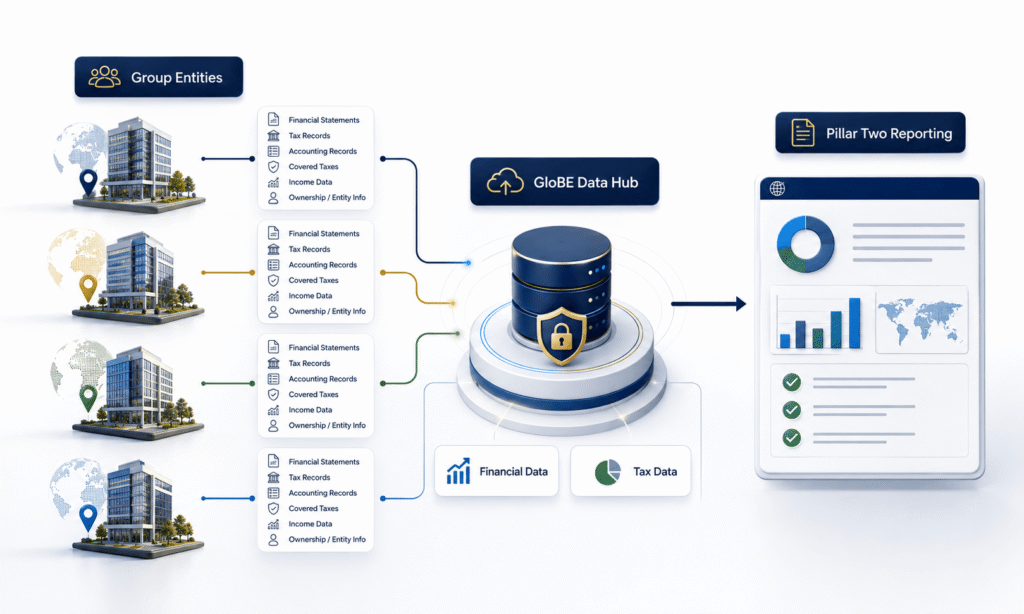
GloBE Data Collection refers to gathering, validating and documenting the financial, tax, and entity-level information needed to apply the Global Anti-Base Erosion (GloBE) Rules. The GloBE Rules are part of the OECD/G20 Pillar Two framework. They are designed to apply a 15% global minimum tax framework to large multinational enterprise groups, with calculations generally performed on a jurisdictional basis. Where the applicable effective tax rate is below the minimum rate, a top-up tax can arise.
The process therefore starts well before a GloBE Information Return is prepared. Finance and tax teams need reliable source data that can support the calculations and demonstrate how figures were derived.
What Are the GloBE Rules?
The GloBE Rules create a coordinated framework for calculating whether an in-scope multinational group has paid an appropriate level of tax in each relevant jurisdiction.
The framework involves concepts such as:
- GloBE Income
- Adjusted Covered Taxes
- Effective Tax Rate (ETR)
- Top-up Tax
- Constituent Entities
- Jurisdictional calculations
- Qualified Domestic Minimum Top-up Tax (QDMTT)
The rules are technical, but the practical starting point for businesses is straightforward: identify the entities involved and make sure the underlying accounting and tax information is complete, accurate, and traceable.
What Does GloBE Data Collection Mean for UAE Businesses?
For a UAE entity, GloBE data collection can involve extracting information from existing accounting systems and then making the adjustments required under the GloBE framework. This means the accounting team should not assume that the UAE Corporate Tax return or financial statements alone contain everything needed for Pillar Two.
Do UAE Entities Need to Prepare for GloBE Data Collection?
Not every UAE company is automatically subject to the GloBE rules. The first step is to determine whether the UAE entity belongs to an in-scope multinational enterprise group. Under the UAE DMTT rules, the relevant threshold is based on consolidated group revenue of at least €750 million in at least two of the four financial years immediately preceding the relevant financial year.
A small UAE company operating independently may therefore have no Pillar Two obligation simply because it pays UAE Corporate Tax.
Questions UAE Businesses Should Ask
Before starting a detailed data exercise, the finance and tax teams should establish:
- Is the UAE entity part of a multinational enterprise group?
- Does the consolidated group meet the €750 million revenue threshold?
- Is the UAE company a Constituent Entity?
- What fiscal year does the group use?
- Does the group have entities in other jurisdictions implementing Pillar Two?
- Does the group need to prepare a GloBE Information Return?
- Could the UAE DMTT apply?
- Does the parent company have centralized Pillar Two reporting procedures?
This initial scoping exercise prevents businesses from collecting large amounts of unnecessary information.
UAE Accounting Information Required for GloBE Calculations
UAE Accounting systems often contain much of the information needed for GloBE calculations. However, teams must understand which figures are relevant and which adjustments may be required. The exact information required depends on the group’s structure, accounting framework, elections, safe harbours and applicable rules. The OECD continues to update administrative guidance and commentary, so businesses should work from the rules applicable to their reporting period.
Financial Statement Data
A useful starting point is the entity’s financial reporting package.
Relevant information may include:
- Profit or loss information
- Balance sheet information
- Current tax expense
- Deferred tax information
- Equity information
- Consolidation adjustments
- Relevant accounting adjustments
- Supporting schedules
The purpose is not simply to copy financial statement figures into a GloBE calculation. Accounting results normally provide the starting point from which the required GloBE adjustments are considered.
General Ledger and Trial Balance Data
The general ledger can provide the detailed evidence needed to understand how reported amounts were generated.
Finance teams should consider whether they can efficiently retrieve:
- Trial balance data
- General ledger balances
- Chart of accounts
- Account-level transaction details
- Tax-related accounts
- Journal entries
- Intercompany accounts
- Consolidation entries
- Supporting schedules
A well-structured chart of accounts can make this process much easier.
For example, if tax expenses, foreign exchange movements, intercompany charges and other relevant accounts are clearly classified, the finance team can identify potentially relevant items without reviewing every transaction manually.
Tax Accounting Information
Tax information is another important part of the data collection process.
Depending on the circumstances, teams may need to review:
- Current tax expense
- Deferred tax balances
- Tax provisions
- Tax adjustments
- Tax payments
- Tax credits
- Tax incentives
- Tax reconciliation schedules
The treatment of these items under the GloBE Rules can differ from their treatment under domestic tax accounting. That is why finance teams should avoid assuming that an item appearing in a UAE tax computation automatically receives the same treatment for GloBE purposes.
What Accounting Data Should UAE Entities Collect?
A practical GloBE data collection process should identify the source of each required data point.
Core Accounting Data Checklist
A UAE entity within an in-scope multinational group may need to organize information such as:
- Legal entity name and identification details
- Ownership and group structure
- Financial statement information
- Trial balance
- General ledger data
- Current tax expense
- Deferred tax balances
- Covered tax information
- Tax adjustments
- Intercompany transactions
- Related-party transactions
- Consolidation adjustments
- Currency information
- Permanent and temporary differences
- Relevant tax incentives
- Supporting documentation
The final data requirements should be determined from the applicable GloBE rules and the group’s reporting methodology rather than from a generic checklist.
Why Entity-Level Data Matters
Pillar Two reporting can require information to be traced back to individual Constituent Entities and jurisdictions. A group may have a centralized tax department, but the underlying accounting information often originates from local finance teams.
That creates a practical responsibility for UAE accounting teams: they need to provide reliable local data in the format required by the group reporting process.
How UAE Accounting Data Is Used in GloBE Calculations
The relationship between accounting data and GloBE calculations can be understood as a sequence:
Accounting records → GloBE adjustments → GloBE Income and Covered Taxes → Jurisdictional ETR → Top-up Tax assessment
From Accounting Profit to GloBE Income
GloBE calculations generally use financial accounting information as a starting point, subject to the specific rules and adjustments under the GloBE framework. This means accounting profit should not simply be treated as GloBE Income. Certain items may require specific treatment under the rules. The finance and tax teams therefore need to understand the bridge between reported accounting results and the GloBE calculation.
Maintaining this bridge is particularly useful during review because it gives the group a clear audit trail from source accounting records to the final GloBE figures.
Calculating the GloBE Effective Tax Rate
The GloBE framework generally compares adjusted covered taxes with GloBE Income on a jurisdictional basis.
The simplified concept is:
GloBE Effective Tax Rate = Adjusted Covered Taxes ÷ GloBE Income
The actual calculation involves detailed rules, adjustments, and exclusions, so this formula should be viewed as a high-level explanation rather than a complete calculation methodology.
When Top-Up Tax May Become Relevant
If the applicable jurisdictional effective tax rate falls below the 15% minimum rate, the GloBE framework can result in a top-up tax calculation. The UAE DMTT is designed to collect applicable domestic top-up tax in the UAE for qualifying in-scope MNE groups rather than leaving the relevant under-taxed profit to be taxed elsewhere.
GloBE Data Collection and UAE Corporate Tax: What Is the Difference?
A common mistake is to treat UAE Corporate Tax compliance and Pillar Two compliance as the same exercise. They are connected, but they serve different purposes.
UAE Corporate Tax focuses on the UAE’s domestic tax rules. GloBE calculations apply an international framework designed for large multinational enterprise groups.
UAE Corporate Tax Data vs GloBE Data
The two processes can differ in terms of:
- Purpose
- Tax base
- Accounting starting point
- Adjustments
- Tax treatment
- Jurisdictional calculations
- Reporting requirements
- Group-level coordination
A company can therefore have accurate UAE Corporate Tax records and still need additional work before its data is ready for GloBE reporting.
Why Existing UAE Corporate Tax Records May Not Be Enough
GloBE calculations can require information that is not normally presented in a standard UAE Corporate Tax return.
For example, the group may need to understand:
- How financial accounting profit connects to GloBE Income
- How covered taxes are determined
- How deferred tax information is treated
- How entity-level information feeds into jurisdictional calculations
- Which adjustments apply under the GloBE Rules
- How the UAE entity’s information fits into the group’s consolidated Pillar Two process
This is why GloBE preparation should involve both accounting and tax professionals.
What Is QDMTT and Why Does It Matter for UAE Accounting?
The UAE has introduced a Domestic Minimum Top-up Tax, or DMTT, for qualifying MNE groups. The UAE Ministry of Finance states that the DMTT applies to Constituent Entities of MNEs meeting the €750 million global revenue threshold and is effective for financial years starting on or after 1 January 2025.
The UAE DMTT is closely aligned with the OECD GloBE Model Rules, administrative guidance and commentary.
QDMTT vs GloBE Top-Up Tax
A domestic minimum top-up tax and the wider GloBE top-up tax are related but should not be treated as identical concepts.
The key practical point for UAE finance teams is that the UAE DMTT makes accurate UAE-level accounting and tax data particularly important for affected groups.
Accounting Data Needed for UAE DMTT Calculations
Depending on the applicable rules and group methodology, teams may need to support calculations using:
- UAE entity financial data
- GloBE Income information
- Covered tax information
- Relevant adjustments
- Tax reconciliation schedules
- Entity and ownership information
- Supporting accounting records
Because Pillar Two implementation is technical and continues to develop, teams should verify current UAE rules and OECD guidance for the relevant fiscal year.
GloBE Information Return: What Accounting Teams Should Know
The GloBE Information Return, commonly called the GIR, provides a standardized reporting framework for administering the GloBE Rules. The OECD describes the GIR as a standardized information return containing information needed by tax administrations to assess compliance and the correctness of top-up tax liabilities.
The OECD also provides an XML schema to support automatic exchange of GIR information between tax administrations.
What Is the GloBE Information Return?
The GIR brings together information about the group, its entities, jurisdictions and GloBE calculations.
It is therefore not simply a tax return prepared from one UAE company’s accounting software.
The underlying data may come from multiple entities and multiple systems across the group.
What Information Can Feed Into the GIR?
The reporting process can involve:
- MNE group information
- Group structure
- Constituent Entity information
- Jurisdictional information
- GloBE calculations
- Effective tax rate information
- Top-up tax information
- Safe-harbour information where applicable
- Supporting adjustments
The OECD’s current GIR materials also include guidance relating to filing and exchange mechanisms.
Who Should Coordinate the GIR?
A strong internal process normally involves cooperation between:
- CFO or finance leadership
- Local accounting teams
- Group tax department
- Tax advisers
- Consolidation teams
- External auditors or other reviewers where appropriate
The accounting team should not be expected to interpret every GloBE rule independently. Its key role is to provide complete and traceable source information.
How to Build a GloBE Data Collection Process in the UAE
A structured process can reduce manual work and improve data quality.
Step 1: Identify In-Scope UAE Entities
Start with the group’s legal entity structure.
Identify which UAE companies could be Constituent Entities and confirm how the group determines its Pillar Two scope.
Step 2: Map Existing Accounting Systems
Create an inventory of the systems that contain relevant information.
This may include:
- ERP systems
- General ledger
- Tax software
- Consolidation platforms
- Financial reporting tools
- Group reporting templates
The objective is to determine where each required data point originates.
Step 3: Create a GloBE Data Dictionary
A data dictionary can help the team understand exactly what information is required.
For each data point, document:
- Data field
- Source system
- Reporting period
- Responsible person
- Required adjustment
- Review procedure
- Supporting evidence
This approach is much more reliable than asking teams to “send all GloBE data” without clear instructions.
Step 4: Reconcile Accounting and Tax Data
Reconciliation should connect the relevant accounting records with tax calculations.
For example, teams may compare:
Financial statements → Trial balance → Tax computation → GloBE calculation
Any unexplained difference should be investigated and documented.
Step 5: Document Adjustments
Every material adjustment should have supporting documentation.
A reviewer should be able to understand:
- What changed?
- Why did it change?
- Which rule supports the treatment?
- Who prepared the adjustment?
- Who reviewed it?
- What source data supports it?
Step 6: Establish Review and Approval Controls
GloBE data should pass through a defined review process before it reaches the group’s final reporting package.
Clear responsibilities can help prevent:
- Duplicate data
- Missing data
- Incorrect classifications
- Unsupported adjustments
- Inconsistent treatment between entities
Common GloBE Data Collection Mistakes UAE Businesses Should Avoid
Even a technically strong Pillar Two process can fail if the underlying data is poorly managed.
Common issues include:
- Assuming UAE Corporate Tax data automatically satisfies GloBE requirements
- Waiting until the reporting deadline to collect information
- Ignoring entity-level accounting data
- Failing to reconcile financial and tax records
- Treating accounting profit as GloBE Income without reviewing required adjustments
- Overlooking deferred tax information
- Using inconsistent approaches across UAE entities
- Failing to document adjustments
- Relying on uncontrolled spreadsheets
- Separating the finance and tax teams too much
The most effective approach is to treat GloBE data as a controlled reporting process rather than a one-time compliance exercise.
GloBE Data Collection Example for a UAE Entity
Consider an illustrative UAE subsidiary that belongs to a large multinational group.
The company maintains its own accounting records in the UAE and reports monthly financial information to its parent company.
Its finance team maintains:
- General ledger
- Trial balance
- Financial statements
- Current tax records
- Deferred tax schedules
- Intercompany accounts
Instead of waiting for the parent company to request information at the end of the reporting cycle, the UAE team maps these records to the group’s GloBE data requirements.
The process could look like this:
UAE accounting records → Data extraction → GloBE adjustments → UAE jurisdictional calculation → Internal review → Group reporting
The example demonstrates why GloBE preparation is closely connected to accounting data quality.
It also shows why finance teams should establish the process before the final reporting deadline.
How to Prepare Your UAE Accounting Team for GloBE Reporting
A practical preparation plan can start with a simple internal checklist.
Recommended GloBE Preparation Checklist
- Confirm whether the group is in scope.
- Identify UAE Constituent Entities.
- Confirm the relevant fiscal years.
- Assign finance and tax responsibilities.
- Map accounting and tax data sources.
- Review financial reporting data.
- Review current and deferred tax information.
- Identify potential data gaps.
- Establish reconciliation procedures.
- Document GloBE adjustments.
- Create review and approval controls.
- Maintain supporting evidence.
- Monitor changes to UAE and OECD guidance.
The OECD’s GloBE framework continues to receive administrative guidance and updates. Its 2026 consolidated commentary incorporates guidance released through January 2026, so businesses should avoid relying on outdated implementation summaries.
How Ripple Business Setup Can Help With GloBE Data Collection
GloBE compliance requires accurate accounting information, organized tax records, and reliable financial data. For UAE entities that are part of an in-scope multinational group, collecting and reconciling this information can become a detailed process. Ripple Business Setup can help businesses organize their accounting and tax information and prepare for evolving UAE compliance requirements. Our team can assist with accounting data review, financial record organization, tax compliance support, and coordination of information needed for GloBE-related reporting.
Whether you need support reviewing your accounting records or preparing your business for UAE tax and compliance requirements, having the right process in place can help reduce errors and improve reporting readiness.
Contact Ripple Business Setup:
Phone: +971 50 593 8101
Email: info@ripplellc.ae
Website: www.ripplellc.ae
FAQ
What is GloBE Data Collection?
GloBE Data Collection is the process of gathering and validating financial, tax, entity, and other information needed to apply the OECD Pillar Two GloBE Rules and support related reporting.
Does GloBE apply to every UAE company?
No. Pillar Two is aimed at qualifying large multinational enterprise groups. The UAE DMTT applies to qualifying UAE Constituent Entities of MNE groups meeting the applicable €750 million revenue threshold.
What accounting information is needed for GloBE?
Depending on the group’s circumstances, information can include financial statement data, trial balances, general ledger information, current and deferred tax data, intercompany information, consolidation adjustments and supporting schedules.
Is UAE Corporate Tax the same as GloBE tax?
No. UAE Corporate Tax is the UAE’s domestic corporate tax regime, while GloBE is part of the international Pillar Two framework. Existing UAE tax data may support GloBE calculations, but it does not necessarily replace the separate GloBE analysis.
What is GloBE Income?
GloBE Income is the income figure used under the GloBE Rules after applying the specified rules and adjustments to the relevant financial accounting starting point.
What is the GloBE effective tax rate?
The GloBE effective tax rate is a jurisdictional measure broadly comparing adjusted covered taxes with GloBE Income. The detailed calculation contains specific rules and adjustments.
What is QDMTT in the UAE?
The UAE’s Domestic Minimum Top-up Tax is a domestic minimum tax mechanism for qualifying in-scope multinational groups. The UAE Ministry of Finance states that it applies for financial years starting on or after 1 January 2025.
What is a GloBE Information Return?
The GloBE Information Return is a standardized reporting form used to provide information required for the administration and compliance of the GloBE Rules.
Do UAE subsidiaries of foreign multinational groups need GloBE data?
A UAE subsidiary may need to provide GloBE data when it forms part of an in-scope multinational group. The exact reporting and filing responsibilities depend on the applicable UAE rules, group structure and filing arrangements.
How should UAE companies prepare their accounting systems for Pillar Two?
They should first identify their scope, map required data to existing accounting systems, establish reconciliation procedures, document adjustments and create clear responsibilities between finance and tax teams.
Conclusion
GloBE Data Collection is becoming an important consideration for qualifying multinational groups with UAE operations. The process starts with accurate UAE Accounting information. Financial statements, general ledgers, trial balances, tax records and supporting schedules can provide the foundation for GloBE calculations, but teams must also consider the specific adjustments and reporting requirements under the Pillar Two framework.
Disclaimer: This article provides general information about GloBE Data Collection, UAE Accounting, and Pillar Two requirements. Rules and guidance may change, so businesses should verify the latest requirements with the UAE Ministry of Finance, Federal Tax Authority, or a qualified tax adviser before making compliance decisions.